Lec 4 - The Immune Response
 Call Kai
 Learn
Learn Practice Test
 Spaced Repetition
 Match
Match Flashcards
 Knowt Play
1/36

There's no tags or description
Looks like no tags are added yet.
Name | Mastery | Learn | Test | Matching | Spaced | Call with Kai | Chat |
|---|
No analytics yet
Send a link to your students to track their progress
37 Terms
Our forefront barrier / protection against pathogens is also the largest organ in the body. What is it?
the SKIN!
What makes the skin such a good barrier?
well the top layer is DEAD! there’s low nutrients and antimicrobials as well.
also, it’s basically impenetrable unless you have cuts etc.
T/F: Pathogens don’t want the skin because it’s waxy (they want water) and low in nutrients.
true
What spots do pathogens get into the body?
digestive tract
respiratory system
skin
reproductive system
so basically anywhere with a mucus membrane!
Can pathogens enter the ears?
No because our outer ears have skin to protect it.
What are the first guards of our immune system? ie first line of defense
Hint: __________ cells, almost sounds like a military rank
Sentinel cells!
sentinel = a guard or watchman who stands post to watch for danger
A major type of sentinel cell is a….
… a macrophage!
How do macrophages work?
They gobble up bacteria (aka phagocytosis).

What does pathogen mean?
Patho = suffering
-gen = producer
So something that induces suffering! How fitting!
Name some types of pathogens!
ex. prions, parasites, fungi, ….
ex. prions, parasites, fungi, viruses, viroids, protists
Ok so we have our skin and sentinel cells as first lines of defense, but what if the pathogen gets PAST it — What does the immune system do then?
It will recruit help from patrolling immune cells! It calls upon the INNATE immune system!
What is the immune cell in the second line of defense (the innate immune system) ?
Hint: Inside are tiny sacs (granules) filled with potent enzymes and chemicals used to destroy invaders.
neutrophils!
T/F: Neutrophils are the most abundant type of white blood cells (leukocytes).
true!
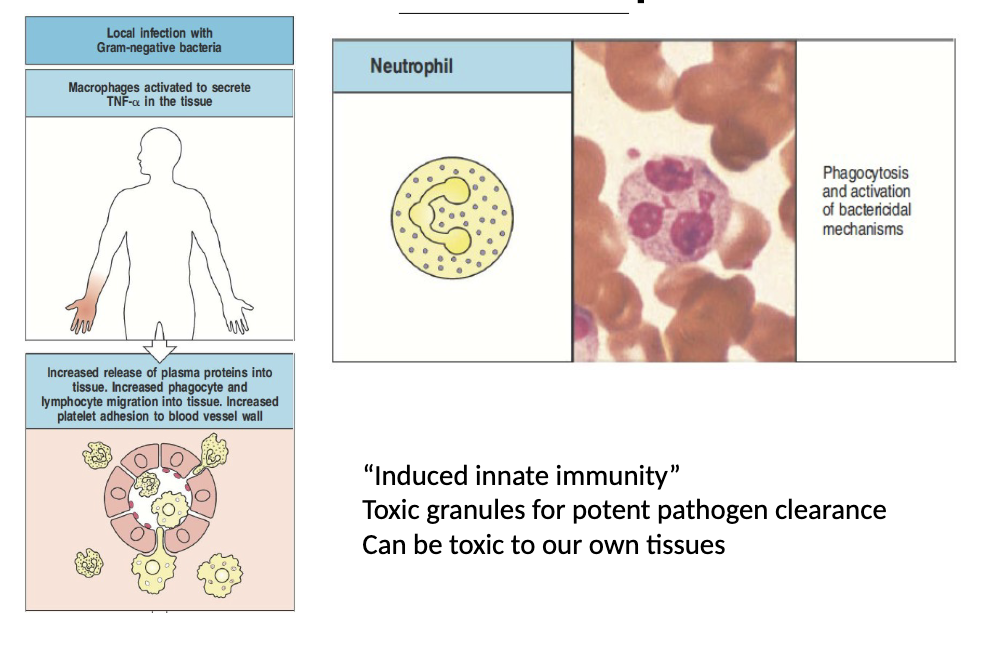
Neutrophils come out of the BLOOD and usually in response to a cytokine. They make their way to tissues. They phagocytose pathogens.
Do we like neutrophils being in our tissues?
hell no!!We don’t like neutrophils in our tissues cuz they’re super aggressive and will affect innocent native cells in the process, NOT JUST THE PATHOGENS.
Imagine an unkind and agressive army causing civillian casualties.
Ok so if neutrophils are so aggressive, how do we regulate them then?
Well they die after 24 hours anyway!
Their mentality is: “We can always be regenerated but it would be worse if the body died from infection”.
Some infections DISSEMINATE. What does that mean?
that means they SPREAD! they have life cycles that take them through multiple tissues.
in this case we need a stronger immune response, the ADAPTIVE IMMUNITY!
When you get a bad cold, what is the reason your brain gets foggy?
It’s because you’ve diverted a huge amount of resources to fight it!

Innate vs Adaptive Immunity
innate is immediate defense
adaptive is delayed defense and INDUCED by innate immunity. highly potent and systemic
T/F: T and B cells are part of the innate immune system.
FALSE! part of the adaptive.
T/F: Macrophages and neutrophils are part of the innate immune system.
true
The adaptive immune system’s B and T cells are mostly found in what system?
the lymphatic system, in the lymph nodes!
Why are lymph nodes typically centrally located, i.e. closer to the core?
to maximize coverage!


Lymph nodes are connected by vessels called ____________ that do what?
They are connected by vessels called lymphatics that sample fluid from tissues for screening.
T/F: Lymphatics look very similar to veins, but the only difference is that they end in tissues.
true!
T/F: Our army is always on.
true!
What cell is the wake up alarm cell?
Dendritic cell! It is the messenger!
The Dendritic cell is the antigen presenting cell (APC). What process does it do?
Macropinocytosis - sampling surroundings to find antigens
macro = big
pino = draping (think pinot like pinot noir)

What are dendritic cells programmed to do?
they run from site of infection to the lymph nodes through lymphatic vessels. Activate T cells and instructs them to deal with this specific pathogen.
What does it mean when an antigen presents?
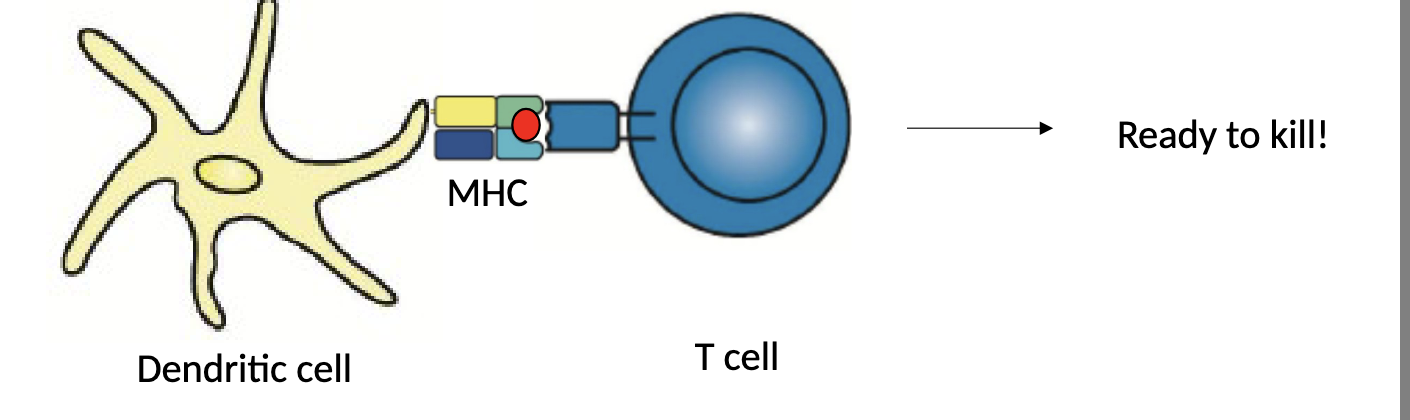
dendritic cell captures antigen from pathogen —> eats it —> breaks it up into little pieces → pieces go to the MHC
antigen is taken up from the extracellular space into intracellular vesicles
in early endosomes of neutral pH, endosomal proteases are inactive
acidification of vesicles activates proteases to degrade antigen into peptide fragments
vesicles containing peptides fuse with vesicles containing MHC class 2 molecules
Then the T cell multiplies and hunts all the antigens and will kill the cell. Then the T cell multiples and hunts all the antigens like the red dot in the pic, and will kill the cell. This army then becomes rampant in our body on “a search for blood”.
Hold on! I’m confused because weren’t our T cells always programmed to look for viral antigens?
Well yes but they become ACTIVATED into hunter mode because of the dendritic cells.
T/F: Adaptive immune cells monitor you for the rest of your life.
true!
Do most adaptive immune cells die shortly after infection?
yes
If most adaptive immune cells die shortly after infection, those that remain are “memory cells” which are always….
…always looking and remembering.
Why do adaptive immune cells die? Cuz Cells are maybe a little too energy inefficient.
ex. Like for every millions of killer adaptive immune cells, there are only 10 plasma cells that MAKE antibodies.
A small number of plasma cells produce high antibody titres for decades. What do antibodies do?
Antibodies equip our sentinel cells for battle! They can better kill and clear pathogens using existing energy-depleting cells!
Summarize the order of protection:
Intrinsic barriers - epithelial cells. Pathogens want to be inside of us because we have water, nutrients, and energy.
Sentinel cells - defend and sample. Macrophage and dendritic cells lie just below epithelial cells.
Sentinel cells recruit induced innate immunity. So if infection is too strong, macrophages call for an induced immune response. Neutrophils are potent killers.
Simultaneously, dendritic cells are running off to the lymph node where they’ll activate T cells. And T cells then activate B cells.
A bunchhh of T cells return to the site of infection to kill the pathogen.
B cells then turn into (differentiate into) plasma cells when they’re activated by an infection or foreign substance.
Recall what do plasma cells do? They produce antibodies!

Summary of the Immune Response:
…
