Chem Ch. 3 Notes
 Call Kai
 Learn
Learn Practice Test
 Spaced Repetition
 Match
Match Flashcards
 Knowt Play
1/55

There's no tags or description
Looks like no tags are added yet.
Name | Mastery | Learn | Test | Matching | Spaced | Call with Kai | Chat |
|---|
No analytics yet
Send a link to your students to track their progress
56 Terms
400 BC — The Greek Philosophers
Debate concerning the nature of matter
Democritus
stated all matter was made of invisible ultimate particles known as atomos
Aristotle
stated all matter is continuous, no ultimate particles; was believed until the 1700s
200 to 1700 AD — The Alchemists
1st experimenters experimented in secret
trying to turn base metals into gold
discovered many useful things (medicines, gun powder)
Alchemists
1st experimenters; experimented in secret; discovered many useful things (ex. medicines, gun powder)
1600-1700 AD — The Atomists
Galileo, Boyle, Bacon, Newton | First since Democritus to believe matter was made of atoms
1782 — Antoine Lavoisier
Father of Modern Chemistry; made quantitative obs. about chem. rxns.; Law of Conservation of Matter
1782 — Law of Conservation of Matter (Mass)
In an ordinary rxn., matter cannot be created or destroyed only rearranged
1799 — Joseph Proust — Law of Definite Proportions
Most famous for his studies of iron pyrite, FeS2, also known as fools gold. He discovered that all iron pyrite consisted of 46.5% iron and 53.5% sulfur by mass.
1799 — Law of Definite Proportions
Elements that make up a compound are always in a certain proportion by mass; suggested that matter came in packages of certain sizes
1803 — John Dalton — First Atomic Theory
After studying the works of lavoisier, Proust and many others, John Dalton, an english school teacher and chemist, proposed the first atomic theory.
1803 — First Atomic Theory
John Dalton
All matter is made of indivisible particles (atoms)
Atoms of the same element are the same
Atoms of different elements are different
In a chem. rxn. atoms are only rearranged
Atoms of different elements combine chemically in definite Proportions to make compounds
raised many questions; why do atoms of different elements act differently?
1811 — J.J. Berzelius
Element Symbols; established modern system of chemical symbols for elements

1803 — John Dalton
Solid Atom; tiny, indivisible particle
1886 — Eugen Goldstein
Discovered Canal Rays (Anode Rays)
1886 — Discovery of Canal/Anode Rays
Eugene Goldstein; led to the development of mass spectometry
1896 — Henri Becquerel
Discovery of Radioactivity
1896 — Discovery of Radioactivity
Henri Becquerel; suggested very strongly that something was coming out of the supposedly indivisible atoms
1897 — J.J. Thomson
Discovered Electron (studied Cathode Ray Tube); determined that Cathode Rays were made of electrons with properties
1897 — Discovery of the Electron (Cathode Ray Tube with properties)
J.J. Thomson
e- are negative particles
e- from all atoms are the same
e- had an e/m (charge to mass) ratio of 1.759 × 10⁸ c/g

1897 — Plum Pudding Model
Positive sphere of matter with electrons embedded throughout; J.J. Thomson knew his atom still didn’t fit all of the facts
1898 — Wilhelm Wien
Discovered the Proton; Doing approx. same experiments as Thomson, discovered that Canal Rays consisted of protons with properties
1898 — Discovery of the Proton
Wilhelm Wien; properties:
charged +1
All have the same mass of 1 amu (1.67 × 10⁻²⁴ g)
1909 — Rober Millikan
Oil Drop Experiment; discovered the charge and mass of the electron
1909 — Oil Drop Experiment
Robert Millikan;
The charge on each oil drop was a whole # multiple of -1
Used the electron charge & Thomsons e/m ratio to find electron mass of 0 amu
1910 — J.J. Thomson
Discovered Isotopes using a modified Crooke’s Tube that separated particles by mass, he discovered two different types of neon. They were chemically identical, but had different masses.
1910 — Discovery of Isotopes
J.J. Thomson; Crookes’ Tube separating neon particles by mass
Isotope
atoms of the same element that are chemically the same & have different masses; every naturally occurring element consists of mixtures of more than one isotope
1911 — Ernest Rutherford
Gold Foil Experiment; testing plum pudding model
1911 — Gold Foil Experiment
Ernest Rutherford; concluded that:
the atom is mostly empty space
the atom contains a tiny, dense, core called nucleus

1911 — Nuclear Atom
Ernest Rutherford; Tiny, dense, + core (nucleus) surrounded by empty space containing e-
1913 — Niels Bohr
Came up with the Planetary Atom - Tiny, dense + core (nucleus) surrounded by e- in energy levels that orbit nucleus

1913 — Planetary Atom
Niels Bohr;
e- in an atom can only exist if they have certain “allowed energies” (energy is quantized)
e- orbit the nucleus at a calculated distance from the nucleus determined by e- energy
1926 — Erwin Schrodinger
came up with the Electron Cloud (Quantum Mechanical) Atom
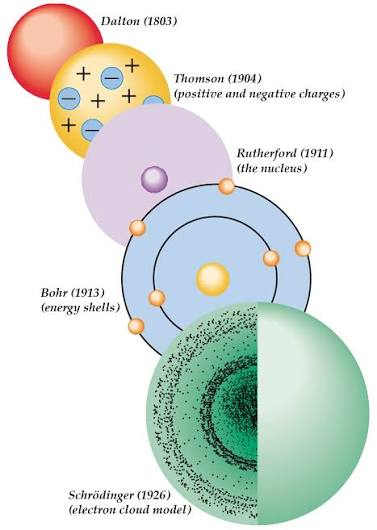
1926 — Electron Cloud Atom
Erwin Schrodinger
tiny, dense + nucleus surrounded by e- in mathmatically defined regions called orbitals
e- do not follow nice neat paths
According to Bohr and Schrodinger
Electrons in an atom can only exist if they are in “allowed” energy levels, or shells
1932 — James Chadwick
Discovered the Neutron; while bombarding a Be atom with alpha particles, he knocked off a neutron
1932 — Discovery of the Neutron
James Chadwick; Scientists began to suspect that the atom contained a third particle, which was similar to the proton, but was neutral.
The atom consists of 2 major parts
Nucleus and Electron Cloud
Nucleus
tiny, dense, + core
Electron Cloud
set of mathematically defined regions in space around nucleus
The atom consists of three major subatomic particles
Protons, Neutrons, Electrons
Protons
+1 Charge; 1 amu
Neutrons
0 Charge; 1 amu
Electrons
-1 Charge; 0 amu
Nuclear Notation (Isotopes)

Atomic Number (Z)
# of p+ in nucleus; unique to each element
Mass Number (A)
sum of p+ and n0 in the nucleus of an atom; identifies the isotope
Atomic Mass/Weight
A weighted average of all naturally occurring atoms of an element
(mass isotope x % abundance) + (mass isotope x % abundance) / 100
Nuclear Radiation
Fission and Fusion; produces a lot of energy
Fission
heavy atoms split
produces radioactive waste
lower temp. required (in comparison)
Fusion
light atoms join
no radioactive waste produced
high temp. required (ex. stars are fusion reactors)
Nuclear Decay
Alpha Decay, Beta Decay, Gamma Radiation
Alpha Decay
produces alpha particles (24He)
stopped by clothes, skin, paper
weakest
B
Beta Decay
produces a beta particle (-10e or -10B) high speed, high energy electron
stopped by glass, thin sheets of metal, thick wood
Gamma Radiation
produces gamma rays (high energy electromagnetic radiation)
no charge, no mass
stopped by thick concrete, thick sheets of lead
strongest