NEUROANATOMY- Neurons
 Call Kai
 Learn
Learn Practice Test
 Spaced Repetition
 Match
Match Flashcards
 Knowt Play
1/141

There's no tags or description
Looks like no tags are added yet.
Name | Mastery | Learn | Test | Matching | Spaced | Call with Kai | Chat |
|---|
No analytics yet
Send a link to your students to track their progress
142 Terms
What is a neuron?
smallest and most basic unit of the nervous system
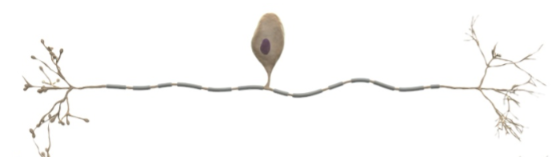
identify
Unipolar
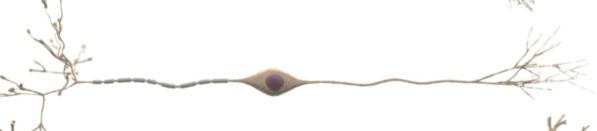
identify
Bipolar
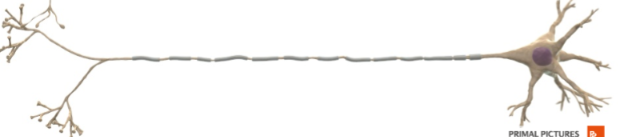
identify
Multipolar
Parts of a Neuron
receive signals
Dendrites
Parts of a Neuron
Process information (grey matter)
Cell Body
Parts of a Neuron
Transmits information to next neuron/muscle fibers
Axon (single)

1
dendrites
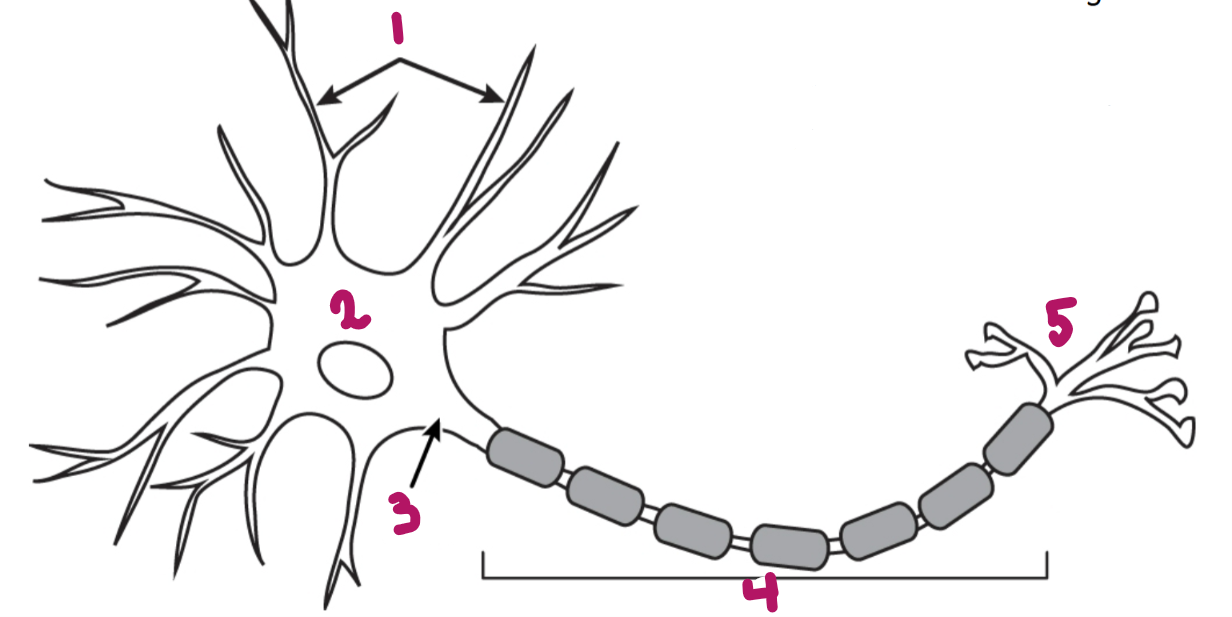
2
cell body
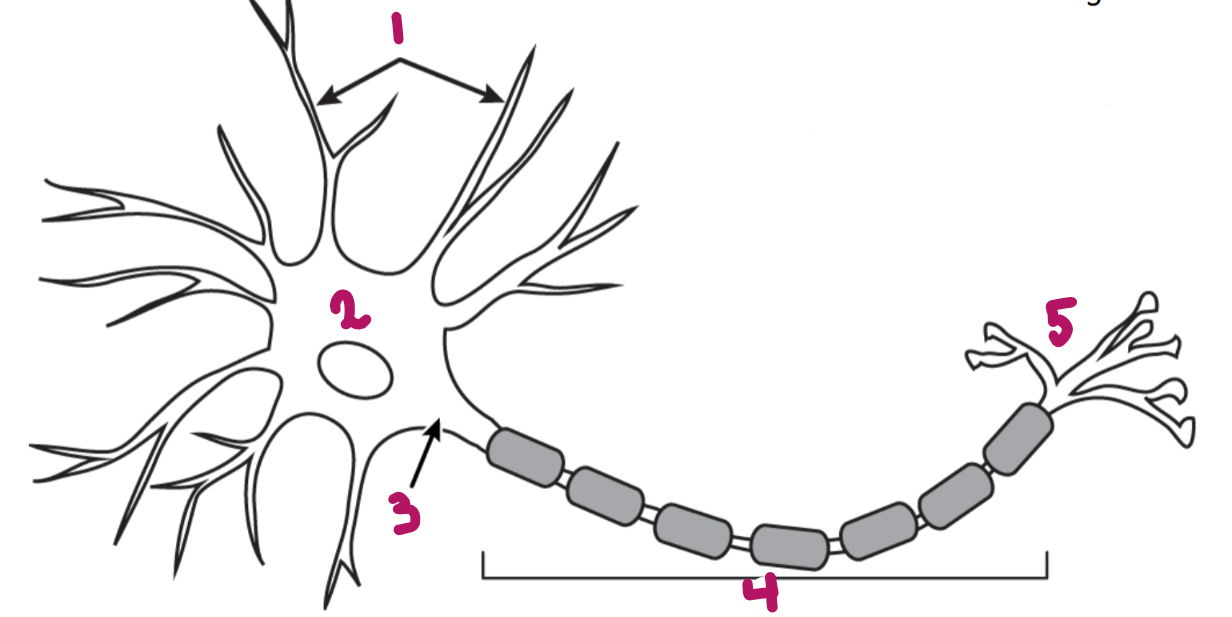
3
Axon Hillock
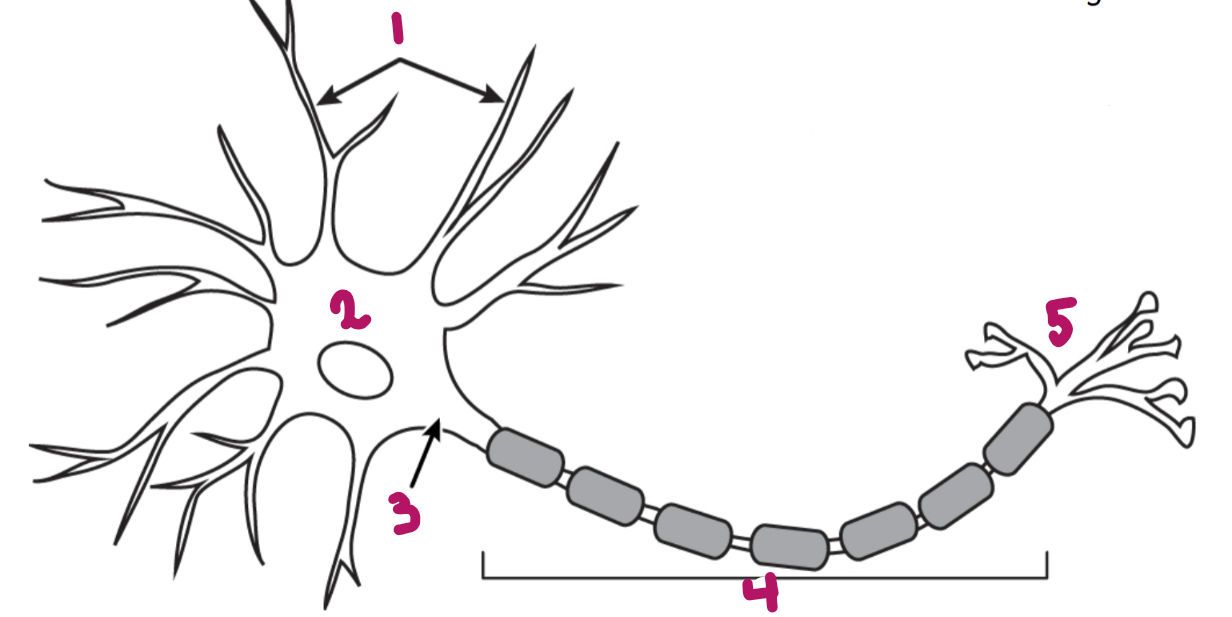
4
axon

5
Presynaptic terminal
Contains:
Nucleus
Endoplasmic reticulum
Golgi apparatus
Mitochondria
Ribosomes
Secretory vesicles
Cell Body – AKA Soma
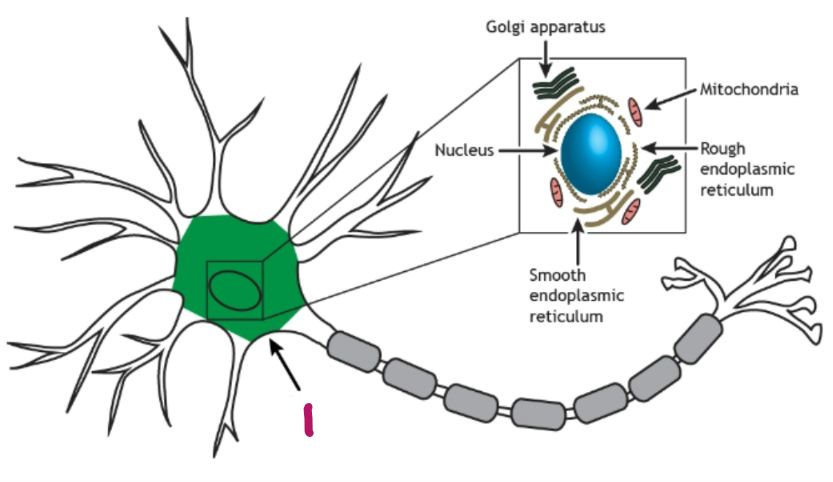
1
Soma (cell body)
Dendrites → Cell Body → Axon → Next neuron/muscle
Receive → Process → Send
What is the typical number of axons in a neuron?
one
the main job of the axon is»»
Transmits the electrical signal _____from the cell body
away
Where does the electrical signal travel from and to?
From the ______ → _______
axon hillock; presynaptic terminal
fatty substance that increases the speed of conduction
myelin
How does myelin increase conduction speed?
The action potential jumps from one node to the next
Breaks (gaps) in the myelin sheet
myelin sheet
How long can an axon be?
It can exceed 1 meter (such as in the sciatic nerve)
How fast can a nerve signal travel?
Up to 150 m/s (335.5 mph)
sends signal away
Axon
fatty + faster
Myelin
gaps in myelin
Nodes of Ranvier
Axon length
>1 meter
Speed
up to 150 m/s

1
axon hillock

2
myelin
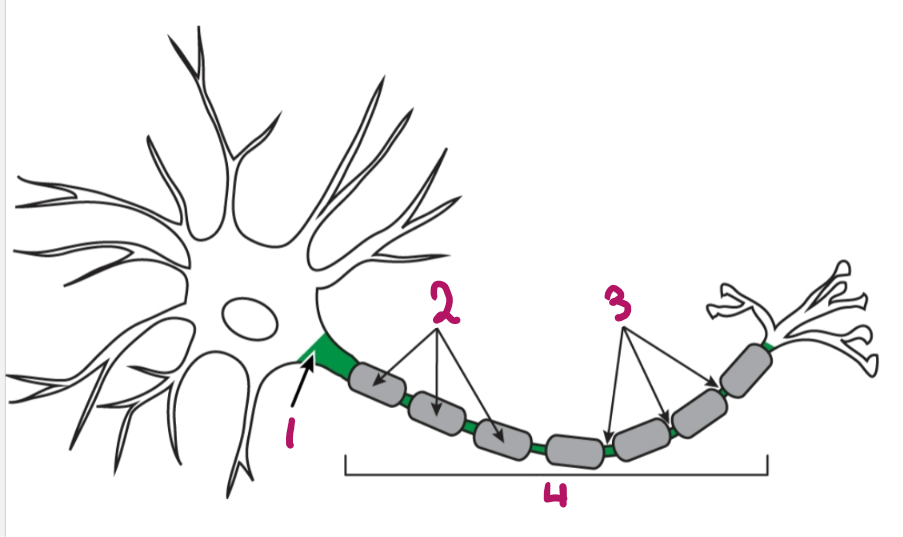
3
nodes of ranvier
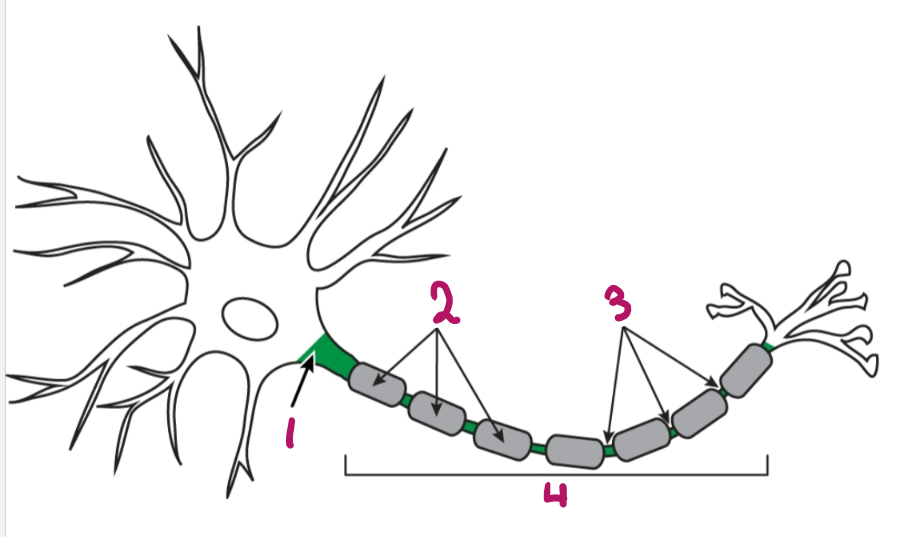
4
axon
Glia =
glue
the components/cells (glue) that hold nervous tissue together
neuroglia
What are astrocytes?
The largest and most abundant glial cells in the CNS
What are the largest and most abundant glial cells in the CNS?
Astrocytes (CNS)
What structures do astrocytes connect?
CNSP
Capillaries, neurons, synaptic endings, and the pia mater
Astrocytes provide ________ support.
Structural
Astrocytes help form the ________
blood-brain barrier
Astrocytes recycle excess ________ and ________.
ions; neurotransmitters
Astrocytes exchange nutrients between ________ and ________.
capillary blood; neurons
Astrocytes secrete chemicals that aid ________, ________, and ________.
migration; growth; synapse formation
Astrocytes repair damaged ________
nervous tissue
What are the 6 main functions of astrocytes?
1. Structural support
2. Blood-brain barrier
3. Recycle excess ions & neurotransmitters
4. Exchange of nutrients between capillary blood & neurons
5. Secrete chemicals that aid migration, growth, and synapse formation
6. Repair damaged nervous tissue
basically form myelin sheath
Oligodendrocytes (CNS)
protection by removing cellular debris, micro-organisms, and damaged tissue
Microglial cells (CNS)
secretion & circulation of cerebrospinal fluid
Ependymal cells (CNS)
What do Schwann cells do?
Form the myelin sheath around axons in the PNS.
What are Schwann cells compared to in the CNS?
They are basically the oligodendrocytes of the PNS
What do satellite cells do?
Provide structural support and a barrier and regulate exchange between neuron cell bodies and interstitial fluid
What is the main function of satellite cells?
Structural support and forming a barrier around neuron cell bodies
What do satellite cells regulate?
The exchange of substances between neuron cell bodies and interstitial fluid.
Satellite cells regulate exchange between what two things?
Neuron cell bodies and interstitial fluid.
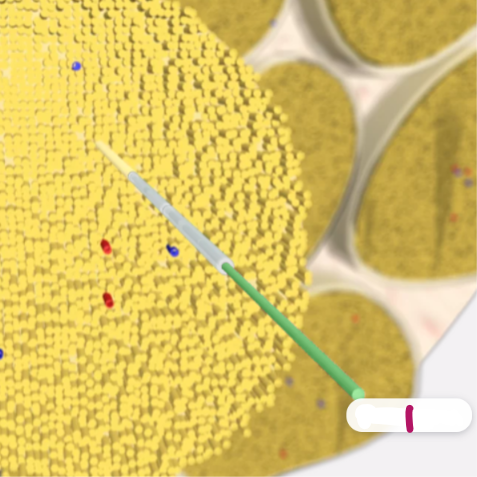
1
axon
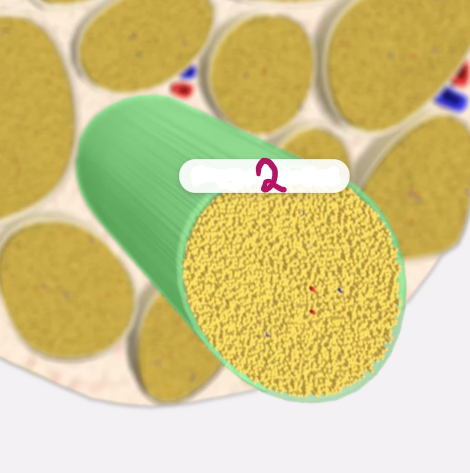
2
Perineurium
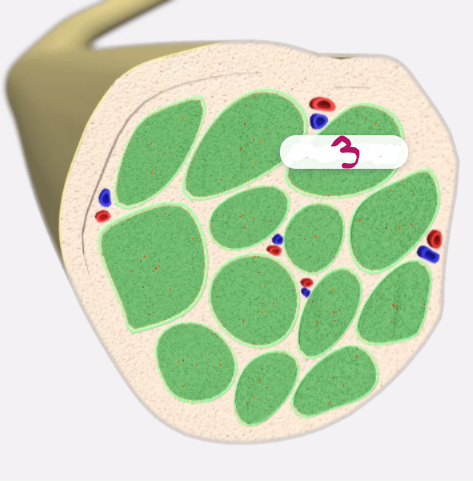
3
fascicle

4
epineurium
nerve
A collection of axons bundled
together and enclosed by
perineurium forms a nerve
fascicle. Fascicles, bundles
together and surrounded by
epineurium
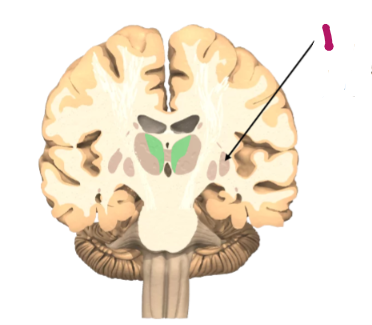
1
Basal Nuclei
cluster of neuronal cell bodies in CNS
Nucleus
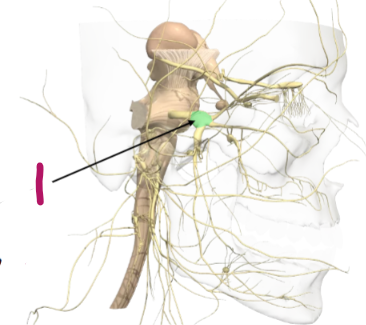
1
Trigeminal Ganglia
cluster of neuronal cell bodies in the PNS
Ganglion
most abundant; structural support & blood-brain barrier
Astrocytes
form myelin
Oligodendrocytes
protect by cleaning
Microglial cells
cerebrospinal fluid circulation
Ependymal cells
myelin for nerves in PNS
Schwann cells
structural support & barrier
Satellite cells
What is an action potential?
An electrical signal that travels along a neuron to transmit information
Where does an action potential begin?
At the trigger zone of the neuron.
What must happen for an action potential to begin?
A stimulus must be strong enough to reach the threshold
What is threshold?
The point at which the membrane has been depolarized enough to trigger an action potential.
What are the three phases of an action potential?
Depolarization → Repolarization → After-hyperpolarization
What happens during depolarization?
The inside of the neuron becomes more positive.
What causes depolarization?
Channels open, allowing positive ions to enter the neuron.
What happens during repolarization?
The membrane becomes less positive and moves back toward its resting state.
What causes repolarization?
Sodium entry stops and potassium leaves the cell.
What is after-hyperpolarization?
A brief period when the membrane becomes more negative than its normal resting state.
Why does after-hyperpolarization happen?
The channels involved in returning the membrane to its resting state do not close immediately, causing the membrane to temporarily become too negative.
What does propagation mean?
The movement of an action potential along the axon.
In what direction does an action potential normally propagate?
Toward the axon terminal.
Why does an action potential move forward instead of backward?
The part of the axon that just fired becomes refractory, so it temporarily cannot fire another action potential
What does refractory mean?
The recently activated part of the membrane is temporarily unable to fire another action potential.
Where does continuous conduction occur?
In unmyelinated axons.
How does continuous conduction work?
The action potential travels continuously along the entire axon membrane, activating one section after another.
Why is it called continuous conduction?
Because the signal travels along each section of the membrane instead of jumping over sections.
Is continuous conduction faster or slower?
Slower than saltatory conduction
Where does saltatory conduction occur?
In myelinated axons
What is myelin?
An insulating covering around parts of the axon
What are Nodes of Ranvier?
Gaps in the myelin sheath along the axon
How does saltatory conduction work?
The action potential appears to jump from one Node of Ranvier to the next.
Is saltatory conduction faster or slower?
Faster than continuous conduction.
Why is saltatory conduction faster?
Because the action potential jumps between nodes instead of traveling along every section of the axon membrane.This allows the impulse to propagate more quickly, as the insulated sections of the axon do not require depolarization.
What is the main difference between continuous and saltatory conduction?
Continuous conduction occurs in unmyelinated axons and travels along the entire membrane. Saltatory conduction occurs in myelinated axons and appears to jump from node to node.
Which type of conduction is faster?
Saltatory conduction
Why is continuous conduction slower?
The action potential must activate each section of the axon membrane one after another
Why is saltatory conduction faster?
The action potential jumps between Nodes of Ranvier, so it does not need to travel across every section of the membrane
What do continuous and saltatory conduction have in common?
Both propagate an action potential along the axon toward the axon terminal
What is the goal of both types of conduction?
To carry the electrical signal from the trigger zone toward the axon terminal.