Cell Membrane
 Call Kai
 Learn
Learn Practice Test
 Spaced Repetition
 Match
Match Flashcards
 Knowt Play
1/42

There's no tags or description
Looks like no tags are added yet.
Name | Mastery | Learn | Test | Matching | Spaced | Call with Kai | Chat |
|---|
No analytics yet
Send a link to your students to track their progress
43 Terms
Structure of Cell Membrane
Phospholipid bilayer- contains hydrophobic tails and hydrophilic heads
Composed of glycerophospholipids
Function of Cell Membrane
Selectively permeable and has a fluid structure
The thicker the membrane the more selective
Decreasing Membrane Fluidity
Cholesterol embedded among the lipids restricts the movements of acyl chains
Increasing Membrane Fluidity
Cholesterol prevents the close packing of lipids (prevents their crystallization)

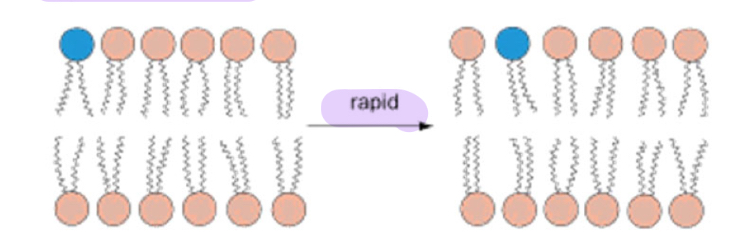
This is an example of:
Transverse diffusion (flip-flop)
This is an example of:
Lateral diffusion
Integral membrane proteins
Span the bilayer
They serve as carriers, channels, and transporters
Peripheral membrane proteins
More loosely associated with the membrane via interactions with lipid head groups or integral proteins
Simple diffusion
The movement of a molecule down its concentration gradient (high to low) without needing for energy or a protein
Passive transport diffusion
The movement of a molecule down its concentration gradient (high to low) with the assistance of a protein, but without the need for energy
Common carrier proteins in passive transport diffusion
leak channels
gated channels
stretch channels

This is an example of:
Leak channel
Pore is continuously open

This is an example of:
Gated Channel
Pore is open, but has a physical barrier

This is an example of:
Stretch channel
As membrane pulls apart, membrane opens and vice versa
Active transport diffusion
The movement of a molecule across a membrane with the assistance of a protein and the need for energy (ATP)
Concentration gradient of low to high
Secondary active transport diffusion
The movement of a molecule across a membrane with the assistance of a protein and this protein does not directly need energy, but the mechanism leverages energy invested by another cellular process
Chemicals that can diffuse across the phospholipid bilayer
Lipid soluble
Uncharged
Chemicals that require a channel to diffuse across the phospholipid bilayer
Lipid insoluble
Charged
Sodium-potassium ATPase pump
Membranes have a greater K+ permeability (compared to Na+), thus the membrane relies on this pump.
Pumps 2 K+ into the cell and 3 Na+ out for each ATP hydrolyzed
Maintains the Na/K gradients and membrane potential
Na is found in higher concentrations on outside of cell
K is found in higher concentrations on inside of the cell
Approximate concentrations of sodium
Inside cell is low (12mM)
Outside cell is high (145mM)
Approximate concentrations of potassium
Inside cell is high (155mM)
Outside cell is low (4mM)
Approximate concentration of chloride
Inside cell is low (4.2mM)
Outside cell is high (123mM)
Approximate concentration of calcium
Inside cell is low (0.1mM)
Outside cell is high (1.5mM)
How are membrane channels gated?
Channels only see size and charge. If the hole in the protein that conducts cations is big enough to allow calcium, sodium, and potassium through the channel
General movement through the channels is passive diffusion
Predict how movement of an ion across the membrane would impact membrane potential.
look at notes
How is an action potential conducted along the cell membrane?
To achieve an action potential, the membrane must depolarize to “threshold”
Therefore, depolarization can lead to an action potential (excitation)
Hyper-polarization can make it harder to accomplish an action potential (inhibition).
Predict how changes in extracellular concentration of potassium, calcium, and sodium impact membrane potential.
Practice in notes
Excitatory cues influence membrane potential by…
Depolarize (hypo-polarize) the membrane
Inhibitory cues influence membrane potential by…
Hyper-polarize the membrane
Spatial summation to threshold
Two dendritic signals are added together to reach the threshold
Temporal summation to threshold
One dendritic signal is needed to reach the threshold
Action potential refractory period
Channel is closed at resting membrane potential
Channel opens by depolarization (action potential)
Channel inactivates so that no action potential can occur, it allows for action potential to go in one direction
Refractory period importance
It’s important that the action potential only ‘travels’ in one direction.
Conductance
Flow of ions

Cardiac Action potential

Na+ conductance (Nerve and Cardiac)

Ca2+ conductance (Cardiac)

K+ conductance (Cardiac)

Nerve Action potential

Ca2+ conductance (Nerve)

K+ conductance (Nerve)
Describe how an action potential is conducted along the cell membrane
Trigger at the start: A stimulus makes the inside of the cell less negative. If it reaches the threshold voltage (around -55 mV), voltage-gated sodium channels open.
Sodium influx: Sodium ions rush into the cell, making the inside positive (depolarization).
Local current spread: The positive charge inside flows sideways to the next neighboring patch of the membrane.
Reaching threshold ahead: This local current brings the next patch up to its threshold, opening its sodium channels and repeating the spike.
Refractory period: Behind the moving wave, sodium channels close and potassium channels open to reset the membrane voltage, ensuring the signal only moves forward and cannot go backward
SNARE proteins
Activated by the binding of calcium
Pull synaptic vesicles filled with acetylcholine down and fuse it with the presynaptic membrane to allow neurotransmitter to be released into the synaptic cleft