Vis Dis RBCs
 Call Kai
 Learn
Learn Practice Test
 Spaced Repetition
 Match
Match Flashcards
 Knowt Play
1/243

There's no tags or description
Looks like no tags are added yet.
Name | Mastery | Learn | Test | Matching | Spaced | Call with Kai | Chat |
|---|
No analytics yet
Send a link to your students to track their progress
244 Terms
RBC`s contain the protein_______ who's function is to transport oxygen and carbon dioxide to and from all the body tissues
Hemoglobin
What defend against bacteria, viruses, and foreign antigens
WBC`s
What are responsible for preventing blood loss from hemorrhage and exert their main effect on the blood vessel wall
Platelets
What is the cellular formation, proliferation, differentiation and maturation of blood cells
Hematopoiesis
Hematopoietic tissues and organs
Spleen
Lymph nodes
Thymus
Bone marrow
Liver
RES
Hematopoiesis begins around
19th day of gestation
Hematopoiesis is stimulated by
erythropoietin (produced by the Kidney), leukopoeitin and thrombopoietin
Final natural of B cell occurs in
The bone marrow
Final maturation of T cells occurs in
Thymus
Immature RBC is
Reituclocyte
RBC production is called
Erythropoiesis
_______ is the primary regulator of erythropoiesis
Erythropoietin
RBC is a _______ with a life span of
Biconcave disc with a life span of 120 days
RBC`s main function is to
Transport hemoglobin
RBC contain
90% hemoglobin
10% water
Patient presents with osteopenia, legit follow up
CBC
Normal adult male RBC count
4.5-6.0 million
Normal adult female RBC count
4.0-5.5
Type of anemia is based on
Cell size and HgB content (color)
What values do you look at on the list to know if they have anemia
RBC
HgB
HcT
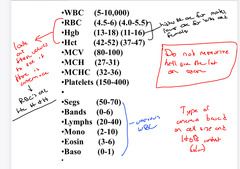
Decreased hemoglobin (Hgb) levels equals
Decrease oxygenation of the tissues (tired, less energy)
Hemoglobin transports
Oxygen and carbon dioxide
What is the percentage of total blood volume made up of RBC
Hematocrit (HCT)
Anemia is mainly categorized by
Cell size
Different ways to describe cell size
Noromcytic
Microcytic
Macrocytic
What determines the color of the of he blood
HgB content
Ways to describe color of blood
Normochromic
Hypochromic
Hyperchromic
MCV means
Mean corpuscular volume
What indicates the size (average volume) of RBC
Mean corpuscular volume (MSV)
MCV above 100
Macrocytic
MCV below 80
Microcytic
What indicates the color of the RBC
Mean corpuscular hemoglobin
MCH
Mean corpuscular hemoglobin
What measures the average amount (weight) of total hemoglobin (Hgb/#RBC)
Mean corpuscular hemoglobin (MCH)
MCH greater than 31
Hyperchormic (polychromatia)
MCH less than 27
Hypochromic
MCHC
Mean corpuscular hemoglobin concentration
What measures the average concentration of percentage of hemoglobin within a single RBC
MCHC (mean corpuscular hemoglobin concentration)
MCH indicates
Color of the RBC
MCHC less than 32
Hypochromic
MCHC more than 36
Hyperchromic (polychromesia)
Decreased RBC and/or Hgb and/or HcT
Anemia
Anemia is classified by
Cell size and colo
Most common anemia
Micorcytic/Hypochromic
Microcytic/hypochromic anemia
Decreased MCV and MCH/MCHC
Normocytic normochromic
Normal MCV and MCH/MCHC
Macrocytic normochromic or Hyperchromic
Increased MCV
Normal or increased MCH/MCHC
Anemia is generally due to
Decreased production
Increased breakdown
Blood loss
Anemia is classified by
RBC morphology (cell size)
Low MCV and MCH/MCHC
Microcytic hypochromic anemia
Normal MCV and MCH/MCHC
Normoctyci normochromic
High MCV normal or increased MCH/MCHC
Macrocytic Hyperchromic or normochromic
Types of Microcytic hypochromic anemia
Iron deficiency anemia (IDA)
Anemia of chronic disease (ACD) or ARD
Thalassemia
Chronic blood loss (which is really and IDA)
Most common Microcytic hypochromic anemia
Iron deficiency anemia (IDA)
Types of Macrocytic normochromic anemia
B12 deficiency
folic acid (B9) deficiency
Alcoholism
Liver disease
Most common Macrocytic normochromic anemias
B12 deficiency
Folic acid (B9) deficiency
Types of normocytic normochromic anemia
Anemia of chronic disease (anemia of inflammation)
Acute blood loss
Hemolytic anemia (Sickle cell anemia)
Aplastic anemia
Most common normocytic normochromic anemia
Anemia of chronic disease (anemia of inflammation)
Iron is transported by
Transferrin
Storage iron in 2 for a
Ferritin
Hemosiderin
A common cause of blood loss anemia is
Heavy menstrual flow
What is the most common cause of anemia worldwide
Iron deficiency (IDA) (chronic blood loss CBD)
Acute bleeding results in
Normocytic normochromic anemia
Chronic blood loss results in
Microcytic hypochromic anemia (really an IDA)
Iron deficiency anemia is usually due to
Chronic blood loss (GI blood loss in MC)
In the developed world the most common cause of iron deficiency anemia is
Blood lost during menses in premenopausal women
Iron is necessary for formation of
Heme
Vast majority of of iron is present in
Hemoglobin
Normal iron loss per d
1-2 mg/day
TRUE or FALSE
Dietary deficiency is uncommon in adults
TRUE
What is the most common cause of IDA
Chronic blood loss
-especially in the GI tract
Severe iron deficiency may cause
Smooth tongue and brittle nails
Development of unusual cravings for specific foods and unusual substances
Pica
Pica for ice
Pagophagia
With iron deficiency anemia you have __________ iron, ________ ferritin, with _________ serum total iron binding capacity (TIBC)
Decreased iron
Decreased ferritin
Increased total iron binding capacity (TIBC)
Why is there increased total iron binding capacity (TIBC)
Cause there is a decrease in iron so there the amount of protein that binds to iron is increased
IDA is what type of anemia
Microcytic hypochromic anemia
Variation in size of RBC
Anisocytosis
Variation in shape of RBC
Poikilocytosis
Platelet count with IDA is usually
Normal
What measures the extent to which iron-biding sites in the serum can be saturated
Total iron binding capacity (TIBC)
Differential diagnosis for IDA
Other Microcytic hypochromic anemias
-thalassemia, anemia of chronic disease, chronic blood loss
Anemia of chronic disease has _________ iron, ________ ferritin, and TIBC is __________
Decreased iron
Normal to increased ferritin
TIBC is low or normal
Thalassemia has _________ iron parameters although more _______
Normal iron parameters
More microcytosis
Another name for anemia of inflammation
Anemia of chronic disease (ACD)
Subtype of anemia of chronic disease
Chronic renal disease (CRD)
Anemia of chronic disease has _______serum iron, ________ TIBC, ________ferritin
Low serum iron
Low TIBC
Normal or increased ferritin (stores of iron are okay, just can't get to it)
Most of the time anemia of chronic disease is
Normocytic normochromic
What stimulates RBC production
erythropoietin
If anemia of chronic disease is related to kidney disease then it's known as
Anemia of renal disease (ARD)
Hereditary disorder anemia
Thalassemia
What anemia is characterized by reduced synthesis of globulin chains (alpha or beta) of hemoglobin
Thalassemia
Thalassemia is what type of anemia
Microcytic hypochromic anemia
2 types of thalassemia
Alpha and beta
Thalassemia results in
Reduced hemoglobin synthesis
Alpha thalassemia is primarily seen in people from
China and Southeast Asia
Bertha thalassemia is primary in people from
Mediterranean
Thalassemia major is also known as
Cooley`s anemia
Mediterranean anemia
Outcome of having thalassemia major or minor
Minor= clinically normal or require no treatment, symptoms appear under times of stress
Major= require regular transfusions
Thalassemia has iron parameters that are
Normal (normal TIBC, iron and ferritin)