HHS Chemistry nuclear review
 Call Kai
 Learn
Learn Practice Test
 Spaced Repetition
 Match
Match Flashcards
 Knowt Play
1/65

There's no tags or description
Looks like no tags are added yet.
Name | Mastery | Learn | Test | Matching | Spaced | Call with Kai | Chat |
|---|
No analytics yet
Send a link to your students to track their progress
66 Terms
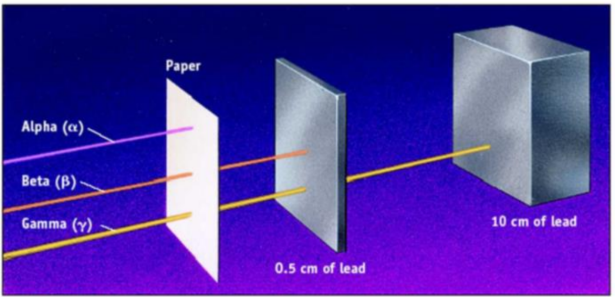
a) What do you notice about how easy it is to block Alpha radiation?
b) What do you notice about how easy it is to block Beta? Did the paper do anything?
c) What do you notice about how easy it is to block Gamma? Did the paper, aluminum, or lead do anything?
a) It’s very easy to block Alpha radiation with just paper
b) It’s a little more harder to block Beta but not as easily as alpha. Paper didn’t do much but aluminum did a lot more
c) Paper and lead blocks off better than aluminum but they do block off
A was easy to block with a sheet of paper and the thin sheet of Aluminum. It was also almost entirely blocked by 2 cm of air.
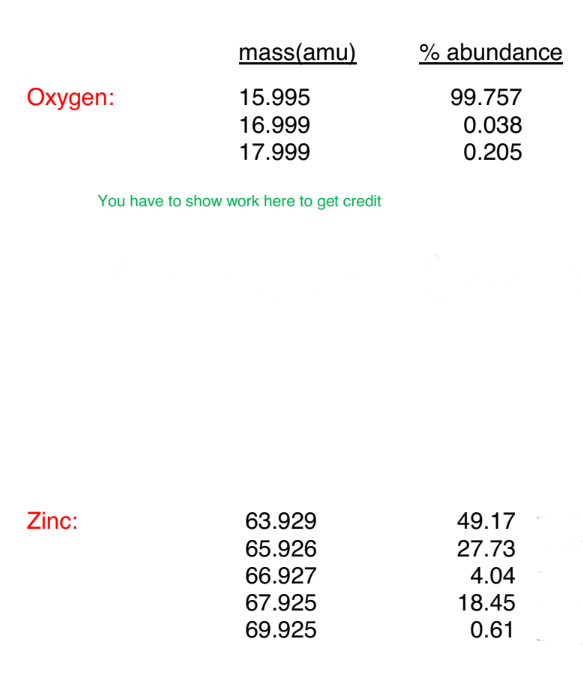
Use the following formula to calculate these atomic masses
A.M. = ((mass #)#1 x %/100) + ((mass #)#2 x %/100) + etc........
A.M. of O = 15.999 amu
A.M. of Zn = 65.378 amu
a) what do you notice about how much the Alpha radiation decreased with distance?
b) what do you notice about how much the Beta radiation decreased with distance?
c) what do you notice about how much the Gamma radiation decreased with distance?
d) which one decreased the most with distance?
e) Why does the radiation get weaker as you get farther away?
f) So if the radiation gets weaker with distance, what is the best protection from radiation?
a) It decreased significantly even with the one cm difference
b) Beta decreased significantly as well, just not as much as the alpha radiation. It was a lot more gradual
c) Gamma decreased but not as significantly as alpha or beta
d) Alpha decreased the most
e) The more space you have, the more the geiger counter is likely to miss the radiation spot
f) Getting as far away as it as possible
proton (p+)
positively charged subatomic particle
mass is 1 atomic mass unit (1 amu)
electron (e-)
negatively charged subatomic particle
mass is 1/1840 amu
Neutron (no)
subatomic particle with no charge
mass is a tiny bit greater than 1 amu
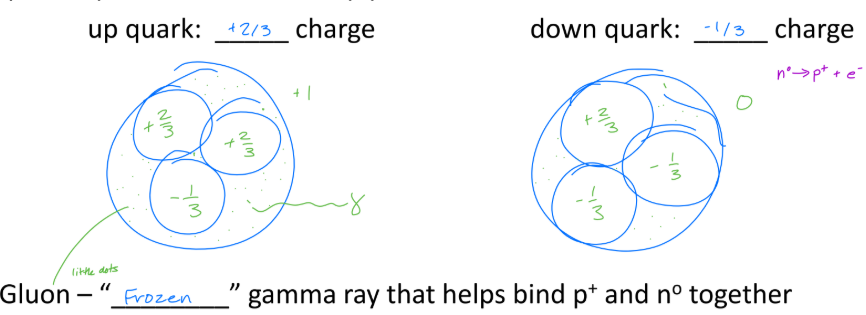
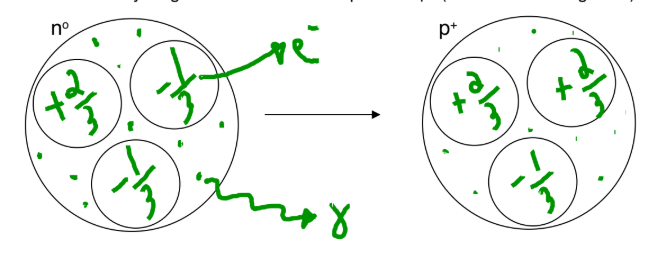
made up of 1 quark that has a +2/3 charge and 2 quarks that have a -1/3 charge
nucleus
the central core of an atom
composed of protons and neutrons
electrons circle around the nucleus
1896, Jan. 1
Wilhelm Röentgen published a paper on the “Roentgen rays” (x-rays) he discovered
made the first X-ray of his hand
in the next year over 1000 scientific papers on X-rays were published, mostly medical
1896, Mar 2
Henri Bacquerel discovered that Uranium gave off radiation spontaneously
put UK(SO4)2 in a drawer with film and the sample developed the film
1898
Pierre and Marie Curie (Marya Sklodowska) found that a certain mass of U made the same amount of radiation no matter what compound it was in
ex: U2O3, UK(SO4)2, pure U
discovered elements Po and Ra (both radioactive)
discovered that radioisotopes have “half-lives”
won the Nobel Prize in 1903 with Bacquerel
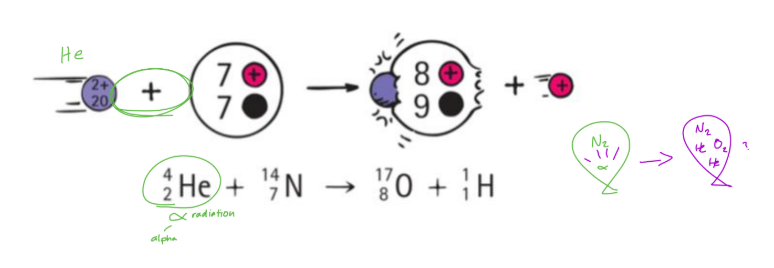
1919
Rutherford became the “first successful alchemist”
changed Nitrogen into Oxygen by using alpha radiation
1932
Chadwick discovers the neutron from nuclear decomposition
1930s-present day
many subnuclear particles are discovered
(quarks, bosons, mesons, leptons, etc.) and their anti-particles (anti-matter!)
Atomic number
number of protons in the nucleus
an atom’s “fingerprint”
also equals the number of e-
in all atoms: # of p+ and # of e-
Mass number
total number of p+ and no in the nucleus
= p+ + no
Remember, the Atomic Mass on the P.T. is the average of all of the Mass Numbers
Isotopes - what happens if you make an atom of oxygen, nitrogen, and neon with a PHET simulation?
oxygen can have between 8 and 10 neutrons
nitrogen can have between 7 and 8 neutrons
neon can have between 10 and 12 neutrons
This shows that atoms can have different numbers of neutrons
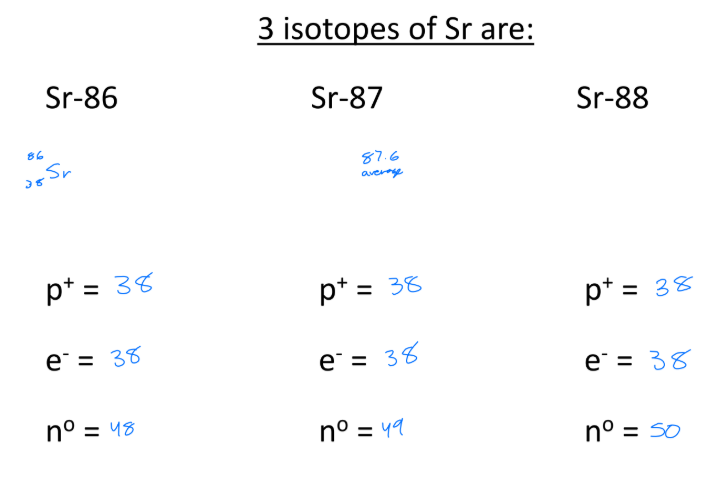
Isotopes
atoms that have the normal number of p+ but different numbers of no
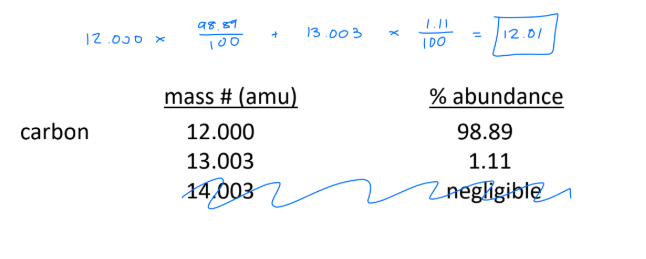
Atomic Mass calculation
- “weighted” average of the mass numbers of all isotopes of an element
- to calculate, use the % abundance found in nature
A.M. = ((mass #)#1 x %/100) + ((mass #)#2 x %/100) + etc........
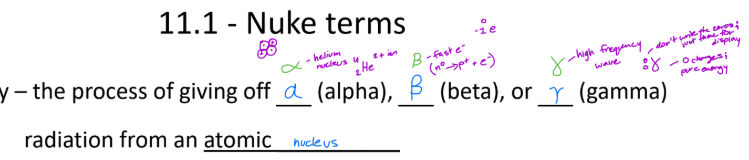
Radioactivity
the process where unstable atomic nuclei spontaneously give off radiation to become more stable.
Radioisotopes
an isotope of an element that emits radiation because its nucleus is unstable (a bad p+/no ratio)
ex: Uranium-238, carbon-14
an unstable isotope of an element that undergoes radioactive decay.
Radioactive decay
an unstable nucleus loses energy and/or mass to gain stability (a good p+/no ratio)
the natural process where an unstable nucleus loses energy by emitting radiation and changes into a different atom or isotope.
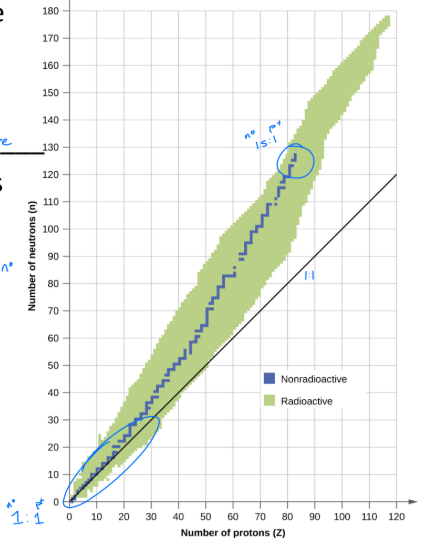
Nuclear Stability chart
this shows which isotopes are stable and unstable
notice there is a middle blue stripe where they are stable
if it is too heavy or too light it won’t be stable and it’s radioactive
notice after 83 p+ they are always radioactive
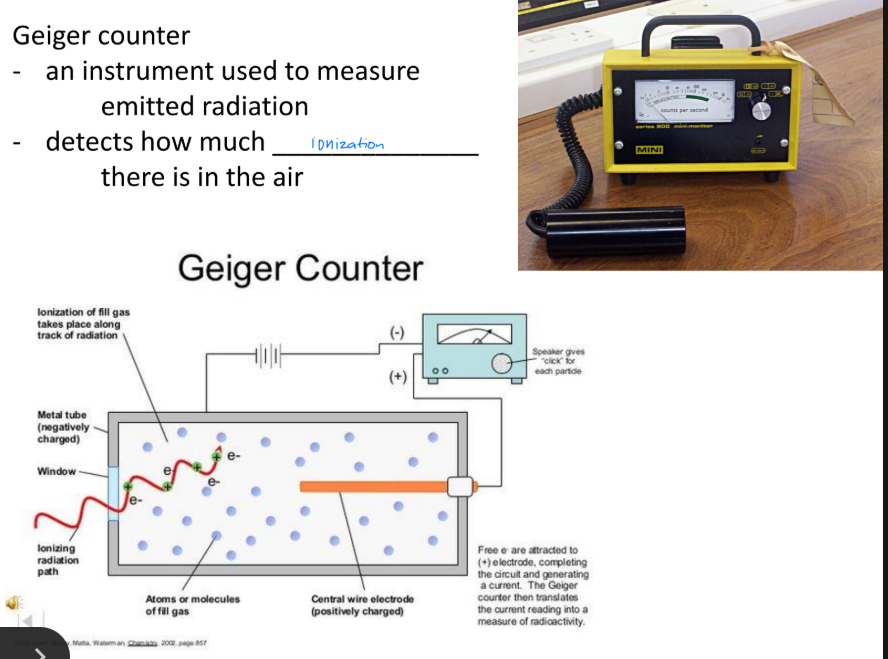
Geiger counter
an instrument used to measure emitted radiation
detects how much ionization there is in the air
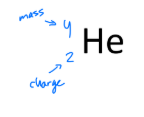
α (alpha)
a helium nucleus (without the 2 e-)
Mass(amu) of 4 and 2+ charge
low penetrating power
α is only dangerous if it is right next to your skin because a few inches of air or a thin shield like paper can block most of it.
β (beta)
a fast moving electron (that comes from nucleus!)
Small mass(amu) (basically 0) and negative charge
no —→ p+ + e-
medium penetrating power

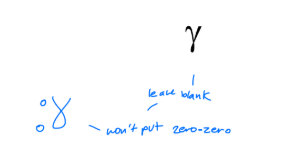
γ (gamma)
high frequency EM radiation
No mass(amu) and no charge
high penetrating power
γ can be dangerous over much longer distances because it can penetrate through more materials like thin sheets of lead. It can also move through miles of air.
positron
a positively charged electron
an electron’s anti-particle, if they touch each other they annihilate themselves into pure energy
This is true with an matter/antimatter interaction
quark
particles that make up p+ and no
up quark: +2/3 charge
down quark: -1/3 charge
Gluon – “Frozen” gamma ray that helps bind p+ and no together
Matter & Energy
there is only one type of substance in the universe: Energy!!!
coupled = energy that is “solidified” into the matter that makes up the universe
energy stored as matter (mass); according to Einstein, matter is “solidified” energy.
decoupled = energy that is “free,” when matter decomposed into energy
energy that is released or separated from matter (energy no longer stored in mass).
How do nuclear reactions differ form ordinary chemical reactions
They involve changes in the nucleus where chemical reactions only affect the e- shells
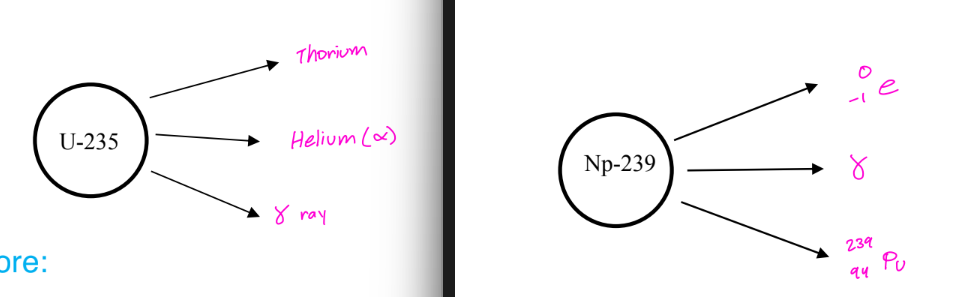
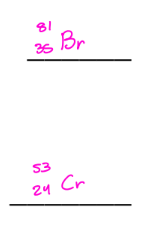
For U-235 and Np-239, use graphics to show what it emits
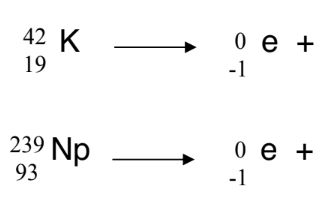
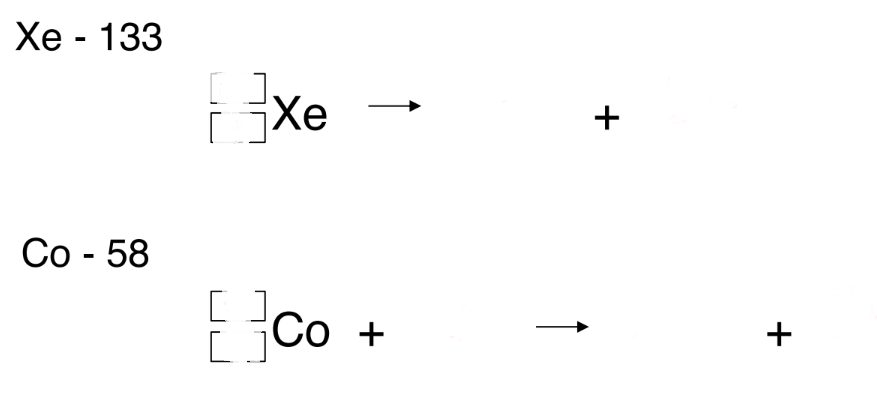
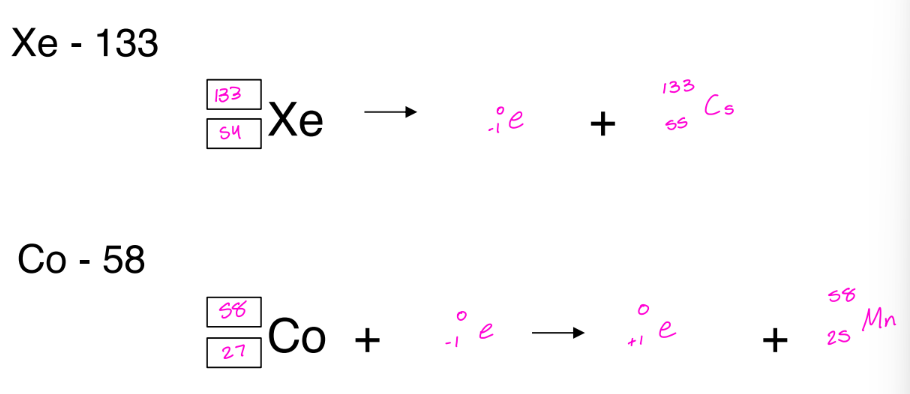
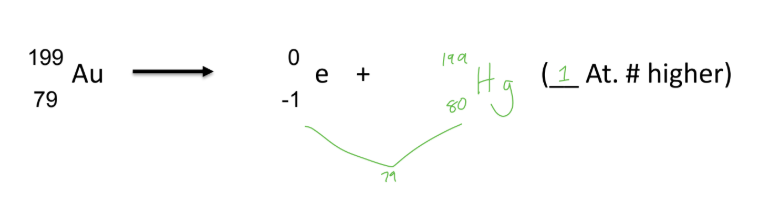
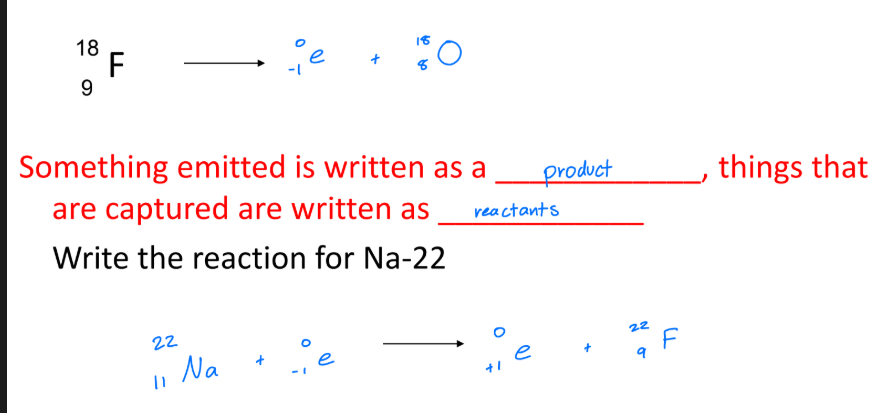
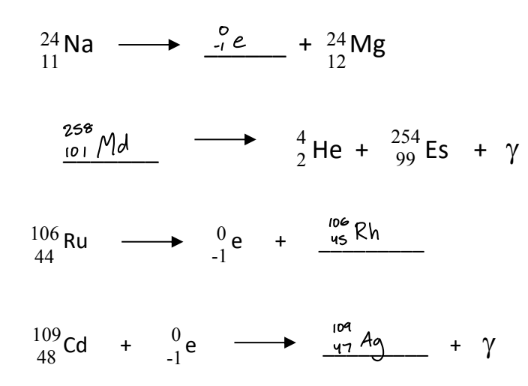
Complete these β emission nuclear reactions
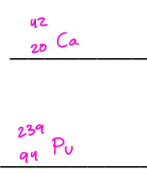
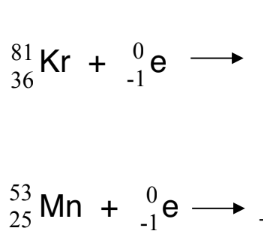
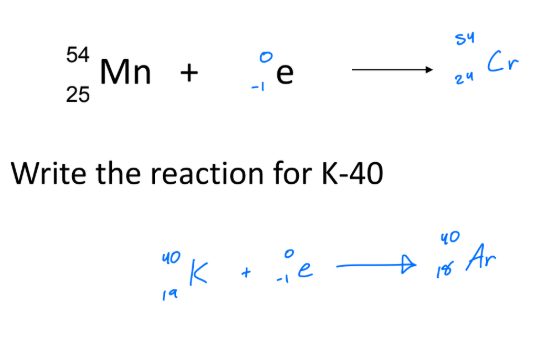
Complete these β capture reactions (an e- from the orbitals is absorbed into a no):
Now look at the back of your Nuclear Periodic Table to write these reactions:
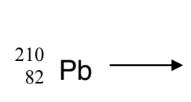
Complete this combination α/β emission nuclear reaction (gives off both α & β):

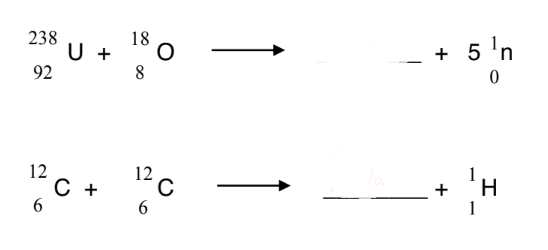
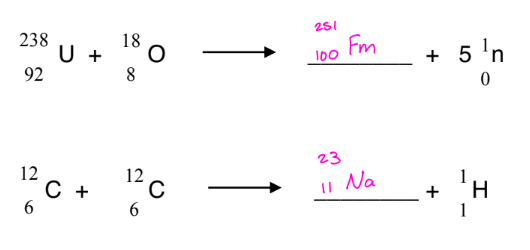
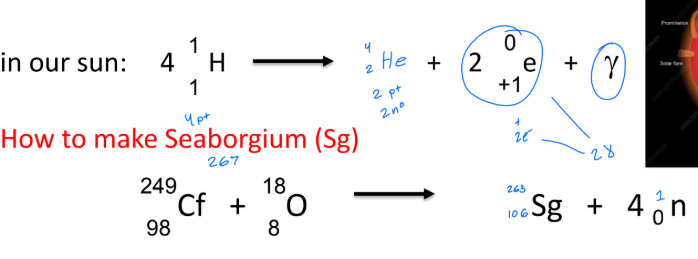
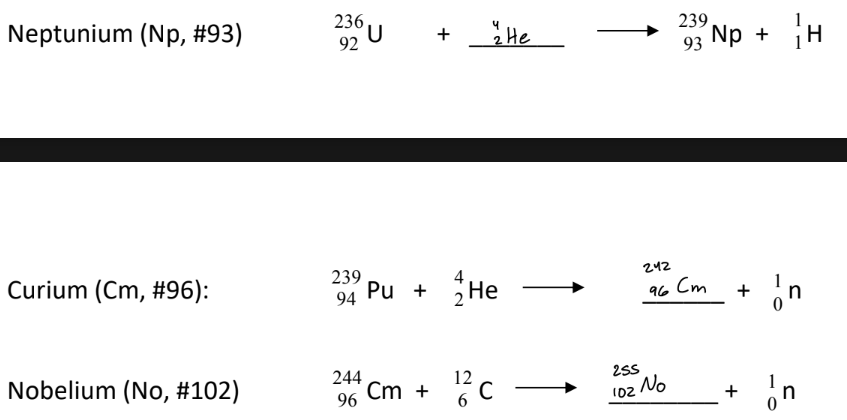
Complete these fusion reactions (smashing together 2 nuclei):
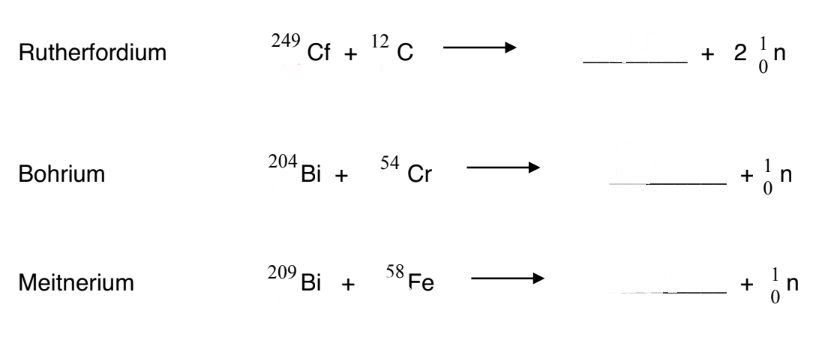
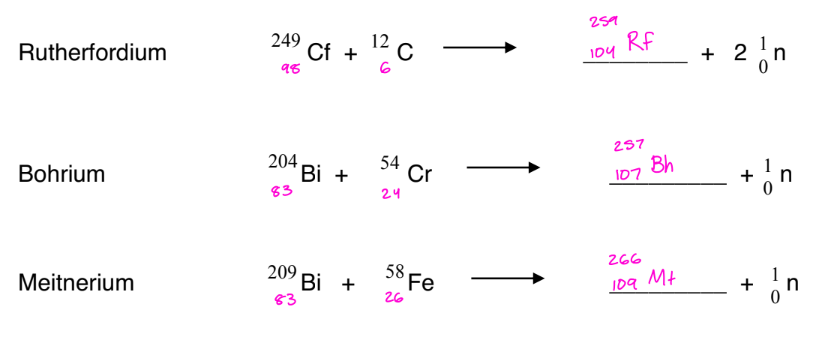
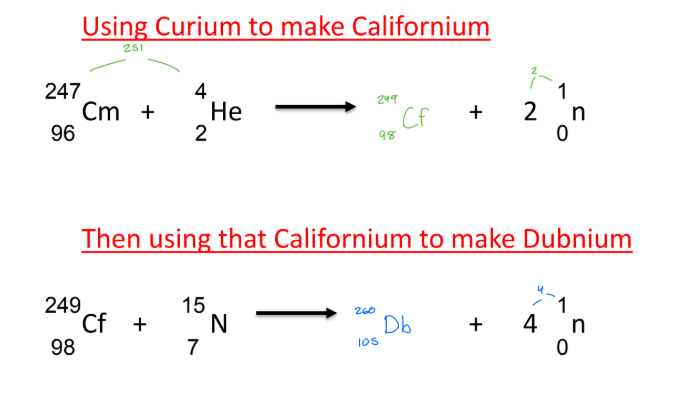
Complete these fusion reactions that were recently used to make some “new” elements.
Two smaller atomic nuclei were accelerated and smashed together to make heavier nuclei.
Also fill in the missing charges on bottom
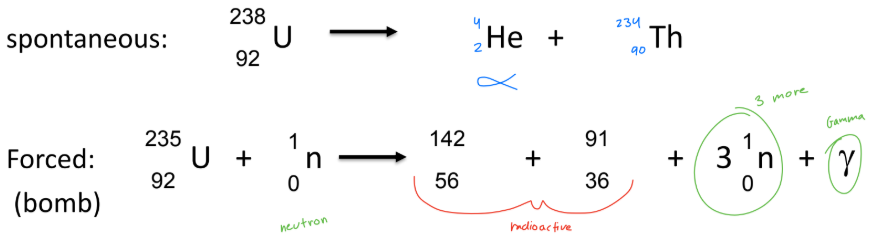
nuclear fission
a nucleus splits apart and ejects particles and energy
may be spontaneous or forced (smashed)
the splitting of a large atomic nucleus into smaller nuclei, releasing a large amount of energy.
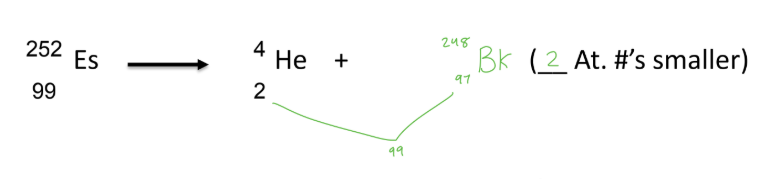
α emission
a nucleus spontaneously gives off an a and becomes less massive
β emission
a nucleus spontaneously emits a b particle
a neutron turns into a proton
β capture
in a proton-rich nucleus, an e- from the shells absorbs into a proton, causing a proton to be converted into a neutron
after this there is a better p+/no ratio
Positron (β+) emission:
in a proton-rich nucleus, an e+ from one of the quarks can be flung out, causing a proton to be converted into a neutron
after this there is a better p+/no ratio
nuclear fusion
when smaller nuclei combine to make a new, heavier element
what happens in the core of our Sun
nuclear fusion is used to make all trans-uranium elements in cyclotrons and particle accelerators
most fusion reactions give off lots more energy than fission, but it’s too difficult for our current technology to sustain it efficiently (but we are getting very close!!!)
the combining of small nuclei into a larger nucleus, releasing energy (this powers the Sun).
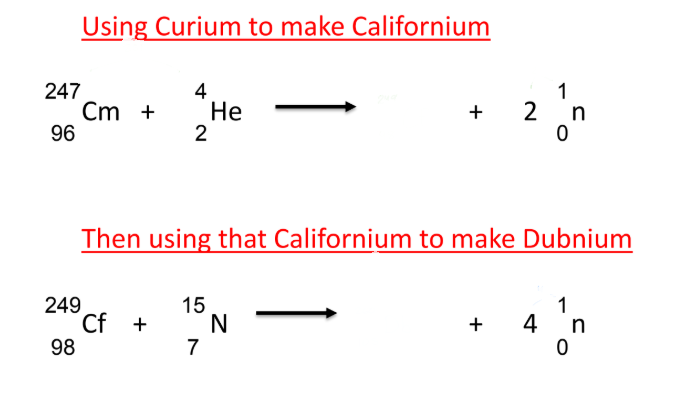
Write these heavy-element fusion reactions:
Notice that they frequently also make neutrons as products
Half-life
elements that have short half-lives must have been recently created in a lab by fission or fusion from other elements
the amount of time it takes for half of a radioactive sample to decay.
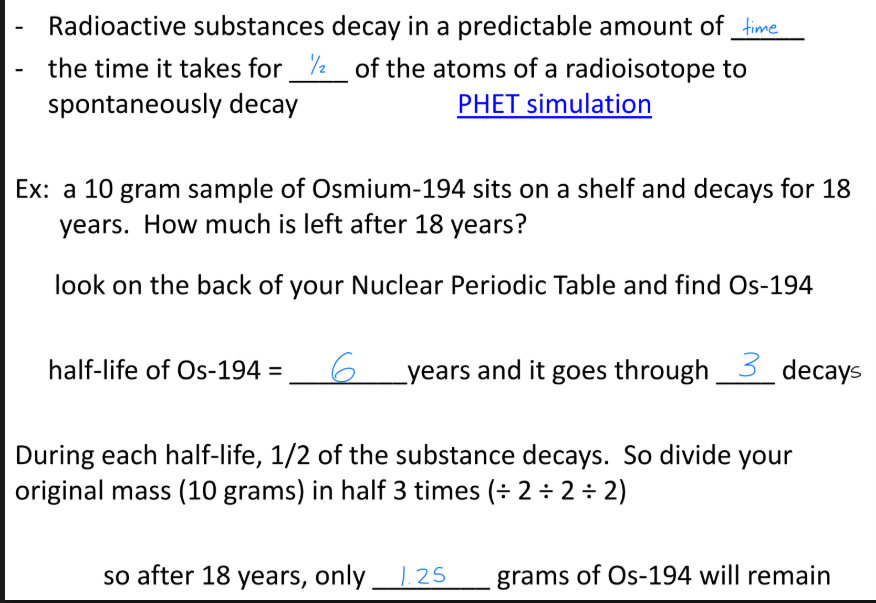
mass final equation
massfinal = massoriginal x 1/2 (# of half-lives)
not on test
Energy calculations
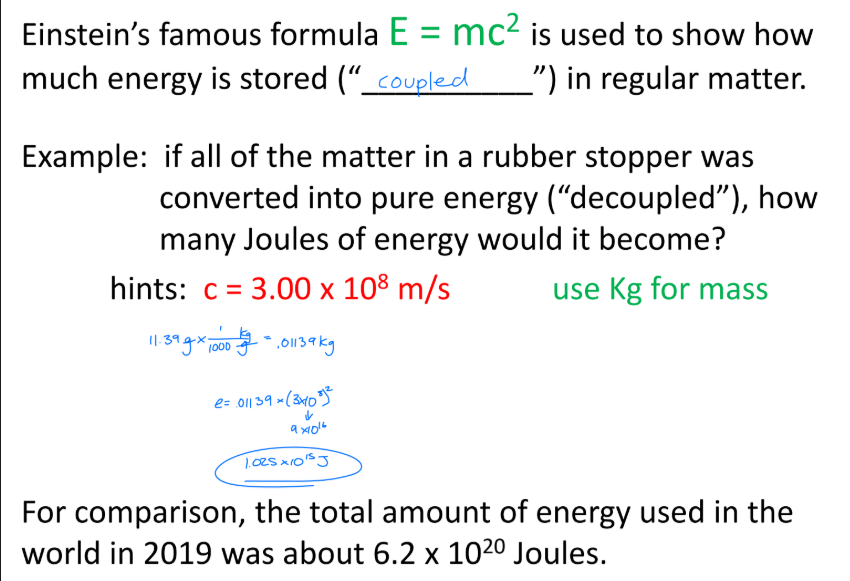
Interesting E=mc2 application
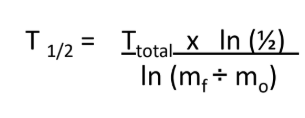
half-live formula
on test
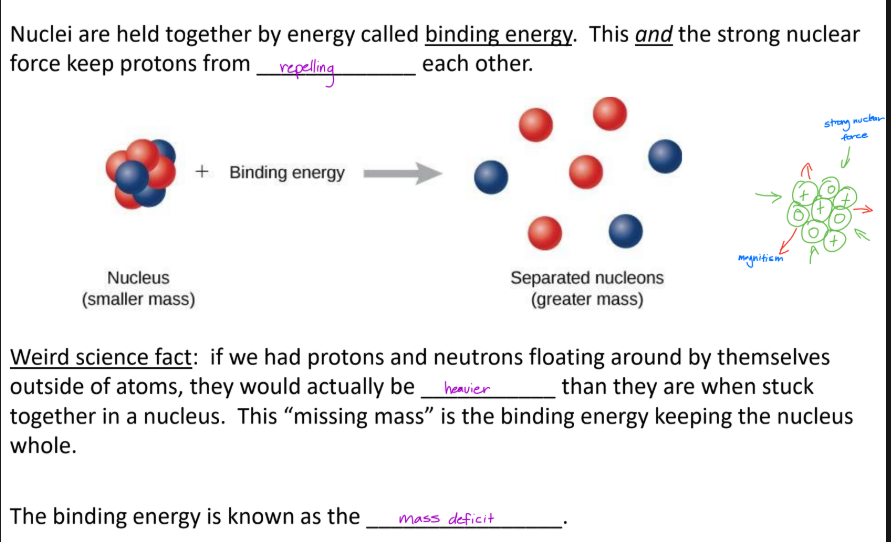
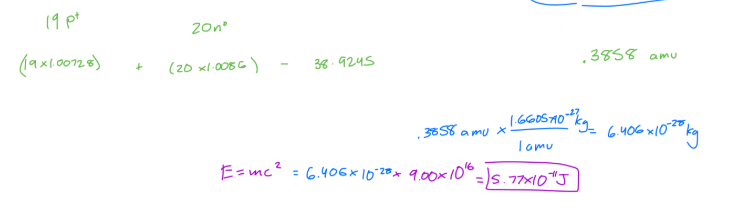
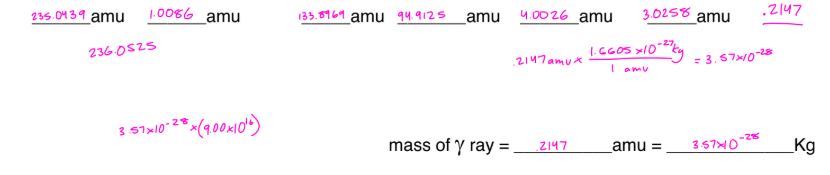
Calculate the binding energy keeping an atom of K-39 together (mass = 38.9245 amu)
p+ mass + no mass - final atom mass = mass deficit
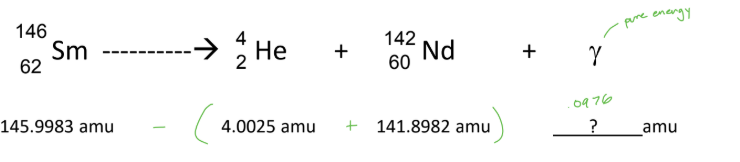
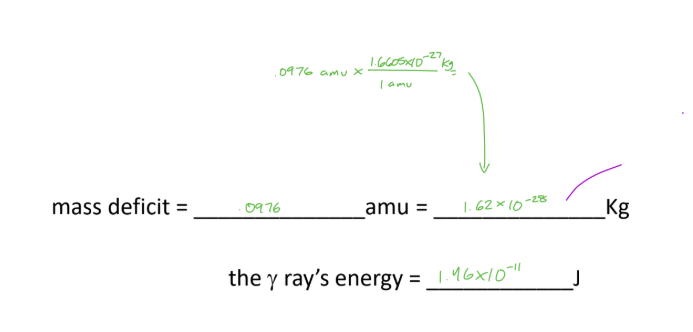
Now let’s calculate the amount of energy given off as a gamma ray in an actual nuclear reaction:
A sample of radioactive Gold-195 (Au-195) had an original mass of 180 grams. It sat on a shelf for 677 days. How many grams will be left?
14 grams will remain
Let’s say a manufacturer makes a 1.50 gram sample and then ships it to a hospital. When it arrives at the hospital there are only 1.15 grams of actual I-131 left. How long did it take to transport it?
it was made 3.1 days ago
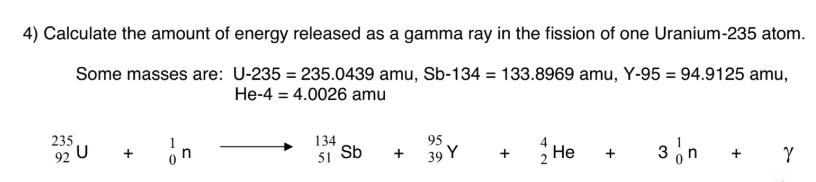
A golf ball sized piece of U-235 has about 2.50 x 1024 atoms. How much energy would they all give off together? 1 U-235 atom = 3.21 × 10⁻¹¹
If the annual energy consumption of the entire world’s population is about 6.2 x 10²⁰J, how many “golf ball” sized pieces of U-235 would be needed to supply the world with power for a year?
8.03 × 10¹³ J
7.72 × 10⁶ golf ball sized pieces of U-235
radiation
energy or particles released from an unstable nucleus (such as alpha, beta, or gamma radiation).
mass defect
the difference between the mass of an atom’s nucleus and the total mass of its individual protons and neutrons; this “missing” mass becomes binding energy.
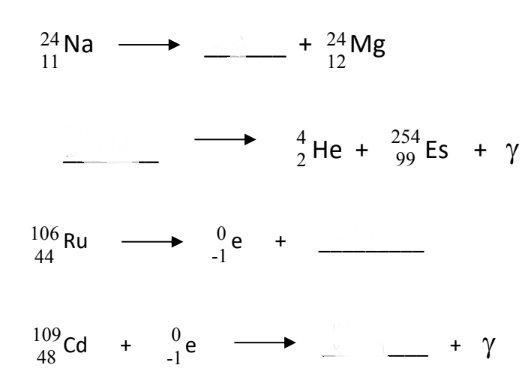
Finish these α and β emission and Electron Capture nuclear reactions. Fill in the blanks:
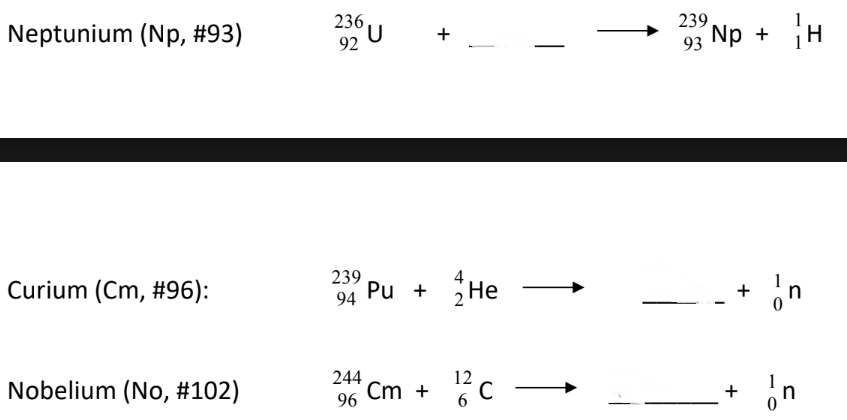
The following reactions show how some transuranium elements are created in particle accelerators by bombarding smaller nuclei together.
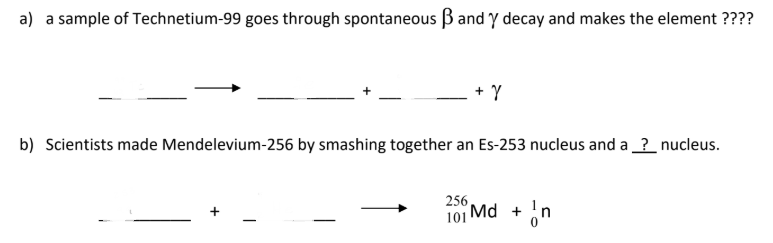
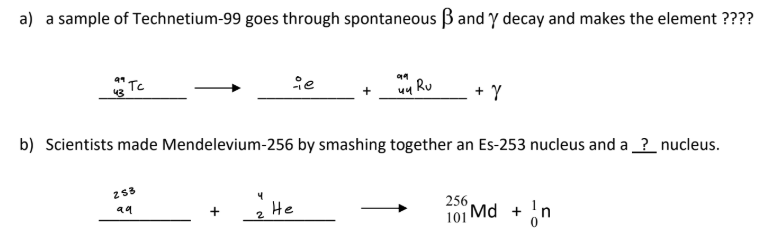
Set up these entire equations:
*Es for missing piece
8) You find a new radioactive isotope that hasn’t been measured before. You isolate 17.3 grams of it from a rock you found in the ground. Then you let it sit on a shelf for 15 days and find that there is only 2.9 grams of this mystery element left. How long is its 1⁄2-life?
9) You start with a 500 g sample of Rh-101 and, after 10 years, only 63 grams remain, how long is its half-life?
8) 5.8 days
9) 3.3 years
watch for sig figs
An atom of Na-23 is completely changed into energy. (How? I don’t know, just say it does.) The mass of the atom is 3.85 x 10⁻²⁶ Kg. How much energy would be released when all of the protons, neutrons, and electrons are completely changed to energy?
3.47 × 10⁻⁹ J
Calculate the binding energy keeping the nucleus of Al-28 (mass = 27.97477 amu) together. Use the table of conversions in your notes to find the mass of all of the individual protons and neutrons.
3.74 × 10⁻¹¹ J
Draw a picture showing how a neutron’s 3 quarks change in order to turn it into a proton. Make sure it accounts for everything in the formula no ---> p+ + e- + γ. (also show some gluons)
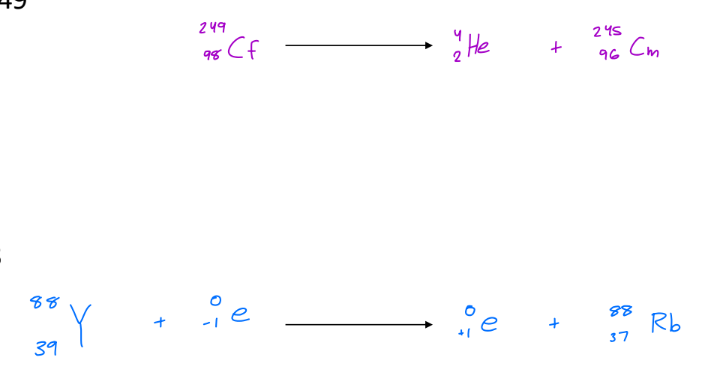
Write nuclear equations for the following reactions. Use the information on back of your Nuclear Periodic Table.
Cf-249
Y-88
Binding energy problem
on test
