Bio 210 Exam 2
 Call Kai
 Learn
Learn Practice Test
 Spaced Repetition
 Match
Match Flashcards
 Knowt Play
1/80

Earn XP
Description and Tags
w/ Prof Greg Tyson
Name | Mastery | Learn | Test | Matching | Spaced | Call with Kai | Chat |
|---|
No analytics yet
Send a link to your students to track their progress
81 Terms
Efficiency of transport of materials within a cell decreases
with size, limiting the maximum cell size
A researcher growing cells in culture observed that the cells
always divided once they reached a certain size, regardless of her
adjustments to nutrients and temperature in the growth
chamber. What could explain these observations?
a. Increasing cell size is accompanied by increasing cellular
reactions, which produce more heat that threatens cell
survival.
b. Efficiency of transport of materials within a cell decreases
with size, limiting the maximum cell size.
c. The cell’s surface area increases faster than its volume as it
increases in size, leading to an inability of the cell to feed
itself
more efficent to perform a specialized function
seperate enviroments (acidic levels vary)
Why do organelles exist?
They are synthesized from within membranes
Most proteins are in the cytosol because they are
hydrophilic; how are membrane proteins (which
are hydrophobic) made?
A) They simply diffuse from the cytosol to the appropriate membrane
B) They are synthesized from within membranes
C) They have a hydrophobic shell that encases them to maintain
proper folding
D) There are actually no proteins in the cell membrane
Which types of proteins would leave a cell
entirely?
Could be cell signaling
Antibodies
Enzymes to break down food
Some other organelles have DNA
The book says: “The nucleus contains most of the
genetic information”. Why not all?
A) Some of the DNA is exported out of the nucleus
B) Some other organelles have DNA
C) DNA is often released outside the cells
D) Other???
rough er analogy
production factory
vesicle analogy
delivery truck
lysosome analogy
recycling factory
plasma membrane analogy
final delivery site
golgi analogy
shipping warehouse

smooth er
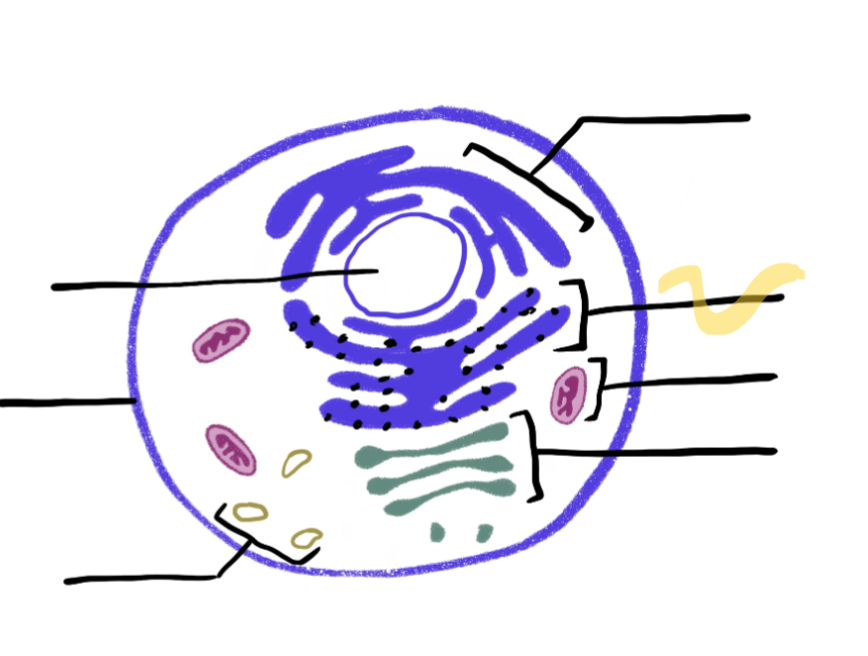
rough er

mitocondria

golgi apparatus

lysosome

cell membrane

nucleus
Membranes are the borders between different regions of a cell.
Where membranes exist, differing cell environments can be
maintained.
• The plasma membrane borders the entire cell separating the
internal environment from the external environment
• Like food packaging, it’s shape and structure is based on what’s inside
What is a membrane
lipids
proteins
carbohydrates
Which of the below are cell membranes made of?
A) Lipids
B) Carbohydrates
C) Proteins
D) Nucleic acids
What is a cell surface antigen and what is it made
of?
Something on the cell surface that can be recognized
• Sometimes immune system will react to
• Proteins, but can also be carbohydrates
Why do materials move?
Molecules are in motion and their motion increases the
entropy of the system (less order)
• Molecular collisions result in molecules being moved along
a gradient (concentration gradient or free energy gradient)
• Through random molecular collisions directional motion can be
accomplished
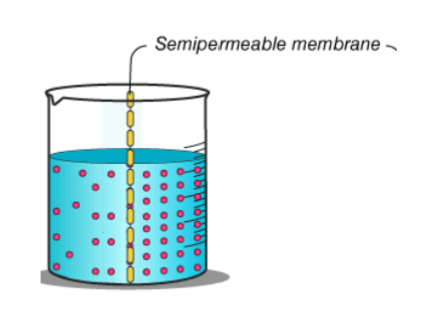
Biological membranes are semipermeable
What does this mean?
small uncharged molecules can pass through the hydrophobic lipid bilayer
large polar molecules and ions cannot pass through the lipid bilayer
which molecules can freely pass across the membrane?
• Hydrophobic molecules (e.g. lipids)
• NOT charged molecules (ions) or polar molecules
Transport proteins may assist ions and polar molecules
across the membrane
In which direction can molecules go across the membrane?
high concentration → low concentration
A) Water will move from left to right
Imagine a semipermeable membrane that can
allow osmosis to occur. What will happen?
A) Water will move left to right
B) Water will move right to left
C) Red particles will move left to right
D) Red particles will move right to left
Where does most energy for life on earth come from?
water
the sun
soil
air
the sun
The polysaccharide requires a membrane protein
A lipid and a polysaccharide are both moving
from high to low concentration. Which is true?
A) Both require carrier proteins
B) Both involve facilitated diffusion
C) Both are active transport
D) The polysaccharide requires a membrane protein
Receptor-mediated endocytosis can be
hijacked: when does this occur?
Viruses! Have surface proteins that can mediate this to gain cell
entry
• Part of what makes viruses specific
The dna in a prokaryotic cell is not enclosed in a membrane- bound nucleus
What is a difference between a prokaryotic and eukaryotic cell?
Cellular processes in a prokaryotic cell are compartmentalized, whereas compartmentalization is absent in a eukaryotic cell
a prokaryotic cell is not enclosed by a cell membrane, and a eukaryotic cell is enclosed.
The DNA in a prokaryotic cell is not enclosed in a membrane- bound nucleus
A prokaryotic cell does not use DNA as its genetic material
A prokaryotic cell does not use ribosomes for protein synthesis, whereas a eukaryotic cell does

Cell A, because it has a larger surface area to volume ratio than cell B
The villi of the small intestines are lined with epithelial cells that absorb nutrients from digested food on one side and transfer these nutrients into the blood on the other side. Which cell shown in the figure would be most efficent as an epithelial cell in the intestinal villi, and why?
Cell B, because it has a greater volume than the cell A
Cell A, because its volume is greater than its surface area
Cell B, because it has a greater surface area than cell A
Cell A, because it has a larger surface area to volume ratio than cell B
Cell B, becuase it has a larger overall size than cell A

7, 2, 6, 3
Which numbers represent cytoplasm, pili, ribosome, and cell wall, in that order?
2,8,6,4
5,2,6,3
5,6,1,4
7,2,6,3
7,6,5,3
trans-golgi
A vesicle carries a protein to the cell membrane, where it is inserted into the phospholipid bilayer. The vesicle budded off from which subcellular structure before making the trip through the cytoplasm to the cell membrane?
trans-golgi
cic-golgi
rough er
smooth er
medial- golgi
microtubules, intermediate filaments, and microfilaments
The cytoskeleton consists of
calcifed microtubules
cilia, flagella, and microfilaments
internal cell wall
microtubules, intermediate filaments, and microfilaments
ribosomes on the rough endoplasmic reticulum; golgi apparatus
Some proteins on the surface of a mammalian cell contain carbohydrates. These proteins are synthesized by ___ and the sugars are added in the ___.
ribosomes on the rough endoplasmic reticulum; golgi apparatus
cytoplasmic ribosomes: smooth endoplasmic reticulum
the golgi apparatus: rough endoplasmic reticulum
cytoplasmic ribosomes: cell membrane
mitocondrial ribosomes: smooth endoplasmic reticulum
proteins in the cytosol would break down
If all the lysosomes within a cell suddenly ruptured, what would be the most likely result?
proteins in the cytosol would break down
more proteins would be made
the DNA in mitochondria would break down
the mitochondria and chloroplasts would divide
there would be no change in cell function
mitocondria and plastids have DNA that encodes some proteins used by the organelles
Which statement can be used as evidence for the endosymbiosis theory?
In eukaryotes, the endoplasmic reticulum is continuous with the nuclear envelope
Compartmentalization of individual functions in separate organelles allows eukaryotes greater ability to carry out a wide diversity of functions
Vacuoles are membrane-bound organelles that store toxic molecules and waste products
mitocondria and plastids have DNA that encodes some proteins used by the organelles
internal membranes are the sites of photosynthesis in photosynthetic prokaryotes
Cell Theory
Theory that all living things are made of cells, cells are the basic unit of life, and all cells come from pre-existing cells
Eukaryote
An organism whose cells contain a nucleus and membrane- bound organelles (plants, animals, fungi, protist)
Prokaryote
An organism whose cells lack a nucleus and membrane-bound organelles (bacteria, archaea)
surface to volume ratio
the amount of cell surface area compared with its volume. SMaller cells have a higher ratio, allowing more efficent exchange of materials
Plasma Membrane
The selectively permeable membrane, primarily made of phospholipids, surrounding a cell that controls what enters and leaves
nucleoid
the region in a prokaryotic cell where its DNA is located
Organelle
A specialized structure within a eukaryotic cell that performs a specific function
nucleus
membrane bound organelle that contains most of a eukaryotic cells DNA
Cytoplasm
Everything inside the plasma membrane except the nucleus, includes the cytosol adn organelles
nuclear pore
an opening in the nuclear envelope that controls movement of proteins into and out of the nucleus
ribosome
A structure that builds proteins using instructions from messenger RNA. They can be free in the cytosol or bound in the rough ER.
smooth endoplasmic reticulum
A membrane network involved in lipid production nd detoxification (lacks ribosomes)
rough endoplasmic reticulum
a membrane network covered with ribosomes that make membrane proteins
golgi apparatus
an organelle that modifies, sorts, and packages proteins and lipids for transport
vesicle
a small membrane bound sac that transports or stores substances inside or outside a cell, including to and from the ER, golgi, lysosomes, adn plasma membrane
Lysosome
an acidic organelle containing digestive enzymes that break down waste, damaged cell parts, and materials taken into the cell. A cells “stomach”
emdomembrane system
A group of membranes and organelles, including the nuclear envelope, ER, golgi, vesicles, lysosomes, and plasma membrane, that make, modify, and transport cell materials
mitochondria
organelles that produce ATP
chloroplasts
a plant organelle where photosynthesis occurs
endosymbiont theory
the theory that mitochondria and chloroplasts evolved from free living bacteria that were engulfed by larger cells and formed a mutually beneficial relationship
vacuole
a membrane bound storage compartment thats typically for nutrient storage or structure
peroxisome
an organelle that breaks down fatty acids and detoxifys harmful substances, producing and breaking down hydrogen peroxide
cytoskeleton
a network of protein fibers that supports cell shape and helps with movement, and cell division
microfilaments
the thinnest cytoskeletel fibers; they help maintain cell shape, enable movement, and assist in cell division
actin
the protein that makes up microfilaments
intermediate filaments
cytoskeletal fibers that provide mechanical strength and help stabalize the cell and its organelles
microtubules
hollow cytoskeletal tubes that help maintain cell shape, move organelles, and seperate chromosomes during cell division
tubulin
the protein that makes up microtubules
extracellular matrix
a netwok of proteins and carbohydrates outside animal cells that provides support, attachments, and communication
cell wall
a rigid layer outside the plasma membrane that supports and protects cells. Made of different components in different cell types, but present in plants, fungi, and bacteria
Both a and c
Which of the following describes how your body uses the foods you eat?
a. The food is broken down through catabolic reactions
b. the food is broken down through anabolic reactions
c. The components of the food are used in anabolic reactions
d. The components of the food are used in catabolic reactions
e. Both a and c
f. both b and d
The exergonic reaction provides free energy that helps drive the endergonic reaction
In biology, exergonic and endergonic reactions are often paired. Which statement is most accurate?
A. The endergonic reaction becomes exergonic on its own
B. The exergonic reaction provides free energy that helps drive the endergonic reaction
C. The two reactions cancel each other out, so neither occurs.
D. Coupling eliminates the need for enzymes
What is the energy currency of cells?
ATP
ATP releases energy to endergonic reactions
Which describes how ATP is used by the cell?
a. ATP stores energy from teh anabolic reactions
b. ATP releases energy to endergonic reactions
c. ATP accepts energy from exergonic reactions
d. ATP is used once, then broken down by the cell
OIL RIG
Oxidized, I Lose (electrons)
Reduced, I Gain (electrons)
Phospholipid
A molecule with a hydrophilic phosphate head and hydrophobic tail: they form the basic structure of a cell membrane
amphipathic
having both hydrophilic and hydrophobic regions (phospholipid)
fluid mosaic model
the description of the membrane as a flexible phospholipid bilayer containing moving proteins, cholesterol, and carbohydrates
Cholesterol
A lipid in animal cell membranes that helps regulate membrane fluidity and stability
integral membrane protein
a protein permanently attached to or embedded in the membrane, often spanning the entire bilayer
Peripheral membrane protein
A protein temporarily attached to the membrane surface or to an integral membrane protein
Glycolipid
A lipid with the carbohydrate attached
glycoprotein
A protein witha carbohydrate attached
Semipermeable
allowing some substances to cross a membrane while preventing others from crossing
passive transport
movement of substances across a membrane without the cell using energy (down a concentration gradient)