MSK Examination and Intervention Overview
 Call Kai
 Learn
Learn Practice Test
 Spaced Repetition
 Match
Match Flashcards
 Knowt Play
1/83

There's no tags or description
Looks like no tags are added yet.
Name | Mastery | Learn | Test | Matching | Spaced | Call with Kai | Chat |
|---|
No analytics yet
Send a link to your students to track their progress
84 Terms
MSK Topics
Categories including Physical Therapy Examination, Foundations for Evaluation, Differential Diagnosis, & Prognosis, and Interventions.
Physical Therapy Examination
Includes Anatomy, Physiology, Tests, Movement analysis, and Biomechanics.
Foundations for Evaluation, Differential Diagnosis, & Prognosis
Covers Differential Diagnosis of MSK conditions, Connective tissue, Plan of care, and Pharma management.
Interventions
Focuses on Rehabilitation, Daily activities, Complications, and Environmental factors.
Long Sitting test
Assesses posterior rotation of pelvis.
Closed vs. Open chain for strengthening
Differentiates between types of exercises for muscle strengthening.
Eccentric muscle action
Generates more force than concentric muscle action.
Rule of 6
Refers to recovery timelines of 6 weeks, 12 weeks, and 6 months for major surgeries like rotator cuff.
Janda's Crossed Syndromes
A concept in physical therapy related to muscle imbalances.

Forward head posture exercise combination
Strengthen the deep cervical flexors and stretch the sternocleidomastoids and upper cervical extensors.
Lateral femoral condyle
Flatter, does not extend as far distally, and projects further posteriorly compared to the medial condyle.
Screw home mechanism
Describes the lateral rotation of the tibia on the femur at full extension.
Unlocking the knee motion
Lateral (External) rotation of the femur on the tibia occurs when going from position A to position B.
Strengthening example for G. Med
Illustrates a specific exercise approach for strengthening.
Neck problems exercise combinations
Strengthen the deep cervical flexors and sternocleidomastoids and stretch the upper cervical extensors.
Superior glide of the patella
Motion that can occur during knee movements.
Lateral (External) rotation of the tibia
A possible motion during knee unlocking.
Lateral (External) rotation of the femur
A motion that occurs during knee unlocking.
Major Surgeries recovery timelines
Refers to the recovery periods of 6 weeks, 12 weeks, and 6 months.
Astrologer prediction
Involves supination of forearms to connect ulnar sides of hands.
Palmar creases
The appearance of a half moon shape in these creases is linked to the astrologer's prediction.
Complications in rehabilitation
Factors that may affect the rehabilitation process.
Environmental factors in rehabilitation
External conditions that can influence rehabilitation outcomes.
Long axis distraction at the knee joint
A technique used in physical therapy to mobilize the knee joint.
Concentric contraction
A type of muscle contraction where the muscle shortens while generating force.
Eccentric contraction
A type of muscle contraction where the muscle lengthens while generating force.
Isometric contraction
A type of muscle contraction where the muscle generates force without changing length.
Shoulder abduction
Movement of the arm away from the body in the coronal plane.
Excessive upward rotation of the left scapula
A condition where the left scapula rotates excessively upward during shoulder abduction.
Weakness of serratus anterior
A condition that may contribute to scapular winging and excessive upward rotation.

Weakness of lower trapezius
A condition that may lead to poor scapular control and excessive rotation.
Weakness of rhomboid major & minor
A condition that may affect scapular stability and positioning.
Weakness of pectoralis major
A condition that may influence shoulder movement and stability.
Surgical repair of full thickness rotator cuff tear
A procedure to fix a complete tear in the rotator cuff muscles.
Passive and assisted movement
Therapeutic techniques used to promote mobility in a patient post-surgery.
Conventional Approach for Achilles Tendon Repair
6 weeks immobilization and non-weight bearing.
Early Remobilization Approach for Achilles Tendon Repair
Initiation of movement immediately after surgery or after 1 or 2 weeks.
Phase 1 rehabilitation (Achilles Tendon Repair)
Active ROM of non-immobilized joints and muscle setting exercises of dorsiflexors, invertors, evertors, and plantarflexors at 2 weeks.
Weight-shifting activities
Activities performed in bilateral stance while wearing an orthosis when partial weight bearing is permitted.
R ankle instability
A condition characterized by a lack of stability in the right ankle, often following an injury.
Lateral ankle sprain
An injury to the ligaments on the outside of the ankle.
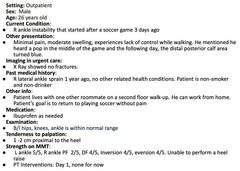
Ibuprofen
A medication used to relieve pain and reduce inflammation.
Strength on MMT
Manual Muscle Testing results indicating the strength of the muscles.
Heel raise
An exercise to strengthen the calf muscles, which the patient is unable to perform.
Positive special test
A clinical test result indicating a specific injury or condition.
Achilles Tendon Repair
Surgical procedure to repair the Achilles tendon.
Weight bearing
The act of putting weight on a limb or joint.
Conventional Approach
6 weeks immobilization and non-weight bearing.
Early Remobilization Approach
Initiating movement immediately after surgery or after 1 or 2 weeks.
Phase 1 (Up to 4-to-6 weeks)
Initial rehabilitation phase focusing on active ROM and muscle setting.
Active ROM
Active range of motion exercises for non-immobilized joints.
Muscle setting exercise
Exercises targeting dorsiflexors, invertors, evertors, and plantarflexors at 2 weeks post-op.
R ankle instability
Condition characterized by instability in the right ankle, often following an injury.
Tenderness to palpation
Sensitivity or pain felt when an area is pressed or touched.
Strength on MMT
Muscle strength assessment showing L ankle 5/5, R ankle PF 2/5, DF 4/5, Inversion 4/5, eversion 4/5.
Anterior drawer test
A special test used to assess ankle instability.
Lachman test
A special test primarily used to assess knee stability.
Thompson test
A special test to assess the integrity of the Achilles tendon.
Apley's test
A special test used for assessing meniscal tears in the knee.
CAM boot
A controlled ankle motion boot used for immobilization and support post-surgery.
Heel raises in standing
An exercise that involves lifting the heel off the ground while standing.
Active Insufficiency
The inability of a two joint muscle to shorten simultaneously at both joints.
Passive Insufficiency
The inability of a two joint muscle to lengthen simultaneously at both joints.
Two / Multi-Joint Muscles
Muscles that cross more than one joint and can exhibit active and passive insufficiency.
Proper shoe modification
Adjustments to footwear to accommodate recovery and improve function post-injury.
Active Insufficiency
The inability of a two joint muscle to shorten simultaneously at both joints
Passive Insufficiency
The inability of a two joint muscle to lengthen simultaneously at both joints
Step 1
Name of the Muscle
Step 2
Is it a two joint muscle?
Step 3
End Range? Function of the muscle?
Step 4
Active or Passive
Practice Question 6
Active insufficiency of right iliopsoas will be caused by?
Practice Question 7
What is the MOST likely cause of reduced hip flexion with knee extension?
Practice Question 8
Which of the following orthotic would MOST LIKELY benefit a patient with excessive foot pronation?
Stretch vs. Strengthen
Forward head posture
Closed vs. Open chain
Screw home mechanism
Eccentric vs. Concentric
Shoulder rotators
Rule of 6
6 weeks, 12 weeks and 6 months for major surgeries like rotator cuff/ Achilles tendon repair
Kinematic Chain
A concept related to the movement of body segments
Foot Pain Intervention
Providing an orthotic to relieve pain from excessive foot pronation

Lymphatic System Class
Thursday 2/15: Lymphatic System at 5 pm PST
Neuro Examination Class
Saturday 2/17: Neuro Examination at 8:30 am PST
APTA CSM
See us at APTA CSM in Boston MA at Booth #11054
NPTEFF Mixer
Stop by our NPTEFF Mixer on Friday 7pm-9pm EST at The Boston Convention Center