49 Disorders of the Endocrine Pancreas II
 Call Kai
 Learn
Learn Practice Test
 Spaced Repetition
 Match
Match Flashcards
 Knowt Play
1/35

There's no tags or description
Looks like no tags are added yet.
Name | Mastery | Learn | Test | Matching | Spaced | Call with Kai | Chat |
|---|
No analytics yet
Send a link to your students to track their progress
36 Terms
Hospitalize for 24-48 hours to ensure hypoglycemia doesn't occur, then re-evaluate in 7-10 days
What should you consider doing when first starting a patient on insulin therapy?
Resolution of clinical signs and owner satisfied with progress
Glycemic control for diabetes is achieved based on what in animals
SHOULD: maintain a log, observe clinical signs, do glucose curves at home
SHOULD NOT: change insulin dose at home without partnership from you
The owner should and should NOT be doing what things at home when managing an animal who needs insulin?
Every 2-4 hours
How often do you need to take blood samples in order to do glucose curves?
We want it to be trace or 1+ every so often. If it's always negative, we worry the patient is hypoglycemic but obviously with 4+ we worry about hyperglycemia
What should urine testing look like when managing insulin in diabetic patients?
Paws and ear
What places are best to collect one drop of blood for glucose monitoring in animals?
You need to assess the owner's injection technique, tell them when/how often to take blood samples, educate them on symptoms of hyper and hypoglycemia
What kind of client education do you need to be doing if they are going to be managing an animal with insulin or taking blood glucose curves
DOGS: between 100-250
CATS: between 100-300 (but ideally you can get cats on "tight regulation", 60-120)
What do you want blood glucose to be for cats and dogs after managing insulin? What is the ideal?
Ideal blood glucose curve: starts between 200 and 300 before insulin but after fed. The Nadir is the lowest the blood sugar will ever get at 6 hours (halfway thru), and the end point is the blood sugar increasing as the insulin wears off. The glucose differential measures how high it starts, and how low it gets.
DO NOT CHANGE
Describe this glucose curve and what you would do to fix it
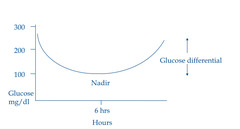
Insufficient Insulin Dose: Glucose starts way too high so the nadir doesn't get low enough at 6 hours (which is halfway thru dosing interval)
TO FIX: increase insulin amount by 10-20%, small dose increase which you give for 1-2 weeks and check again
note: on the slides, this graph looks the EXACT SAME as insulin resistance
Describe this glucose curve and what you would do to fix it
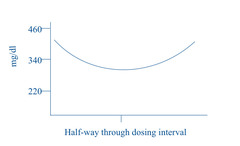
Inappropriate duration of insulin action (short duration of action): Nadir and beginning glucose are good, but notice the 6 hour halfway dosing interval is way too late, so the Nadir comes too early.
TO FIX: dose of insulin is okay but length isn't sufficient, instead of giving insulin 1x per day, change to 2x (or if giving 2x, change to giving 3x per day)
Describe this glucose curve and what you would do to fix it
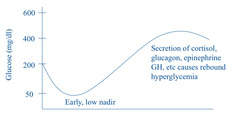
SOMOGYI EFFECT: You are giving too much insulin. The Nadir drops off too fast and too low causing a rebound hyperglycemia from other hormones going crazy because their job is to antagonize insulin. The problem is if you don't check the curve soon enough, you may catch it as the glycemia is on the rebound, and you think to increase insulin which will make it worse
TO FIX: decrease the amount of insulin you give
Describe this glucose curve and what you would do to fix it
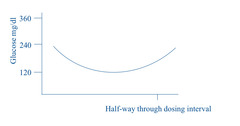
Insulin resistance: Insulin is working but you are giving a very high dose (over 2.2 U/kg/dose). It also appears the glucose curve starts too high and doesn't drop low enough.
TO FIX: rotate where owner gives the insulin to the patient
note: in the slides, this graph looks the EXACT SAME as insufficient insulin dosing
Describe this glucose curve and what you would do to fix it
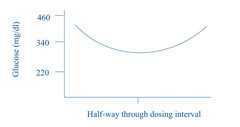
Over 2.2 U/kg/dose
What dosage of insulin administration is considered "insulin resistance"
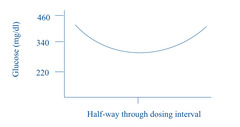
Insulin resistance
Rapid insulin metabolism, anti-insulin antibodies, severe obesity, drugs like glucocorticoids and progestational agents, and endocrine disorders like hyperthyroid may cause what types of issues with insulin?
To measure effectiveness to see if insulin lowers blood glucose and to assess the duration/length of insulin
Why do you do a blood glucose curve?
a. initial regulation
Select which applies to these monitoring parameters: urine glucose monitoring and blood glucose curves:
a. initial regulation
b. intermediate regulation
c. long term regulation
b. intermediate regulation
Select which applies to these monitoring parameters: serum fructosamine and fasting/mean blood glucose:
a. initial regulation
b. intermediate regulation
c. long term regulation
c. long term regulation
Select which applies to these monitoring parameters: glycosylated hemoglobin (aka A1C):
a. initial regulation
b. intermediate regulation
c. long term regulation
every 2-4 months
When you have glucose and insulin controlled, how often should you reexamine the patient?
1. hypoglycemia
2. recurrence of clinical signs
3. insulin overdose
Name some of the complications that can come from administering insulin to manage glucose in patients:
Cause hypoglycemia
Strenuous exercise can cause problems in patients on insulin why?
Decrease insulin dose by 25-30%, food by mouth, karo syrup on gums if obtunded
How can you treat hypoglycemia in patients who are on insulin?
Recurrence of clinical signs
What is the most common "complication" of patients on insulin?
Somogyi effect
What kind of glucose curve does insulin overdose cause?
Recurrence of clinical signs
Short duration of insulin effect, inadequate absorption of insulin, circulating insulin binding antibodies, and concurrent disease that interferes with insulin action may cause what complication to occur with insulin administration?
hypoglycemia related to Insulin overdose
TO FIX: IV/oral dextrose, fluids
An animal who is being managed with insulin presents with seizures, ataxia, anorexia, shaking, vocalizing, and vomiting/diarrhea. Thoughts? And how do you fix it?
FALSE: while urine glucose monitoring can be performed at home by the owner, changes to insulin should not be made in response to urine glucose alone
TRUE OR FALSE: urine glucose monitoring may be used alone to adjust insulin dosage and can be performed at home by the owner
d. Fructosamine under 400, blood glucose over 180
What measure of blood glucose and serum fructosamine indicate stress induced hyperglycemia?
a. FR under 400, BG under 180
b. FR over 400, BG under 180
c. FR under 400, BG under 60
d. FR under 400, BG over 180
e. FR over 400, BG over 180
b. Fructosamine over 400, Blood glucose under 180
What measure of blood glucose and serum fructosamine indicates owner non-compliance?
a. FR under 400, BG under 180
b. FR over 400, BG under 180
c. FR under 400, BG under 60
d. FR under 400, BG over 180
e. FR over 400, BG over 180
c. Fructosamine under 400, Blood Glucose under 60
What measure of blood glucose and serum fructosamine indicates overregulation?
a. FR under 400, BG under 180
b. FR over 400, BG under 180
c. FR under 400, BG under 60
d. FR under 400, BG over 180
e. FR over 400, BG over 180
up to 14 days
How long does the continuous glucose monitoring system, Freestyle Libre, monitor glucose for?
Diabetic remission
What is the primary goal of treating cats with diabetes?
Diagnosing early and getting in well controlled remission within 6 months + glargine insulin usage and low carbohydrate diet
Name the positive indicators of remission in feline diabetes management
FALSE: The factors listed are NOT shown to have an affect on remission
TRUE OR FALSE: The following factors have been shown to affect feline diabetes remission:
obesity, diabetic ketoacidosis, breed, concurrent disease
This means the owner has to change the dose of insulin every time before they give it
With "tight regulation" of feline insulin and blood glucose, ideally you can keep them between 60 and 120. What does this mean?