Week 5:Exchange rates and balance of Payments
 Call Kai
 Learn
Learn Practice Test
 Spaced Repetition
 Match
Match Flashcards
 Knowt Play
1/41

There's no tags or description
Looks like no tags are added yet.
Name | Mastery | Learn | Test | Matching | Spaced | Call with Kai | Chat |
|---|
No analytics yet
Send a link to your students to track their progress
42 Terms
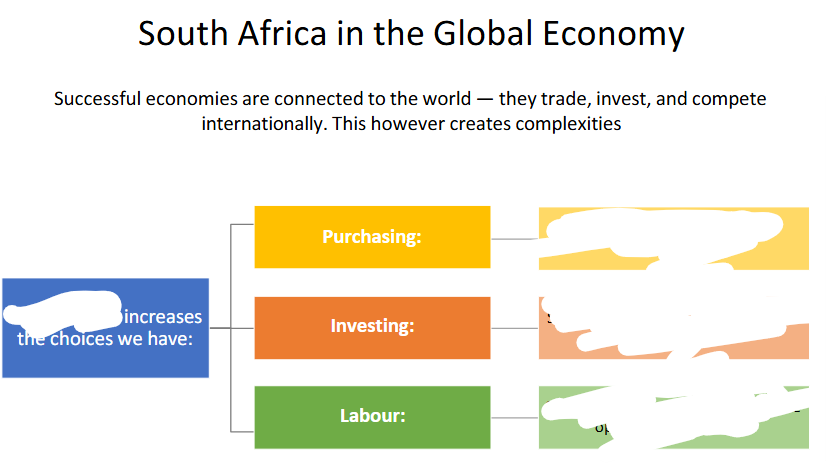
With an open economy what 3 things are possbile to decided whether to do local or abroad( WTI)
Work,Trade, invest
What is inflation simply put,what causes it to rise and to go down and whats the link to unemployment
Inflation is simply the rise in the general level of prices over time, caused mainly by too much demand (demand-pull) or rising costs of production (cost-push), and it falls when demand weakens or costs ease
its link to unemployment is captured by the Phillips Curve, which shows that when unemployment is low, wages and prices tend to rise, while high unemployment usually keeps inflation down.
When unemployment is low, firms struggle to find enough workers, so they compete by offering higher wages to attract and keep staff. As wages rise, workers have more income to spend, which increases demand for goods and services.
Is too low inflation good or bad
Yes, a low and stable inflation rate is generally good because it preserves purchasing power, reduces uncertainty, and supports investment and job creation — but if inflation is too low or negative (deflation), it can signal weak demand, discourage spending, and trap economies in stagnation.
What are the objectives of policy authorities
Stability
Currency
Growth
Maintain price stability and this means
low and stable inflation
Currency is not excessively volatile
Allow balanced and sustainable growth because this stabilizes local industries
What questions do we ask for each category

Define:
Exchange rate
Foreign currency
Foreign exchange market
The rate at which currencies are exchanged is denoted as the Exchange Rate. The price of one currency in terms of another
The money or legal tender of another country is denoted as the foreign currency
The foreign exchange market is the market in which the currency of one country is exchanged for the currency of another country.
For e.g., in the current foreign exchange market, R16.02 are exchanged for 1 U.S. dollar, i.e. R16.02/$
What’s an international currency and what can it interchangebly be called and why
The first point:The currency isn’t just used inside its home country, but also by people, businesses, and governments outside that country to trade, invest, or settle payments across borders. For example, the US dollar is issued in America, but it’s widely used by non-Americans in global trade, finance, and reserves.

In context of exchange rates define
Appreciation
Depreciation
Appreciation: When a currency increases in value relative to another (and the other currency depreciates). Thus, the appreciating currency is exchanged for more units relative to the other weaker currency.
Depreciation: When a currency decreases in value relative to another (and the other currency appreciates). Thus, the depreciating currency requires more of its units relative to the stronger currency
In context of exchange rates,what two ways can it be quoted
Direct quote: Shows how much local currency is needed for 1 unit of foreign currency. Need R16 for 1 dollar
Indirect quote: Shows how much foreign currency is needed for 1 unit of local currency. 1 dollar for R16

This shows the changes of exchange rates, appreaciation and depreciation
Which quote do we normally work with

In the foreign exchange market:
What is demand defined by (Hint: dollars)
What are the 4 sources of demand
Importers
Investors
Assets
Tourism
3rd point explained: They are selling to South Africans (or other buyers in South Africa) who purchase those assets. The demand for dollars arises because the American investors now need to convert their rand proceeds into dollars.

The demand curve is downward sloping:
When US goods are cheaper what does it mean for South Africans and demand for American products
what do South Africans want to take advantage of

In the market for USA dollars what is:
Definition of supply in this context
What are the 3 sources of supply
Exports
Shares and assets
Tourists
I=Basically saying demand for Rands from American pov,which supplies us (SA) with foreign currency (their dollars)

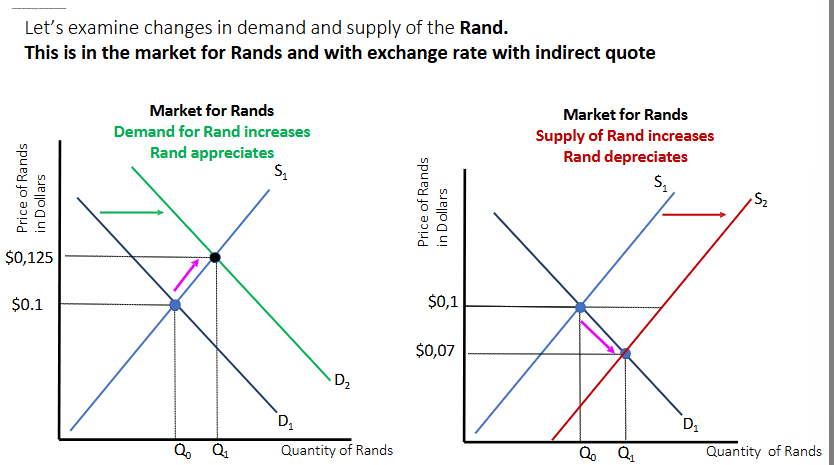
Price axis has changed, it is now “the price of Rands
quoted in dollars”. Indirect quote.
“How many dollars are needed to purchase one Rand
This is known as the market for?
Give n example of how we would know if the rend weakened
Why does the quantity demanded for ____ increase

Give an example of Rand becoming stronger
When rand strengthens, the quantity ____of
Rands increases. Why?
Shows a + relationship between what two items
Rand supply increases when the Rand strengthens because South Africans find foreign goods and assets cheaper. To buy those foreign items, they must exchange more Rand for foreign currency, so they supply more Rand into the forex market.
The positive relationship (upward-sloping supply curve) means: as the Rand’s value rises (each Rand buys more dollars), South Africans are more willing to trade Rand for foreign currency, so the quantity of Rand supplied increases.

When SA rand becomes more expensive it _____ against a _____


What causes outward shift in terms of dollars
give an example,lets say USA wins the BID to host 2026 Fifa world cup
Does this cause US dollar to appreciate or depreciate


What causes the inward shift of supply
Give an example,lets say foreigners stop buying SA goods due to oil spill messing up goods in containers
Does this cause US dollar to appreciate or depreciate
Less supply of dollars → dollars become scarcer.
When something is scarce, its price rises. In the forex market, the “price” of the dollar is the exchange rate (R/$).
So, if fewer dollars are offered (supply curve shifts left), buyers must bid more rand per dollar to get them.
That higher exchange rate means the dollar appreciates (stronger relative to the rand).
👉 The positive relationship is just the law of supply and demand applied to currency: scarcity pushes value up.


How is each thing illustrated
Does the rend and dollar appreciate/depreciate in each case
Is the exchange rate fixed
Supply of dollars increases → Rand appreciates, Dollar depreciates.
Why? More dollars are being offered in the forex market (e.g., US firms buying SA minerals). With extra dollar supply, dollars become cheaper relative to rand. That means each rand can buy more dollars → rand strengthens.Supply of dollars decreases → Rand depreciates, Dollar appreciates.
Why? Fewer dollars are available (e.g., US citizens stop investing in SA). Dollars become scarcer, so their value rises. Now each rand buys fewer dollars → rand weakens.In the foreign exchange market, the exchange rate is determined by supply and demand, not fixed.
If more dollars are supplied (say, US firms bring in dollars to buy SA minerals), then dollars are more abundant relative to rand.
When something is abundant, its price falls


What type of quote is this
What’s happening with the shifts
what are the axis titles
(*NOTE in exam/tests must show the equilibrium points)
What are 3 main examples that cause changes in demand for rand and explain them
-Exports
-Interest
-Exchange rate
(Honorable mentions: Demand for SA goods,services and tourism)

What are 2 main changes in supply of the rand and explain them
-imports
-Interest


Complete the flow chart
Current account basics → It records trade in goods, services, income, and transfers between South Africa and the rest of the world. So if net exports imporve CA improves same goes for NE worsening
Improved current account (depreciation) is good for export industries and balance of payments, but it risks higher inflation.
Lower domestic prices (appreciation) is good for consumers and inflation control, but it can hurt exporters and worsen the current account.

What 3 things could happen if the rand weakens
-Inflation
-___ exports
-Oil

why do more exports lead to countries prices rising therefore inflation
When the Rand depreciates, South African exports become cheaper abroad, so foreign buyers demand more SA goods.
To meet this higher demand, local firms produce more, which often pushes up domestic costs (wages, raw materials, transport).
At the same time, imports become expensive, so South Africans rely more on local goods. This extra demand for local products adds further pressure on prices.
The combined effect — higher demand + higher costs — leads to domestic price increases, i.e. inflation.
What are the 3 properties of Flexible exchange rates
Determined by
No direct ___ intervention
Indirect influence
Name 3 countries besides SA that has flexible exchange rates

Do all countries have flexible exchange rates?
No,floating,pegged and hybrid system
-Peggeed refers to when a currency value is tied to anpther major currency (Denmarks pegs its currency(Danish krone) to the euro
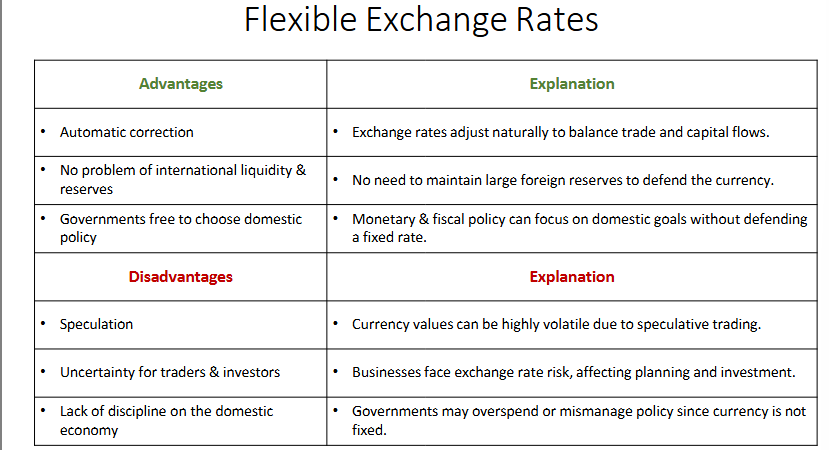
What are the 3 Advantages of a flexible exchange rate and what are the 3 disadvantages to a flexible exchange rate and explain asseblief
Automatic
International liquidity
Domestic policy
Speculation
Uncertainty for…
Lack of discipline
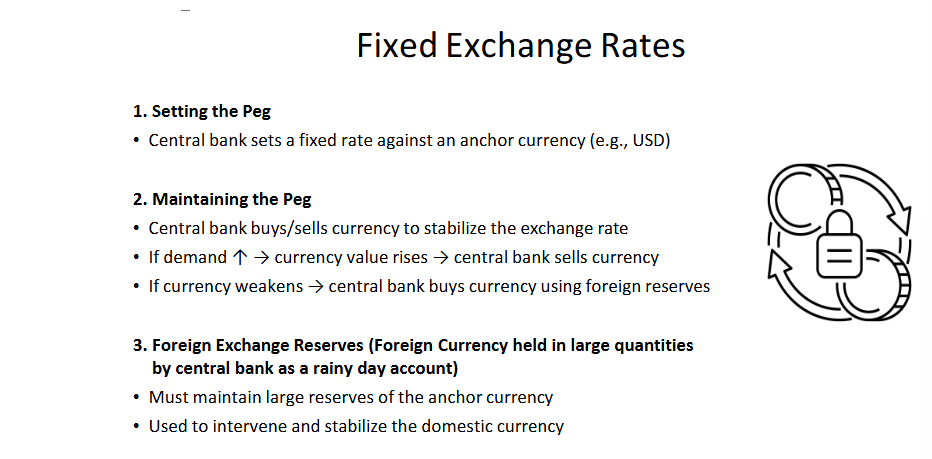
In point 2 (Maintaining the Peg),they mean demand for the domestic currency (the one being pegged).
EXAMPLE
Suppose South Africa pegs the Rand to the US dollar at R10 = $1.
If foreigners suddenly want more Rand (to buy SA exports or invest in SA assets), the demand for Rand rises.
Normally, this extra demand would push the Rand’s value up (say to R8 = $1).
To stop that appreciation and keep the peg at R10 = $1, the SA Reserve Bank sells Rand (TO WHOEVER needs it in the forex market to buy SA goods and services) and buys dollars. By increasing Rand supply, it balances demand and holds the exchange rate steady.
What are the 6 Advantages of fixed Exchange rates
Discipline
Speculation
Boosts
Investment
Stability & ___
Inflation

Difference between monetary and fiscal policy
Monetary policy is how a country’s central bank (like the Reserve Bank) manages money supply and interest rates to control inflation, stabilize the currency, and support growth, while fiscal policy is how the government uses taxation and public spending to influence demand, employment, and overall economic activity; in short, monetary policy works through credit and money, fiscal policy works through taxes and budgets.
👉 Shortcut cue: Monetary policy = central bank, interest rates, money supply; Fiscal policy = government, taxes, spending.
What are the disadvantages of fixed exchange rate
Dependency
Limited —- policy
Vulnerability to ____
____ imbalances
EXPLANATION OF TRADE IMBALANCES:
If the pegged country’s currency is overvalued (too strong compared to its true market value), its exports become expensive and fall, while imports become cheap and rise.
This imbalance means the pegged country is buying more from abroad than it sells — leading to a trade deficit in its own current account.
The anchor/reference country (like the US if the peg is to the dollar) isn’t directly affected in this way; the imbalance shows up in the pegging country’s trade flows.
👉 In short: the deficit belongs to the pegging country, because its strong currency hurts exports and boosts imports, worsening its own current account.

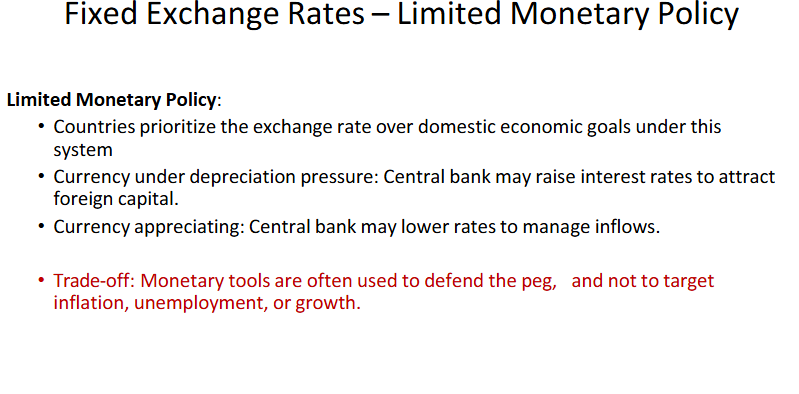
Fixed exchange rates come with limited monetary policy,what does that mean??
What do countries prioritize
when Currency under depreciation pressure what does Central bank do
Currency appreciating, what does central bank do
What’s the trade-off
bank may lower interest rates. Lower returns discourage foreign inflows, reducing demand for the domestic currency and preventing it from becoming too strong. Why is being too strong a problem?
he central bank uses interest rates mainly to stabilize the exchange rate, even if that conflicts with domestic goals like controlling inflation or boosting growth.
What’s a hybrid system
How does it work
Buy & sell currency to maintain
Interventions are____
What is its purpose
Reduce(speculative attacks)
Maintain competitiveness in ___


How are fluctuating exchange rates managed
How does the central bank avoid this and make equilibrium unchanged
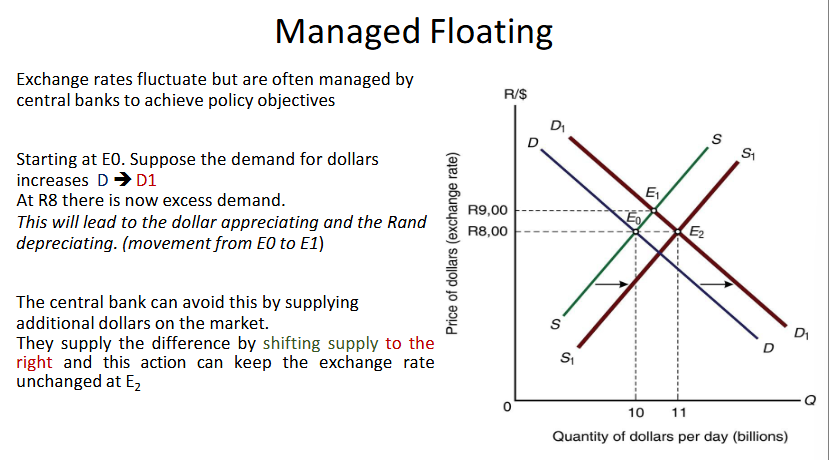
Central bank intervenes when needed to influence the currency’s value in line with _______
Why does CB depreciate the currency
balance
reduce risk of (2)
Shift economy
Why may CB appreciate the currency
Curb ___
Lower the cost of ___
Deflationary recession
When the central bank raises interest rates to defend the currency, borrowing becomes expensive.
Less borrowing → less spending → demand falls → economy slows → risk of recession with falling prices (deflation).
Higher D prices,more expensive,less demand etc.
Curb demand‑pull inflation
If the economy overheats (too much demand pushing prices up), higher interest rates(on loans/credit) reduce spending power.
Less demand → slower price increases → inflation is curbed.

What are the two major components of the balance of payments
Current account & Financial account

Explain whats in each point

What is ‘Balance on current account’
Whats a trade surplus/deficit
What three things does balance on current account measure

What does the financial Account record and track
What are the 4 main components
D investment
P investment
____ derivatives
O investments

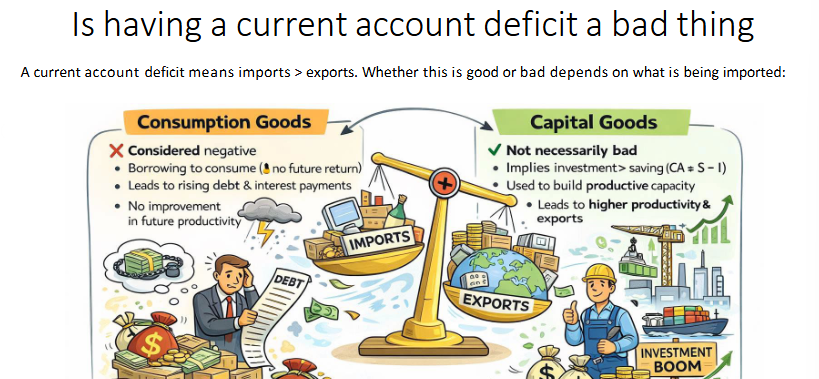
Is having a current account in deficit a bad thing
Short answer: Yes and No
Why??