Christian Scriptures Exam 2
 Call Kai
 Learn
Learn Practice Test
 Spaced Repetition
 Match
Match Flashcards
 Knowt Play
1/78

There's no tags or description
Looks like no tags are added yet.
Name | Mastery | Learn | Test | Matching | Spaced | Call with Kai | Chat |
|---|
No analytics yet
Send a link to your students to track their progress
79 Terms
other Ancient Near Eastern erotic poetry
The Love Song of Shu-Suen
Dumuzi-Inanna Love Songs
The Love Song of Shu-Suen
inscribed on a small clay tablet in SUmerian cuneiform script
29 lines w/no title
addressed to the king
fourth ruler of the third dynasty of Ur
variety of euphemisms
religious ritual facet
temple prostitute would have sexual intercourse with the king in place of the goddess Inanna
Inanna and Dumuzi Love Songs
series of erotic nuptial poems — the king and the goddess Inanna
Dumuzi was a prominent ruler of the Sumerian city of Erech (3rd millennium BCE)
Inanna was the goddess of sexual love, fertility, and procreation, also national prosperity
all kings would take on Dumuzi’s role
Purpose of erotic poetry
individual celebration of sensual love
sensual love as a means of symbolizing greater social good
alternate titles for Song of Songs
The Song of Solomon
traditional attribution of the text to author
The Canticles of Canticles
The Song of Songs
meaning the greatest of all songs
structure of Song of Songs
series of smaller songs voiced by the Lover (bridegroom/king), Beloved (bride), or “Daughters of Jerusalem” (Greek chorus of sorts)
collated ~25 lyric poems
some in entirety, some are fragments of songs in a chain
some translations mark the speaker in the margin (B for bride, D for Daughters, G for bridegroom)
no other overarching literary structure
euphemism and symbolism in Song of Songs
every object is an analogy, or uses another phrase to refer to something that might otherwise be impolite to speak of
relating Sumerian poetry to Song of Songs
thought that Song of Songs took the idea of erotic poetry from the Sumerians — possibly even older songs used here in a new context
even if there is no direct relationship, the Song is drawing on traditional material in the same vein as Sumerian poetry does
The Superiority of Pre-Critical Exegesis
essay by David Steinmetz
univocal approach — a text has only one legitimate meaning
equivocal approach — a text maintains numerous legitimate meanings
ancient and medieval world were more accepting of the equivocal approach
literal sense of scripture
straight-forward historical meaning of the text which was intended by the original author for the original audience
Aquinas thought this was the most important sense
spiritual sense of scripture
additional meanings to a text that aren’t explicitly expressed
allegory, typology, mystical, anagogical
allegorical sense of scripture
Greeks found gods’ behavior to be crude and immoral, searched for a deeper meaning below the surface
allowed for the stories to live on with contemporary meanings
Jews and Christians found some material to be inconsistent with morality in later ages, so they used an allegorical interpretation ot explain unpalatable literal ideas
acknowledges the literal sense and uses it as a symbol
tropological sense of scripture
examines the moral lessons the text conveys
allegorical = virtue of faith, tropological = virtue of charity/love teaching the reader HOW to act morally or ethically
Israel’s past is an example of what not to do (disobey God, etc)
anagogical sense of scripture
theological virtue of hope
directs the reader towards the future, anticipation of events to come
equivocality and the Song of Songs
Jerusalem
historical city
allegorical Church of Christ
anagogically as the heavenly city of God
tropologically as the soul of man
Beloved
Israel
Church
Soul
Heavenly City
Spiritual reading is so much more important than the literal meaning of sensual pleasure
why the title “Psalms”
tehillim = praises
greek word psalmos = song
sometimes called the Psalter
what is the book of Psalms
diversified collection of sacred poems
not in the same historical time/context/purpose/origins/interpretations
a gathering into one place/text
purpose of these texts is to engage in rituals of worship and the spiritual life of the community/individual
Hebrew poetry is loosely defined, but these are certainly different from many other forms of Hebrew writing
Tanakh
Torah (law)
Nabi’im (prophets)
Ketuvim (writings)
mizmor levidad
“a song of David”
Talmud
central text of Rabbinic Judaism
claims all the Psalms were written by David
titles of the Psalms
originally thought insignificant bc of later addition
When were titles added
Who added the titles
What was the intended purpose of the added title
author titles of Psalms
indicate who the Psalm was composed or dedicated to
historical titles of Psalms
13 Psalms
genre titles of Psalms
literary or musical suggestions/notations
miktam/maskil are untranslated
shir
song
mizmor
psalm
tefillah
prayer
lamenatstseakh
to the choir master
binginoth
stringed instrument
organization of the Psalms
five-fold division
illustrates the idea of receiving a collection
Psalms of praise
confession and exhortation that God is the creator of the universe and redeemer of the world
Psalms of lament
express the sorrows encountered in life, contains emotion from joy to sadness
Psalm of thanksgiving
report the existence of a crisis and adds that the crisis has passed and God has delivered
Psalms of trust
depict the psalmist amidst the uncertainty and proclaiming trust in God’s deliverance
Psalms of the earthly king (Royal Psalms)
divine ordination of of the Israelite monarchy
use the term “king,” “anointed,” and make direct reference to David or the activity of the monarchy
Psalms of the heavenly king (Yahweh Psalms)
proclaim the kingdom of God within the context of the failure of the Davidic monarchy
Wisdom Psalms
meditate on the themes present in other books considered “wisdom literature”
focus on the ill effects of foolish behavior and the benefits of living an upright life
Imprecatory Psalms
contain extremely harsh condemnation and judgement of the enemies of the Psalmist
“curse psalms”
Sagacious Literature of the Old Testament
wisdom literature — sought to inform the student of the practical and intelligent way to live life
books of Sagacious literature
Proverbs
Job
Ecclesiastes
Sirach (Ecclesiasticus)
The Book of Wisdom
what is “wisdom”
hokma — a gift given by God and a skill that is learned or developed
could be synonymous with “excellence”
Proverbs
clear rulebook of moral and religious instructions as given to a Jewish youth
Proverbs of Solomon — Son of David and King of Israel
Proverbs of Solomon
Proverbs of Solomon — which the men of Hezekiah king of Judah copied
The words of Agur son of Jakeh of Massa
The words of Lemuel, king of Massa, which his mother taught him
characters of Proverbs
Lady Wisdom, Dame Folly, righteous (those who abide by what is right and just), wicked (those who deal in violence)
Job
sustained narrative which addresses God’s justice in light of moral worth
Satan within Job
a prosecutor in service of Yahweh, evaluating people and brining them forth for judgement
two phases of testing in Job
Yahweh allows Satan to strike Job’s wealth
Bodily affliction
primary history
Genesis—2 Kings
tragic
secondary history
1 and 2 Chronicles, Ezra, and Nehemiah
comic
structure of the Chronicler’s History
genealogies of I Chronicles 1-9
reign of David in I Chronicles 10-29
reign of Solomon in II Chronicles 1-9
reigns of Judean kings to Zedekiah in II Chronicles 10-36
end of II Chronicles blends/overlaps beginning of Ezra
Ezra-Nehemiah divided
Ezra 1-6: return of the exiles and reconstruction of the Temple
Ezra 7-10: “Ezra Memoir” describing Ezra’s activity and is written in the first person
Nehemiah 1-7: the coming of Nehemiah to the city and the trouble concerning the building of the wall of Jerusalem
Nehemiah 8-10: reading of the Law by Ezra and ratification of the covenant
Nehemiah 11-13: various misc. matters (dedication of the walls and Nehemiah’s second visit to the city)
Authorship and editing of the Chronicler’s History
Rabbinic Judaism and Christian medievals believed Ezra wrote all 4 books
19th century scholarship argued a separate Chronicler had written/edited the material from disparate sources
recent scholars maintain that a single author composed these 4 books
source criticism of the Chronicler’s History
I and II Chronicles used other Old Testament books as source
Ezra-Nehemiah has no clear citation of other sources
purpose of Ezra-Nehemiah
set forth the theological significance of all things rebuilding Jerusalem, provide the restoration community with a clear identity
apocrypha
uncanonical
Septuagint
Greek version of the Hebrew bible
pentateuch
historical writings (Tobit, Judith, Esther additions, and Maccabees)
Major and minor prophets
Jesus knew and quoted THIS
Deuterocanonical
Tobit
Judith
Baruch
Sirach
Wisdom
I and II Maccabees
Additions to Esther and Daniel
Gospel
old english: god “good” and spel “story”
latin: eu “good” and angelion “message”
Number of Gospels
35-50+ noncanonical gospels
Gospel of Thomas, Mary, Infancy Gospel of Thomas, and Judas
Synoptic gospels
gospels that report largely the same material
Johannine Gospel
Gospel of John — only similar in passion narrative
Jesus’ childhood
birth
visitation by shepherds and magi
presentation at the temple
flight to egypt
teaching in the temple at 12
Galilean ministry
the bulk of Jesus’ ministry
teaching
healings
concern for the poor and afflicted
Passion week
Triumphal Entry (Palm Sunday)
spent time teaching in the temple
celebrating passover meal with disciples
garden of Gethsemane
arrest and trial before Sanhedrin
Interrogated by Pilate
executed via crucifixion
resurrection
ascension
kerygma
oral traditions
Mark’s gospel
passion account with a prologue
deeds over teachings
Jesus the SUFFERING Messiah
Matthew’s Gospel
infancy→baptism/temptation→teachings/healing/miracle→execution
Jesus as the New David and New Moses
Luke’s Gospel
chronology is important
orderly account
Christ the Universal Savior
John’s Gospel
~80-110 CE
John the son of Zebedee is the author
didn’t use the same sources, or drastically reshaped them
gentile or mixed audience
prologue of creation/cosmos, then signs/discourses, passion account
Jesus as the Incarnate Logos
Two genealogies
Matthew
names in descending order
traces back to Abraham
Joseph is incidental
Jewish Messiah
spoke towards the Jews
42 ancestors back
sets of 14
Luke
ascending order
traces back to Adam
Joseph is the "connection” not Mary
Savior to all
minimize Jewish-specific narratives
77 ancestors back
No explicit divisions
Emphases in Matthew’s genealogy
Jesus as the “New Abraham”
Jesus as the “New David”
Women in the Genealogy
3 sets of 14 — David’s name is symbolized by #14
5 women included
Tamar
Rahab
Ruth
Bathsheba
Mary
contradiction of names in two genalogies
natural descent vs legal descent
genealogies could be in different orders just like other things to add to thematic emphasis
only an issue for modern readers
Nativity account/Infancy account
nativitas “birth”
annunciations
nativities
purification
flight to Egypt
“Synthetic Approach”
blends Matthew and Luke’s gospels together and adds/alters elements
The Infancy Gospel of Thomas intro
a look into non-canonical gospel traditions to see some parallels and contrasts between (non)canonical gospels in theme and composition
Agrapha
sayings and stories of Jesus which are outside of the canonical Gospel
Protoevangelium of James
Mary’s birth and marriage
after the normal nativity narrative, Herod seeks to kill John the Baptist
Herod kills Zechariah
Gospel of Pseudo-Matthew
normal nativity in Bethlehem, flight to Egypt, animals worship Jesus, in egypt 365 idols fall down into broken pieces before Jesus
Infancy Gospel of Thomas
seeks to describe the doings of Jesus in boyhood
infant prodigy at school
astounds his family and playmates with miracles
not to be confused with the Gospel of Thomas (a collection of sayings of Jesus)
authorship is unknown
mid to late 2nd century
even as a child, Jesus was a vessel of divine mysteries
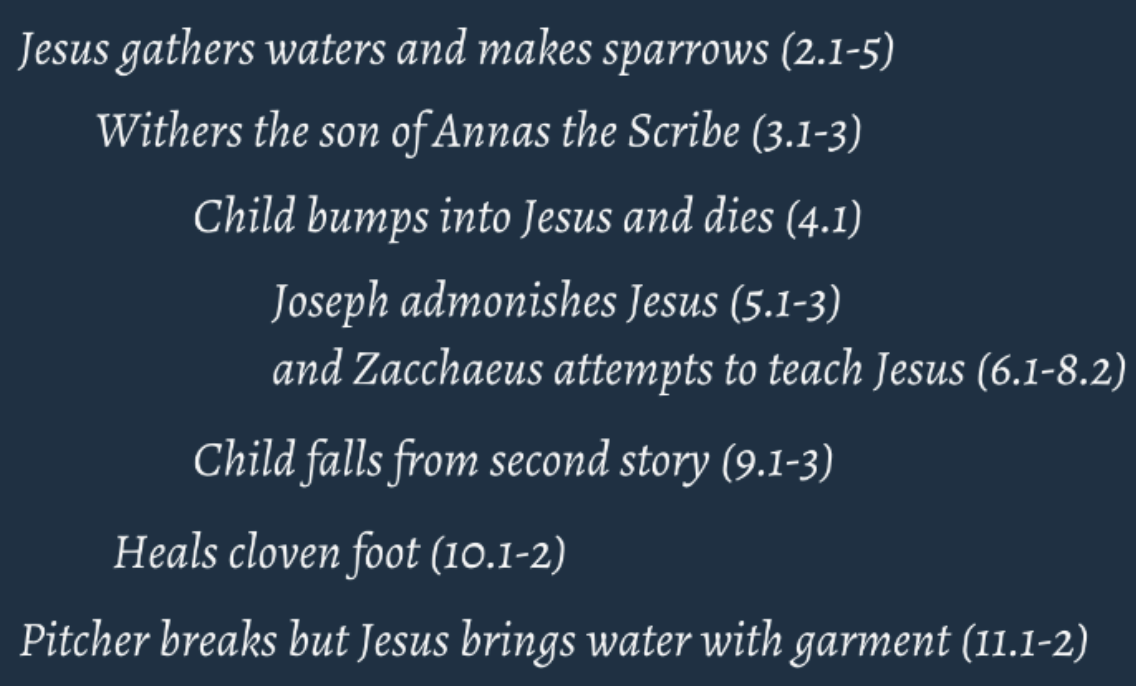
Organization of Infancy Gospel of Thomas
series of stories about child Jesus
Chiastic Structure