microbial growth
 Call Kai
 Learn
Learn Practice Test
 Spaced Repetition
 Match
Match Flashcards
 Knowt Play
1/165

There's no tags or description
Looks like no tags are added yet.
Name | Mastery | Learn | Test | Matching | Spaced | Call with Kai | Chat |
|---|
No analytics yet
Send a link to your students to track their progress
166 Terms
What do we mean by microbial growth?
Refers to the number of cells, not the size
Microbes that are “growing” are increasing in number and accumulates into?
Colonies (groups of cells large enough to be seen w/o microscope)
Enumerate the physical requirements for microbial growth
Temperature, pH, osmotic pressure
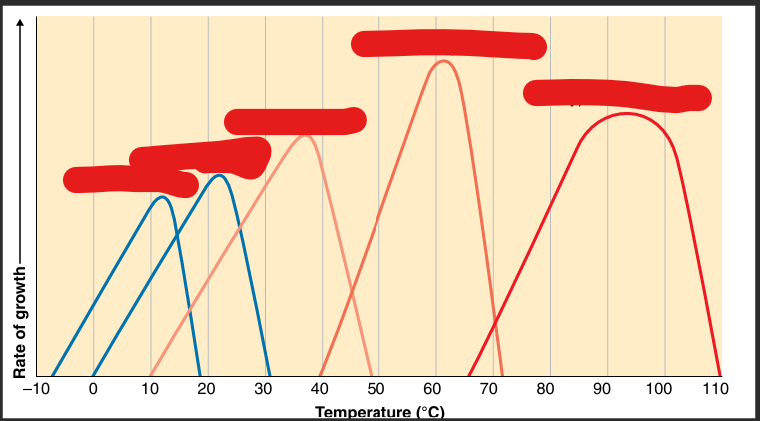
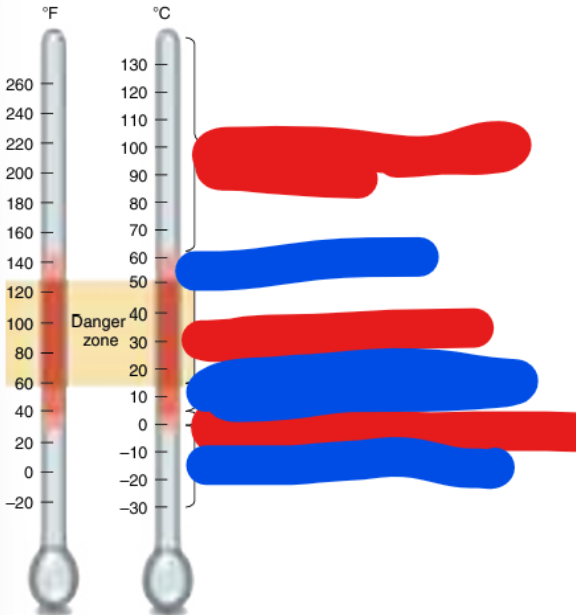
Microorganisms are classified into three primary groups on the basis of their preferred range of temperature:
psychrophiles (cold-loving)
mesophiles (moderate-temperature-loving)
thermophiles (heat-loving)
The lowest temperature at which the species will grow
Minimum growth temperature
The temperature at which the species grows best.
Optimum growth temperature
The highest temperature at which growth is possible.
Maximum growth temperature
Minimum growth temperature leads to what?
Decrease in enzyme activity and slower metabolism
Maximum growth temperature leads to what?
Can denature proteins such as enzymes & carrier proteins → cell death
What do you call microorganisms that can grow at 0°C but has higher optimum temperatures?
Psychrotrophs
What is something to take note about psychrotrophs in regard to where they grow?
more common, grow fairly well at refrigerator temperatures, spoilage microorganisms

Most common method of preserving household food supplies.
Refrigeration
Can microbes survive subfreezing temperatures?
Yes, they become dormant, but they do gradually decline in number.
Spoilage brought about by psychrotrophs
Mold mycelium, slime on food surfaces, off-tastes/off-colors
Which bacterium would theoretically be more likely to grow at refrigerator temperatures: a human intestinal pathogen or a soilborne plant pathogen?
Soilborne plant pathogens because those environments are cooler than the human body (which usually where mesophiles thrive).
True psychrophiles: min, opt, max (in C)
0, 10-15, 20
Psychrotrophs: min, opt, max (in C)
0, 20-30, 35/40

The most common type of microbe based on temperature requirements.
Mesophiles
Optimum temperature for many pathogenic bacteria is?
37°C
Mesophiles: min, opt, max (in C)
10, 25-40, 45
Thermophiles are found usually where
Sunlit soil, hot springs
Thermophiles: min, opt, max (in C)
45, 50-60, 70-80
Why are thermophiles important in composting?
Their metabolic activity generates heat to break down complex organic matter into simpler forms.
Hyperthermophiles live usually where?
Volcanic springs, hydrothermal vents
Why does water not boil even at temperatures above hundred degrees in the ocean?
Because of the immense pressure in the ocean depths (boiling point increases with pressure)
Hyperthermophiles: min, opt, max (in C)
60-80, 80-110, >121
pH means?
power of hydrogen
Most bacteria grow best in what pH range
near neutral; 6.5-7.5
Bacteria tolerant of acidity (ex. chemoautotroph found in drainage water from coal mines and forms sulfuric acid can be ok at pH 1).
Acidophiles
Molds and yeasts generally grow at what optimal pH range?
5-6
Why are phosphate salts used in media in laboratory?
Lab cultured bacteria produce acids that may interfere with their own growth so these are added to media:
1) buffer effect of pH
2) provide phosphorus (nutrient)
Why do microorganisms need water?
They are composed of water (80-90%) and get their nutrients in solution
What type of environments caused by increase in salt or sugar, cause plasmolysis?
Osmotic pressure
What type of organism requires high osmotic pressure/salt concentrations?
Extreme/obligate halophiles
Organisms that can tolerate high salt concentration/do not require them (OK up to 2%).
Facultative halophiles
The concentration of agar in growth media.
1.5%
Enumerate the chemical requirements of microbes.
Carbon, Nitrogen, Sulfur, Phosphorus, Oxygen, Trace elements, Organic growth factors
What makes carbon so biologically important?
Carbon is the structural backbone of living matter; it is needed for all the organic compounds that make up a living cell.
How do chemoheterotrophs vs. chemo/photoautotrophs get carbon?
Chemoheterotrophs - proteins, carbs, lipids
Chemoautotrophs/photoautotrophs - carbon dioxide
Why do microorganisms need nitrogen?
Protein synthesis (along with sulfur), DNA/RNA synthesis (along with phosphorus), ATP
PRIMARILY: to make the amino group needed for proteins
Most bacteria do what to get nitrogen?
Decompose proteins and using it to form new protein & other N-containing compounds.
How do other bacteria get nitrogen aside from decomposing proteins?
Some bacteria use NH4+ or NO3−
A few bacteria use N2 in nitrogen fixation
How is sulfur used for?
Synthesize sulfur-containing amino acids and vitamins (thiamine, biotin)
Where would you get sulfur from?
Sulfate ion, hydrogen sulfide, sulfur-containing amino acids
Why is phosphorus essential for microbial growth?
Synthesis of nucleic acids and phospholipids, ATP
Usual source of phosphorus
Phosphate ion
Give examples of trace elements.
Iron, copper, molybdenum, zinc
Differentiate cofactors from coenzymes
Cofactor - inorganic/organic; help activate enzymes
Coenzyme - organic; carrier for chemical groups of electrons
Why is oxygen considered a poisonous gas (in a sense)?
Very little molecular oxygen existed back then so if life had not evolved to use that for metabolism, life could not have arisen.
A way to neutralize oxygen (which one would consider prob toxic)
Combine it with hydrogen to form water (which releases energy)
Type of bacteria that undergoes aerobic growth with no oxygen required.
Obligate aerobes
How does oxygen affect obligate aerobes and facultative anaerobes?
Presence of enzymes catalase and superoxide dismutase (SOD) allows toxic forms of oxygen to be neutralized; can use oxygen.
Why are obligate aerobes at a disadvantage?
Oxygen may be poorly soluble in the water of their environment (so many just stuck with the ability to still grow even without oxygen)
Organisms that can use oxygen when it is present but are able to continue growth by using fermentation or anaerobic respiration when oxygen is not available.
Facultative anaerobes
Are facultative anaerobes equally efficient with or without oxygen?
Their efficiency in producing energy decreases in the absence of oxygen.
Anaerobes are bacteria that cannot use molecular oxygen for energy. What is the most familiar example of this?
Clostridium (tetani and botulinum)
Enumerate the four toxic forms of oxygen
singlet oxygen (1O2-), superoxide radicals (O2-), peroxide anion (O22-), hydroxyl radical (OH·)
What do you call normal mol. oxygen boosted to a higher energy state?
Singlet oxygen
Organisms attempting to grow in atmospheric oxygen (and use it as a final electron acceptor) must produce what enzyme?
Superoxide dismutase (SOD)
Why are superoxide radicals so toxic?
Instability; likes stealing electrons from another molecule which makes it become a radical → domino effect (gg wp ur fcked)
What types of bacteria produce SOD?
Aerobic bacteria, facultative anaerobes, aerotolerant anaerobes


After the production of hydrogen peroxide, what enzyme is used to neutralize it?
Catalase or peroxidase
How can catalase be easily detected.
Oxygen bubbles are released.
How does catalase and peroxidase differ from one another?
Catalase (water and oxygen); peroxidase (water)
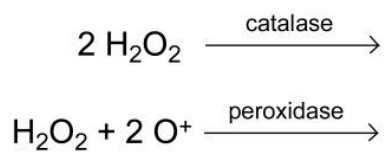
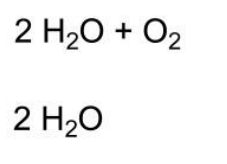
Another intermediate form of oxygen and probably the most reactive. Formed in cytoplasm by ionizing radiation.
Hydroxyl radical
Type of bacteria that grows only anaerobically (stops in presence of oxygen).
Obligate anaerobes
Why are obligate anaerobes anaerobic?
No enzymes to neutralize harmful forms of oxygen.
Fermentative and cannot use oxygen for growth, but they tolerate it fairly well.
Aerotolerant anaerobes
Common example of lactic acid–producing aerotolerant anaerobes.
Lactobacilli
How can aerotolerant anaerobes tolerate oxygen?
Possess SOD
They are aerobic; they do require oxygen. However, they grow only in oxygen concentrations lower than those in air.
Microaerophiles
How does oxygen affect microaerophiles?
Produce lethal amounts of toxic forms of oxygen if exposed to normal atmospheric oxygen.
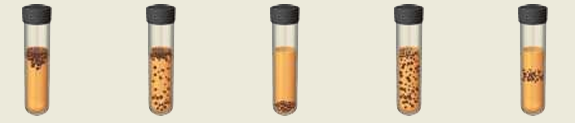
obligate aerobes → facultative anaerobes → obligate anaerobes → aerotolerant anaerobes → microaerophiles
Organic compounds obtained from the environment
Organic growth factors (vitamins, amino acids, purines, pyrmidines)
Purines vs. pyrimidines
Purine (2 rings; adenine, guanine) & pyrimidine (1 ring; cytosine, thymine, uracil)
Most microbes grow attached to surfaces (sessile) rather than free-floating (___).
planktonic (nekton if you are moving)
These attached microbes are members of complex, slime enclosed communities that adhered to a surface.
Biofilms
A biofilm can also be considered as what? (a complex polymer containing many times its dry weight in water)
Hydrogel
“Biofilms are ubiquitous in nature in water” (what does bro mean)
It means that it is there everywhere and cannot be avoided.
The ability of bacteria to communicate and coordinate behavior (cell density alters gene expression).
Quorum sensing
Bacteria that use quorum sensing produce and secrete a signaling chemical called what?
Inducer
Microbes reversibly attach to conditioned surface and release polysaccharides, proteins, and DNA to form what?
Extracellular polymeric substance (EPS)
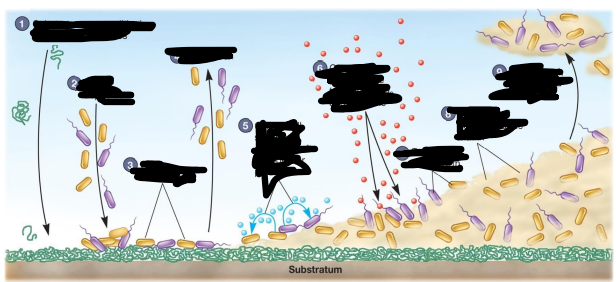

The EPS and change in attached organisms’ physiology protects microbes from harmful agents like what?
UV light, antibiotics, antimicrobials
Sloughing off of organisms can result in?
Contamination of water phase above the biofilm such as in a drinking water system.
Example of biofilm-forming bacteria that is found in decaying organic material and freshwater, also called slime bacteria.
Myxobacteria
What molecule can inhibit film formation since it binds to iron and is found in many human fluids?
Lactoferrin
This is an autoinducer molecule produced by many gram-negative organisms that induces expression of target genes that regulate a lot of functions.
Acylhomoserine lactone
What autoinducer found in Candida albicans manages its dimorphic transition and virulence?
Farnesoic acid
Enumerate processes regulated by quorum sensing.
Symbiosis, pathogenicity (increased virulence factor), DNA uptake for antibiotic resistance
Example of symbiosis involving bioluminescence.
Vibrio fischeri (makes the light) and bioluminescence in squid (keeps bacteria safe)
Nutrients prepared for microbial growth
Culture medium
No living microbes
Sterile
Introduction of microbes into medium
Inoculum
Microbes growing in/on culture medium
Culture
A complex polysaccharide (from algae) used as solidifying agent for culture media in Petri plates, slants, and deeps.
Agar