Chete glass packaging
 Call Kai
 Learn
Learn Practice Test
 Spaced Repetition
 Match
Match Flashcards
 Knowt Play
1/78

There's no tags or description
Looks like no tags are added yet.
Name | Mastery | Learn | Test | Matching | Spaced | Call with Kai | Chat |
|---|
No analytics yet
Send a link to your students to track their progress
79 Terms
20th century
The shift in glass manufacturing at the turn of the ______ represents one of the most significant leaps in industrial history
Crown cork system
The most perfect system of bottler stoppering invented
William Painter
The "Crown Cork" seal, patented by _____ in 1892, required a standardized rim to prevent leaks and carbonation loss.
Automatic Bottle Machine (1903)
Michael Owens’ invention of the ___________ is often cited by labor historians as a more effective tool for social change than many early laws.
mold boys" or "carrying-in boys
carry hot bottles to the annealing ovens (lehrs) or to open and close molds
30,000
The Owens machine could produce ______ bottles in 24 hours
wall-thickness inconsistency.
A primary limitation of mouth-blown glass was _________
(areas where the glass was dangerously fragile
"thin spots"
excessive weight that increased shipping costs
heavy bottoms
Contour Bottle
For Coca Cola, the 1915 introduction of the "_____" created a physical trademark. Uniformity ensured that a consumer in New York received the exact same experience as one in Georgia, cementing brand reliability.
Silica Sand
Soda Ash (sodium carbonate)
Limestone (calcium carbonate)
Alumina (aluminum oxide)
Sources of Glass:
Silica Sand (silicone oxide)
primarily sourced from silica sand, is the foundational raw material in glass manufacturing, constituting 70-75% of the formulation for common soda lime glass. It provides an amorphous, transparent, and durable network structure, with high-purity quartz essential for specialized optical or high temperature glass.
Soda Ash (sodium carbonate)
in glass manufacturing it acts primarily as a flux to significantly lower the melting point of silica (sand) from over to manageable temperatures. It enables the production of common soda-lime glass by enhancing energy efficiency, improving flow, and forming a workable melt. Commonly known as soda ash and washing soda
Limestone (calcium carbonate)
- acts as a crucial stabilizer in glass manufacturing to increase durability, chemical resistance, and mechanical strength. It introduces calcium oxide to the mixture, which reduces the melting point of silica. It also improves the stability of glass and prevents it from dissolving in water.
Alumina (aluminum oxide)
is a vital raw material in glass manufacturing that enhances chemical durability, strength, and thermal resistance. It is widely used in producing specialized glasses like fiberglass.
1. Inert to most chemicals
2. Impart no odour and taste to product.
3. Impermeability is important for long-term storage of products sensitive to volatile loss or oxidation by atmospheric oxygen.
4. Clear
5. Perceived as having upscale image
6. Rigidity of glass means shapes and volumes do not change under vacuum or pressure. 7. Stable at high temperature, making it suitable for hot-fill and retortable products.
Advantages of Glass Packaging
a. Fragile
b. Cracks when subjected to sudden change in temperature.
c. Expensive compared to other packaging material.
d. Transportation cost is high because of its heavy weight.
e. Less pressure safety and impact resistance.
f. Special Care and protection are required.
Disadvantages of Glass Packaging
Mixing & Melting
Manufacturing Process
Mixing & Melting
- - It is where raw materials are melted in a furnace. A feeder then delivers a "gob" of molten glass to the forming machine.
Mixing of all raw materials such as the silica, soda ash and limestones are placed in the mixing then into the furnace which is over 1000 deg Celsius. Molten glass “gob are now transported to molds ready for molding.
Shaping/ molding process
It is where raw materials are melted in a furnace. A feeder then delivers a "gob" of molten glass to the forming machine.
Blow and Blow
Wide Mouth Press and Blow
Narrow Neck Press and Blow:
3 types of Forming Processes:
Blow and Blow
Used primarily for narrow-neck containers.
is a fundamental technique in glass manufacturing, specifically designed for creating containers with narrow openings, like beer bottles, soda bottles,
Versatility in Design: It is the industry standard for any bottle where the neck is significantly narrower than the body.
Reduced Surface Friction: Because a metal plunger doesn't enter the body of the parison, there is less risk of internal surface defects or "chill marks" from cold metal contact.
Blow and Blow advantages
Wide Mouth Press and Blow
Specifically for wide-mouth jars.
A molten gob drops into the blank mold. A large metal plunger is pressed into the glass, forcing it to fill the mold and the neck finish simultaneously. This creates a very well-defined parison
The wall thickness is extremely uniform.
Wide Mouth Press and Blow key advantage
Narrow Neck Press and Blow:
A process used for lightweighting and high-precision narrow-neck bottles.
It is a more advanced evolution of the traditional "Blow and Blow" method. The key difference is that instead of using compressed air to form the initial cavity, a metal plunger is used to physically press the glass.
a. Lightweighting: Because the wall thickness is so uniform, manufacturers can use less glass to achieve the same strength.
b. Consistency: The internal diameter of the neck is extremely precise.
c. Faster Production: Better heat distribution allows the glass to cool more predictably, speeding up the machine cycle.
Narrow Neck Press and Blow advantgaes
Annealing
After forming, containers pass through a lehr for controlled cooling to prevent internal stress and breakage. If a freshly blown glass bottle is set on a table to cool at room temperature, it would likely shatter within minutes.
This is because glass is a poor conductor of heat; the outside would cool and shrink rapidly while the inside remained molten and expanded. This tug-of-war creates massive internal residual stress.
Hot End Coating (HEC):
A coating applied before annealing, this thin layer (e.g., tin oxide) increases the adhesion of subsequent coatings and strengthens the glass.
Lehr
is a long, continuous tunnel kiln equipped with a conveyor belt that moves the glass through precisely controlled temperature zones.
540°C to 570°C
Annealing Point Temp (roughly _________ for standard soda-lime glass) At this temperature, the glass is still solid but just "soft" enough for internal atoms to rearrange and dump their stress.
Soaking (Holding) Zone
The glass is held at this constant temperature for a set period. This ensures the temperature is uniform throughout the entire thickness of the glass— from the thick base to the thin neck.
Controlled Cooling Zone
This is the most critical stage. The temperature is lowered very slowly. If cooled too fast during this window, new stresses will be "frozen" into the glass.
Strain Point
the temperature below which glass no longer undergoes structural relaxation
Polariscope
To verify that the Lehr is doing its job, quality control technicians use a _________.
When viewed through polarized light, stressed glass shows "ghostly" rainbow patterns. A perfectly annealed bottle will appear dark or uniform, indicating that the internal molecular "tension" has been erased.
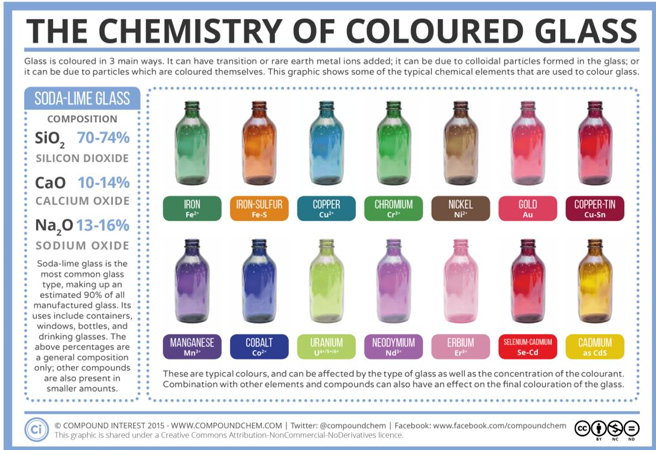
Flint
Basic Clear Glass. Used in majority of packaging applications.
Amber
Brown glass. Known to filter out light in the critical ultraviolet (UV) region. Iron and sulfur for brown color
Emerald
Bright green glass used mostly for wines and lime or lemon flavored soft drinks. Chrome Oxide is used to make glass it’s green color.
Blue glass
Cobalt oxides give glass it’s blue color
GLASS PACKAGING ANATOMY
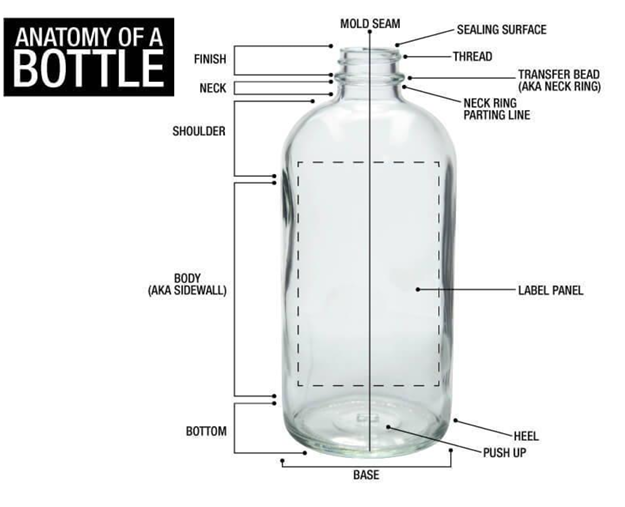
Sealing Surface
The flat, circular top surface of the finish which makes direct contact with the closure to form a seal. It’s sometimes referred to as the “land.” If the sealing surface is not flat, the container could leak.
Thread
A spiral-shaped ridge on the finish of a bottle intended to mesh with a similarly sized screw-type closure to seal the container.
Neck Ring or Transfer Bead
A horizontal ridge at the base of the finish used for transferring the bottle from one part of the production process to the next
Mold Seam
The slight vertical ridge that runs through the neck ring and the rest of the finish. The seam indicates where two halves of the finish molds were joined.
Body
The main part of the bottle where the sidewalls are usually (but not always) vertical.
Bottom
The entire lower part of the bottle below the sidewalls. The bottom includes the heel, base and pushup. The bottom may have letters and symbols molded into it that indicate the number of the mold cavity that produced the container and the manufacturer. The manufacturer symbol is called a “punt mark”
Heel
The lower part of the bottle where the body (sidewall) turns from vertical to horizontal. The heel joins the sidewall to the bottom-bearing surface and may have a small recessed spot that serves as a registration device for labeling and decorating equipment.
Pushup
An inward dome in the center of the base. The resulting ring around the outside of the bottom ensures stability, providing an even bearing surface upon which the bottle rests
Finish
The top part of the container, above the neck, shaped to accommodate a specific closure. Historically, the finish was made during the last part of the bottle molding process, which is how it got its name
Neck
The portion of the container that is above the shoulder and below the finish. The neck is where the cross-section of the bottle grows smaller to join the finish
Shoulder
The part of the bottle that joins the wide main body and the narrower neck. The slope of the shoulder is one factor in determining how quickly a product will be dispensed when the bottle is inverted
Label Panel
A flat area on the body of the bottle that can accept the application of a label. Label panels are sometimes recessed to protect the labels from rubbing together during shipping and the edges from fraying.
Mold Parting Line
The bottom plate is the part of the mold that shapes the bottom of the container. The parting line is a slight horizontal ridge formed in the joint between two parts of the mold
Base
An even bearing surface that forms a ring around the outside of the bottom upon which the bottle rests. On glass containers, this ring usually is given a stippled finish in the mold to mask scratches that occur during handling
“T” Dimension
NECK FINISH DIMENSIONS: measures the outside diameter of the thread. This measurement determines the closure counterpart for the bottle
“E” Dimension
measures the outside diameter of the neck. The thread depth is determined by the difference between “E” and “T” divided by two
“I” Dimension
measures the inner diameter of the bottle neck. are required at the very minimum for sufficient clearance for filling tubes. Linerless closures with a plug or land seal and dispensing plugs and fitments require a controlled dimension for proper fit.
“S” Dimension
measures from the top of the finish to the top edge of the first thread. This measurement is the key factor to determine the orientation of the closure and the amount of thread engagement between the bottle and the cap.
“H” Dimension
the height of the neck finish. This is measured from the top of the neck to the point where the diameter “T” (the outside diameter of the thread) extends down to where it intersects with the shoulder.
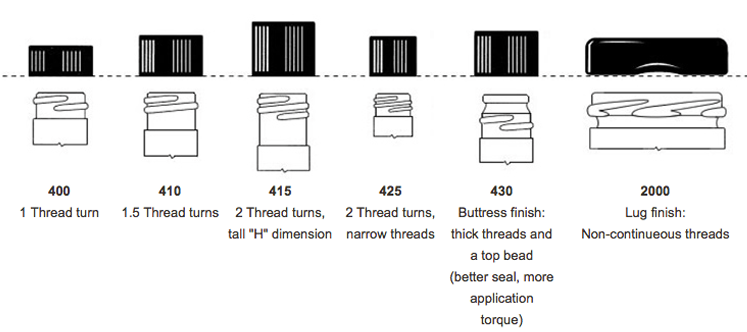
Thread finishes
DBJ neck finish
is a tamper-evident screw cap for dairy, beverage, and juice. This neck features a ring beneath the threads that catch on to a detachable ring of a DBJ cap. When the user unscrews the cap from the container for the first time, the ring will break off from the cap, making it tamper-evident. This closure is not recommended for carbonated products, hot-fill applications, nitrogen gas-injected applications, or freezing.
Narrow Neck Containers:
Wide Mouth Containers
Form Variations
General Types of Glass Packaging
Narrow Neck Containers
Includes bottles for beverages like beer or spirits, often using crown cork or cork seals.
Wide Mouth Containers
Includes jars for the food industry, typically using thread, lug, or side-sealing systems.
Top Sealing
Side Sealing
Cork Sealing
Types of Sealing System
Crown Cork
The sealing surface is on the top of the finish and used for narrow neck containers being filled under pressure
Thread or Lug
The sealing surface on the top of the finish is closed by a screw type cap. Used for wide mouth jars and narrow neck bottles
Side Sealing
The sealing surface is on the side of the finish, and the cap is pressed on to seal the contents. It is used for wide mouth jars in the food industry
Cork Sealing
The seal is made on the inside of the finish. It is used with narrow neck bottles.
Economy Rounds
are very common in the marketplace. They have a wide mouth (opening) and are perfect for sauces. They are the classic mayonnaise jar.
Paragon Jars
are tall and lean. Commonly seen storing olives or other types of pickled products as well has jam and jelly preserves.
Boston Round Bottle (Winchester Bottle)
This heavy and strong bottle is very commonly used for chemical applications but is also used in food and cosmetic industries as well
Long Necked Bottles
These bottles come in a variety of sizes but the most common woozy bottle sighting for me is the intrepid hot sauce or cocktail bitters.
Wine Bottles
These usually come clear for white wines and tinted for red wines
Ampoules
is a tiny single dosage vial with a sealed neck
CAPACITY
VISUAL
Methods of Checking Dimensions
capacity
-The most important single property of a container is its _____. U
nit of measure is usually in metric units (ml or L)
The ____ is defined as brimful or state filling height.
Johnnie Walker’s 180g bottle
The world’s lightest whisky bottle.