Campbell biology chapter 2 12th edition
 Call Kai
 Learn
Learn Practice Test
 Spaced Repetition
 Match
Match Flashcards
 Knowt Play
1/42

There's no tags or description
Looks like no tags are added yet.
Name | Mastery | Learn | Test | Matching | Spaced | Call with Kai | Chat |
|---|
No analytics yet
Send a link to your students to track their progress
43 Terms
Matter
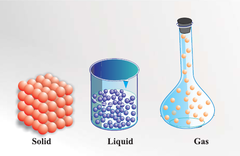
Anything that has mass and takes up space
Element
A substance that cannot be broken down into simpler substances
Compound
substance formed by the chemical combination of two or more elements in definite proportions

essential elements
A chemical element required for an organism to survive, grow, and reproduce.
trace elements
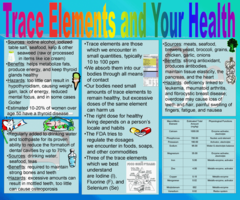
An element indispensable for life but required in extremely minute amounts.
Atoms
smallest unit of matter

Nuetrons
Neutral particles that don't have an electric charge
Protons
Positively charged particles
Electrons
Negatively charged particles

atomic nucleus
An atom's dense central core, containing protons and neutrons.

Dalton
A measure of mass for atoms and subatomic particles; the same as the atomic mass unit, or amu.

atomic number
the number of protons in the nucleus of an atom

Atomic mass
The average mass of all the isotopes of an element

Isotopes
One of several atomic forms of an element, each with the same number of protons but a different number of neutrons, thus differing in atomic mass.

half-life
length of time required for half of the radioactive atoms in a sample to decay

radioactive isotope
An isotope (an atomic form of a chemical element) that is unstable; the nucleus decays spontaneously, giving off detectable particles and energy.

radiometric dating
method used to determine the age of rocks using the rate of decay of radioactive isotopes

Energy
The capacity to cause change, especially to do work (to move matter against an opposing force).
potential energy
stored energy that results from the position or shape of an object

electron shell
an energy level of electrons at a characteristic average distance from the nucleus of an atom

valence electrons
The electrons in the outermost shell (main energy level) of an atom; these are the electrons involved in forming bonds.

valence shell
The outermost energy shell of an atom, containing the valence electrons involved in the chemical reactions of that atom.

Chemical bonds
An attraction between two atoms, resulting from a sharing of outer-shell electrons or the presence of opposite charges on the atoms. The bonded atoms gain complete outer electron shells.

covalent bond
a bond formed when atoms share one or more pairs of electrons
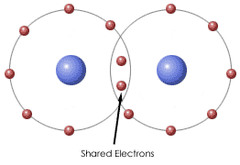
Molecule
two or more atoms held together by covalent bonds
single bond
a covalent bond in which one pair of electrons is shared between two atoms

double bond
A covalent bond in which two pairs of electrons are shared between two atoms

Valence
The bonding capacity of a given atom; the number of covalent bonds that an atom can form, which usually equals the number of unpaired electrons in its outermost (valence) shell.
Electronegativety
The attraction of a given atom for the electrons of a covalent bond.
non polar covalent bond
a covalent bond in which the bonding electrons are shared equally by the bonded atoms, resulting in a balanced distribution of electrical charge

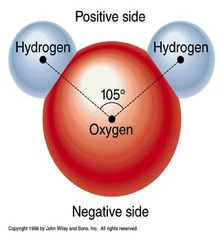
polar covalent bond
A covalent bond between atoms that differ in electronegativity. The shared electrons are pulled closer to the more electronegative atom, making it slightly negative and the other atom slightly positive.

Ions
positively and negatively charged atoms
Cation
A positively charged ion
Anion
A negatively charged ion
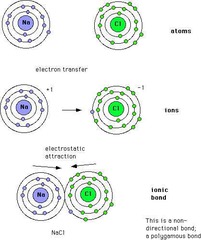
ionic bond
A chemical bond resulting from the attraction between oppositely charged ions.

ionic compound
composed of positive and negative ions that are combined so that the numbers of positive and negative charges are equal
hydrogen bond
A type of weak chemical bond formed when the slightly positive hydrogen atom of a polar covalent bond in one molecule is attracted to the slightly negative atom of a polar covalent bond in another molecule.

vaan der waals interactions
attractions between molecules that are close together as a result of these charges
chemical reaction
the process by which one or more substances change to produce one or more different substances

Reactant
a substance that takes part in and undergoes change during a reaction.

Products
The elements or compounds produced by a chemical reaction.

chemical equilibrium
In a chemical reaction, the state in which the rate of the forward reaction equals the rate of the reverse reaction, so that the relative concentrations of the reactants and products do not change with time.

Orbitals
The three-dimensional space where an electron is found 90% of the time.
