bones
 Call Kai
 Learn
Learn Practice Test
 Spaced Repetition
 Match
Match Flashcards
 Knowt Play
1/64

There's no tags or description
Looks like no tags are added yet.
Name | Mastery | Learn | Test | Matching | Spaced | Call with Kai | Chat |
|---|
No analytics yet
Send a link to your students to track their progress
65 Terms
Cartilage
A strong, flexible connective tissue that provides support and cushions joints.
articular cartilages
Ends of most bones at movable joints
costal cartilage
Ribs to sternum
Where is cartilage found?
External ear
Nose
Larynx — including epiglottis
Respiratory tubes
Between vertebrae — intervertebral discs
Pubic symphysis
Certain movable joints — articular discs/menisci
perichondrium
Cartilage is surrounded by a layer of dense irregular connective tissue
Hyaline cartilage
Looks like frosted glass
It makes up the articular cartilage that covers the ends of adjoining bones in movable joints.
It also forms the cartilaginous attachments of the ribs to the sternum, accounts for most of the cartilage found in the respiratory structures, and forms the embryonic skeleton
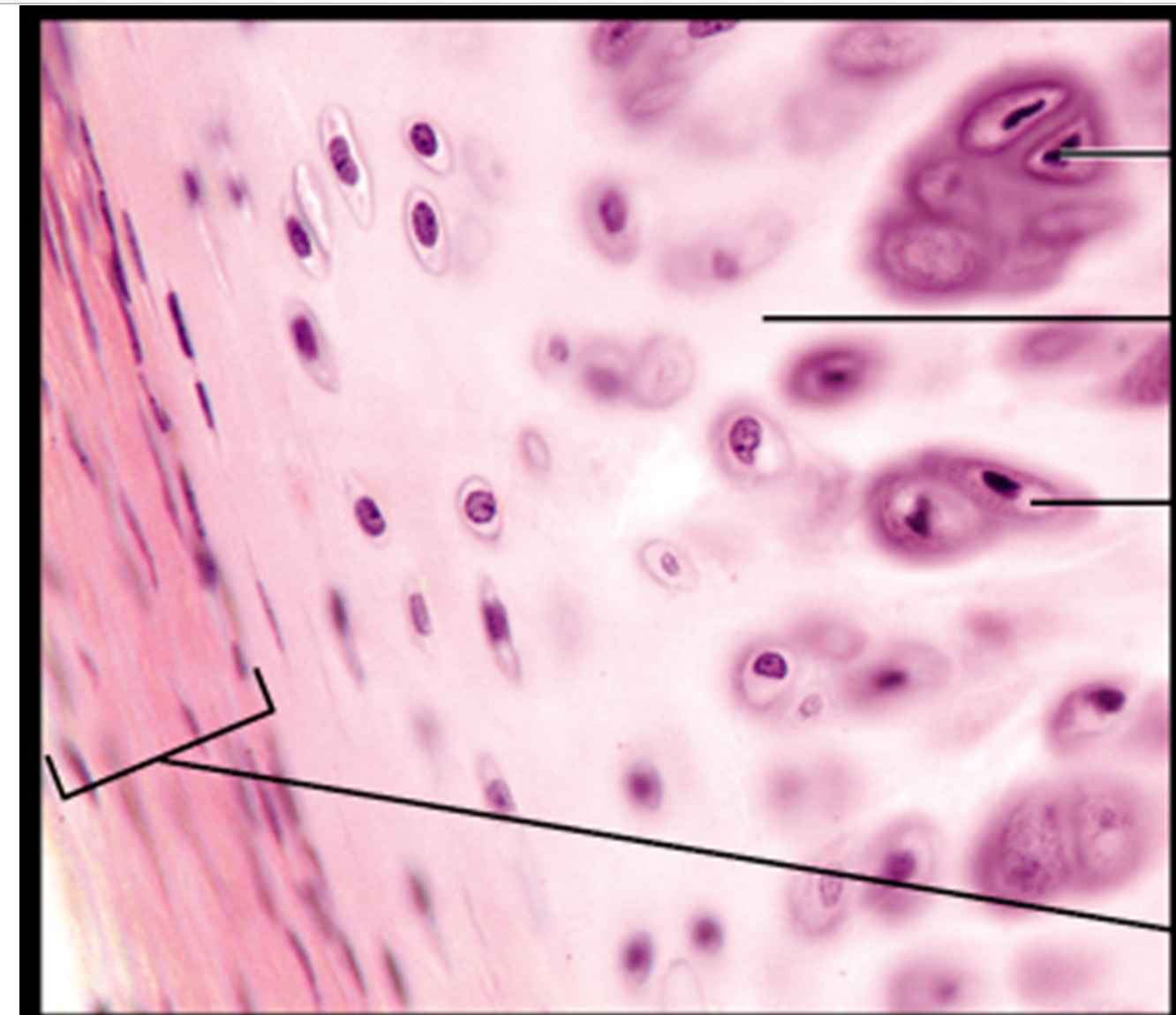
Elastic cartilage
similar to hyaline cartilage, but its matrix contains many elastic fibers along with the delicate collagen fibrils
good at bending

Fibrocartilage
an unusual tissue that resists both strong compression and strong tension (pulling) forces
Occurs in certain ligaments and certain cartilages that experience both of these forces.
Locations of Fibrocartilage
anulus fibrosus portion of the discs between the vertebrae and in the articular discs of some joints, for example the menisci of the knee.
Locations of elastic cartilage
epiglottis and the outer ear are both made from elastic cartilage
Location of hyaline cartilage
Articular surfaces, nose, trachea, larynx, costal cartilage
Function of hyaline cartilage
Support, cushioning, reduces friction
Function of elastic cartilage
Flexible support; maintains shape
Function of Fibrocartilage
Resists compression and absorbs shock
Location of Fibrocartilage
Intervertebral discs, pubic symphysis, menisci of knee
appositional growth
growth from outside,” cartilage-forming cells (chondroblasts) in the surrounding perichondrium produce the new cartilage tissue by actively secreting matrix
interstitial Growth
growth from within,” the chondrocytes within the cartilage divide and secrete new matrix.
Why are bones organs
because they contain several different tissues
Support
Provides the body with structure and shape.
Movement
Bones act as levers that muscles use to move the body.
Protection
Protects vital organs, such as the brain, spinal cord, and heart/lungs.
Mineral storage
Stores calcium and phosphate.
Blood cell formation & energy storage
Red marrow produces blood cells; yellow marrow stores fat.
Energy metabolism
Bone cells release hormones that help regulate blood sugar and energy metabolism.
What are the six major functions of the bony skeleton?
Support
Movement
Protection
Mineral storage
Blood cell formation & energy storage
Energy metabolism
Osteogenic cells
are stem cells that differentiate into bone-forming osteoblasts.
Osteoblasts
are cells that actively produce and secrete the organic components of the bone matrix
Osteocytes
function to keep the bone matrix healthy.
Osteoclasts
break down bone by secreting hydrochloric acid and lysosomal enzymes.
How do bones withstand tension and compression
Collagen fibers resist tension, while calcium mineral salts resist compression.
Foramen
Opening for nerves and blood vessels
Fissure
Narrow slit for nerves and blood vessels
Meatus
Canal-like passageway
Sinus
Air filled space within a bone
Fossa
Depression that provides space for another structure
Sulcus (groove)
Groove for a nerve, blood vessel, or tendon
Condyle
Rounded surface that forms a joint
Facet
Flat surface that forms a joint
Head
Expanded end that forms a joint
Process
Projection for muscle/ligament attachment
Tubercle
Small projection for muscle/ligament attachment
Tuberosity
Large, rough projection for muscle attachment
Crest
Narrow ridge for muscle/ligament attachment
Spine
Sharp, slender projection for muscle/ligament attachment
Trochanter
Very large projection for muscle attachment
compact bone
dense outer layer that looks smooth and solid to the naked eye
spongy bone
a honeycomb of small needle-like or flat pieces called trabeculae
Organic compounds of a bone
Collagen fibers → flexibility and tensile strength
Inorganic compounds of a bone
Calcium phosphate/mineral salts → hardness and resistance to compression
Intramembranous ossification:
Bone develops directly from connective tissue; forms most flat bones.
Endochondral ossification
Bone develops by replacing a cartilage model; forms most long bones.
reduction
the realignment of the broken bone ends to repair a fracture.
closed reduction
The bone ends are coaxed back into position by the physician’s hands
Comminuted
Bone breaks into 3 or more pieces.
Compression
Bone is crushed, often in vertebrae.
Spherical
Bone breaks into a round/spherical shape.
Epiphyseal
Fracture occurs through the epiphyseal plate.
Depressed
Bone is pushed inward, common in skull fractures.
Greenstick
Bone bends and partially breaks; common in children
List symptoms of osteoporosis.
Often no symptoms until a fracture occurs
Bone fractures easily, especially hip, spine, and wrist
Back pain
Loss of height
Stooped/hunched posture
Bones become weak and fragile
Name two ways aged bone differs from young bone.
Aged bone: Less dense and more brittle; more likely to fracture.
Young bone: More dense, strong, and flexible.