Year 10 Chemistry - Chemical Patterns
 Call Kai
 Learn
Learn Practice Test
 Spaced Repetition
 Match
Match Flashcards
 Knowt Play
1/53

There's no tags or description
Looks like no tags are added yet.
Name | Mastery | Learn | Test | Matching | Spaced | Call with Kai | Chat |
|---|
No analytics yet
Send a link to your students to track their progress
54 Terms
What are the features of the three subatomic particles?
Particle | Charge | Relative mass | Location |
|---|---|---|---|
Proton | +1 | 1 amu | Nucleus |
Neutron | 0 (neutral) | 1 amu | Nucleus |
Electron | −1 | Negligible (~1/1836 amu) | Shells around the nucleus |
Number of protons = atomic number = what defines the element
In a neutral atom, number of electrons = number of protons
What is the difference between atomic number and mass number?
Atomic number (Z) = number of protons
The smaller number shown that identifies the element
Mass number (A) = protons + neutrons
The larger number shown on the periodic table

How do you calculate the number of protons, neutrons and electrons in an atom?
Protons = atomic number
Electrons = atomic number (for a neutral atom)
Neutrons = mass number − atomic number
What is an isotope?
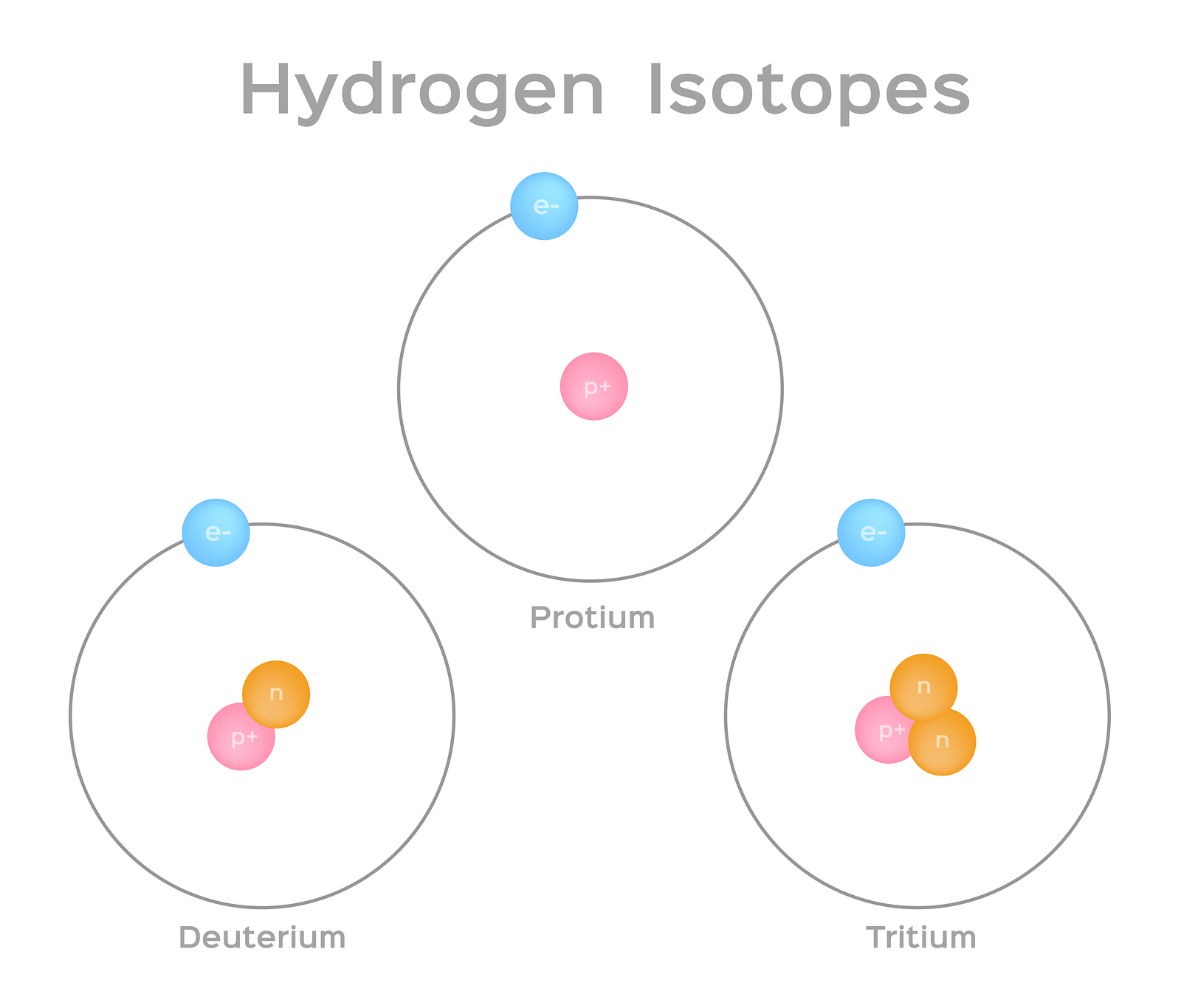
Atoms of the same element with the same number of protons but a different number of neutrons
Same chemical properties (same electron arrangement), but different physical properties (mass, density)
E.g. Carbon-12, Carbon-13, Carbon-14 all have 6 protons but 6, 7 or 8 neutrons
Isotopes can be stable (e.g. C-12) or unstable/radioactive (e.g. C-14) if the nucleus has an imbalanced proton-to-neutron ratio
Relative atomic mass on the periodic table is a decimal because it's the weighted average of all naturally occurring isotopes of that element, based on their mass and abundance
How does relative atomic mass differ from mass number and atomic mass?
Mass number: The total number of protons and neutrons in the nucleus of a specific atom
Atomic mass: The absolute mass of a single, specific atom of an element, usually expressed in atomic mass units (amu or u)
Relative atomic mass: The weighted average of all naturally occurring isotopes of an element, based on it’s mass and abundance

How is the periodic table arranged?
Vertical groups
Based on shared properties
Elements in the same group have the same number of valence (outer shell) electrons
Gives them similar chemical behaviour
Horizontal periods
Based in order of increasing atomic number
Period number tells you no. of electron shells that atom has (using the simple shell-filling method)
A zig-zag "staircase" line separates metals (left) from non-metals (right), with metalloids sitting along it
Also divided into s, p, d and f blocks, based on which subshell is being filled

What are the main families (groups) of elements?
Group 1 — Alkali metals
Group 2 — Alkaline earth metals
Group 15 — Pnictogens (nitrogen family)
Group 16 — Chalcogens (oxygen family)
Group 17 — Halogens
Group 18 — Noble gases
Middle block — Transition metals (including Lanthanoids and Actinoids)

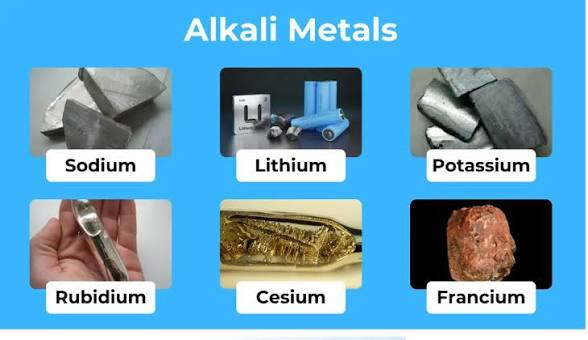
What are alkali metals (Group 1)?
Soft, shiny, easily cut metals
Highly reactive — react strongly with water to form an alkaline (basic) solution and hydrogen gas
Reactivity increases going down the group (outer electron is easier to lose as it's further from the nucleus)
What are the halogens (Group 17)?
Highly reactive non-metals, one electron short of a full outer shell
Distinctive colours: chlorine = green gas, bromine = red-brown liquid, iodine = silvery-purple solid
Reactivity decreases going down the group

What are noble gases (Group 18)?
Have a full outer (valence) shell — a stable electron configuration
Very unreactive, rarely form compounds

What are transition metals?
Occupy the middle block of the periodic table
Many can form more than one type of ion (variable oxidation states), e.g. Fe²⁺ and Fe³⁺
Typically hard, dense, good conductors, with high melting points

What are the properties of metals?
Solid at room temperature (except mercury, a liquid)
Shiny (high lustre)
Good conductors of heat and electricity
Malleable (can be hammered/rolled into sheets) and ductile (can be drawn into wires)
Usually high melting points
Located on the left/centre of the periodic table; tend to lose electrons to form positive ions (cations)
What are non-metals?
Dull or glassy appearance
Brittle solids, or exist as gases (one, bromine, is a liquid)
Poor conductors of heat and electricity (insulators)
Low melting points
Located on the right of the periodic table; tend to gain electrons to form negative ions (anions)
What are metalloids?
Elements with properties of both metals and non-metals (e.g. silicon, boron)
Sit along the zig-zag line dividing metals and non-metals
Can be polished to a shine but are poor conductors (often semiconductors)
Brittle — cannot be bent or drawn into wires
What is atomic radius?
Atomic radius: The distance from the centre of the nucleus to the outer edge of the electron cloud (outermost electron shell)
A measure of the overall size of an atom
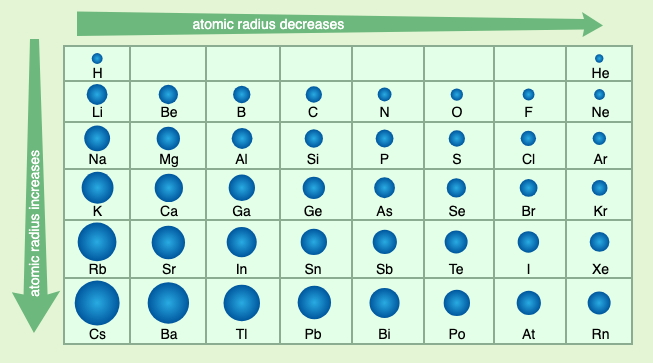
What is the trend in atomic radius across the periodic table?
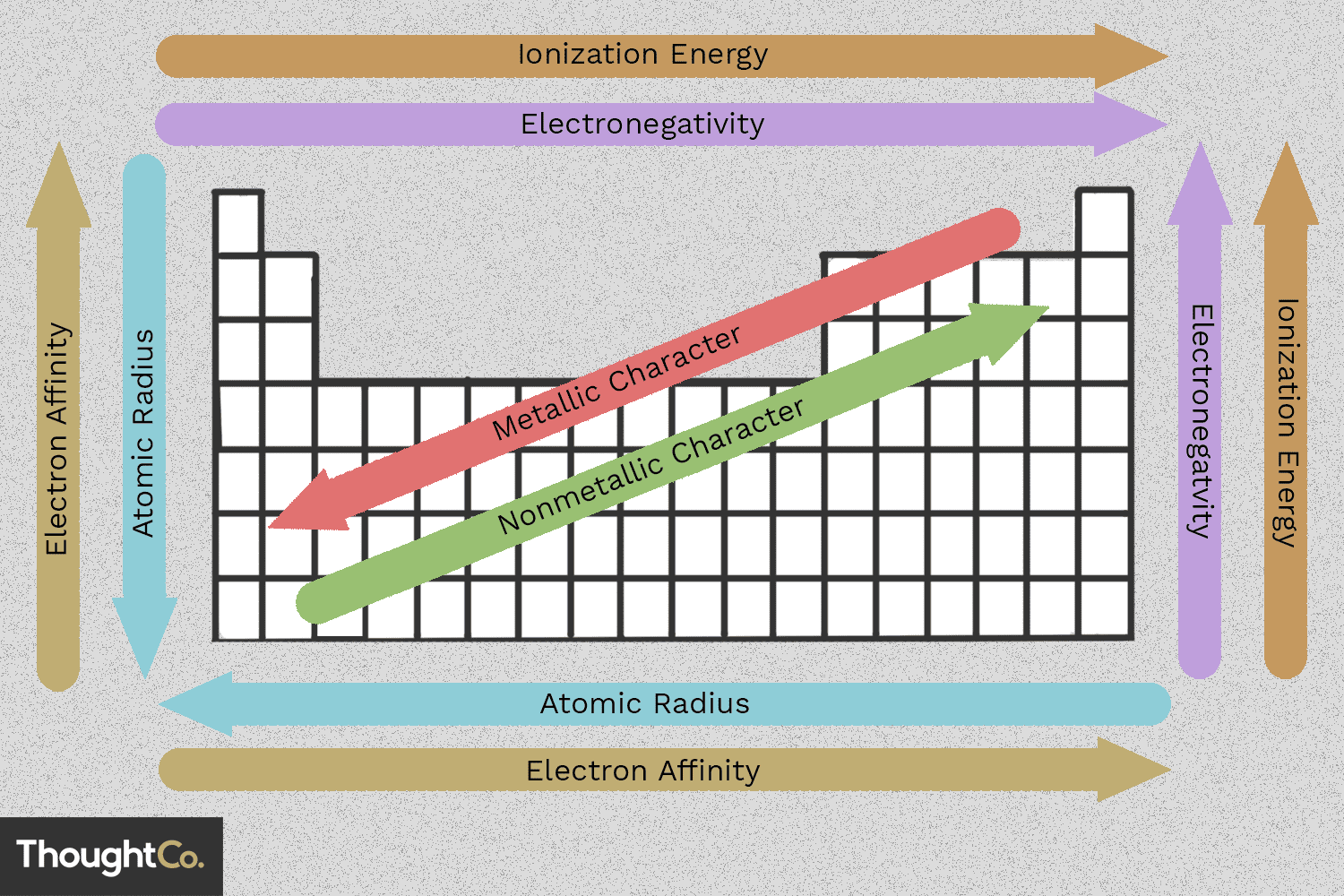
Down a group: Atomic radius increases
Each element down the group has one more electron shell
Therefore outer electrons sit further from the nucleus increasing radius
Across a period (left to right): Atomic radius decreases
No new shell is added, but each step adds a proton (increasing nuclear charge)
This pulls the same electron shell in more tightly, decreasing element’s radius
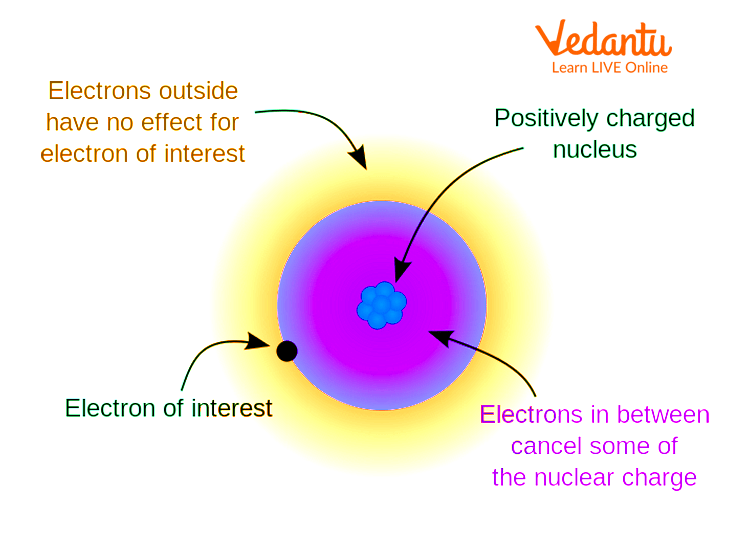
What is electron shielding?
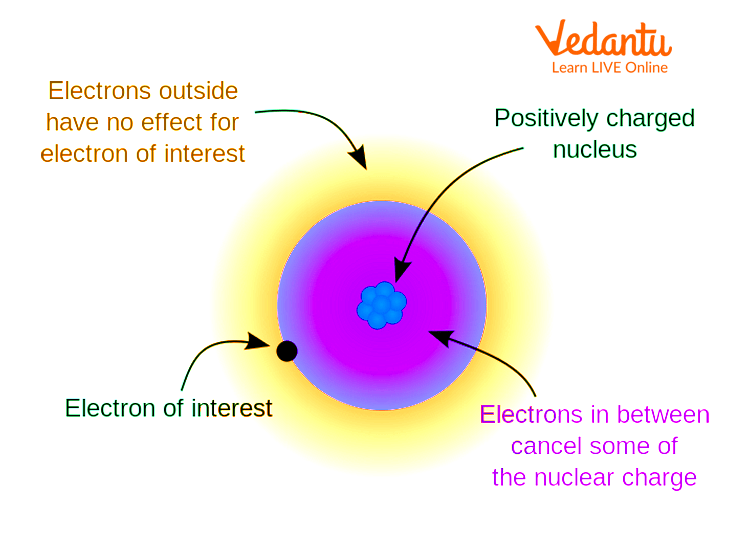
Electron shielding: The effect where electrons in inner shells reduce the attractive pull the nucleus has on the outer-shell electrons, because they sit between them
Inner-shell electrons partly block ("shield") outer electrons from the full attractive pull of the nucleus
The more inner shells present, the greater the shielding, so outer electrons feel a weaker effective pull from the nucleus
Explains why radius increases (+ electron shell) and electronegativity decreases (more shielding) going down a group, despite the nucleus having more protons
What is the definition of electron shielding?
Electron shielding: The effect where electrons in inner shells reduce the attractive pull the nucleus has on the outer-shell electrons, because they sit between them
What is electronegativity?
Electronegativity: A measure of how strongly an atom attracts a shared pair of electrons in a bond
Metals have low electronegativity (as they tend to give electrons)
Non-metals have high electronegativity (they tend to attract/gain electrons)
Noble gases generally have no electronegativity value, as they don't typically form bonds

What is the trend of electronegavity across the periodic table?
Across a period: Electronegativity increases
Nuclear charge increases (more protons), so the nucleus attracts electrons more strongly
Down a group: Electronegativity decreases
Atomic radius is larger and shielding is greater (due to + electron shell)
Hence the nucleus's pull on the outer electrons is weaker
What are the rules for filling electron shells?
Rule 1: Max electrons per shell = 2n²
Shell 1: 2, shell 2: 8, shell 3: 18, shell 4: 32
Rule 2: The valence (outermost) shell can only ever hold a maximum of 8 electrons
Rule 3: Once the next shell has begun filling, transition metals "back-fill" electrons into the previous shell (up to its true capacity)

How do you write electron configurations for elements beyond 20 electrons?
Fill shells normally up to 2, 8, 8, 2 (20 electrons)
Once the 4th shell has at least 2 electrons, start back-filling the 3rd shell up to its maximum of 18, then continue filling the 4th shell with any remaining electrons
EG Arsenic (33 e⁻): 2,8,8,2 → back-fill shell 3 to its max of 18 (= 30 total) → remaining 3 electrons fill shell 4 → 2, 8, 18, 5
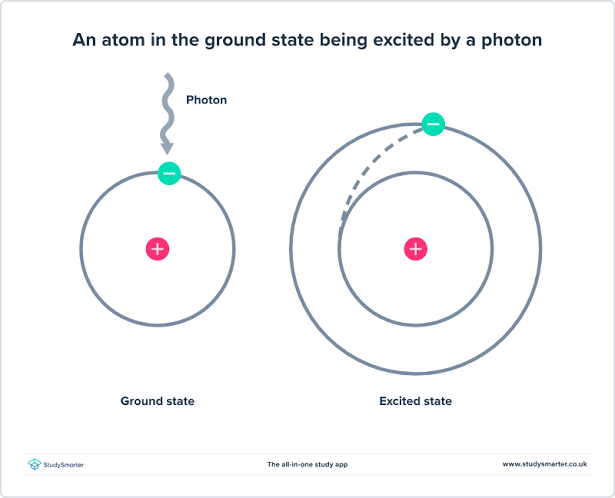
What is the difference between atoms in ground state and excited state?
Ground state: Electrons occupy the lowest available energy shells, the normal, most stable arrangement
Excited state: En electron absorbs energy and jumps to a higher, less stable shell

What happens when an electron returns from an excited state to the ground state?
The electron falls back down to a lower shell, releasing the absorbed energy as light
A larger "jump down" releases more energy, light closer to the violet end of the spectrum
A smaller "jump down" releases less energy, light closer to the red end of the spectrum
What is a subshell?
A subdivision within an electron shell where electrons are actually located
Each main shell is made up of one or more subshells (EG Shell 2 has 2 subshells s (2) and p (6) = 8 max)

What is the maximum number of electrons each subshell can hold?
s → 2
p → 6
d → 10
f → 14
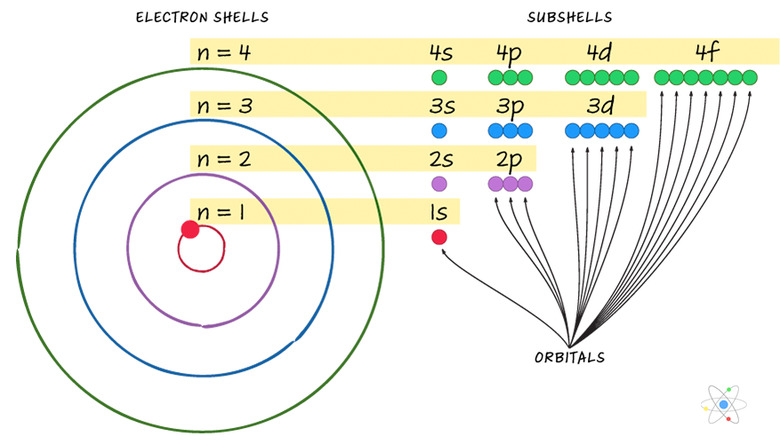
How many subshells are in each electron shell
Shell 1: 1s (max 2)
Shell 2: 2s, 2p (max 2+6 = 8)
Shell 3: 3s, 3p, 3d (max 2+6+10 = 18)
Shell 4: 4s, 4p, 4d, 4f (max 2+6+10+14 = 32)
The shell number (n) determines how many types of subshell it contains, starting from s

How do you write a subshell electron configuration?
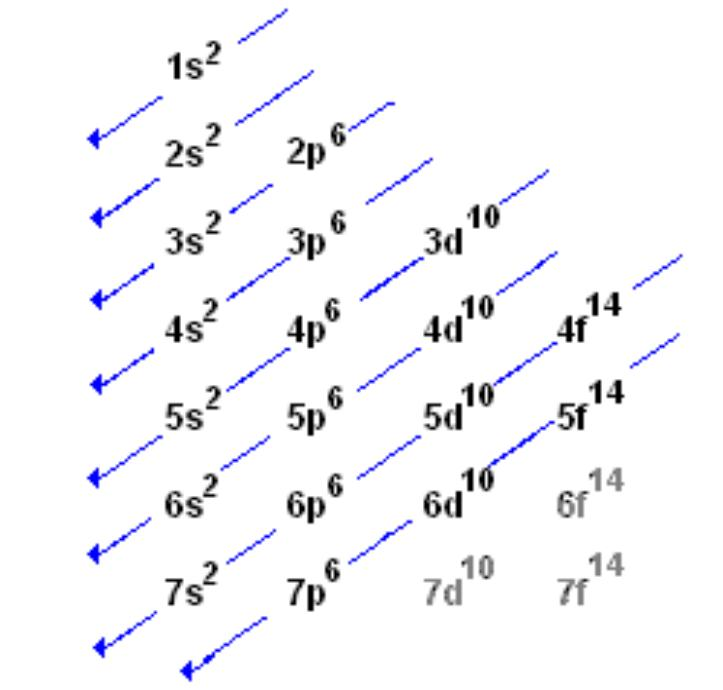
Fill subshells in order of increasing energy (using the filling order diagram provided)
Format: Shell number, subshell letter with the number of electrons in that subshell as subscript
Sodium (11 e⁻): 1s² 2s² 2p⁶ 3s¹
Phosphorus (15 e⁻): 1s² 2s² 2p⁶ 3s² 3p³
Potassium (19 e⁻): 1s² 2s² 2p⁶ 3s² 3p⁶ 4s¹
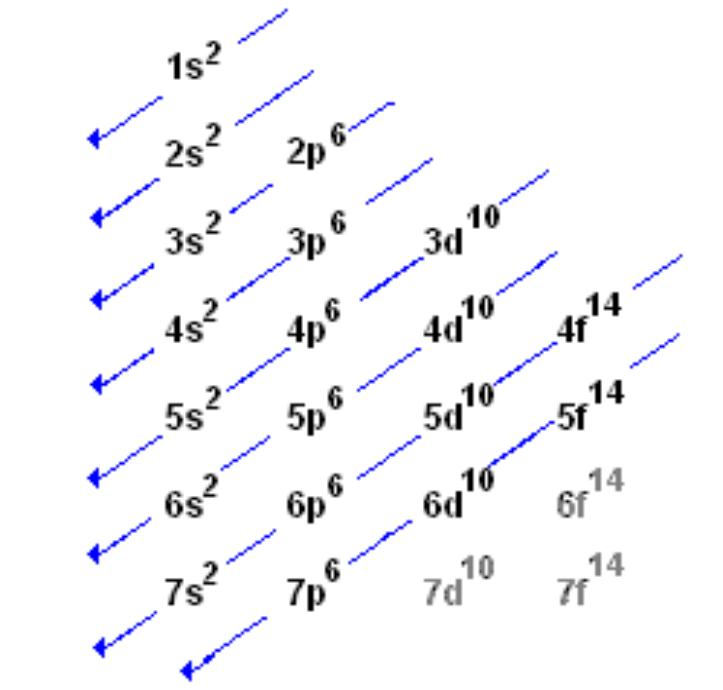
Why does the 4s subshell fill before the 3d subshell?
Even though 3d belongs to the lower (3rd) shell, it has a higher energy than 4s
Electrons fill the lowest-energy subshells first, so 4s fills before 3d — this is why transition metals appear to "back-fill" shell 3 after shell 4 has started

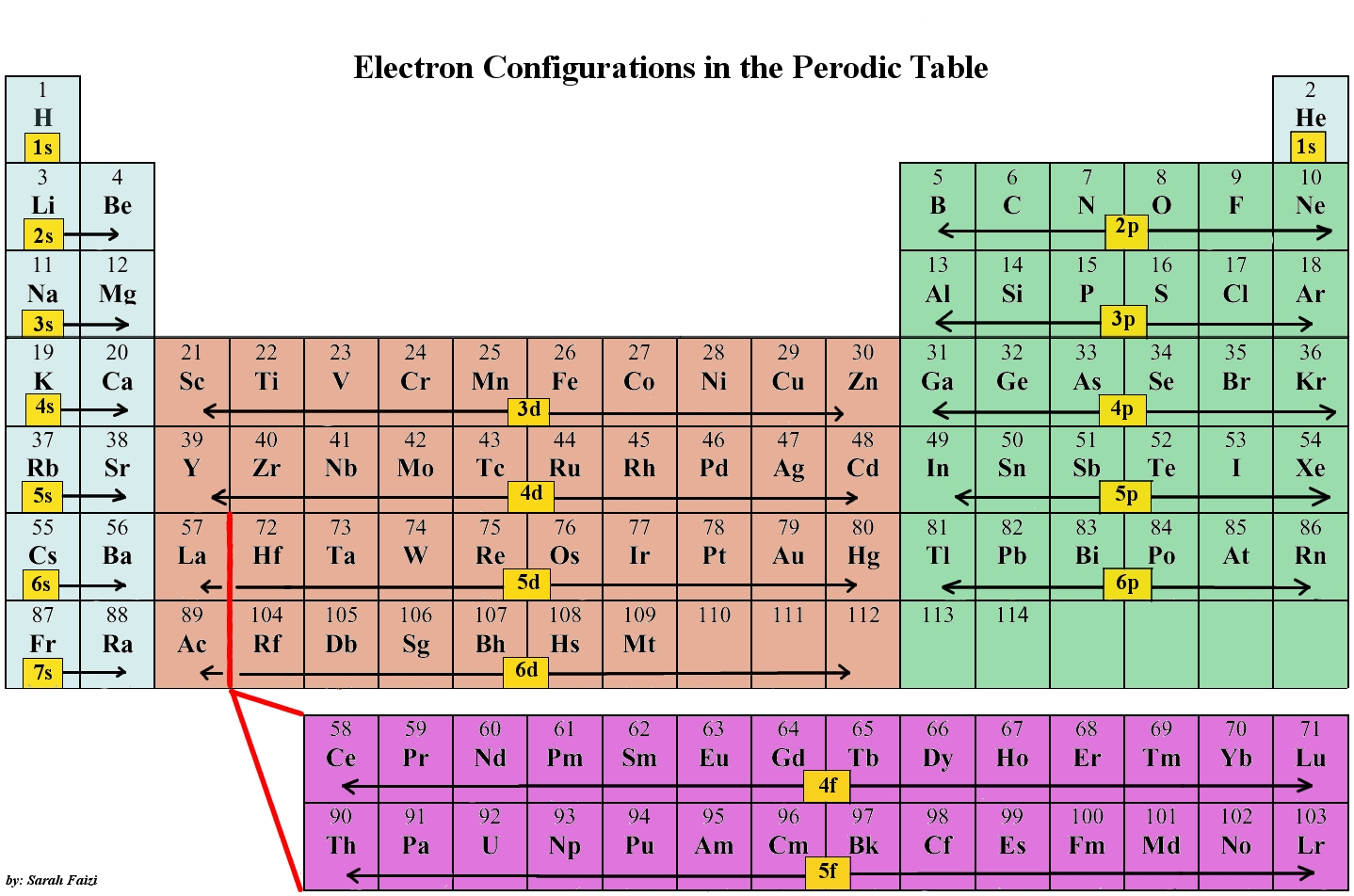
How does the periodic table show subshell filling order?
The block an element sits in (s, p, d or f block) shows which type of subshell is currently being filled
The period number tells you the highest shell number in use
What is the difference between a cation and an anion?
Cation = A positive ion, formed when an atom loses electrons; usually a metal; written first in a formula
Anion = A negative ion, formed when an atom gains electrons; usually a non-metal; written second in a formula

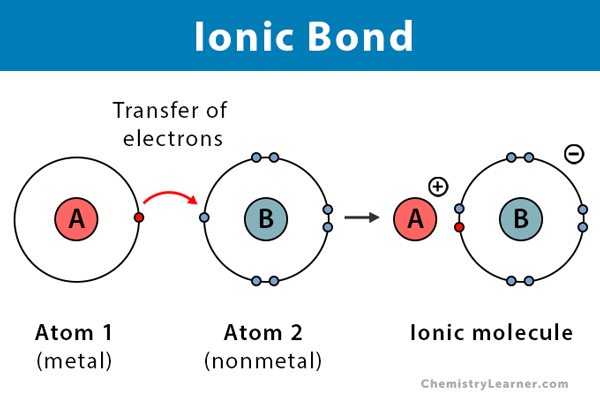
What is the process of ionic bonding?
Ionic bonds: Bonds that occur between metal and non-metals
The metal atom transfers one or more electrons to the non-metal atom
The metal becomes a positive ion (cation); the non-metal becomes a negative ion (anion)
The oppositely charged ions are held together by strong electrostatic attraction
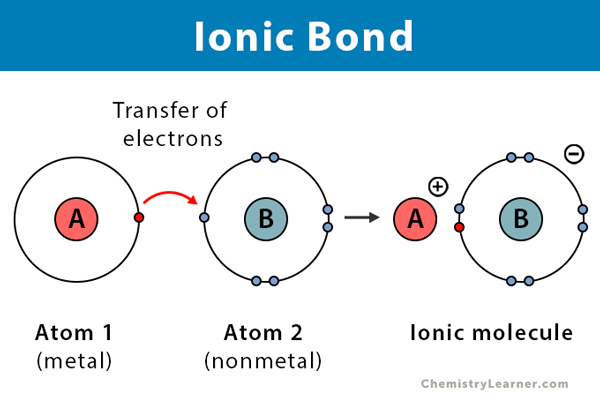
How do you draw an electron transfer (ionic bonding) diagram? Example: Magnesium + Chlorine
Step 1: Draw each reactant atom with its full electron configuration
Step 2: Use an arrow to show the electron(s) moving from the metal atom to the non-metal atom
Step 3: Write the name/formula of the ionic compound formed
If the metal has more electrons to lose than one non-metal atom can accept, involve more than one non-metal atom
Mg gives one electron to each of two Cl atoms to form MgCl₂
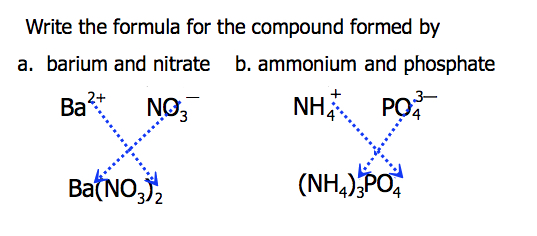
How do you write the formula of an ionic compound?
Example: Aluminium Oxide
Step 1: Write the cation symbol, followed by the anion symbol
Step 2: Write each ion's charge (use the ion charges data sheet)
Step 3: Balance the charges so total positive charge equals total negative charge
Step 4: Write the balancing ratio as subscripts and drop the charges
For polyatomic ions needing a subscript, place the ion in brackets with the subscript outside, e.g. Mg(OH)₂
Al₂O₃
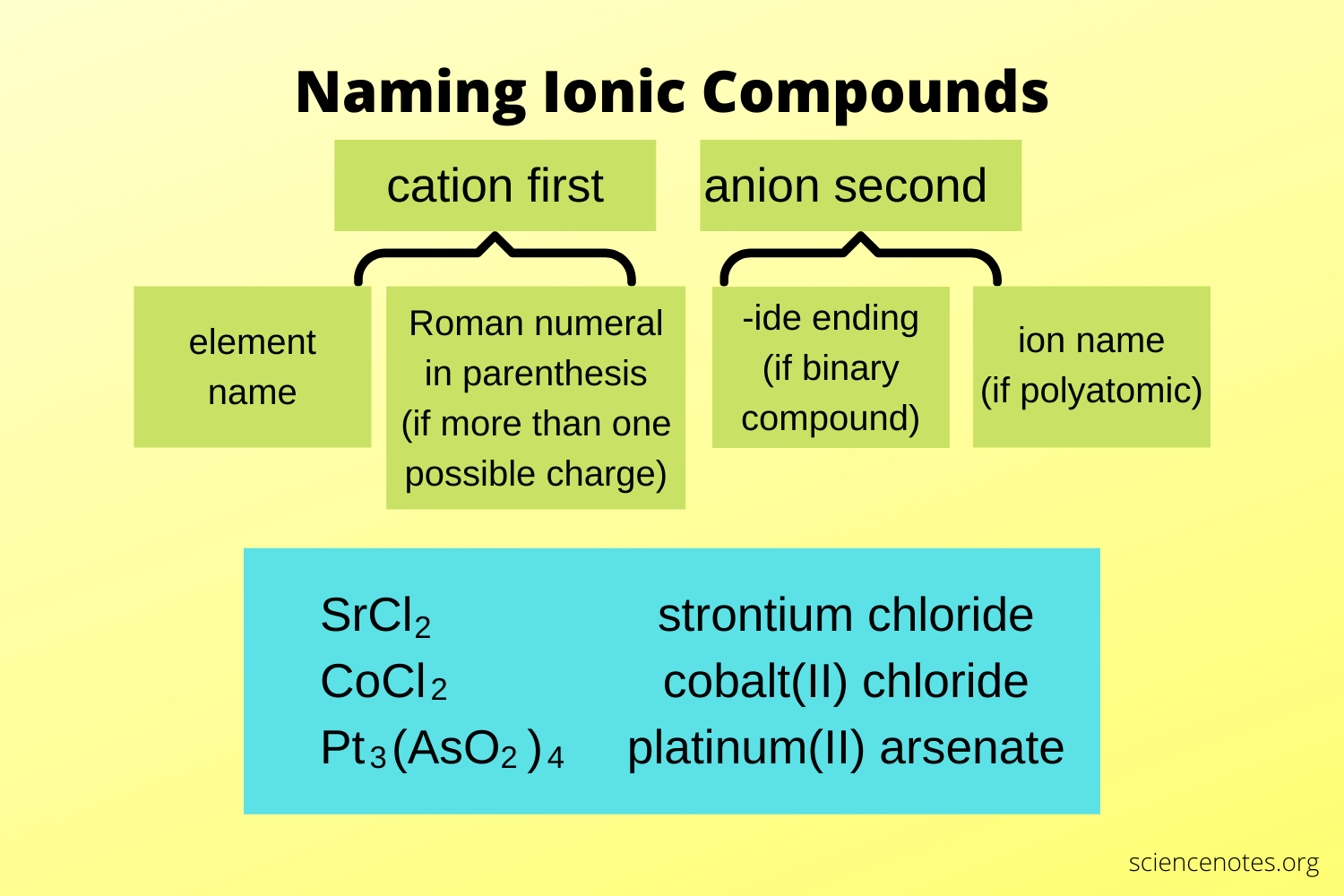
How do you name an ionic compound?
The cation (metal) keeps its normal element name and is named first
The anion (non-metal) name is changed to end in "-ide" and is named second (e.g. chlorine → chloride, oxygen → oxide)
This "-ide" rule doesn't apply to polyatomic anions (e.g. sulfate, carbonate, nitrate keep their own names)
What is a polyatomic ion?
A group of two or more atoms bonded together that carries an overall charge and acts as a single ion
Can be positive or negative (usually ‘+’ cation)
Common examples: Hydroxide (OH⁻), nitrate (NO₃⁻), sulfate (SO₄²⁻), Carbonate (CO₃²⁻), Ammonium (NH₄⁺)
Treated as one unit when writing formulas
If a subscript is needed, put the whole ion in brackets first, e.g. Mg(OH)₂

Is a polyatomic ion a cation or an anion?
Most common polyatomic ions are anions
EG sulfate, nitrate, carbonate, hydroxide
Small number are cations, the main one being ammonium, NH₄⁺
Whether it's a cation or anion still follows the same rule as simple ions: cations are written/placed first in a formula, anions second
What are the properties of ionic compounds, and why?
Form a repeating lattice of ions (not individual molecules)
High melting and boiling points: Due to strong electrostatic forces act between ions)
Brittle: Sharp force shifts the lattice so like-charged ions align and repel, shattering the structure
Conduct electricity when molten or dissolved in water (ions are free to move), but not as a solid (ions are fixed in place)
Overall electrically neutral — total positive charge equals total negative charge
What is covalent bonding?
Covalent bonds: Bonds formed when two non-metal atoms share a pair of electrons, with each atom contributing one electron to the pair
Both positively charged nuclei are attracted to the shared (bonding) electron pair, holding the atoms together
Occurs between atoms of the same non-metal element (e.g. Cl₂) or different non-metal elements (e.g. CO₂)
Atoms share electrons (rather than transferring them) in order to achieve a full outer shell (the octet rule)

How do you draw a dot-and-cross diagram for a covalent molecule?
Show each atom's valence (outer shell) electrons as dots or crosses around its symbol
Work out how many electrons each atom needs to complete its octet
Overlap the outer shells so the shared electron pair sits between the two atoms — this bonding pair counts towards both atoms' octets
Any electrons not involved in bonding are shown as lone pairs
O₂: two electron pairs are shared between the atoms (double bond)
H₂O: oxygen shares 2 of its 6 valence electrons, one with each H atom; 2 lone pairs remain on O
NH₃: nitrogen shares 3 of its 5 valence electrons, one with each H atom; 1 lone pair remains on N

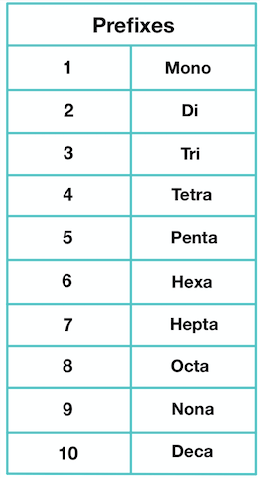
How do you name a covalent compound?
Name both elements in the order they appear in the formula
Use prefixes to show how many atoms of each element are present: mono-, di-, tri-, tetra-, penta-, etc. (mono- is usually dropped from the first element)
The second element's name ending changes to "-ide"
E.g. CO₂ = carbon dioxide, PCl₃ = phosphorus trichloride, N₂O₄ = dinitrogen tetroxide
What determines how reactive a metal is?
Reactivity: An element’s ability to ionise
Reactivity depends on how easily a metal atom can lose its outer shell (valence) electrons to form a positive ion
Losing 1 electron is easier than losing 2, so generally Group 1 metals are more reactive than Group 2 metals
Reactivity increases going down a group, as outer electrons are further from the nucleus and more shielded, so are held less tightly

What can the reactivity series be used to predict?
Displacement reactions between a metal and a compound
Whether a metal will react with water or acid
How easily a metal corrodes (oxidises)
Which metals are suitable for particular uses (e.g. jewellery vs batteries)
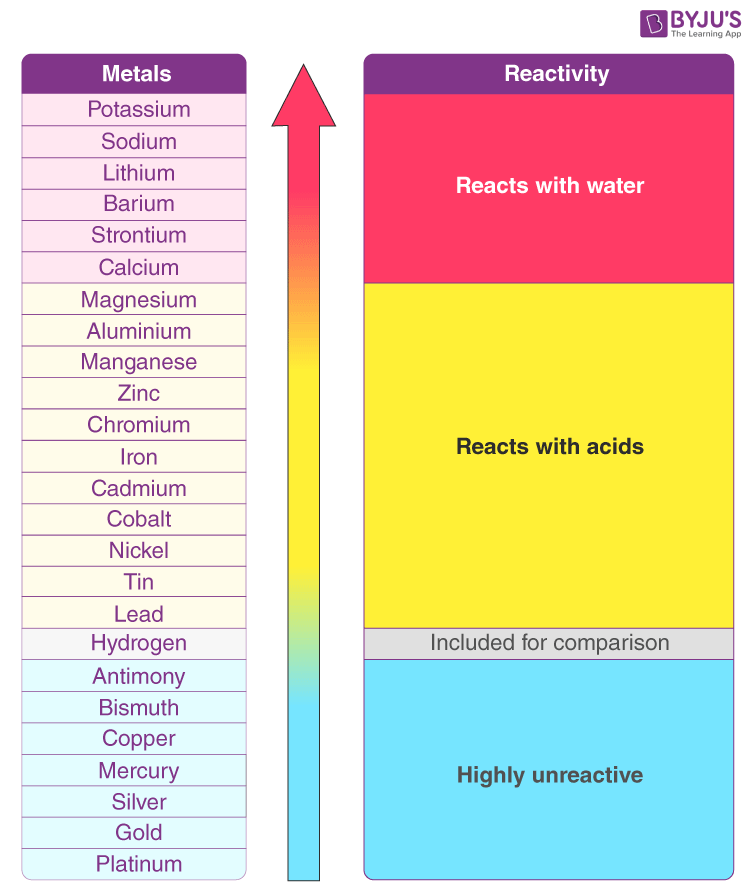
How does the reactivity series predict displacement reactions?
A more reactive metal will displace a less reactive metal from its compound in solution
E.g. Fe + CuSO₄ → FeSO₄ + Cu, because iron is more reactive than copper

How does the reactivity series predict reactions with water and acids?
Highly reactive metals (e.g. potassium, sodium, calcium) react vigorously with water
Metals above hydrogen in the reactivity series react with acids to produce hydrogen gas; metals below hydrogen (e.g. copper) do not react
General word equation: metal + acid → metal salt + hydrogen (this is a displacement reaction)

What is an electron shell?
A region surrounding the nucleus containing a specific number of electrons
What is the octect rule? How is it shwon in noble gases?
Octect rule: Atoms are most stable when they have 8 electrons in their outer (valence) shell
Atoms gain, lose, or share electrons during reactions in order to achieve this stable arrangement
Noble gases (Group 18) already have a full outer shell of 8 electrons (2 for helium) — this is why they're already stable and rarely react to form compounds

What is the relationship between shielding, bonding forces and melting point?
More shielding weakens the attraction between a nucleus (or metal cation) and its surrounding electrons
For metals and ionic compounds: more shielding down a group → weaker attraction between particles → generally lower melting points
For molecular covalent substances (e.g. H₂O, CO₂): melting point depends mainly on the strength of the intermolecular forces between separate molecules, not the strong covalent bonds within each molecule — these intermolecular forces are much weaker and easily overcome
Stronger intermolecular forces = more energy needed to separate molecules = higher melting point
What is the relationship between valency, oxidation number and ionic charge?
Valency = The number of electrons an atom needs to gain, lose or share to achieve a full outer shell
Oxidation number = The charge an atom would have if electrons were fully transferred to/from it
For simple ions, valency, oxidation number and ionic charge are all numerically the same, e.g. magnesium loses 2 electrons → valency 2, oxidation number +2, ion charge Mg²⁺
All three can usually be predicted from an element's group number on the periodic table
What is a molecular formula?
Molecular formula: Shows the symbols of the elements present in a compound and the ratio (number) of atoms of each element joined together
E.g. H₂O shows 2 hydrogen atoms bonded to 1 oxygen atom in every molecule
What is valency?
Valency: The number of electrons an atom needs to gain, lose or share to achieve a full outer shell
Determines how many bonds an atom can form, or the size of the charge on the ion it forms
Can usually be predicted from an element's group number on the periodic table
What is a displacement reaction?
Displacement reaction: A reaction where a more reactive element displaces (replaces) a less reactive element from its compound
Metal + metal compound: a more reactive metal replaces a less reactive metal in a salt solution, e.g. Fe + CuSO₄ → FeSO₄ + Cu
Metal + acid: metal + acid → metal salt + hydrogen — the metal displaces hydrogen from the acid
Non-metals can also displace each other this way, e.g. a more reactive halogen displacing a less reactive halogen from a solution

How do you predict whether a displacement reaction will occur?
Compare the positions of the two elements on the reactivity series
A reaction only occurs if the element doing the displacing is HIGHER (more reactive) than the element being displaced
If the added element is LOWER (less reactive) than the one already in the compound, no reaction occurs
E.g. Zn + CuSO₄ → reaction occurs (Zn is more reactive than Cu); Cu + ZnSO₄ → no reaction (Cu is less reactive than Zn)

What is the formula mass/weight of a molecule?
The sum of the atomic weights of the atoms in the formula of the compound
It is given in atomic mass units (amu)
EG Formula mass:CH₄ = 12 × 1 + 1 × 4 = 16amu
Can be used to find percentage composition