L2 | Classification and Structure of Bones
 Call Kai
 Learn
Learn Practice Test
 Spaced Repetition
 Match
Match Flashcards
 Knowt Play
1/13

There's no tags or description
Looks like no tags are added yet.
Name | Mastery | Learn | Test | Matching | Spaced | Call with Kai | Chat |
|---|
No analytics yet
Send a link to your students to track their progress
14 Terms
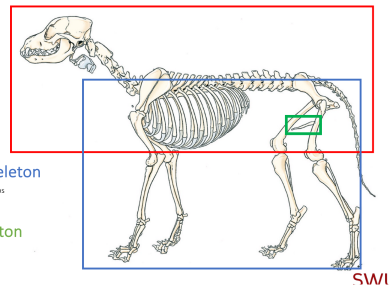
Q: The skull, vertebral column, ribs, and sternum are separate sections that consist the ……. A. Axial skeleton B. Splanchnic skeleton C. Cartilaginous skeleton D. Appendicular skeleton
A. Axial skeleton (Red Box)
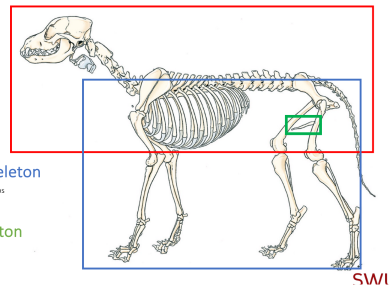
Q: The bones that form the limbs, pelvis, and scapula belong to the ……. A. Axial skeleton B. Splanchnic skeleton C. Vertebral column D. Appendicular skeleton
D. Appendicular skeleton (Blue Box)
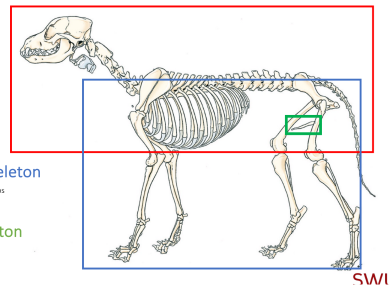
Q: The Os penis is part of the ……. A. Appendicular skeleton B. Splanchnic skeleton C. Exoskeleton D. Axial skeleton
B. Splanchnic skeleton (Green Box)
Q: …… are longer than wide; act as supporting columns and as levers, with examples like the femur, humerus, radius, ulna, tibia, and fibula. A. Long bones B. Short bones C. Flat bones D. Irregular bones
A. Long bones
Q: …… have a typical cuboidal shape, possess six surfaces, and include examples like the carpals and tarsals. A. Long bones B. Sesamoid bones C. Flat bones D. Short bones
D. Short bones
Q: …… consist of two plates of compact bone separated by cancellous bone, function in muscle attachment, and include the scapula, pelvis, and skull. A. Irregular bones B. Flat bones C. Short bones D. Pneumatic bones
B. Flat bones
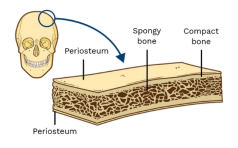
Q: The spongy layer in the cranium that absorbs shock is called the ……. A. Cortex B. Periosteum C. Diploë D. Medullary cavity
C. Diploë
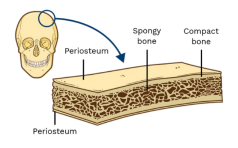
Q: …… show no uniformity in development and are for support and ligament attachment, such as the vertebrae. A. Long bones B. Flat bones C. Short bones D. Irregular bones
D. Irregular bones
Q: …… are bones that contain air cavities, are lined by mucous membrane rather than marrow, communicate with the respiratory system, and are found in birds. A. Sesamoid bone B. Pneumatic bone C. Flat bone D. Abberant long bone
B. Pneumatic bone
Q: The ribs are classified as an ……. A. Irregular bone B. Short bone C. Abberant long bone D. Sesamoid bone
C. Abberant long bone
Q: …… have a resemblance with sesame seeds and protect tendons at the places where greatest friction is developed, like the patella and navicular bone. A. Sesamoid bone B. Short bones C. Pneumatic bones D. Flat bones
A. Sesamoid bone
A. Spongy bone
B. Compact bone
C. Diploë
D. Bone marrow
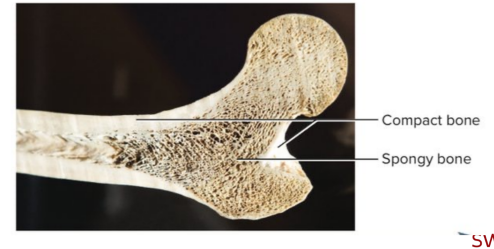
A. Compact bone
B. Cortex
C. Spongy bone
D. Periosteum
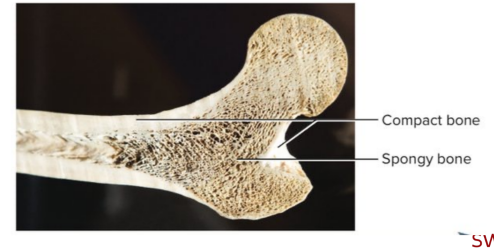
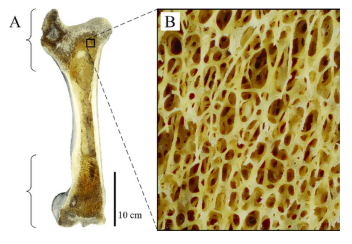
A. Compact bone
B. Cortex
C. Spongy bone
D. Periosteum