AP Bio Unit 2
 Studied by 11 people
 Call Kai
 Learn
Learn Practice Test
 Spaced Repetition
 Match
Match Flashcards
 Knowt Play
1/58

Earn XP
Description and Tags
Name | Mastery | Learn | Test | Matching | Spaced | Call with Kai |
|---|
No analytics yet
Send a link to your students to track their progress
59 Terms
Ribosomes
Synthesize protein according to mRNA sequence
Ribosomes are found in all forms of life, reflecting common ________ of all known life.
Ancestry
______ Endoplasmic Reticulum (ER) compartmentalizes the cell
Rough
______ Endoplasmic Reticulum (ER)’s functions include detoxification and lipis synthesis
Smooth
ER provides mechanical ______ and carries out _____ synthesis.
Support, protein
Golgi’s functions include _______ and chemical modifications of proteins and ______ for protein transport
Folding, packaging
Mitochondria have a ______ membrane
Double
______ membrane of mitochondria is smooth
Outer
_____ membrane of mitochondria is convoluted, forming folds
Inner
Mitochondrial double membrane provides compartments for different metabolic ________
Reactions
Lysosomes have enzymes that…. (hydrolyze)
Break down stuff by adding a water molecule
_____ hold and release macromolecules and cellular waste products.
Vacuoles
Chloroplasts are found in photosynthetic algae and plants and contain a ________ _______ membrane
Double outer
The folding of the inner membrane of a cell increases the surface area, allowing ______ ATP to be synthesized
More
Thykaloids and the stroma are found in the
Chloroplast
Grana
Stacks of organized thykaloids
______ occurs in the chloroplast
Photsynthesis
Krebs cycle occurs in the
Matrix of mitochondria
Electron transport and ATP synthesis occur…
The inner mitochondrial membrane
As the cell size increases, the SA:V ratio decreases, decreasing the rate of
Diffusion
___ size, high SA:V ration, high rate of diffusion is ideal for a cell
Low
Phospholipid structure
Polar (hydrophillic) heads facing intra and extracellular environment
Nonpolar (hydrophobic) tails facing in towards each other
Hydrophillic embedded proteins have
Charged and polar side groups
Hydrophobic embedded proteins have
Nonpolar side groups
Cell membrane is made up of phospholipid molecules embedded with proteins, steroids, _________, and ______ that flow on the surface of the cell within the membrane.
Glycoproteins, glycolipids
The cell membrane is … (permeability)
Selective permeable
The _____ _____ model ( cell membrane made up of phospholipids, glycoproteins, glycolipids, etc.) results in the selective permeability of the membrane.
Fluid mosaic
Small _____ molecules can pass through the membrane freely.
nonpolar
______ substances (large polar molecules and ions) pass through the membrane through embedded channel and transport proteins
Hydrophillic
Polar uncharged molecules (like H²O) pass through the membrane in _____ amounts
Small
Cell walls of plants, prokaryotes, and fungi are composed of complex _____.
Carbohydrates
______ transport is the movement of molecules from high to low concentrations without ATP (particle transport)
Passive
______ transport required the direct input of energy to move molecules from low to high concentration (particle transport)
Active
2 examples of active transport (we learned in class)
Na+ K+ pump, contractile vacuole
Concentration gradient
A difference in the concentration between two areas (intracellular and extracellular)
Exocytosis (Bulk transport)
Large macromolecules are secreted out of the cell
Endocytosis (bulk transport)
Macromolecules are transported into the cell
3 types of endocytosis
Pagocytosis
Pinocytosis
Receptor-mediated endocytosis
Phagocytosis (cell eating)
Cells take in solids,
Pinocytosis (cell drinking)
Cell takes in liquids
Receptor-mediated endocytosis
Receptor proteins recognize macromolecules and take them into the cell
Membrane proteins are needed for active
Transport
Water potential =
Solute potential + pressure potential
Solute potential=
-iCRT
i=_____, C= _______ R=______, T=______
Ionization constatnt, molar concentration, pressure constant, temperature (in Kelvin)
Internal membranes facilitate cellular processes by minimizing competing interactions and by increasing _______ ______ where reactions can occur.
Surface areas
Endosymbiotic Theory
Mitochondria and chloroplasts were free living prokaryotes, were engulfed by early eukaryotes, evolved to live inside them in a symbiotic relationship.
A hypertonic solution has a _______ water potential than hypotonic
Lower
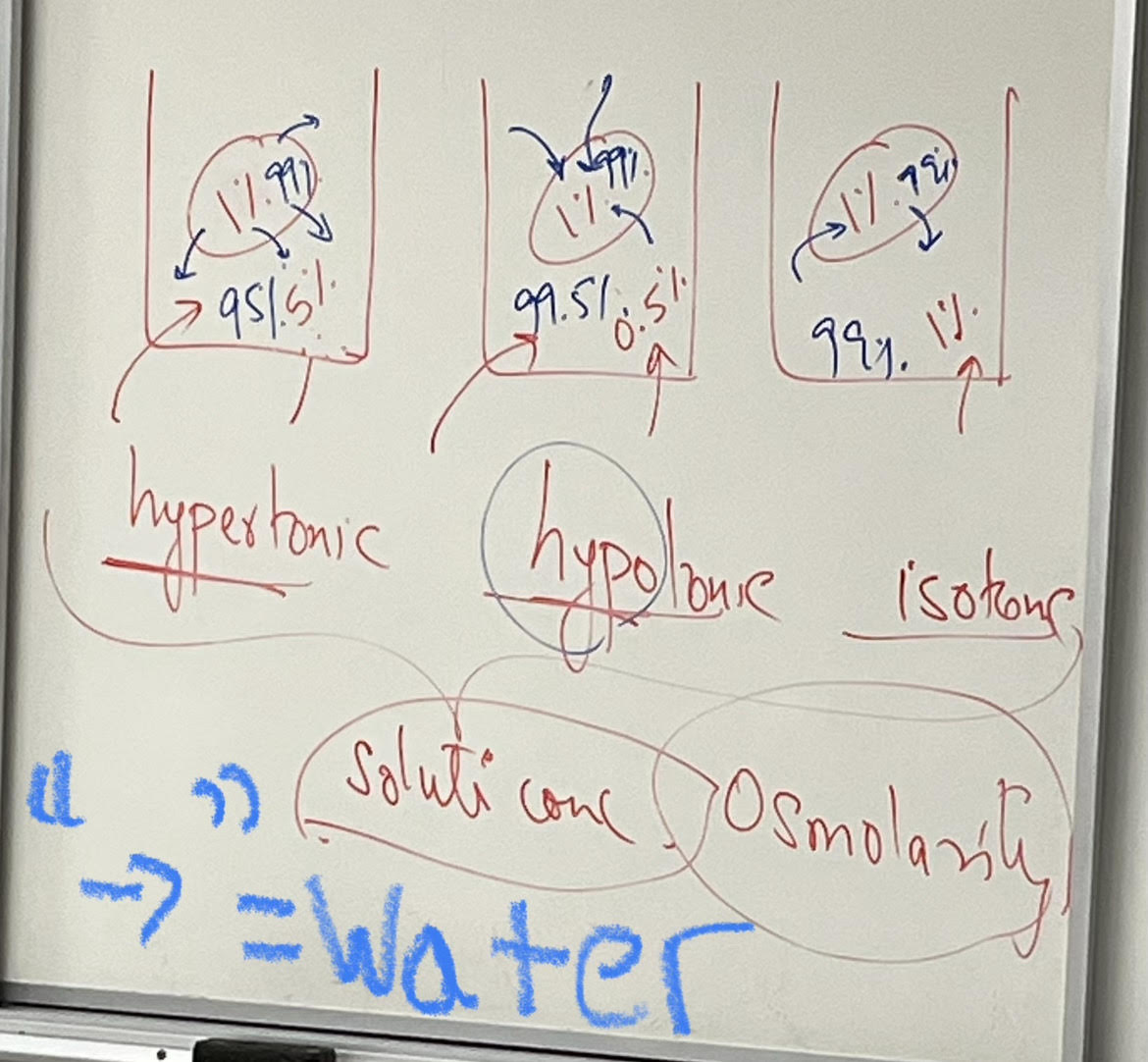
Hypertonic Solution
Has a higher solute concentration than the cell that’s placed in it
In a hypertonic solution, the cell ________ water
Loses
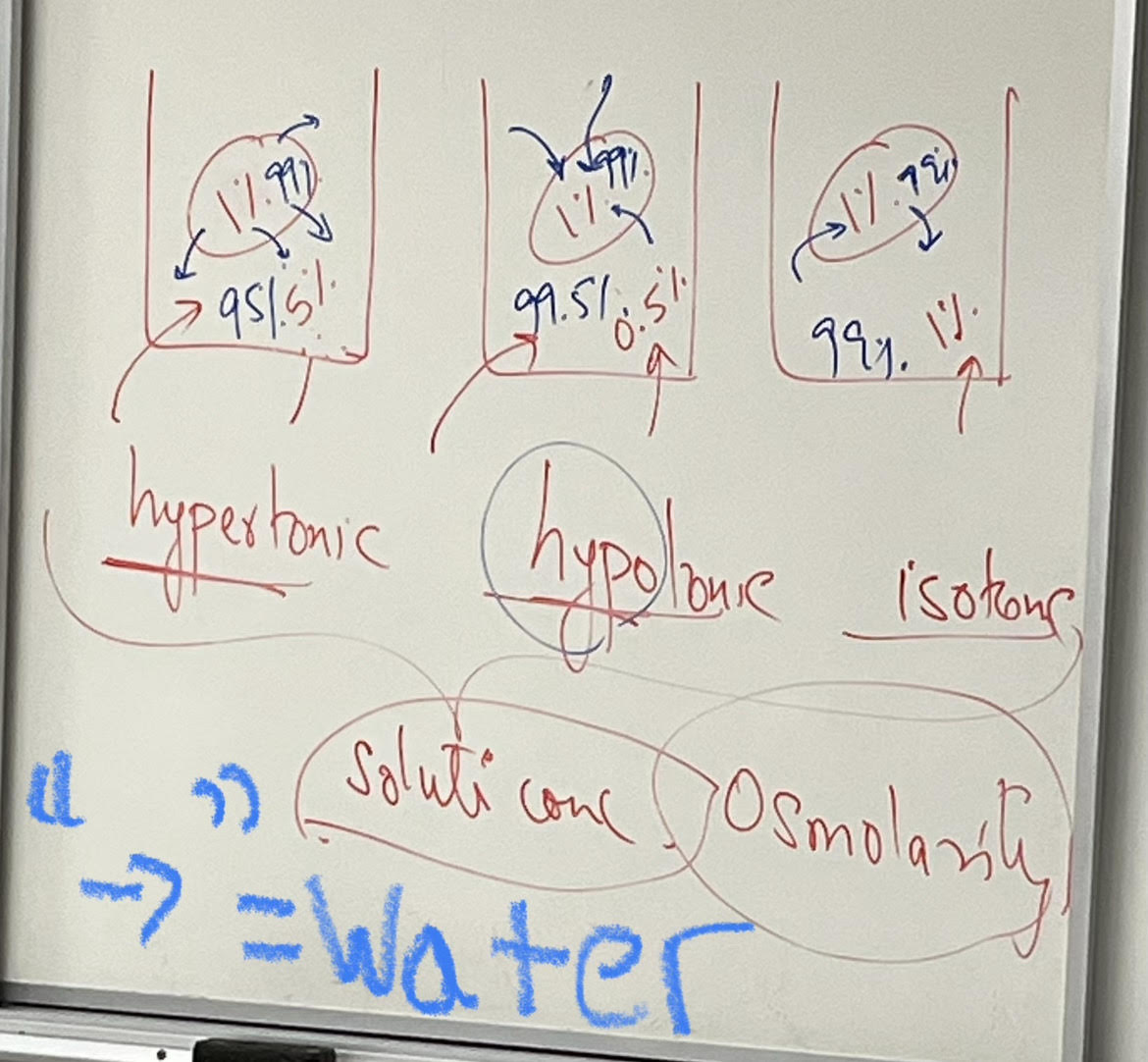
Hypotonic solution
Solution has a lower solute concentration than the cell
In a ______ solution, the cell gains water
Hypotonic
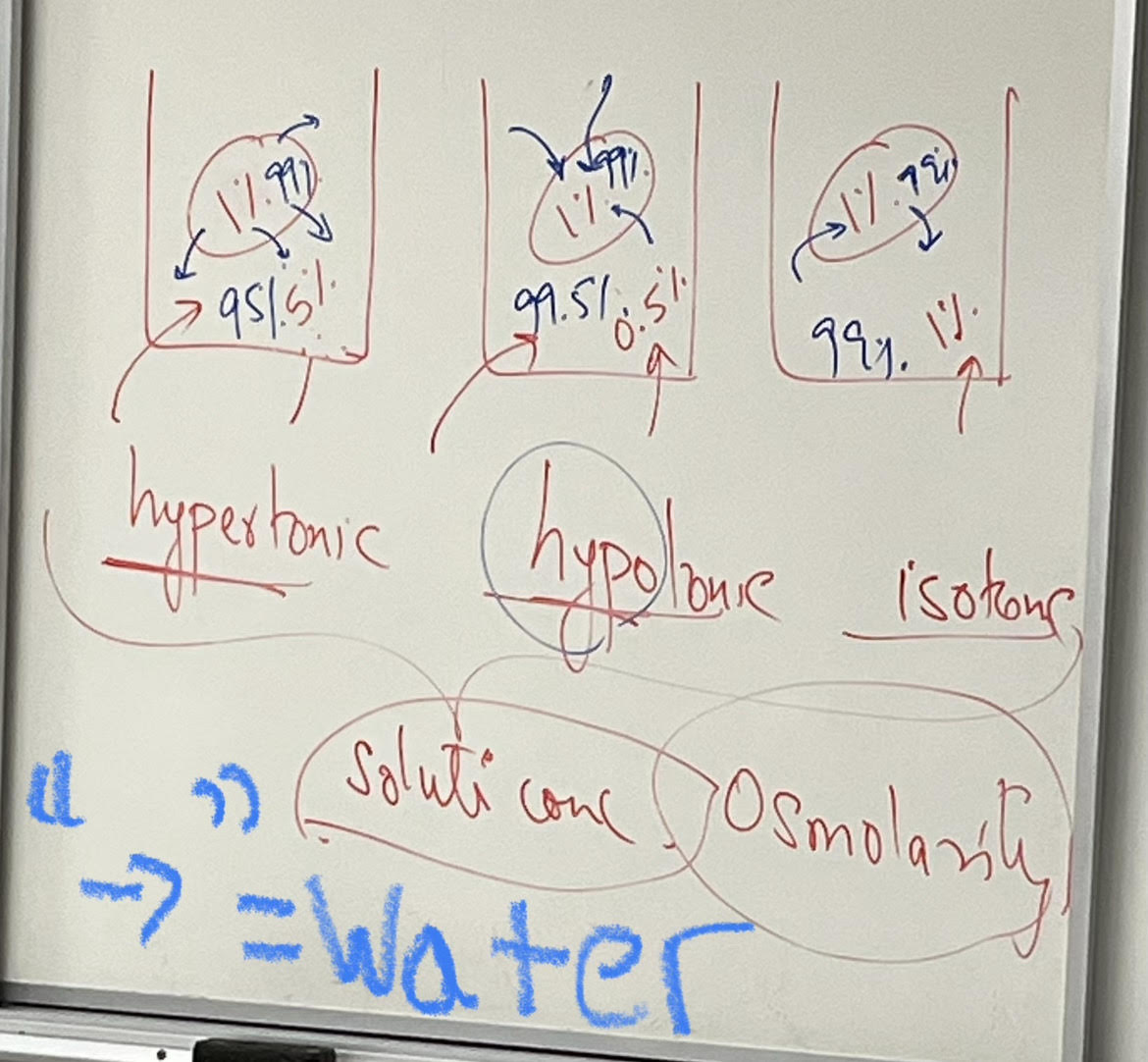
Isonotic solution
Solution concentration is the same for substance and cell
In an isotonic solution, the rate of water into the cell
Is the same as the rate of water out of the cell
Water moves from _____ to _____ (Hyper/hypo/iso)
From hypotonic to hypertonic
Water moves from _____to _____ (High/low water potential)
From high to low potential
Water moves from ______ to ______ (high/low osmolarity)
Low to high osmolarity
Osmolarity
Solution concentration
Sucrose diverges into ___ constants, NaCl diverges into __ constants (i in iCRT)
1, 2
 Note
Note  Flashcards (33)