Lecture 4 - The Complement System
 Call Kai
 Learn
Learn Practice Test
 Spaced Repetition
 Match
Match Flashcards
 Knowt Play
1/71

There's no tags or description
Looks like no tags are added yet.
Name | Mastery | Learn | Test | Matching | Spaced | Call with Kai | Chat |
|---|
No analytics yet
Send a link to your students to track their progress
72 Terms
Where are complement proteins mainly produced
Liver
Opsonization
Coating of a pathogen with antibodies/complement proteins so that it can be more readily taken and destroyed by phagocytic cells
Complement system is composed of more than how many proteins
30
Main function of the complement system
Soluble plasma proteins that act to opsonize and lyse pathogens
Complement proteins circulate in inactive forms, they are activated in the presence of
Pathogens or antibodies bound to pathogens
3 different proteolytic pathways that lead to complement activation in order
Alternative pathway, Lectin pathway, Classical pathway
Zymogen
An inactive complement protein in your body
Proteases
Enzyme that breaks proteins
When do zymogens become enzymatically active
After proteolytic cleavage by another complement protein
Complement pathways are triggered by proteins that act as ___ to detect the presence of pathogens
PRRs
What are the 3 distinct effector pathways, end product
Inflammation, phagocytosis, membrane attack
Complement fixation
Activation of complement proteins promotes the attachment of specific proteins to the pathogen surface to serve as opsonin to be recognized for phagocytosis
Inactive complement protein nomenclature
Simple letter and number, ex. C1 and C2
Order of complement protein discovery
C1, C4, C2, C3, C5, C6, C7, C8, C9
Is C3a or C3b the larger fragment
C3b
Exceptions to the nomenclature of cleaved proteins
C2a is the larger fragment, C1 is made of C1q, C1r, C1s
What are the complement proteins that are not involved in all 3 pathways and which ones are they in
C1 - Classical
C2 - Classical and Lectin
C4 - Classical and Lectin
Lectin pathway: What are the soluble carbohydrate-binding proteins that initiate the pathway
Mannose-binding lectin (MBL) and ficolins
Lectin pathway: What do MASPs do (MBL-associated serine proteases)
Trigger the cleavage of complement proteins and activation of the pathway
Classical pathway: What initiates it
When C1 recognizes a microbial surface directly or binds to antibodies already bound to a pathogen
Alternative pathway: What initiates it
Spontaneous hydrolysis and activation of C3, which can bind directly to microbial surface - C3 Tickover
What step do all 3 pathways of complement activation converge at
C3 Convertase
What is C3 convertase
Enzyme that cleaves C3 into C3a and C3b to activate it
What are the functions of C3a and C3b
C3b is an opsonin coating the surface of the pathogen (opsonization), C3a is the lost smaller fragment that aids in inflammation
All pathogens generate ____ to lead to the formation of ___ to disrupt cell membranes
C5 convertase, membrane-attack complex (MAC)
What is an anaphylatoxin (C3a)
Molecules capable of activating an inflammatory response by triggering degranulation of cells capable of inducing inflammation
What bond do opsonins attach to the pathogen surface
Covalently
What kind of bond does inactive C3 have
Thioester bond
What happens when C3s Thioester bond is exposed after breaking
Pathogen will use the Thioester bond to attach
What if the pathogen doesn’t attach to the Thioester bond right away
Water will attack to make it soluble and get lost in the blood
What are the C3 and C5 convertases of the Alternative pathway
C3bBb and C3b(2)Bb
What is CRP (classical pathway)
Acute-phase protein made mainly by the liver during inflammation
Lectin pathway: Mannose-binding lectin and ficolins form complexes with what and recognize what
Serine proteases to recognize particular carbohydrates on microbial surfaces
Lectin pathway: What does MBL recognize on microbes
Repetitive carbohydrates like mannose, fucose, GlcNAc
Lectin pathway: Why does MBL avoid binding sialic acid residues on host cells
Pathogens don’t have it, complement distinguishes self vs. non-self
Lectin pathway: Ficolins have ___-like domains and recognize ____
Fibrinogen-like domains and recognize acetylated sugars
Lectin pathway: What are the five proteins MBL in plasma binds to
MBL-associated serine proteases: MASP-1, MASP-2, MASP-3
Non-enzymatic proteins: MAp19, MAp44
First MASP-2 associated with MBL or ficolin to cleave what
C4 to C4a and C4b
After C4 is cleaved, C4b binds to what to form what
C2 to be cleaved and form C4b2a complex
Once C4b2a is formed, what is it and what does it do
Active C3 convertase to cleave C3 and create multiple C3b for pathway and binding to pathogen surface
Lectin pathway: What is the key enzyme for initiating complement
MASP-2
Classical pathway: What does C1q do in its active form
Bind directly to pathogen surfaces or indirectly to antibody body to pathogens to allow autoactivation of C1r
Alternative pathway: C3 is not completely stable so it undergoes spontaneous hydrolysis to form
iC3
Alternative pathway: What is a Tickover
Production of iC3 is accelerated in the presence of a pathogen
Alternative pathway: After iC3 is formed, what does Factor B do to it
Hydrolyzes it
Alternative pathway: What happens to iC3 after it is hydrolyzed
Become iC3Bb - fluid phase convertase in plasma
Alternative pathway: What cleaves Factor B to activate it and become a subunit of C3
Factor D
Alternative pathway: iC3Bb acts as what to continue cleaving more C3
C3 convertase
Alternative pathway: Surface bound C3b binds another molecule of Factor B, what happens and what is formed
Factor D cleaves it again to leave Bb attached - forming C3bBb
Alternative pathway: What is C3bBb
Alternative C3 convertase bound to surface of pathogen
Which pathway is an amplification loop for C3b formation accelerated by properdin in the presence of pathogens
Alternative pathway
What is properdin
Plasma protein that helps stabilize C3 convertase of the Alternative pathway since C3bBb on the surface of the pathogen is not very stable
What makes Properdin
Neutrophils
C3bBb convertase activity in the Alternative pathway is the equivalent of what
C4b2a in the lectin and classical pathways
How does the Alternative pathway amplify the classical or lectin pathway
Forming an alternative C3 convertase and depositing more C3b molecules on the pathogen
Why do human cells express membrane proteins that inhibit complement proteins
To ensure C3b fixation on host cell surface does not result in targeting these cells for destruction
DAF (decay-accelerating factor) function
Breakdown alternative C3 convertase, C3bBb → C3b + Bb
MCP (membrane cofactor protein) function
Binds to C3b and enhances its cleave to inactive iC3b by factor I, C3b → iC3b

DAF associates with C3bBb so that Bb is let go and the reaction stops

MCP associated to C3bBb so Bb is lost and tehn factor I enhances cleavage to inactive iC3b
iC3b is inactive and can’t do downstream reactions but it can still act as
An opsonin
What does Factor H do to regulate complement activation
Enhances cleave of C3b into iC3b by Factor I
What does Factor H interact with to bind to cell membranes
Sialic acid
How do some pathogens reduce complement activation
Mimic host surfaces by displaying Sialic acid and recruit Factor H through microbial proteins
What binds to complement proteins fixed on the surface of a pathogen to allow for recognition and phagocytosis
Cell-surface receptors
iC3b is a ligand for which complement receptors (PRRs)
CR3 and CR4
What are the 5 complement proteins that make up the Membrane-Attack Complex (MAC)
C5, C6, C7, C8, C9
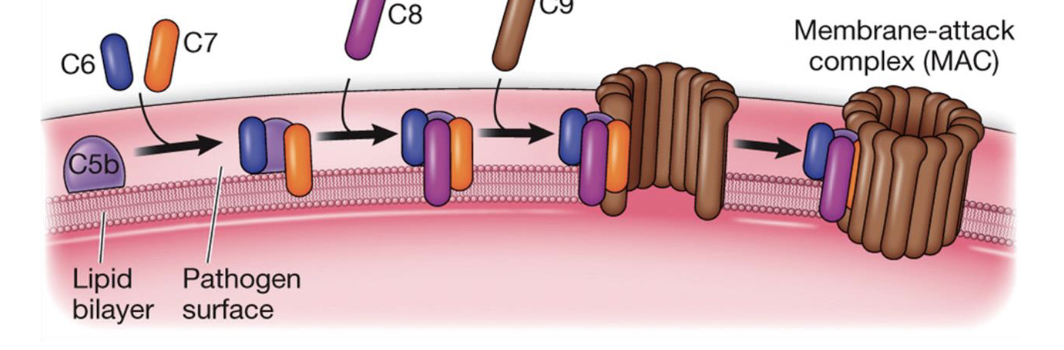
Which complement protein functions as an initiating factor in the formation of the MAC
C5b
If plasma proteins block insertion and assembly, at which complement protein will MAC stop
C7
Examples of plasma proteins
S protein, clusterin, factor J
What step do human cell-surface proteins block
Final pore-forming step of complement
Human cell-surface protein exmaples
CD59, HRF