5.1-5.22 Solids, liquids and gases
 Call Kai
 Learn
Learn Practice Test
 Spaced Repetition
 Match
Match Flashcards
 Knowt Play
1/31

There's no tags or description
Looks like no tags are added yet.
Name | Mastery | Learn | Test | Matching | Spaced | Call with Kai | Chat |
|---|
No analytics yet
Send a link to your students to track their progress
32 Terms
What is density?
The mass per unit volume of a material
What are the units of density?
kg/m³
Are gases or solids denser? And why?
Solids are denser as they have a smaller volume but equal mass compared to gases
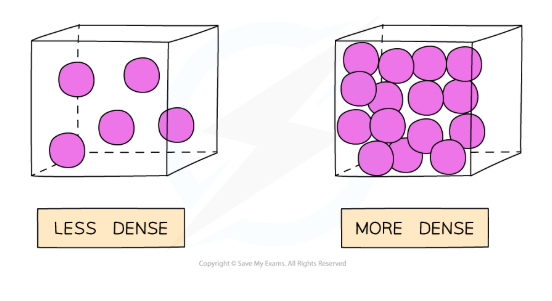
What piece of apparatus do we use to determine the density of irregularly shaped objects?
A eureka can
What is pressure?
The force per unit area
What are the units of pressure?
Pa or N/m²
What is a fluid?
A fluid is a liquid or a gas
The pressure is exerted evenly across the whole surface of the fluid and [ ] [ ] [ ]
In all directions
What is the equation for pressure difference at different depths?
P = ρ × g x ∆h
What is the particle arrangement in solids?
Regular arrangement in rows, particles in a lattice, fixed shape
How are solids different to fluids?
Solids are incompressible
What is the particle motion in a solid?
Particles vibrate about a fixed point
When the temperature of the solid increases, how does this change the particle motion?
Amplitude and frequency of the vibrations increases with the temperature of the solid
What is the particle arrangement in a liquid?
Random, closely packed arrangement
What do liquids have which is not definite, and what is definite?
Liquids have no definite shape, but have a definite volume
What is the particle motion in a liquid?
The particles slide over each other
What is the particle arrangement in a gas?
Particles are far apart and move randomly. Gases are compressible
What are the two ways fo calling the change in state from gas to solid?
Deposition/desublimation
What is specific heat capacity?
The amount of energy required to raise the temperature of 1 kg of the substance by 1 degree C (J/kg °C)
What is the SHC equation?
Change in thermal energy = mass x specific heat capacity x change in temperature
What happens at absolute zero?
The particles in a gas no longer exert pressure
What is absolute zero defined as?
The temperature at which the molecules in a substance have zero kinetic energy
What is 0 K equal to in Celsius?
-273 degrees C
If you have Celsius, what must you do to get Kelvin?
Add 273
The temperature (in Kelvin) is [ ] to the average kinetic energy of the molecules
Proportional: T ∝ KE
If the temperature of a gas remains constant, the pressure of the gas changes when it is either…
Compressed (decreases the volume, which increases the pressure)
Expanded (increases the volume which decreases the pressure)

What can be used to remove air from a sealed container?
A vaccuum pump
What three terms MUST you use when describing links between pressure&volume and pressure&temperature?
Collision
Kinetic energy
Frequency
What is the equational relationship between the pressure and KELVIN temperature for a fixed mass of gas at a constant volume?
P1/T1 = P2/T2
When using gas laws what must the temperature always be?
The temperature must always be in KELVIN!
What is Boyle’s Law equation?
P1V1 = P2V2
If the gas has been compressed, the final pressure is expected to be [ ] than the initial pressure
More