Case 14: On My Tippy Toes
 Call Kai
 Learn
Learn Practice Test
 Spaced Repetition
 Match
Match Flashcards
 Knowt Play
1/42

There's no tags or description
Looks like no tags are added yet.
Name | Mastery | Learn | Test | Matching | Spaced | Call with Kai | Chat |
|---|
No analytics yet
Send a link to your students to track their progress
43 Terms
True
Most lameness in the horse occurs in the distal limb (distal to the carpus/tarsus).
TRUE OR FALSE
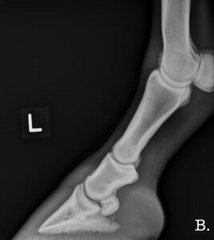
Lateral
What radiographic projection is this?
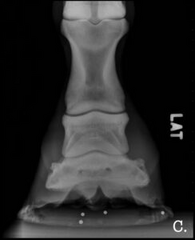
DP
What radiographic projection is this?
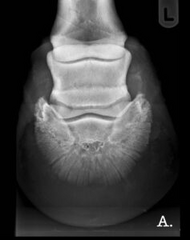
65 degree proximal palmerodistal
What radiographic projection is this?
Skyline
What radiographic projection is this?
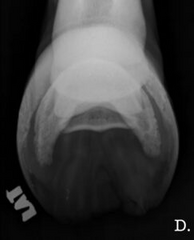
Proximal phalanx (P1)
What is A?
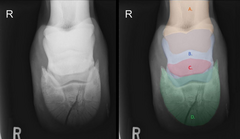
Middle Phalanx (P2)
What is B?
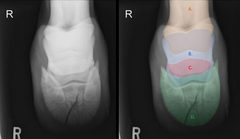
Navicular bone
What is C?
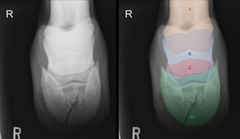
Distal Phalanx (P3)
What is D?
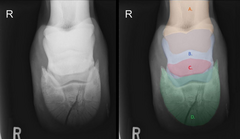
False
justification: P3 is coffin, P2 is short pastern
Another term for the distal phalanx (P3) is the short pastern.
TRUE OR FALSE
A = proximal interphalangeal joint (pastern joint)
B = distal interphalangeal joint (coffin joint)
Identify the labeled joints, A and B
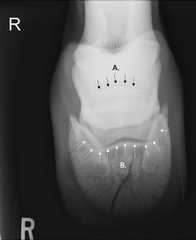
A single 65-degree proximal palmerodistal view of the RF foot is available for review.
Describe the study
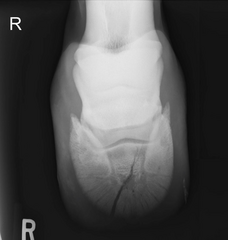
Patient positioning is adequate for interpretation.
Study technique is adequate for interpretation.
Describe the patient positioning and technique
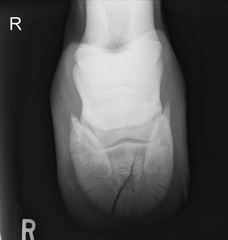
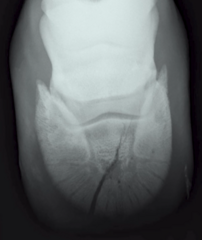
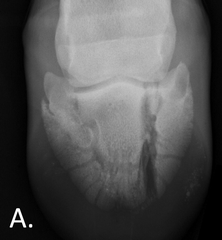
An oblique, minimally displaced fracture coursing from dorso-lateral to palmar-medial, centered over midline is present in P3. The fracture involves the medial articular surface of P3.
Describe the findings of this study
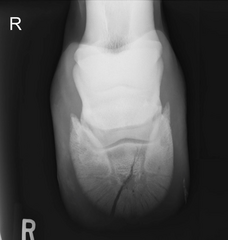
Type II P3 fracture, RF
Describe the conclusions of this study
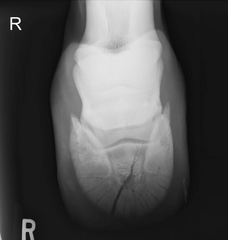
Consultation with a surgeon to discuss therapeutic plan.
Describe the next steps for this study
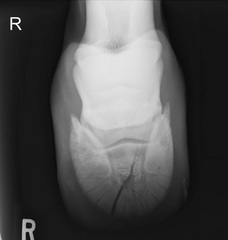
Skyline = palmar cortex of navicular
What view is being taken here? What special structure can be visualized with this view?
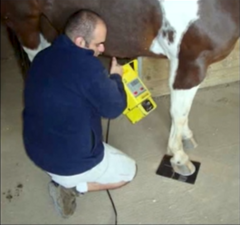
65 degree proximal palmerodistal (65 DP)
What view is being taken here?
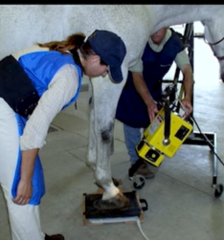
P3 does NOT proliferate because the periosteum is not well developed (will have fibrous union instead), but P2 will
What does the coffin bone (P3) typically NOT DO when responding to injury?
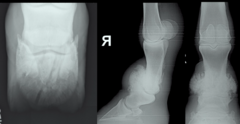
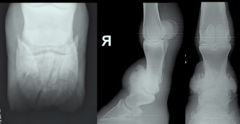
Ringbone
What is this proliferation called?
Type 1, nonarticular palmar/plantar process
Which type of fracture is the yellow line?
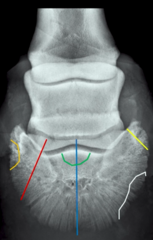
Yellow
Which color is a type 1, nonarticular palmar/plantar process fracture?
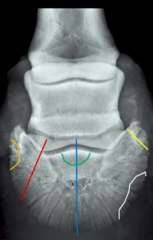
Type 2, articular extending from DIP to solar margin
Which type of fracture is the red line?
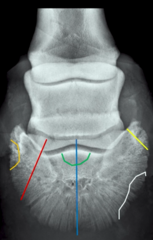
Red
Which color is a type 2, articular extending from DIP to solar margin?
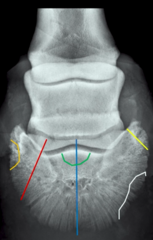
Type 3, articular mid-sagittal, divides into equal parts
What type of fracture is the blue line?
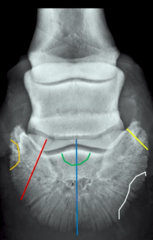
Blue
Which color is a type 3, articular mid-sagittal fracture?
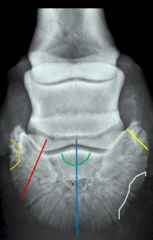
Type 4, articular extensor process
What type of fracture is the green line?
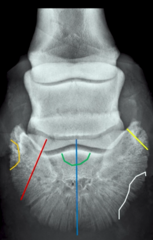
Green
Which color is a type 4, articular extensor process fracture?
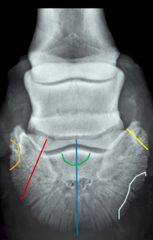
Type 5, articular comminuted body and Type 6, on solar margin
What type of fracture is the white line?
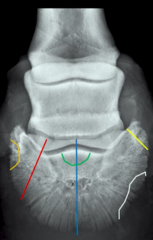
White
Which color is a type 6, solar margin fracture?
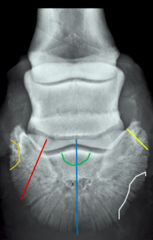
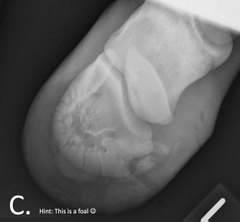
Type 7, solar border of palmar/plantar process in foals
What type of fracture is the orange line (left side)?
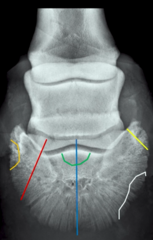
Orange
Which color is a type 7, solar border of the palmar/plantar process fracture in foals?
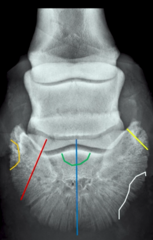
16 weeks (4 mo.)
About how long does it take for fractures of P3 to heal in horses?
Lateral
Where will the marker be on a radiograph? Medial or lateral side?
Coffin joint
The distal interphalangeal joint is also called what?
False
It is not uncommon for the distal phalanx (P3) to respond to trauma, like a fracture, with a prolific periosteal reaction.
TRUE OR FALSE
Type II = articular fracture that extends from articular surface thru solar margin
Which fracture type is this?
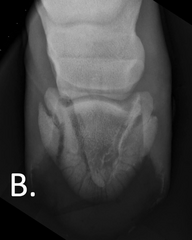
Type I = involves palmar process but not articular
Which fracture type is this?
Type VII = solar border in a foal
Which fracture type is this?
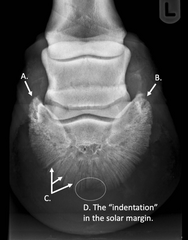
d. medial palmar process of P3
What is A?
a. vascular channels
b. lateral palmar processes of P3
c. crena marginis solaris
d. medial palmar process of P3
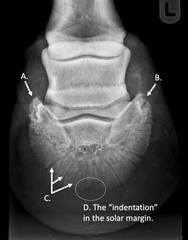
b. lateral palmar processes of P3
What is B?
a. vascular channels
b. lateral palmar processes of P3
c. crena marginis solaris
d. medial palmar process of P3
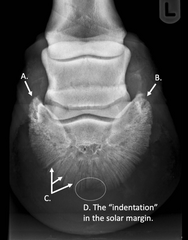
a. vascular channels
What is C?
a. vascular channels
b. lateral palmar processes of P3
c. crena marginis solaris
d. medial palmar process of P3
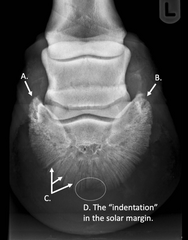
c. crena marginis solaris
What is D?
a. vascular channels
b. lateral palmar processes of P3
c. crena marginis solaris
d. medial palmar process of P3