Word Order
 Call Kai
 Learn
Learn Practice Test
 Spaced Repetition
 Match
Match Flashcards
 Knowt Play
1/45

There's no tags or description
Looks like no tags are added yet.
Name | Mastery | Learn | Test | Matching | Spaced | Call with Kai | Chat |
|---|
No analytics yet
Send a link to your students to track their progress
46 Terms
A German sentence will only start with a verb
if it’s a ‘___ / ___’ question or a _________.
yes, no, command
Magst du Fußball?
Do you like football?
Komm schnell mit!
Come with me quickly!
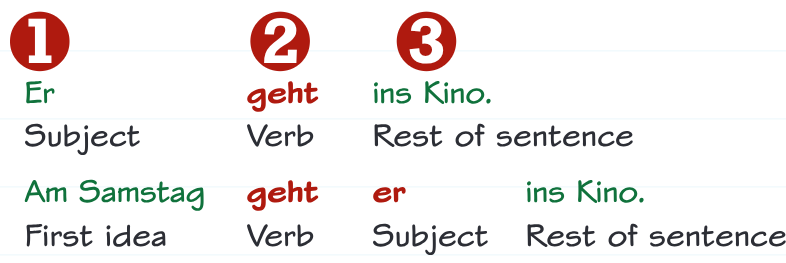
If a word or phrase is added to the start of a sentence, you ______ the verb and subject (swap
them around), so that the verb is back in _______ place.
invert, second
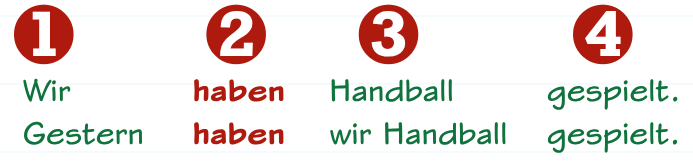
The part of haben / sein is the main verb, so is in
_______ position, and the _____ ________ goes at
the end.
second, past participle
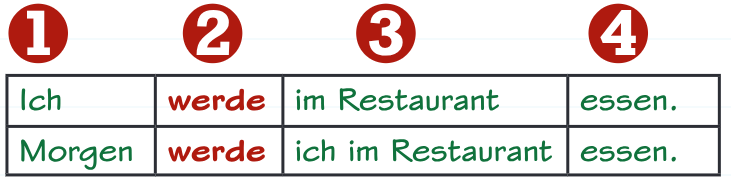
The part of werden is the main verb, so is
in _______ position, and the ________ goes
at the end.
second, infinitive
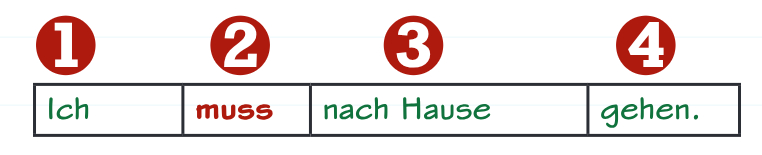
The part of müssen / wollen / sollen / können, etc. is the main verb, so is in _______ position, and the ________ is at the end.
second, infinitive
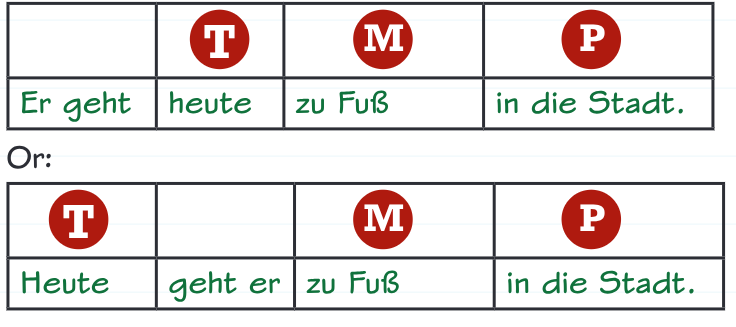
______– ________– ______ (TMP) is the order in
which information should appear in a sentence.
Time, Manner, Place
When you negate a sentence, you must put nicht
in the correct position.
Nicht will precede:
an ________ at the end of a sentence
an _________ at the end of a sentence
a _____ ________ at the end of a sentence
a __________ _____at the end of a sentence
or:it will be the ____ word.
adjective, infinitive, past participle, separable verb, last
Er ist nicht intelligent.
He is not intelligent.
Ich werde nicht heiraten.
I will not get married.
Wir haben nicht gegessen.
We have not eaten.
Er kommt nicht mit.
He’s not coming with us.
Ich verstehe nicht.
I don’t understand.
Write this sentence in the correct order:
mit seiner Familie / fährt / mein
Freund / Jeden Sommer / in den Urlaub.
Jeden Sommer, fährt mein Freund mit seiner Familie in den Urlaub.
Write this sentence in the correct order:
ein spannendes Fußballspiel / wir /
Gestern / gesehen / haben.
Gestern haben wir ein spannendes Fußballspiel gesehen.
Write this sentence in the correct order:
auf die Uni / werde / Ich / gehen /
in der Zukunft.
Ich werde in der Zukunft auf die Uni gehen.
Write this sentence in the correct order:
zelten / ich / gegangen / auf dem
Land / Letztes Jahr / bin.
Letztes Jahr bin ich auf dem Land zelten gegangen.
Write this sentence in the correct order:
müssen / immer / machen / viele
Hausaufgaben / Wir.
Wir müssen immer viele Hausaufgaben machen.
Write this sentence in the correct order:
du / Kannst / später / kommen / ins Kino / ?
Kannst du später ins Kino kommen?
Write this sentence in the correct order:
will / mit dem Zug / Er / fahren /
nach Berlin.
Er will mit dem Zug nach Berlin fahren.
Um … zu + infinitive is the way to say ‘to’
when you mean ‘__ ______ __’.
in order to
Er arbeitet samstags, um Geld zu verdienen.
He works on Saturdays, (in order) to earn money.
Add a _______ before um and put zu +
infinitive at the end of the clause.
comma
Ich arbeite fleißig, um gute Noten zu
bekommen.
I work hard (in order) to get good marks.
Sie geht aus, um neue Leute kennenzulernen
She goes out (in order) to get to know new people.
With ________ verbs, zu goes between the
______ and the ______ verb as one ________ word.
separable, prefix, main, complete
These structures with zu + infinitive: _____ … zu + infinitive (without … ) and _____ … zu + infinitive (instead of … ).
ohne, statt
Er ging nach Hause, ohne auf mich zu warten.
He went home without waiting for me.
Some verbs need zu … + infinitive after them
to make sense. Use a ______, then put zu +
infinitive at the ____ of the clause.
comma, end
Ich hoffe, gute Noten zu bekommen.
I hope to get good grades.
Wir versuchen, früh ins Bett zu gehen.
We try to go to bed early.
Ich habe begonnen, gesünder zu essen.
I have started to eat more healthily.
Ich habe vor, auf die Uni zu gehen.
I plan to go to university.
Es macht Spaß, ins Kino zu gehen.
It’s fun to go to the cinema.
Es ist nützlich, Mathe zu lernen.
It’s useful to learn maths.
You can add information to a sentence by adding a relative clause starting with ‘______ / ____ / _____ /
____’, as follows.
Start with the ______ clause, which can stand on its own: Der Lehrer ist toll. The teacher is great.
Add the _______ clause, which gives extra information but can’t stand on its own:
… der uns Deutsch unterrichtet … … who teaches us German …Together: Der Lehrer, der uns Deutsch unterrichtet, ist toll.
The teacher who teaches us German is great.
which, who, whom, that, main, relative
When forming a sentence with a relative clause:
put the verb at the ____ of the relative clause
use a _______ to divide the two clauses
decide the ____ by looking at the relative clause itself.
end, comma, case
Ich habe das Buch gefunden, das du verloren hast. (nt, accusative – das Buch is the object of verloren)
I found the book which you lost.
Der Film, den wir gesehen haben, war sehr lang.
(m, accusative – den Film is the object of gesehen haben)
The film that we saw was very long.
Translate this sentence into German using um … zu:
I play sport, (in order) to be healthy.
Ich mache Sport, um gesund zu sein.
Translate this sentence into German using um … zu:
We are going to the cinema, (in order) to see a new film.
Wir gehen ins Kino, um einen neuen Film zu sehen.
Translate this sentence into German using zu + infinitive: I hope to find a job.
Ich hoffe, eine Arbeit zu finden.
Translate this sentence into German using um + infinitive: She tries to work hard.
Sie versucht, fleißig zu arbeiten
Translate this sentence into German using relative clauses: The girl who has blonde hair is called Anna.
Das Mädchen, das blonde Haare hat, heißt Anna.
Translate this sentence into German using relative clauses: The people who live here are friendly
Die Menschen, die hier wohnen, sind freundlich.