Nutrition Assessment and Consultation
 Call Kai
 Learn
Learn Practice Test
 Spaced Repetition
 Match
Match Flashcards
 Knowt Play
1/19

There's no tags or description
Looks like no tags are added yet.
Name | Mastery | Learn | Test | Matching | Spaced | Call with Kai | Chat |
|---|
No analytics yet
Send a link to your students to track their progress
20 Terms
Why Nutrition matters
It is the foundation of health and disease prevention
Good nutrition = Maximum health
decreased nutrition consults = increased disease
Increased Vet Tech Nutrition consults = Increased owner compliance = better health
Diet History - Questions
Open-ended:
“Pretend I’m your pet’s sitter…”
“What are your pet’s favorite…”
Closed-Ended
avoid yes/no/leading question
Types of treats
Rewards
What's their favorite treat without adding a whole bunch of calories of things that are bad for them
Medications
Emotional feeding
Are we feeding our pet when we are feeling different emotions
Risks of treats
Excess calories
Not nutritionally complete
Is it a complete meal with all the vitamins and nutritional requirements the pet needs
May interfere with disease management
Diabetes
Percentage of treats in the diet
they should only be10% of the diet
Identifying Nutritional Risk Factors
Historical Indicators
Physical Indicators
Risk factors - Historical Indicators
GI dysfunction, existing medical conditions
Raw/Home/Vegetarian diets
Treats > 10% of total calories
Inadequate feeding management
Risk factors - Physical Indicators
Abnormal BCS/MCS
Weight loss/gain > 10%
Poor coat, dental issues
Physical Exam Focus
Accurate Weight
Necessary for correct caloric intake calculation
Body Composition
Fat vs. Lean Mass
BCS
MCS
Signs of Malnutrition
Skeletal malformation
Coat/skin changes
Eye health
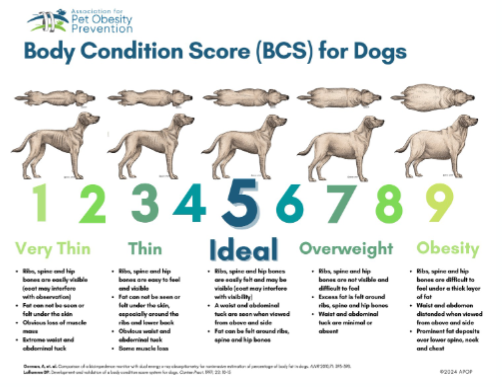
Body Condition Scoring
9 Point system
Inexpensive
Semi-quantitative
Subjective - operator dependent
Impact of breed and hair coat
% body fat by species and gender
Focus on fat, not lean mass
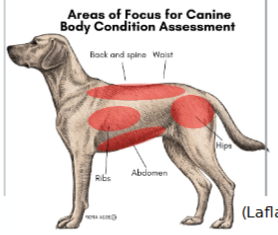
Focus Area for a BCS
Ribs
Abdomen
Pelvis/Hips
Thoracic/Lumbar region
BCS - Dog
Chart - Dog
BCS - Cat
Chart - Cat
Cats have a primordial pouch

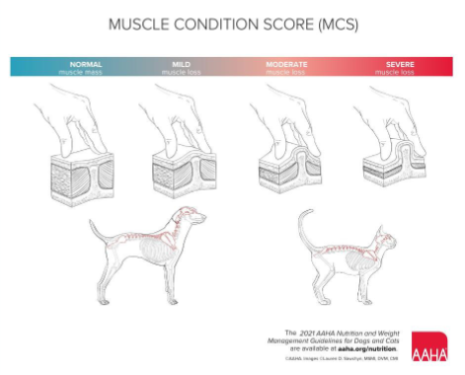
Muscle Condition Scoring
4 point system
Inexpensive
Semi-quantitative
Subjective - operator dependent
Impact of breed and hair coat
Overcoat syndrome
Fat hides muscle loss
Common in sick cats
% muscle by species and gender
Focus on lean muscle mass, not fat
Focus area for MCS
Temporal muscle
Scapula
Lumbar vertebrae
Pelvis
Boney prominences for MCS
Sagittal crest
Scapular spine
Spinous process
Wing of ilium
Greater trochanter
MCS
Chart
Evaluating Pet Food - WSAVA Guidelines
Does the manufacturer employ veterinary nutritionists?
Where is the food production facility located
USA or Foreign production?
Where are the ingredients sourced
Is the company's contract information readily available?
Are you able to consult with a nutritionist on staff?
Are there quality control measures in place?
What are the quality control parameters?
Is the company willing to share a full nutrient analysis?
Evaulating Pet food - AAFCO Guidelines
Questions:
Does the manufacturer create diets based on formulations or feeding trials
Formulation:
Follow a recipe
Does the diet meet AAGCO nutrient profiles?
Label says: "Formulated to meet …"
Feeding Trial:
Fed to actual animals
Measured feeding outcomes
Was the feeding trial completed for a specific life stage?
Label says: "Animal feeding tests using AAFCO procedures…"
Putting it all together for a nutritional assessment
Step 1: Assessment and History
Step 2: Determine Ideal Weight
Step 3: Calculate food dose
Step 4: Discuss Plan with Owner
Step 5: Make specific recommendations
Step 6: Recheck Monthly
Step 7: Follow up