Sensation & Perception - Chapter 6: Space Perception and Binocular Vision (Space Perception and Binocular Vision)
 Call Kai
 Learn
Learn Practice Test
 Spaced Repetition
 Match
Match Flashcards
 Knowt Play
1/35

There's no tags or description
Looks like no tags are added yet.
Name | Mastery | Learn | Test | Matching | Spaced | Call with Kai | Chat |
|---|
No analytics yet
Send a link to your students to track their progress
36 Terms
The philosophical position arguing that there is a real world to sense is known as
realism
According to Euclidean geometry, parallel lines _______ as they extend through space.
remain parallel
_______ is the difference between the two retinal images of the same scene. It is the basis of stereopsis.
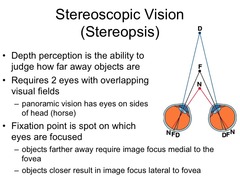
Binocular disparity
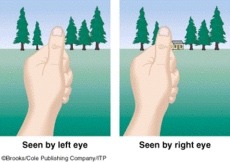
Which of the following is not a monocular cue?
a. Occlusion
b. Relative size
c. Binocular disparity
d. Texture gradient
e. Aerial perspective
c. Binocular disparity
________ provide(s) precise quantitative information about distance in the third dimension.
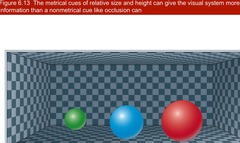
Metrical depth cues
Which of the following is a metrical depth cue?
a. Motion parallax
b. Aerial perspective
c. Linear perspective
d. Stereopsis
e. Convergence
d. Stereopsis
As a depth cue, occlusion provides _______ information.
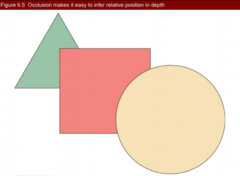
nonmetrical depth
Using the _______ depth cue you can tell far away something is based on how much detail is visible in the elements on the ground between you and the object.
texture gradient
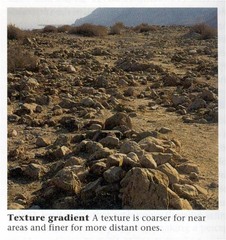
The image below depicts the depth cue of
relative height
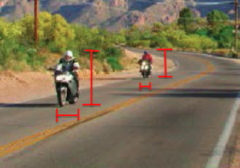
The image below depicts the depth cue of...
familiar size
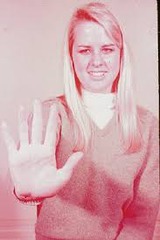
The scene pictured below demonstrates the _______ depth cue.
aerial perspective

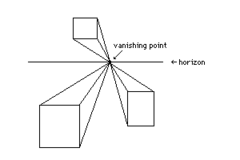
The diagram below illustrates the _______ depth cue.
linear perspective
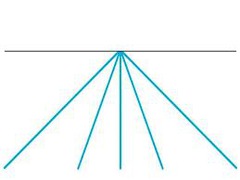
Parallel lines in the world appear to meet at a single location called the
vanishing point
_______ is an important depth cue that comes into play during head movements.
Motion parallax
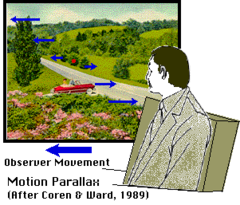
When driving in a car, the fact that light posts by the side of the road move faster across your eye than distant buildings do is known as the visual cue of
motion parallax
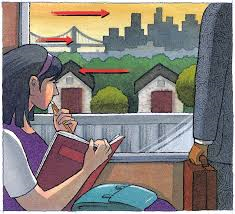
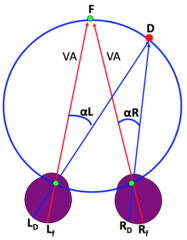
Turning the two eyes inward to place the two images of a feature in the world on corresponding locations in the two retinal images is known as
convergence
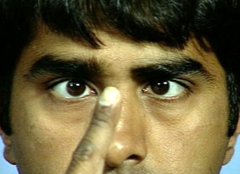
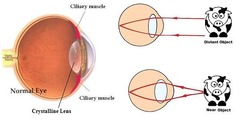
The process by which the eye changes its focus by adjusting the lens is called
accommodation
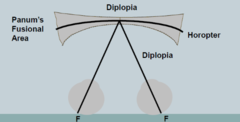
The imaginary circle in the figure below is known as
the horopter
_______ is the surface of zero disparity, or the location of objects whose images lie on corresponding points in the two eyes.
The horopter
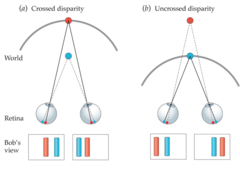
The difference between crossed disparity and uncrossed disparity is that crossed disparity involves objects that are _______ the plane of fixation, while uncrossed disparity involves objects that are _______ the plane of fixation.
in front of; behind
The figure below depicts a(n)
stereoscope
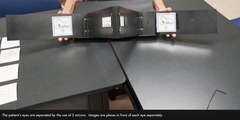
During free fusion, the eyes _______ in order to view a stereogram without a stereoscope.
converge or diverge
Stereoblindness usually results from which of the following?
a. Stroke
b. Visual neglect
c. Childhood disorder
d. Agnosia
e. Glaucoma
c. Childhood disorder
A random dot stereogram contains
no monocular cues
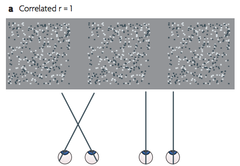
The figure below is an example of
a random dot stereogram
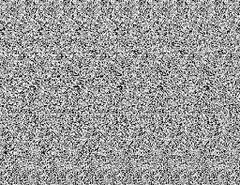
The theoretical significance of random dot stereograms is that they show that
a. accommodation and convergence cannot be uncoupled.
b. stereo vision can be achieved only with identifiable shapes.
c. stereo vision can be achieved without identifiable shapes.
d. the parvocellular system cannot perceive stereo.
e. None of the above
d. the parvocellular system cannot perceive stereo
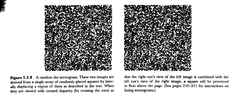
The problem of determining which bit of the image in the left eye should be matched with which bit of image in the right eye is known as the
correspondence problem
Which of the following cannot be used to solve the correspondence problem?
a. A low spatial frequency version of the image
b. The uniqueness constraint
c. The continuity constraint
d. The disparity constraint
e. All of the above can be used to solve the correspondence problem.
d. The disparity constraint
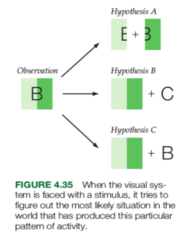
The _______ is based on the idea that prior knowledge could influence the estimates of the probability of a current event.
Bayesian approach
In _______, known information is combined in an optimal way using Bayes' theorem to determine the best possible performance of someone using that information.
ideal observer analysis
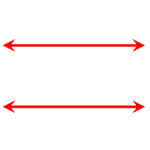
In the illusion below, the viewer mistakes the horizontal lines to be
of different lengths
If the two images below are free fused, they lead to
binocular rivalry
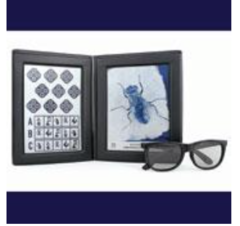
_______ is a measure of the smallest binocular disparity that can generate a sensation of depth.
Stereoacuity
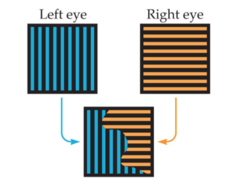
_______ refers to the presentation of two stimuli, one to each eye.
Dichoptic
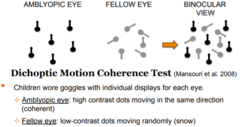
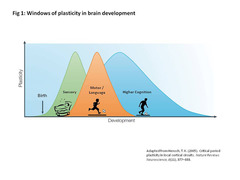
If normal binocular visual stimulation is not experienced during _______ then proper stereo vision might not develop.
the critical period
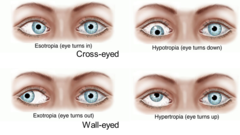
_______ disrupts binocular vision because one or both eyes are not aligned properly.
a. Strabismus
b. Hyperopia
c. Emmetropia
d. Presbyopia
e. All of the above
a. Strabismus