Chapter 20 - Breasts
 Call Kai
 Learn
Learn Practice Test
 Spaced Repetition
 Match
Match Flashcards
 Knowt Play
1/28

There's no tags or description
Looks like no tags are added yet.
Name | Mastery | Learn | Test | Matching | Spaced | Call with Kai | Chat |
|---|
No analytics yet
Send a link to your students to track their progress
29 Terms
What are some things to ask during subjective data collection?
lumps/swelling?
skin changes?
size/firmness changes?
pain?
nipple discharge?
health and family hx?
lifestyle + meds?
screenings/self-awareness?
Are lumps in the breast always abnormal?
No, they can be present in benign breast conditions (fibrocystic breast disease, fibroadenomas)
Dimpling/retracting of the breasts/nipples may indicate _____
possible cancer
One-sided increase in size/firmness may indicate ___
inflammation, pregnancy, or abnormal growth
If a pt complains of lumps/swelling in breast, what should you always ask?
If the lump changes during the menstrual cycle; this is often related
Describe abnormal nipple discharge
spontaneous, unilateral, bloody
What factors in a persons health hx increase risk of breast cancer?
prior breast dx/surgery/trauma
early period (before age of 12)
late menopause (after 52)
first child after 30
What is the best time to do a breast exam?
1 exam after menstruation
What are some lifestyle habits that increase the risk of breast cancer?
high fat diet
alcohol consumption (>2 a day)
smoking
caffeine intake (worsens fibrocystic symptoms)
What is galactorrhea
a condition where the breasts leak milk when a person is not pregnant or nursing a baby
What are meds/treatments that cause breast changes or galactorrhea?
hormones
oral contraceptive pill
antipsychotics
opioids
radiation/chemical exposure (increase risk of cancer)
What are important screening measures?
self-exam
mammogram baseline and annually after 40
In what position should the breasts be palpated?
Lying supine w/ back shoulder blade slightly elevated and arm overhead
How do you palpate the breasts?
Use pads of your 3 fingers. Go from light to med to deep palpation in each location
What is an important area to palpate? Why?
The Axillary Tail of Spence because most breast cancers develop there. This region has the highest volume of glandular and ductal tissue
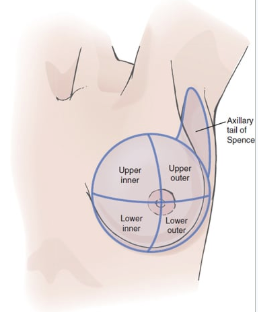
What are the common palpation patterns?
Vertical strip, spokes on a wheel, concentric circles
And of course - include tail of spence!!!!
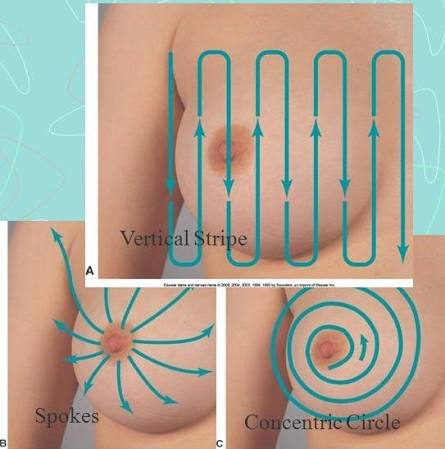
What findings in the lymph nodes in axillae likely indicate cancer?
Not painful, irregular borders
What are major risk factors for breast cancer?
alcohol use
BRCA1/BRCA2 gene
strong family hx
obesity or low bmi
no pregnancy or first child after 30
early period/late menopause
List abnormal breast findings that suggest malignancy
Peau d’orange
Dimpling
Nipple inversion
Nipple discharge (seen in carcinoma, paget’s disease)
Retracted breast tissue
What are other abnormal breast findings that don’t indicate malignancy?
Lactation disorders (plugged duct, abscess, mastitis)
Male breasts (gynecomastia)
What’s the difference b/w a radical mastectomy and modified radical mastectomy?
Radical mastectomy - removes the entire breast, underarm lymph nodes, and chest muscles
Modified radical mastectomy - removes the breast and underarm lymph nodes but leaves the chest muscles intact
What is fibrocystic breast disease?
Benign breast disease marked by round, elastic, defined, tender, and mobile cysts
Fibrocystic breasts are normal two weeks prior to period, then lumps decrease in size during period and a week after
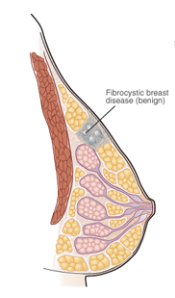
At what age is fibrocystic breast disease most common?
From age 30 to menopause, then it decreases
Describe cancerous tumors
Irregular, firm, hard, not defined masses that can be fixed or mobile
At what age do cancerous tumors typically occur?
After age 50
What are fibroadenomas?
Lobular, ovoid, or round lesions
Firm and well-defined, rarely tender, singular and mobile
At what age are fibroadenomas common?
B/w puberty and menopause
How often do you perform breast self exam?
Monthly, one week after period
Describe Paget’s disease
Form of cancer that affects the nipple and surrounding areola. Looks like a red, scaly, crusty skin rash