Exam 1
 Call Kai
 Learn
Learn Practice Test
 Spaced Repetition
 Match
Match Flashcards
 Knowt Play
1/97

There's no tags or description
Looks like no tags are added yet.
Name | Mastery | Learn | Test | Matching | Spaced | Call with Kai | Chat |
|---|
No analytics yet
Send a link to your students to track their progress
98 Terms
4 Cellular Microorganisms and examples
Fungi (yeasts, molds), Protists (algae, protozoa, slime molds), Bacteria (Escherichiacoli), and Archaea (methanogens).
Acellular organisms
Viruses (composed of protein and nucleic acid), Viroids (composed of RNA), Virusoids (composed of RNA), and Prions (misfolded protein)
What are the 3 domains
Bacteria, Archaea, and Eukarya.
Domain Archaea
unique rRNA sequences, lack of peptidoglycan in cell walls, and unique membrane lipids; many live in extreme environments.
Svedbergs (S)
A unit used to measure how fast molecules settle down in a centrifuge, used to distinguish ribosome sizes (e.g., 70S vs 80S).
Would you find sterols (cholesterol) in bacterial cytoplasmic membrane?
No, bacteria membranes have hopanoids. Archaea have isoprenes
Size of ribosomal subunits?
Prokaryotes = 70S (50+30). Eukaryotes have 80S (60+40)
T/F, archaea have peptidoglycan in their cell walls?
False
Viruses
The smallest of all microbes, require a host cell to replicate. Composed of protein and nucleic acid
Viroids and Virusoids
Infectious agents composed of RNA.
Prions
Infectious agents composed of misfolded proteins.
Characteristics of a living cell
Energy use/metabolism, respond to environmental stimuli, homeostasis, growth/development, reproduction, biological evolution
What organism can defy the dental dogma of molecular biology?
Retroviruses
Antony van Leeuwenhoek
The first person to accurately observe and describe microorganisms
Francesco Redi
Discredited spontaneous generation by demonstrating that maggots on decaying meat came from fly eggs.
John Needham
Broths in flasks: boiled then sealed = broth became contaminated
Lazzaro Spallanzani
Broth in flasks: sealed first then boiled = no growth of microorganisms
John Tyndall
Demonstrated that dust carries microorganisms. Provided evidence for the existence of exceptionally heat-resistant forms of bacteria.
Louis Pasteur
Flasks with long curved necks. Break the necks = no longer sterile. Pebrine disease of silkworms caused by protozoan.
Ferdinand Cohn
Discovered that heat-resistant bacteria could produce endospores.
Agostini Bassi
Disease of silkworms caused by fungus
M.J Berkeley
Potato blight of Ireland caused by water mold
Heinrich de Bary
Smut and rust fungi caused cereal crop diseases
Ignaz Philipp Semmelweiss
A Hungarian doctor who concluded that handwashing could prevent childbed fever
Joseph Lister
A Scottish surgeon who implemented the use of antiseptics to clean surgical instruments to kill germs.
William Stewart Halsted
An American surgeon who became one of the first to use rubber gloves during surgery to prevent the spread of microbes.
Robert Koch
Established relationship between bacillus anthracis and anthrax. Developed Koch’s postulates (teacher Jacob Henle). Credited with development of agar, Petri dish, nutrient broth, methods for isolation
Koch’s Postulates
Organism must be isolated from pt with disease
Organism cultured outside the body (in vitro)
Isolated organism must cause disease in healthy animal
Organism must be recovered
The antibody should be detected in the pt’s serum
Limitations of Koch’s postulates (and potential solutions)
Some organisms cannot be grown in culture (study these with genomic techniques)
Asymptomatic host (measure microbial load)
Using humans is unethical (use animals)
Charles Chamberland
Porcelain bacterial filters to study tobacco mosaic disease (filtering out infectious agents)
Pasteur and Roux
Weakened viruses lose their ability to cause disease. Development of vaccines for chicken cholera, anthrax, rabies
Edward Jenner
Milkmaids that had exposure to cowpox wouldn’t get smallpox
Nosocomial Infections
Hospital-acquired infections (HAI), including urinary tract infections, surgical site infections, bloodstream infections, and pneumonia.
Micronutrients
Also known as trace elements, these include Mn, Zn, Co, Mo, Ni, and Cu; they are ubiquitous in nature and serve as enzymes and cofactors.
Autotrophs
Organisms that use CO2 as their sole or principal biosynthetic carbon source.
Heterotrophs
Organisms that use reduced, preformed organic molecules from other organisms as their carbon source.
Phototrophs
Use light as their energy source
Chemotrophs
Obtain energy from the oxidation of chemical compounds, whether organic or inorganic.
Lithotrophs
Use reduced inorganic substances as their electron source.
Organotrophs
Obtain electrons from organic compounds.
Adenosine 5'-triphosphate (ATP)
The primary energy currency of the cell, composed of adenine, ribose, and three phosphate groups.
Lag Phase
The initial phase of the microbial growth curve where cells are synthesizing new components and adapting to new conditions, but not yet dividing.
Exponential Phase
Also called the log phase; the stage where the rate of growth and division is constant and maximal, characterized by balanced growth.
Stationary Phase
The phase in a closed system where growth ceases and the total number of viable cells remains constant, often due to nutrient limitation or toxic waste accumulation.
Viable But Not Culturable (VBNC)
A hypothesis for the senescence/death phase stating that cells are alive but dormant and capable of growth only when conditions become favorable.
Acellular Agents
Entities including viruses (protein/nucleic acid), viroids (RNA only), virusoids (RNA only), and prions (proteins only).
Virion
A complete virus particle that consists of at least one molecule of DNA or RNA enclosed in a protein coat and cannot reproduce independently of living cells.
Nucleocapsid
The basic structure of all virions, composed of nucleic acid (DNA or RNA) and a protein coat called a capsid.
Protomers
The individual protein subunits that self-assemble to form the viral capsid.
Enveloped Viruses
Virions that possess an outer, flexible, membranous layer derived from the host's plasma or nuclear membranes.
T/F RNA viruses must carry in their own RNA reverse transcriptase on its genome
True
Peplomers
Also known as spikes, these are viral-encoded envelope proteins that project from the surface and are involved in attachment to host cells.
Viral genome can be
Single or double stranded DNA or RNA. Can be segmented or circular
Virion release
Nonenveloped - lyse the host cell
Enveloped - first incorporated into host membrane. Budding
Lysogeny
A relationship where a temperate phage integrates its genome into the host's genome (forming a prophage) without destroying the host cell.
Induction
The process where a prophage is triggered to initiate the synthesis of new phage particles and enters the lytic cycle.
Cocci
Spherical-shaped bacteria. Streptococci (chains), staphylococci (grape-like clusters)
Bacilli
Rod-shaped bacteria. Coccobacilli (very short rods)
Vibrios
Comma-shaped bacteria that resemble rods.
Spirilla
Bacteria with a rigid helical shape. Spirochetes (flexible helices)
Mycoplasma
The smallest known bacteria, measuring approximately 0.3μm. Does not produce a cell wall; is more resistant to osmotic pressure and can survive in hypotonic environment.
How many nm in a micrometer?
1 micrometer = 1000 nm
Where does electron transport chain occur in prokaryotes?
Plasma membrane (no mitochondrial membrane)
Amphipathic lipids
Lipids possessing both polar (hydrophilic) ends and non-polar (hydrophobic) tails.
Peripheral proteins
Membrane proteins that are loosely connected to the membrane and easily removed.
Integral proteins
Amphipathic membrane proteins that are embedded within the membrane.
Hopanoids
Sterol-like molecules found in bacteria that stabilize the plasma membrane, serving as the bacterial version of cholesterol.
Peptidoglycan (murein)
Located outside the cell membrane, unique to bacterial cell walls. Thick in gram positive (stain purple). Thin in gram negative (stain pink).
Cell wall functions
Maintain shape, protect from osmolytic lysis, protect from toxic materials, contribute to pathogenicity (ability to cause disease)
Peptidoglycan structure
Alternating sugars (N-acetylglucosamine (NAG) and N-acetylmuramic acid (NAM)) , alternating D and L amino acids
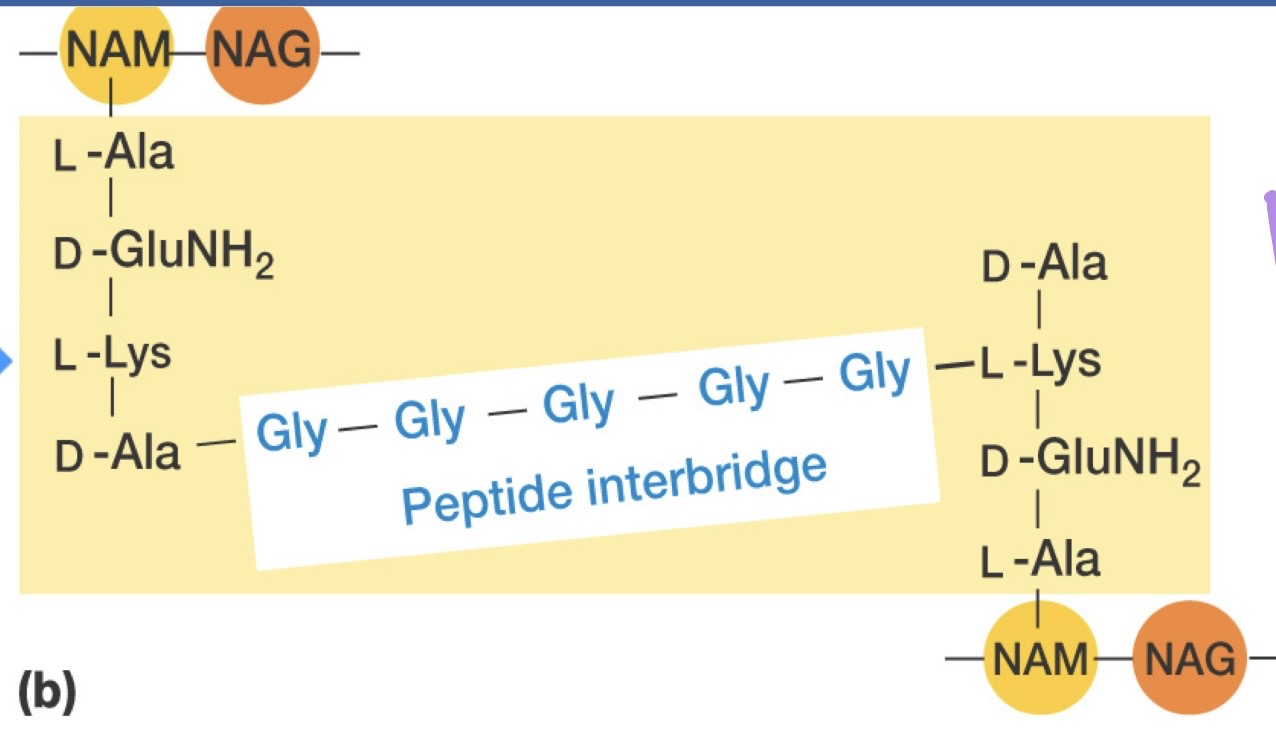
Peptidoglycan cross linkage
Helical shape. Cross-linked by peptides for strength (pentapeptide bridge)
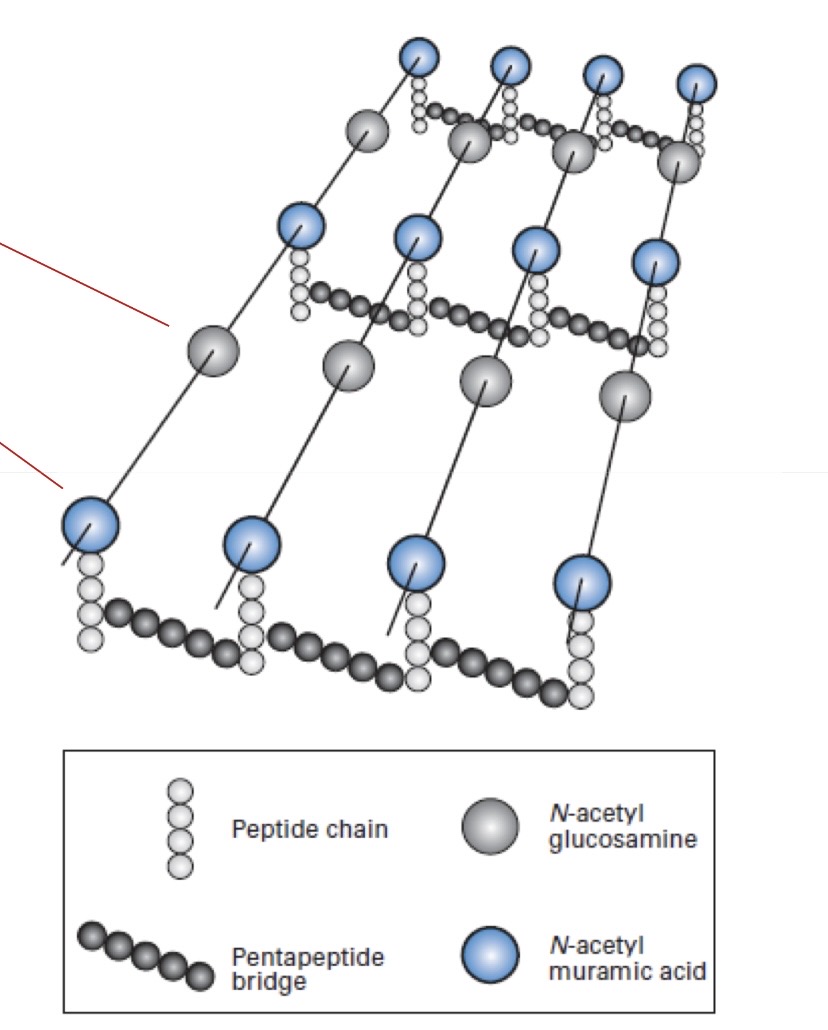
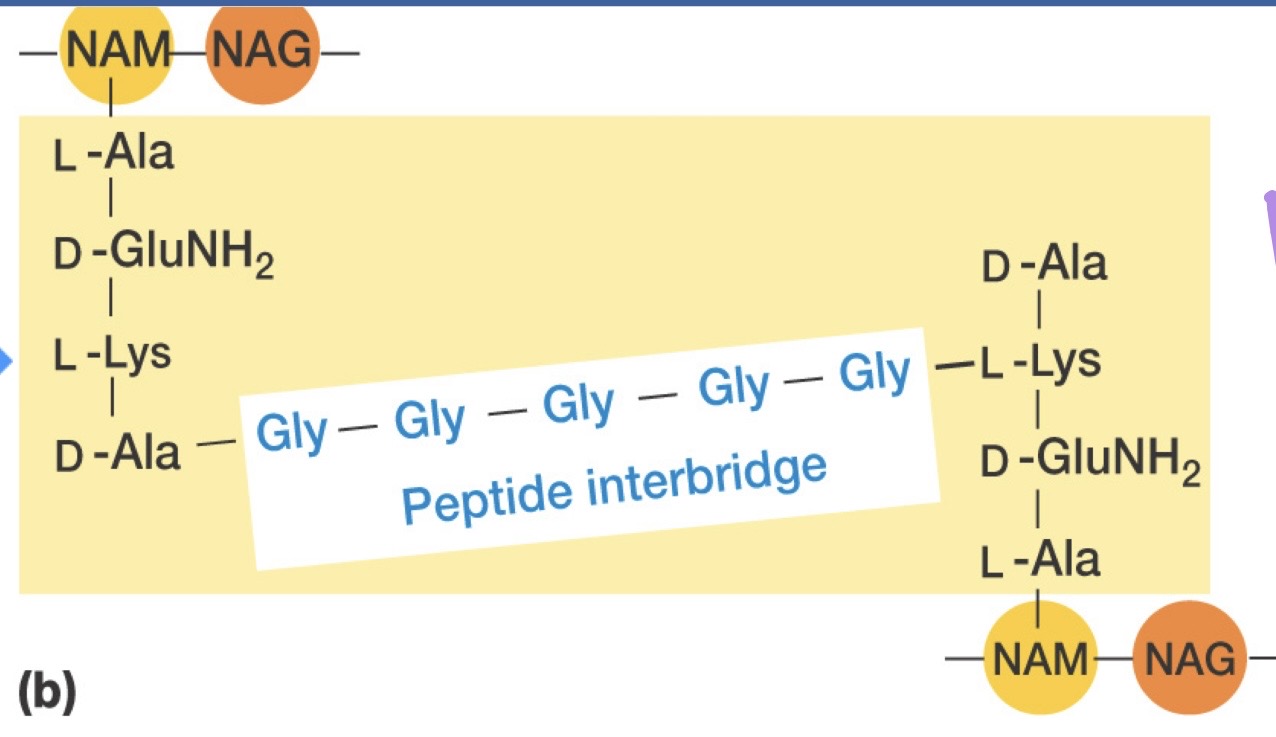
What sugar will amino acids bind to in peptidoglycan structure? Where does pentapeptide bridge attach?
Amino acids bind to NAM (L-Ala, D-Glu, DAP or Lys, D-Ala, etc.). Pentapeptide bridge connects 3rd and 4th position on NAM. Consists of 5x Gly.
Teichoic acids
Negatively charged polymers found in Gram-positive cell walls that help maintain the cell envelope and may bind to host cells.
Gram negative cell walls
Thin layer of peptidoglycan, no teichoic acid, outer membrane consisting of lipids, lipoproteins, LPS (lipopolysaccharide)
Braun’s lipoproteins
Connect outer membrane to peptidoglycan
Lipopolysaccharide (LPS)
A complex molecule in the Gram-negative outer membrane consisting of lipid A, a core polysaccharide, and an O side chain (O antigen).
O side chain (O antigen)
The part of the LPS that extends out from the cell and elicits an immune response.
Periplasmic space
Space between the outer and inner membrane in Gram-negative bacteria, 20−40% of cell volume. Hydrolytic enzymes, transport proteins, etc.
Porin proteins
Proteins that form channels in the Gram-negative outer membrane allowing small molecules of to pass through. Makes so outer membrane is more permeable than plasma membrane
Plasmolysis
The shrinking of a cell that occurs when it is placed in a hypertonic environment and water leaves the cell.
Lysozyme
An enzyme that breaks the bond between NAG and NAM in peptidoglycan.
How does penicillin work?
Inhibits peptidoglycan synthesis (alters FUTURE cells after reproduction)
Protoplasts
Gram-positive cells without a cell wall
Spheroplasts
Gram negative bacteria without a cell wall. Typically retaining two membranes.
Slime layer
A diffuse, unorganized layer of extracellular material that is easily removed and aids in adherence.
Capsule
An organized, amorphous gelatinous layer surrounding the bacterium that determines serological type within a species. Composed of polysaccharides which vary based on bacterial species.
Inclusions
Granules of organic or inorganic material, also known as microcompartments, stockpiled by the cell for future use.
Magnetosomes
Inclusions found in aquatic bacteria containing magnetite particles used for orientation in Earth's magnetic field.
Nucleoid
Non-membrane bound region containing the closed circular, double-stranded DNA molecule. Usually one copy of chromosome.
Supercoiling
Protects DNA in nucleoid, assisting by nucleoid associated proteins (NAP). NAPs differ from histones in eukaryotes.
Plasmids
Small, closed circular extrachromosomal DNA molecules that replicate independently and may confer selective advantages like drug resistance. Helpful but not required for core survival
Loss of a plasmid
Curing
Fimbriae
Short, thin, proteinaceous appendages that mediate attachment to surfaces
Sex pili
Appendages that are longer and thicker than fimbriae, encoded by plasmids, and required for conjugation.
Flagella
Threadlike locomotor appendages required for motility. Must be specifically stained for observation under bright field microscope
Patterns of flagella distribution
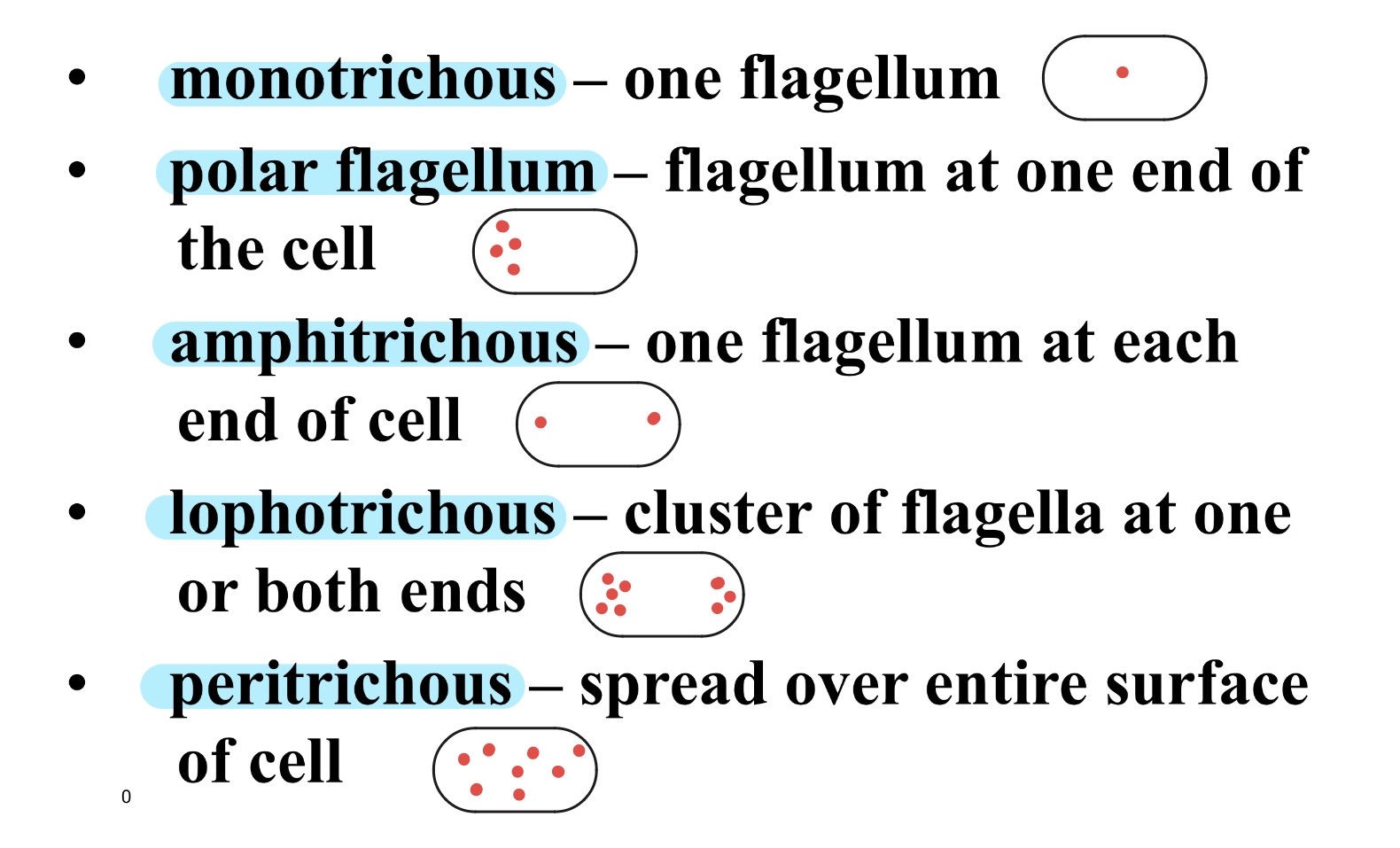
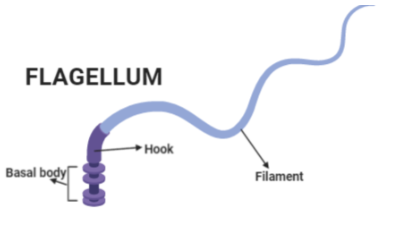
3 parts of flagella
Filament - composed of flagellin protein
Hook - links filament to basal body
Basal body - series of rings that drive flagellar motor
Endospore
A highly resistant, dormant structure containing a dehydrated core, calcium complexed with dipicolinic acid, and SASPs (protect genetic material).