Part 2.2.1 - Autonomic Drugs - Sympathetic drugs Part 1
 Call Kai
 Learn
Learn Practice Test
 Spaced Repetition
 Match
Match Flashcards
 Knowt Play
1/120

Earn XP
Description and Tags
Proverbs 16:3
Name | Mastery | Learn | Test | Matching | Spaced | Call with Kai | Chat |
|---|
No analytics yet
Send a link to your students to track their progress
121 Terms
f. None
Natural catecholamines except:
a. Posses catechol nucleus
b. Posses ethylamine side chains
c. Include Epinephrine, Norepinephrine, and Dopamine.
d. Endogenous
e. All
f. None
e. a and c
Catechol nucleus:
a. Benzene ring
b. With 2 OH group at para position
c. With 2 OH group at ortho position
d. a and b
e. a and c
c. Norepinephrine
The sympathetic post-ganglion particularly releases __________.
a. Dopamine
b. Epinephrine
c. Norepinephrine
d. Serotonin
b. Norepinephrine and Epinephrine
The adrenal medulla produces __________ and _______.
a. Acetylcholine and Epinephrine
b. Norepinephrine and Epinephrine
c. Histamine and Epinephrine
d. Serotonin and Epinephrine
a. Norepinephrine and Dopamine
In the brain, the endogenous substances include __________and __________.
a. Norepinephrine and Dopamine
b. Norepinephrine and Calcium
c. Norepinephrine and Potassium
d. Norepinephrine and Insulin
a. Amino acid precursor is glycine.
Biosynthesis of natural catecholamines:
a) Amino acid precursor is TYROSINE.
b) Tyrosine hydroxylase is the first enzyme needed thus the rate limiting step.
c) Dopamine is the first catecholamine synthesized.
d) Epinephrine is the last catecholamine synthesized.
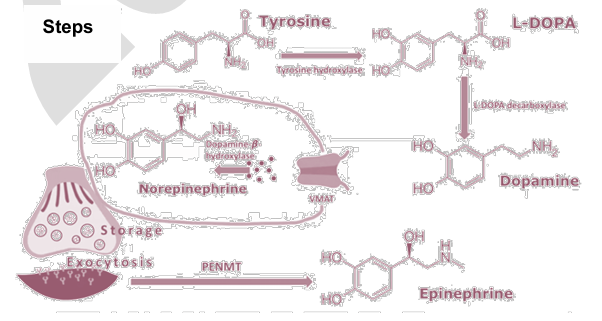
Biosynthesis of natural catecholamines except:
a. Amino acid precursor is glycine.
b. Tyrosine hydroxylase is the first enzyme needed thus the rate limiting step.
c. Dopamine is the first catecholamine synthesized.
d. Epinephrine is the last catecholamine synthesized.
e. None
a. Tryosine hydroxylase
Convert tyrosine to dopa.
a. Tryosine hydroxylase
b. Dopa decarboxylase
c. Dopamine B-hydroxylase
d. 2PNMT
e. Epinephrine
b. Dopa decarboxylase
Convert dopa to dopamine.
a. Tryosine hydroxylase
b. Dopa decarboxylase
c. Dopamine B-hydroxylase
d. 2PNMT
e. Epinephrine
c. Dopamine B-hydroxylase
Convert dopamine to norepinephrine.
a. Tryosine hydroxylase
b. Dopa decarboxylase
c. Dopamine B-hydroxylase
d. 2PNMT
e. Epinephrine
d. 2PNMT
Convert norpepinephrine to epinephrine.
a. Tryosine hydroxylase
b. Dopa decarboxylase
c. Dopamine B-hydroxylase
d. 2PNMT
e. Epinephrine
f. All
Norepinephrine:
a. A fraction can reach the adrenal medulla
b. 2PNMT is present in the adrenal medulla
c. 2PNMT convert norepinephrine in the adrenal medulla synthesizing epinephrine.
d. a and b
e. b and c
f. All
f. All
Adrenal gland:
a. Gland superior to kidney
b. Cortex is the outer layer (Adrenal cortex)
c. Medulla is the inner layer (Adrenal medulla)
d. a and b
e. b and c
f. All
c. Vesicles
Mechanism of storage of neurotransmitter:
a. Exocytosis
b. Endocytosis
c. Vesicles
d. Vacuoles
a. I, II, III
Release of neurotransmitter:
I) Release from the nerve terminals is through a calcium-dependent exocytosis calcium entry.
II) Release in the post-ganglionic endings
III) Release in the SNS except at thermoregulatory sweat glands.
IV) In the brain, majority of neurotransmitter released is NOREPINEPHRINE.
V) In the peripheral organ, majority is EPINEPHRINE which is released from adrenal medullary chromaffin cells.
Release of neurotransmitter:
I. Release from the nerve terminals is through a calcium-dependent exocytosis calcium entry
II. Release in the post-ganglionic endings
III. Release in the SNS except at thermoregulatory sweat glands
IV. In the brain, majority of neurotransmitter released is Epinephrine
V. In the peripheral organ, majority is Norepinephrine which is released from adrenal medullary chromaffin cells.
a. I, II, III
b. II, III, IV
c. I, II, V
d. III, IV
e. I, II, III, IV
a. True
Neurotransmitter is release in the SNS except at thermoregulatory sweat glands.
a. True
b. False
b. Norepinephrine
Majority of neurotransmitter in the brain.
a. Epinephrine
b. Norepinephrine
c. Dopamine
d. a and b
e. b and c
f. All
a. Epinephrine
Majority of neurotransmitter in the peripheral organs.
a. Epinephrine
b. Norepinephrine
c. Dopamine
d. a and b
e. b and c
f. All
a. Reserpine
Agent that can block storage of neurotransmitter:
a. Reserpine
b. Tyramine
c. Ephedrine
d. Amphetamine
e. All
e. Reserpine
Agents that can alter exocytosis of NE except:
a. Guanethedine
b. Guanadrel
c. Bretylium
d. Tyramine
e. Reserpine
f. None
f. None
Agents that enhance exocytosis of NE except:
a. Tyramine
b. Ephedrine
c. Ampethamine
d. Methamphetamine
e. Angiotensin II
f. None
d. All
Agents that inhibits release of NE:
a. Guanethedine
b. Guanadrel
c. Bretylium
d. All
e. None
d. All
Agents that decrease sympathetic effect:
a. Guanethedine
b. Guanadrel
c. Bretylium
d. All
e. None
f. None
Agents that increase sympathetic effect except:
a. Tyramine
b. Ephedrine
c. Ampethamine
d. Angiotensin II
e. Methamphetamine
f. None
f. All
Termination of neurotransmitter may be through:
a. Reuptake
b. Diffusion
c. Metabolism
d. a and b
e. b and c
f. All
f. All
Reuptake inhibitors:
a. Increase NE in synapse
b. Increase NE binding to receptor
c. Increase sympathetic effect
d. a and b
e. b and c
f. All
b. Passive Diffusion -> Metabolism -> Reuptake Process
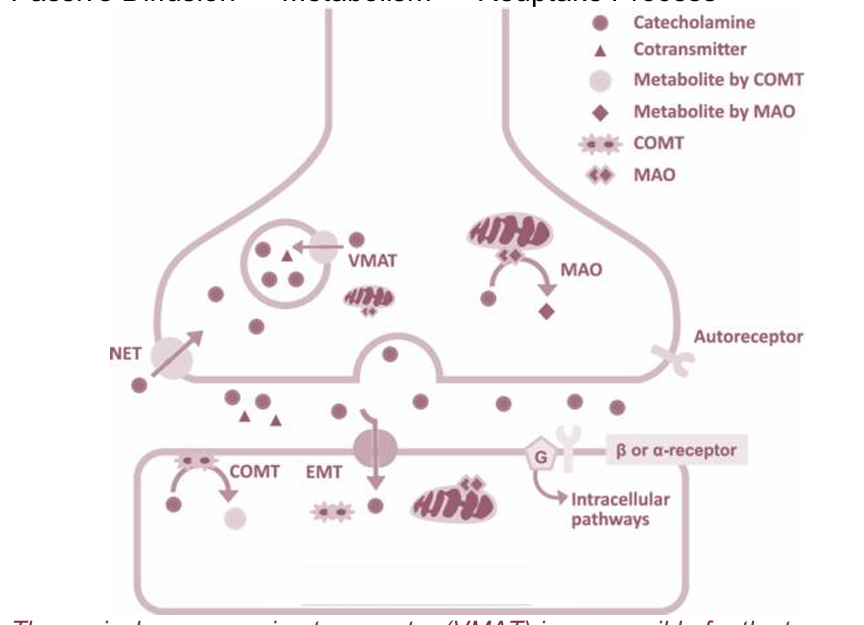
Termination:
a. Metabolism -> Reuptake -> Process Passive Diffusion
b. Passive Diffusion -> Metabolism -> Reuptake Process
c. Reuptake -> Process Passive Diffusion -> Metabolism
c. vesicular monoamine transporter (VMAT)
[Termination]
The ____ is responsible for the transport of catecholamines to the storage vesicles, maintaining their cytosolic concentration low.
a. NET
b. EMT
c. VMAT
d. COMT
d. noradrenaline transporter (NET)
[Termination]
After catecholamines are released into the synaptic cleft, they may be reuptaken into the presynaptic terminal. This reuptake process is carried out by the __________.
a. MAO
b. COMT
c. EMT
d. NET
a. extraneuronal monoamine transporter (EMT)
[Termination]
Catecholamines can also be transported into extraneuronal cells after release into the synaptic cleft. The most important transporter involved in this process is the __________.
a. EMT
b. VMAT
c. NET
d. MAO
c. MAO
[Termination]
Catecholamines are metabolized by intracellular enzymes after their release and reuptake. One important enzyme is located in the outer membrane of mitochondria in neurons and extraneuronal cells. This enzyme is called __________.
a. NET
b. COMT
c. MAO
d. VMAT
b. COMT- Catechol-O-methyl transferase
[Termination]
___is another enzyme responsible for catecholamine metabolism. Unlike MAO, this enzyme is mainly located in extraneuronal cells.
a. EMT
b. COMT
c. NET
d. VMAT
b. COMT and MAO
[Termination]
____are the two main enzymes responsible for catecholamine metabolism. Their enzymatic actions lead to the formation of several products after breakdown of catecholamines.
a. EMT and MAO
b. COMT and MAO
c. NET and COMT
d. VMAT and COMT
c. Alpha1 receptor
Receptor causes contraction of vascular smooth muscle
a. Beta2 receptor
b. Dopaminergic2 receptor
c. Alpha1 receptor
d. Beta3 receptor
b. Mydriasis
Alpha1 receptor stimulation in the radial muscles of the iris causes ________.
a. Miosis
b. Mydriasis
c. Sedation
d. Tremors
c. Goosebumps
-Contraction (piloerection)
Contraction of pilomotor smooth muscles produces ________.
a. Vasodilation
b. Tremors
c. Goosebumps
d. Hypokalemia
b. Urinary retention
Alpha1 receptor stimulation in prostatic smooth muscles may lead to ________.
a. Bronchodilation
b. Urinary retention
c. Lipolysis
d. Sedation
b. Gi-linked
→ Autoregulation (Inhibits further release of NE from the vesicles)
Alpha2 receptors are primarily ________ linked.
a. Gs-linked
b. Gi-linked
c. Gq-linked
d. Na-linked
c. Sedation
Central stimulation of Alpha2 receptors causes ________.
a. Tremors
b. Bronchodilation
c. Sedation
d. Lowers BP
d. Lowers BP
Peripheral stimulation of Alpha2 receptors causes ________.
a. Tremors
b. Bronchodilation
c. Sedation
d. Lowers BP
a. Beta1 receptor
Which receptor increases force of cardiac contraction?
a. Beta1 receptor
b. Beta2 receptor
c. Alpha2 receptor
d. Dopaminergic2 receptor
c. Chronotropism
Increased heart rate is also known as positive ________.
a. Dromotropism
b. Inotropism
c. Chronotropism
d. Lipolysis
b. Inotropism
Increased force of contraction is also known as positive ________.
a. Dromotropism
b. Inotropism
c. Chronotropism
d. Lipolysis
a. Dromotropism
Increased AV nodal conduction is also known as positive ________.
a. Dromotropism
b. Inotropism
c. Chronotropism
d. Lipolysis
b. Renin
Target: Kidneys (Renal Juxtaglomerular Apparatus)
Response: RAAS activation = Increased BP
Beta1 receptor stimulation in the kidneys increases ________ secretion.
a. Dopamine
b. Renin
c. Insulin
d. Potassium
b. Beta2
Bronchodilation is mainly caused by stimulation of ________ receptors.
a. Alpha1
b. Beta2
c. Beta3
d. Dopaminergic2
b. Tocolysis
Relaxation of the uterus caused by Beta2 receptors is called ________.
a. Lipolysis
b. Tocolysis
c. Sedation
d. Mydriasis
a. vasodilation
Targeting blood vessels (skeletal muscles) caused by Beta2 receptors leads to:
a. vasodilation
b. vasoconstriction
a. Gs-linked
qiss:
A1 - q
A2 - i
B1 - s
B2 - s
Beta receptors are primarily ________ linked.
a. Gs-linked
b. Gi-linked
c. Gq-linked
d. Na-linked
b. Hypokalemia
Beta2 receptor stimulation in skeletal muscle cell membranes may cause ________.
a. Hyperkalemia
b. Hypokalemia
c. Sedation
d. Ileus
a. Tremors
Contraction of neuromuscular endplates due to Beta2 stimulation produces ________.
a. Tremors
b. Goosebumps
c. Vasodilation
d. Sedation
c. Lipolysis
Beta3 receptors primarily stimulate ________ in adipocytes.
a. Sedation
b. Bronchodilation
c. Lipolysis
d. Vasoconstriction
c. Gs-linked
Dopaminergic1 receptors are primarily ________ linked.
a. Gi-linked
b. Gq-linked
c. Gs-linked
d. Na-linked
b. Renal and splanchnic
-Vasodilation (⬆GFR = Diuresis)
Dopaminergic1 receptors are mainly located in the ________ blood vessels.
a. Coronary and cerebral
b. Renal and splanchnic
c. Pulmonary and hepatic
d. Peripheral and cutaneous
b. Gi-linked
Dopaminergic2 receptors are primarily ________ linked.
a. Gs-linked
b. Gi-linked
c. Gq-linked
d. Ca-linked
a. Perception and behavior
&
b. Modulation of motor activity
Central stimulation of D2 receptors causes ________.
a. Perception and behavior
b. Modulation of motor activity
c. Relaxation
c. Relaxation (ileus; no peristalsis)
Peripheral stimulation of D2 receptors causes ________.
a. Perception and behavior
b. Modulation of motor activity
c. Relaxation
b. 3,4-dihydroxybenzene
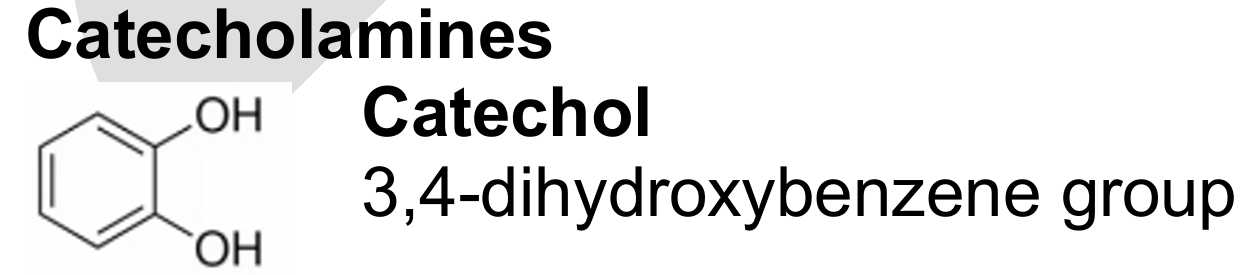
The catechol group is also known as ________.
a. 1,2-dihydroxybenzene
b. 3,4-dihydroxybenzene
c. 2,4-dihydroxybenzene
d. 1,4-dihydroxybenzene
Non-catecholamines___1. Not metabolized by MAO and COMT
Catecholamines ______2. High potency in activating Alpha and Beta receptors
Non-catecholamines___3. Longer half-lives
Catecholamines ______4. Do not penetrate the CNS
Catecholamines ______5. Metabolized by MAO and COMT
Non-catecholamines___6. Administered orally
Non-catecholamines___7. No catechol
Catecholamines or Non-catecholamines
___1. Not metabolized by MAO and COMT
___2. High potency in activating Alpha and Beta receptors
___3. Longer half-lives
___4. Do not penetrate the CNS
___5. Metabolized by MAO and COMT
___6. Administered orally
___7. No catechol
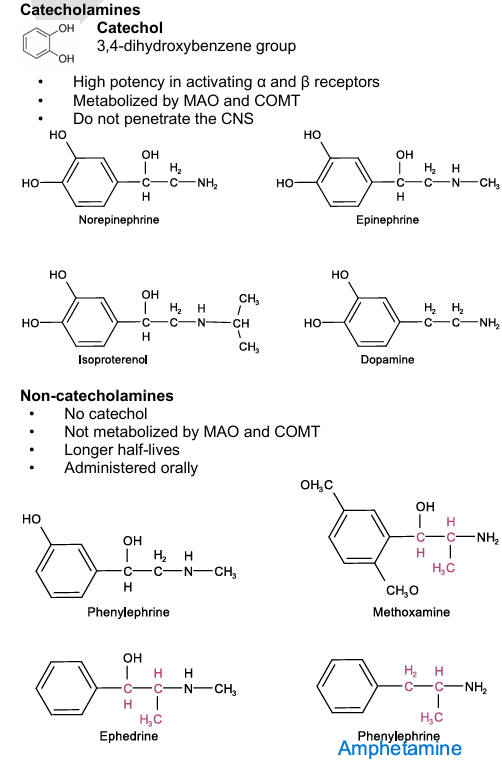
Non-catecholamines___1. Phenylephrine
Catecholamines ______2. Dopamine
Catecholamines ______3. Norepinephrine
Non-catecholamines___4. Methoxamine
Non-catecholamines___5. Amphetamine
Catecholamines ______6. Epinephrine
Non-catecholamines___7. Ephedrine
Catecholamines ______8. Isoproterenol
Catecholamines or Non-catecholamines
___1. Phenylephrine
___2. Dopamine
___3. Norepinephrine
___4. Methoxamine
___5. Amphetamine
___6. Epinephrine
___7. Ephedrine
___8. Isoproterenol
a. Direct-acting: Non-selective
Binds and activate more than 1 general type of adrenergic receptor
a. Direct-acting: Non-selective
b. Direct-acting: Selective
b. Direct-acting: Selective
Binds and activates 1 general type of adrenergic receptor
a. Direct-acting: Non-selective
b. Direct-acting: Selective
b. Epinephrine
[Direct-acting: Non-Selective]
__________ is a non-selective adrenergic agonist that acts on α₁, β₁, and β₂ receptors.
a. Dopamine
b. Epinephrine
c. Norepinephrine
d. Lidocaine
a. α₁
b. β₁
c. β₂
[Direct-acting: Non-Selective]
Epinephrine acts on these receptors:
a. α₁
b. β₁
c. β₂
d. D1
c. Anaphylaxis
e. Anaphylactic shock
f. Anaphylactoid reaction
[Direct-acting: Non-Selective]
Epinephrine is commonly used for ___,_____, and_____
a. Glaucoma
b. Septic shock
c. Anaphylaxis
d. Acute heart failure
e. Anaphylactic shock
f. Anaphylactoid reaction
c. stimulant
[Direct-acting: Non-Selective]
Epinephrine may be used as a cardiac __________.
a. vasodilator
b. depressant
c. stimulant
d. blocker
c. Lidocaine
[Direct-acting: Non-Selective]
Epinephrine is used as a local vasoconstrictor together with __________.
a. Dipivefrin
b. Dopamine
c. Lidocaine
d. Digoxin
a. Dipivefrin
[Direct-acting: Non-Selective]
Prodrug of Epinephrine used to treat glaucoma by lowering intraocular pressure
a. Dipivefrin
b. Dopamine
c. Epinephrine
d. Norepinephrine
a. α₁
b. β₁
[Direct-acting: Non-Selective]
Norepinephrine acts on these receptors:
a. α₁
b. β₁
c. β₂
d. D1
a. Norepinephrine
[Direct-acting: Non-Selective]
_______ primarily acts on α₁ and β₁ receptors and is indicated for septic shock.
a. Norepinephrine
b. Epinephrine
c. Dopamine
d. Lidocaine
b. Septic shock
[Direct-acting: Non-Selective]
Norepinephrine is commonly used for ___.
a. Glaucoma
b. Septic shock
c. Anaphylaxis
d. Acute heart failure
e. Anaphylactic shock
f. Anaphylactoid reaction
a. α₁
b. β₁
d. D1
[Direct-acting: Non-Selective]
Dopamine acts on these receptors:
a. α₁
b. β₁
c. β₂
d. D1
c. Dopamine
[Direct-acting: Non-Selective]
____acts on α₁, β₁, and D1 receptors.
a. Norepinephrine
b. Epinephrine
c. Dopamine
c. cardiogenic
[Direct-acting: Non-Selective]
Dopamine may be used as an alternative treatment for __________ shock.
a. septic
b. anaphylactic
c. cardiogenic
d. hypovolemic
d. Acute heart failure
[Direct-acting: Non-Selective]
Dopamine is indicated for____
a. Glaucoma
b. Septic shock
c. Anaphylaxis
d. Acute heart failure
e. Anaphylactic shock
f. Anaphylactoid reaction
a. α₁
[Direct-acting: Non-Selective]
Digital necrosis is a toxic effect associated with __________ receptor stimulation.
a. α₁
b. β₂
c. D₁
d. M₂
b. β₁
[Direct-acting: Non-Selective]
Ventricular tachyarrhythmias are toxic effects associated with __________ receptor stimulation.
a. α₁
b. β₁
c. β₂
d. D₁
c. α₁-selective
ex: Phenylephrine
[Direct-acting: Selective]
____-selective agonist commonly used for hypotension, nasal and ophthalmic congestion.
a. β₂-selective
b. α₂-selective
c. α₁-selective
d. D₁-selective
c. α₁-selective
[Direct-acting: Selective]
Methoxamine belongs to the group of __________ agonists.
a. β₂-selective
b. α₂-selective
c. α₁-selective
d. D₁-selective
c. α₁-selective
[Direct-acting: Selective]
Phenylephrine and Propylhexedrine belong to the group of __________ agonists.
a. β₂-selective
b. α₂-selective
c. α₁-selective
d. D₁-selective
c. α₁-selective agonist
[Direct-acting: Selective]
Tetrahydrozoline, Oxymetazoline, Nafazoline belong to the group of __________ agonists.
a. β₂-selective
b. α₂-selective
c. α₁-selective
d. D₁-selective
b. Rhinitis medicamentosa
[Direct-acting: Selective]
________ may occur when nasal decongestants are used for more than 3 days.
a. Hypertension
b. Rhinitis medicamentosa
c. Hyperkalemia
d. Hepatotoxicity
c. Hypertension
[Direct-acting: Selective]
A systemic toxic effect of α₁-selective agonists is __________.
a. Tremors
b. Sedation
c. Hypertension
d. Hepatotoxicity
e. Urinary retention
e. Urinary retention
[Direct-acting: Selective]
A systemic toxic effect of α₁-selective agonists common in patients with BPH
a. Tremors
b. Sedation
c. Hypertension
d. Hepatotoxicity
e. Urinary retention
a. Tolerance
[Direct-acting: Selective]
α₁-selective agonist when used for more than 5 days may lead to
a. Tolerance
b. Addition
c. Withdrawal
b. Clonidine
[Direct-acting: Selective]
___is a rapid-acting α₂-selective agonist used for hypertensive crisis.
a. Methyldopa
b. Clonidine
c. Guanabenz
d. Brimonidine
c. ADHD
[Direct-acting: Selective]
Clonidine may also be used as an alternative treatment for __________.
a. Asthma
b. Glaucoma
c. ADHD
d. COPD
b. hypertension
[Direct-acting: Selective]
A toxic effect of Clonidine is withdrawal-induced __________.
a. hyperkalemia
b. hypertension
c. sedation
d. tremors
a. Methyldopa
[Direct-acting: Selective]
_______ is FDA-approved for use in pregnant women with hypertension.
a. Methyldopa
b. Clonidine
c. Apraclonidine
d. Guanfacine
a. Methyldopa
[Direct-acting: Selective]
Sedation and hepatotoxicity are toxic effects associated with __________.
a. Methyldopa
b. Fenoldopam
c. Isoproterenol
d. Salmeterol
a. Methyldopa
[Direct-acting: Selective]
(+) Coombs test is a toxic effect associated with __________.
a. Methyldopa
b. Fenoldopam
c. Isoproterenol
d. Salmeterol
b. α₂-selective agonist
[Direct-acting: Selective]
Methyldopa belongs to the group of __________ agonists.
a. β₂-selective
b. α₂-selective
c. α₁-selective
d. D₁-selective
a. Guanfacine
b. Guanabenz
[Direct-acting: Selective]
These are centrally acting α₂-selective agonists:
a. Guanfacine
b. Guanabenz
c. Brimonidine
d. Apraclonidine
c. Brimonidine
d. Apraclonidine
[Direct-acting: Selective]
These are α₂-selective agonists used as anti-glaucoma agents.
a. Guanfacine
b. Guanabenz
c. Brimonidine
d. Apraclonidine
b. Isoproterenol
__________ is a non-selective β agonist used as an alternative during shock states.
a. Dobutamine
b. Isoproterenol
c. Fenoldopam
d. Methoxamine
c. heart
Isoproterenol, an inotropic agent, may be used in the management of acute __________ failure.
a. renal
b. liver
c. heart
d. respiratory
a. Dobutamine
[Direct-acting: Selective]
___is the first-line β₁-selective agonist for cardiogenic shock.
a. Dobutamine
b. Clonidine
c. Terbutaline
d. Nafazoline
a. Dipyridamole
[Direct-acting: Selective]
Dobutamine may be used for a pharmacologic stress test together with __________.
a. Dipyridamole
b. Lidocaine
c. Salmeterol
d. Ritodrine
a. Acute Heart Failure
[Direct-acting: Selective]
Dobutamine may be used for management of
a. Acute Heart Failure
b. Septic Shock
c. Glaucoma
d. BPH
SABA a. Terbutaline
LABA b. Salmeterol
SABA c. Pirbuterol
LABA d. Formoterol
SABA e. Salbutamol/Albuterol
LABA f. Bambuterol
LABA g. Indacaterol
SABA h. Metaproterenol
[Direct-acting: Selective]
SABA or LABA
___a. Terbutaline
___b. Salmeterol
___c. Pirbuterol
___d. Formoterol
___e. Salbutamol/Albuterol
___f. Bambuterol
___g. Indacaterol
___h. Metaproterenol
b. Ritodrine and Isoxsuprine
[Direct-acting: Selective]
__________ is a β₂-selective agonist used as a tocolytic for preterm labor.
a. Clonidine
b. Ritodrine
c. Dobutamine
d. Apraclonidine