Unit 1
 Call Kai
 Learn
Learn Practice Test
 Spaced Repetition
 Match
Match Flashcards
 Knowt Play
1/76

Earn XP
Description and Tags
1.1-1.6
Name | Mastery | Learn | Test | Matching | Spaced | Call with Kai | Chat |
|---|
No analytics yet
Send a link to your students to track their progress
77 Terms
Business sectors
primary, secondary, tertiary, quaternary
A need
something we require to have to live e.g. food, water, clothes.
A want
something we desire but do not necessarily need for survival. e.g. jewelry. It is unlimited.
Opportunity cost
loss of an alternative due to the alternative you chose.
Business
is a decision making organization that produces goods and/or provides services.
Why businesses exist?
to satisfy needs and wants of people, organizations, and governments.
Stages in the production of finished goods
Input (raw materials, components, machinery, equipment, labor), processes, outputs(Provision of final goods and services)
Factors of production
land, labor, capital, enterprise
Market
a place or process where customers and sellers meet to trade.
Consumers
ones that actually use the product.
Consumer goods
products sold to the public. durable and non durable.
Services
intangible products provided by businesses
Profit
revenue-costs
Revenue
total amount of money brought in by the company by selling products/services
4 functional areas of business
production, marketing, finance, HR
Primary business
Any business that collects raw materials (farming, mining, fishing)
Secondary business
involved in manufacturing. uses raw materials and other resources for making usable products.
Tertiary business
business that provides services
Quaternary biznes
carries out research and analyses information.
Reasons for starting a business (6)
growth, earnings, inheritance and transference, challenge, autonomy, security, hobbies
NINE Factors to consider when starting a busines
The idea 2. finances 3.Human resources 4.skills 5. fixed assets 6.suppliers 7. customers 8.marketing 9.legalities
Public Sector
Owned by government. Provides essential goods and services to the public. (public schools, libraries, parks)
Private sector
owned by individuals and organizations with an aim to reach their own goals.
1 sole trader
Individual who is the owner of their own business. May hire other people (like family) to help run the bis. Financed with personal funds. Unincorporated. Unlimited liability.
+ Few legal formalities, owner gets full profit, full control over the business
- unlimited liability, limited sources of finances, workload, higher production costs
2. partnerships
profit seeking business operated by 2 or more people who finance the business with their own personal funds. It is unincorporated and has unlimited liability.
+ shared responsibilities, privacy
-unlimited liability, longer decision making, conflict, must have mutual trust
3. companies
Businesses owned by shareholders. Incorporated (so a separate entity). Limited liability.
+limited liability, continuity
-complicated and expensive set up. financial info is given to all shareholders. more legal requirments.
Private limited company
doesn’t sell shares to general public - only family & friends. Owners have greater control. Limited finances. eg. chanel, lego
+privacy, owners have more frreddom, limited liability, cheaper to set up than public
-Limited finance than Public bc it cant trade stocks
Public limited company
Sells its shares to general public through stock exchange. eg. coca cola, nike
+more access to finance, limited liability
-lacks privacy, cannot control who buys shares procedure to become PLC is complicated
for profit businesses (social profit businesses, not profit seeking or nonporifit)
cooperatives, microfinance providers, public private partnerships
Cooperatives (producer, consumer, worker)
Businesses owned by group of people working together to achieve shared needs and aspirations. they share ownership, profit, have democratic decision making. Focuses on benefiting the members.
ADVANTAGES OF A COOPERATIVE
collective efforts
the needs of the members are more likely met
financial benefits for members
DISADVANTAGES OF A COOPERATIVE
the business organization does not necessarily achieve all profits it could
hard continuity
harder to make decisions
Consumer cooperative
owned by people who are the customers. they access the sold goods at cheaper prices.
+work incentive, decision making, social benefit it
-limited finace source, slow decision m,
worker cooperative
owned by workers. like a cafe who is owned by the chefs and servers.
producer cooperative
owned by people who produce same type of goods. like farmers who want to access larger markets
Microfinance providers
financial service aimed at small business owners. especially those with low incomes. helps underprivileged take steps towards economic independence.
ppp
gov. work with private sector to create goods and services. like NY central park
Non profit
wants to promote special cause or provide some service. profit is not their objective. any profit is invested back into the businesses. like scouts
NGO (2 types)
profit is not their objetive.private sector obviously. wants to defend and promote a cause (advocacy) creates relief based and community projects (operational)
Pressure groups
nfo to adress a specific cause the members care about like pollution
Mission
Mission is a short or a medium term statement that introduces the purpose of the organisation.
Vision
states the long term aspirations of a business
Ethics and Morals
Ethics are set of rules that are applicable to a certain group or culture.
Morals refer to behavior a certain individual believes to be right or wrong.
Ethical business
business that is responsible for takes responsibility for a fair treatment of their workers, customers, shareholders, and environment. e.g paying employees fairly, using environmentally friendly products.
Unethical business
corruption within the workplace, environmental neglect, exploitation of workers, customers, or suppliers.
Needs and wants
Needs are things we require for survival
Wants are things we desire but do not necessarily need for survival
Opportunity cost
loss of an alternative due to an alternative you chose
customer vs consumer
customer is a person or an organization that purchases the product
consumer is the one who actually uses the products
Aims and objectives, strategies and tactics.
aims are general goals of an org
objectives are short or medium term targets of an organization to achieve its aims
strategies are to meet objectives
tactics are short term actions to meet its objectives
Unlimited liability
owner and business are not legally distinct, creditors can seize personal assets
Stakeholders
are people or organizations that have a direct interest in a business and are affected by its performance.
Internal stakeholders
members of the organization: employees, managers, shareholders, directors
External stakeholders
not members of the organization: customers, suppliers, competitors, government.
Conflict between stakeholders
varying interests, conflict over profit, different aims and objectives.
Stakeholder mapping
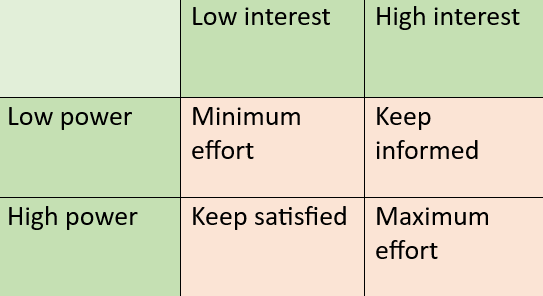
Shareholders
people or organizations that own shares in a company making that partial owners of it.
Market share
firm’s sales within a certain time period as a percentage of the industry’s total sales revenue.
how to measure growth of a business
its revenue, its market share, number of employees
why businesses want to grow
economies of scale, larger market share, survival against rivals, spreading risk by diversifying into new markets.
Economies of scale
lower production costs enjoyed by firms operating on a larger scale.
Multinational companies (MNC)
companies that operate in two or more countries.
+access to more customers so increased sales
economies of scale
risks are spread internationally
-language barrier
culture shock
high transportation costs
+MNC positive impact on host countries
increases jobs and decreases unemployment
introduces new products and skills
increases competition
adds to their GDP
-MNC negative impact on host countries
uses it limited resources
may drive out local businesses
hard to control their activities
Tariff
taxes on imported goods
Quota
limits on value or volume of imported goods
Internal economies of scale & external economies of scale
internal occurs inside the firm and is within its control.
technological economies, financial, marketing, purchasing, managerial economies.
external occurs within the industry but outside the firm thus is outside its control.
improved transportation networks, skilled labor, regional specialization.
large organization
brand recognition
trust due to good image
wide range of services
greater discounts
customer loyalty
small organization
cost control
personalized services
government aid
flexibility
small market size
Internal / organic growth
happens with the business’s own resources to increase the scale of its operations. marketing, new locations, changing prices.
+better control, maintains corporate culture
-slow
External / inorganic growth
growth through mergers and acquisitions.
+fast, introduction to new skills and expertise
-lower, corporate culture
mergers
2 or more business form a new company
acqusitions
one company buys out another by purchasing controlling interest and holding a majority stake.
businesses unable to grow, or in a financial crisis.
4 types of integration in M&A
horizontal - between firms in the same industry.
vertical - in the same industry but different stages of production.
lateral - different industry but similar operations
conglomerate - different industries
M&A
+greater market share
economies scale
product diversification
-conflicts between companies
culture clash
loss of control
joint ventures
two businesses set up a separate legal entity and they share profits costs risks control.
+shared expertise (katsey)
diversified risks
-clash of opinions
sharing profits
Strategic alliances
same as joint ventures except a new legal entity isnt created. its for mutual benefits.
+mutual benefits, less competitions, easy to set up
-miscommunication, short term
franchise
an external growth strategy where the franchisee receives the right to operate under the name of the franchisor in exchange for a royalty fee and a percentage of sales
franchisor + and - (owner of the brand)
+expansion, royalty fees, brand awareness
-if franchisee is incompetent, brand image is harmed, should provide technical support and training
franchisee + and - (org that receives the right to operate under the name of the franchisor)
+high success rate xalxs izidav popularuli saxelit, receives tech support and training
-royalty fees, sharing profits