Fundamentals of computer organisation and architecture
 Call Kai
 Learn
Learn Practice Test
 Spaced Repetition
 Match
Match Flashcards
 Knowt Play
1/47

Earn XP
Description and Tags
Computer Science A level AQA
Name | Mastery | Learn | Test | Matching | Spaced | Call with Kai | Chat |
|---|
No analytics yet
Send a link to your students to track their progress
48 Terms
What does the Current Instruction Register (CIR) do?
Stores the instruction that is currently being executed by the processor.
What does the program counter (PC) do? (register)
Stores the memory location of the instruction that will be needed next by the processor.
What does the memory buffer register (MBR) do?
Also known as the MDR, the register holds the data that has just been read or is about to be written to the main memory.
What does the Memory Address register (MAR) do?
Holds the memory location of the data that has just been read or is about to be written to main memory (primary storage).
What does the status register do?
Keeps track of the status of various parts of the computer for example if there has been an overflow in the ALU.
What does the interrupt register do?
It is a type of status register that stores signals received from other components so it can stop everything before something goes wrong such.
What is RAM?
RAM is primary volatile storage
It is used by the CPU to store data and instructions used by currently running programs and the operating system.
It is designed to be fast
During the fetch execute cycle, the CPU takes instructions from the RAM. These instructions are then put into registers ready for decoding by the control unit.
What is ROM?
ROM is secondary storage storage which is read only and is not volatile
The ROM holds firmware which is the basic instructions to start up the computer. Since this doesn’t change, there is usually no need to write to it
The ROM holds the bootstrap loader which loads the operating system after the computer is booted.
What is HDD storage (secondary storage)?
Hard disk drive storage is comprised of disks in a stack.
How are HDDs written to?
The surface of each disks have loads of magnetic grains. An actuator arm has an electromagnet placed on the end of it which is either turns the magnetic grains left or right based on whether they represent a 1 or a 0.
How is an HDD read?
An actuator arm can move its head along the surface of the disk. The combination of the spinning disk and the moving arm means all parts of the disk can be read.
On the end of the actuator arm, a magnetoresistive sensor reads the magnetic field of each magnetic grain to read whether it represents a 1 or a 0.
Features of an SSD (secondary storage)?
Made up of semi conductors that either hold a charge or not representing 1 or 0
Non volatile secondary storage
High speeds of data transfer compared to magnetic (HDD)
SSDs have NAND Flash which is where the data is stored in a blocks made up of semi conductors
Data is stored in floating gate transistors where the electrons are trapped
What is Optical storage (CD/DVD | Secondary storage)?
A form of non volatile secondary storage where 0s and 1s are represented by pits (1) and lands (0).
To write a laser carves and edits the surface of the disk, it burns in a spiral way.
To read, the laser shines onto the pits and lands. Lands reflect back into the laser, pits don’t.
The disk has a protective layer over the surface to prevent corruption
Why do most modern computers not have an optical disk drive (CD/DVD drives)? [2 MARKS]
Other storage devices have higher storage capacities
Other storage devices can read and write quicker (such as USB drive)
The drives are big and bulky and take up lots of space
Less content now available on disk
What are the steps of a laser printer?
1) A rotating drum inside the printer is coated in a chemical which holds a negative electrical charge.
2) The laser beam is reflected onto the drum and where the light hits the drum, the charge becomes positive where the image should be, effectively creating the image on the drum but invisible and with charge.
3) As the drum rotates it picks up toner which is attracted to the charged part of the drum because the toner is negatively charged.
4) Paper is passed over the drum and by charging the paper with the opposite charge to the toner. the toner is attracted to the paper and away from the drum.
5) The paper is heat treated to fuse the toner onto the paper
What are the steps of the stored program concept (Fetch execute cycle)?
Fetch:
The program counter holds the address of the next instruction
That address is copied over to the Memory Address Register (MAR)
The processor sends the address bus to the RAM
The data bus returns the instruction that was just gotten from the RAM over to the Memory Buffer Register (MBR/MDR)
The instruction in the MBR is then copied to the Current Instruction Register (CIR)
PC increments by 1 / increments to the next instructions address
Decode:
The Control unit decodes the instruction from the CIR
The instruction is often split into opcode and operand
The CU may load up values in the MAR or the ALU depending on the instruction
Execute:
The processor performs the action, this may include:
ALU operations
Memory operations
I/O operations
Updating registers
What does the accumulator do?
Stores the results of the ALU.
What does the control unit do?
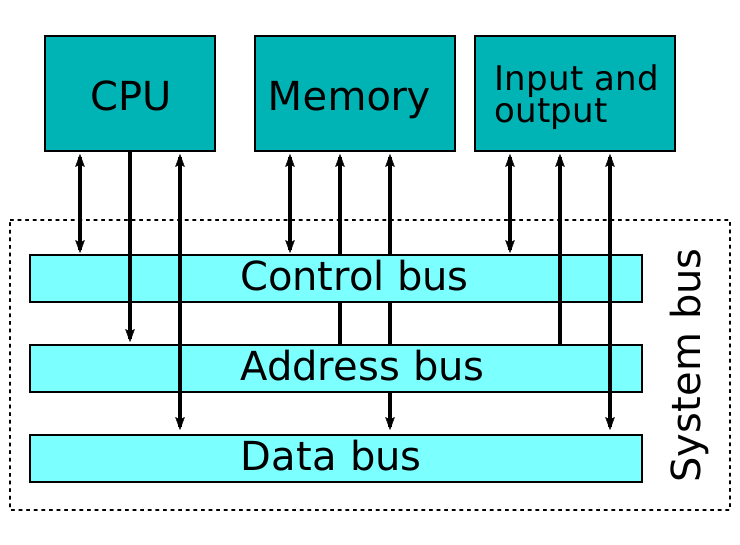
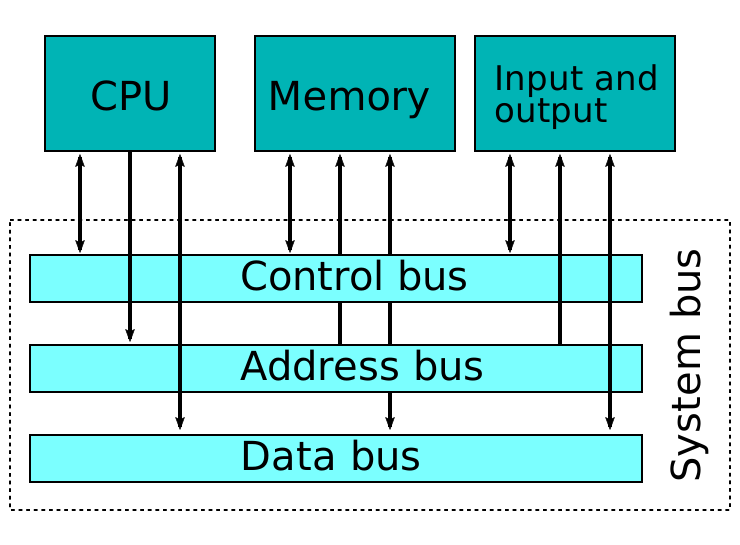
Manages the CPU by sending out buses which helps the fetch execute cycle.
Therefore it co-ordinates data flow between the CPU and memory
It also decodes instructions
It also issues control signals to manage hardware. The control unit ensures all hardware does things in appropriate time according to the clock through control signals
What is Harvard Architecture?
Harvard architecture is a way the processor and main memory can be organised where there are two memories, one for instructions and one for data. Both of these memories can be accessed simultaneously.
What is Von Neumann Architecture?
A way the processor and main memory can be organised where there is just one main memory (for both instructions and data). Only one thing can be done at a time.
Advantages of Harvard Architecture
It is faster because both instructions and data can be accessed simultaneously
Reduces bottlenecks (having to wait for one to finish)
Avoids data being executed as code so better security
Only read from instructions so data can’t be modified by malicious sources
Disadvantages of Harvard Architecture:
Costs more
Increased designing complexity
Less applicable
Advantages of Von Neumann Architecture:
Lower development costs
Easier designing
More applicable
Disadvantages of Von Neumann Architecture:
Less secure (because if you get access to the memory, you get it all)
Slower because no simultaneous memory searching
What does an I/O controller do?
A piece of hardware that allows for the communication of data between the processor and external components like keyboards and mouses.
What does the address bus do?
The address bus carries addresses, specifying where data is sent or to be retrieved from. Every extra address bus you add, doubles the amount of addresses you can hold.
What does the data bus do?
Sends data and instructions to and from different parts of the computer system. Increasing the width of the data bus is to increase the amount of data that can be sent at any one time.
What bus sends instructions
Data bus.
What does the contol bus do?
Sends control signals to tell things when to do something and ensures all the data is going to the right place.
What is each disk in an HDD made up of? (as in segments of the disk)
Tracks and sectors.
What is modern day clock speed?
3-5Ghz/s (3-5 Billion cycles per second)
Is a processor instruction set, processor specific?
Yes.
What is op-code and operands?
Op-code - The operation that is carried out.
Operand - The values themselves such as variable 1 + variable 2, the variables are going to be the operands.
What’s direct addressing (used in assembly)?
When your command has a memory address that needs to be accessed e.g. MOV A, 1000.
What’s immediate addressing (used in assembly)?
When your command just simply has the value rather than a memory address e.g. MOV A, #5
What does Load do in assembly?
It loads a value from main memory into a register.
E.g.
LDR R0, 100
This loads the value from memory address (RAM) 100 into register 0.
What does store do?
The opposite of Load where instead of taking memory from the main memory and putting it into a register, it takes the information from a register and stores it at the memory location you specify in the main memory (RAM).
e.g. STR R0, 58
This stores the value in register 0 into the memory location 58.
What does branching do in assembly?
Like a function in python where it just jumps to the labelled place given a certain condition.
e.g if before it you do a compare of two numbers then you could say:
BEQ next_bit
This would jump to the section of code labelled next_bit if the two numbers were equal.
What does compare do in assembly
Compare just compares the two numbers you put
e.g. CMP R0, #5
You would normally then put a branch after it to tell it what to do given a certain outcome.
What increases a number, Logical shift left or logical shift right?
LSL because if you had 0110 then LSL would make it 1100 and thats bigger.
What does HALT do?
Stops the programs execution. You just type HALT and it does it.
What is the effect of increasing clock speed?
More cycles so more instructions can be performed in a given amount of time.
Increased heat and power consumption
What is the effect on the CPU on increasing cache size?
Faster accessing speeds in general because more can be looked up fast so higher performance
May increase the amount of time to access the data because further away from CPU.
Whats the effect on the CPU by having more cores?
More things can be done at once so faster execution of instructions
The software must be hardware specific though
What’s the effect on the CPU from word length (amount of bits that the CPU can execute in one operation)?
More data handled per instruction so faster
More memory addresses can be referenced
How does the addresses bus width affect CPU performance?
Since it’s just the amount of bits that the address bus can reference, more bus width means more range of addresses that can be referenced.
How does the data bus width affect CPU performance?
More data can be transferred so CPU receives data and instructions faster so can increase speed but not if your CPU can’t execute that much at once then it’s a bit useless