Med Gen Exam
 Call Kai
 Learn
Learn Practice Test
 Spaced Repetition
 Match
Match Flashcards
 Knowt Play
1/273

Earn XP
Description and Tags
AGGHHHHHHH
Name | Mastery | Learn | Test | Matching | Spaced | Call with Kai | Chat |
|---|
No analytics yet
Send a link to your students to track their progress
274 Terms
when do most kids roll over?
4 months
when do most kids sit?
6 months
when do most kids talk?
12 months
when do most kids walk?
18 months
when do most kids name colors/friends?
2.5 yo
when do most kids dress themselves?
3.5 yo
if a child is under 5 years old and behind in 2 or more categories they are classed as having:
global delays
if a child is 5 or older and behind in 2 or more categories they are classed as having:
intellectual disability
what percentage of pediatric hospital patients have genetic components to their admission?
70%
complex traits were solely genetic and mendelian (intellect, mental health, crime propensity)
selective breeding should be used to improve the quality of the human race
forced sterilization of undesirables
what percent of the genetic code is identical between any two people?
99%
chromatin
DNA + folding proteins (histones/nucleosomes)
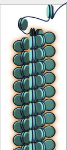
chromosome
chromatin + folding proteins
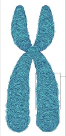
chromatid
one of two identical halves of a chromosome that has been replicated

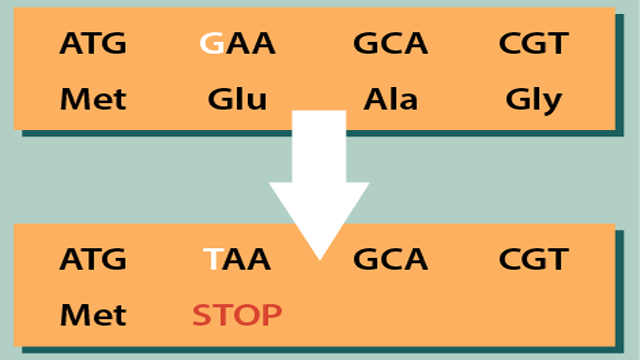
missense variant
a change in a single nucleotide causing a protein to have a different amino acid than normal
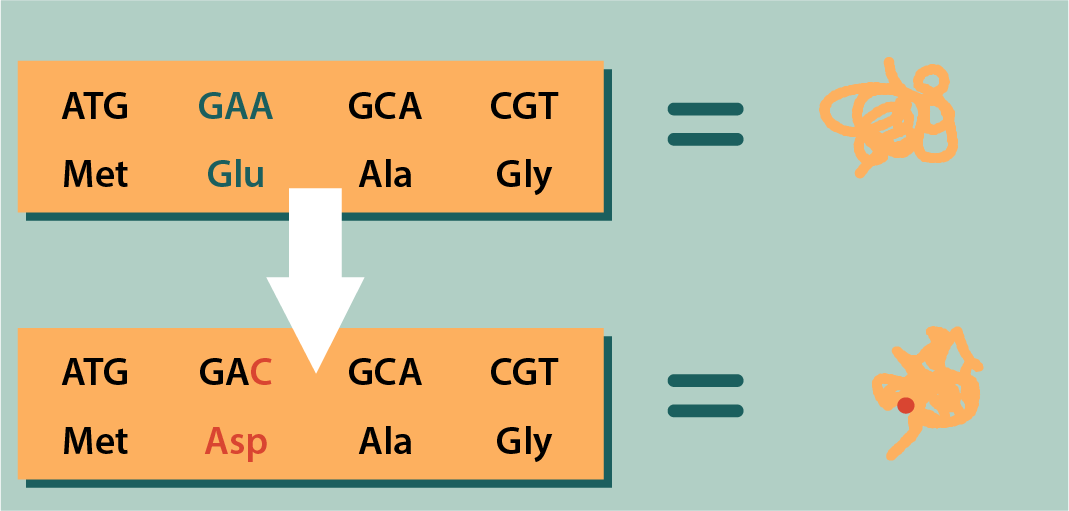
nonsense variant
a change in a single nucleotide causing a protein to end prematurely
silent variant
a change in a single nucleotide that does not change the protein

frameshift variant
a deletion or insertion causing a protein's reading frame to change, every amino acid downstream changes and usually this results in a premature stop codon

complete penetrance
all of the individuals who have a disease-causing variant will express the phenotype

incomplete penetrance
some of the people who have a disease-causing variant will express the phenotype and others will have no phenotype associated with it

variable expressivity
all of the people who have a disease-causing variant will have a phenotype but they have different signs, symptoms, or degrees of severity for the condition

incomplete penetrance and variable expressivity
some of the people who have a disease-causing variant will show a phenotype but the phenotype may be different for every individual (signs, symptoms, degrees of severity), some people with the variant will not show any phenotype though

pleiotropy
a single gene influences 2 or more unrelated phenotypic traits

What is the most common structural chromosome abnormality in humans?
Balanced Translocations
In which scenario is ordering a chromosomal analysis (karyotype) NOT the preferred test?
evaluation of a child with multiple congenital anomalies
fusion of acrocentric chromosomes, usually producing pseudodicentric, 1 in 1000 births
most common is rob(13q14q) - 75%
second most common is rob(14q21q) - 10% - which is the primary familial down syndrome translocation
most common chromsomal abnormality in live births, 1 in 500, inherited 70%
they are asymptomatic, but recurrence risks are impacted
nonallelic homologous recombination
paralogous regions cause misalignment which leads to recurrent dels/dups

nonhomologous end-joining
repairs double-strand breaks in DNA by directly sticking the broken ends back together without needing a template, can result in indels

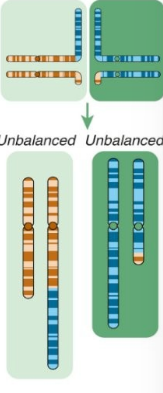
adjacent-1 segregation (in balanced translocations)
non-homologous centromeres go to the same pole, which is the most frequent form of genetic imbalance in carriers of a reciprocal translocation

alternate segregation (in balanced translocations)
a meiotic pattern in individuals with a reciprocal translocation where two normal chromosomes go to one pole and two translocated chromosomes go to the opposite pole, producing genetically balanced and viable gametes

adjacent-2 segregation (in balanced translocations)
homologous centromeres move into the same new cell together
a person inherits two identical copies of a single chromosome (or part of a chromosome) from one parent, error in meiosis II
can be detected through CMA due to large region of homozygosity
a type of uniparental disomy where a person inherits two different homologous chromosomes from one parent and no copy from the other, error in meiosis I
usually not detected by CMA
Trisomy 21 (Down syndrome)
most common aneuploidy and trisomy in liveborn (1 in 700), most common genetic cause of ID, 60 year life expectancy
symptoms: hypotonia, short stature, curved fifth digit, single palmar crease, mostly mild to moderate ID, atrioventricular canal defect, TE fistulas, duodenal atresia, Hirschsprung disease, distinctive facial features
Trisomy 18 (Edwards syndrome)
second most common trisomy in liveborn infants (1 in 5000), more common in miscarraiges than live pregnancies
75-95% mortality within first year
symptoms: poor prenatal growth, microcephaly, rocker bottom feet, hypertonia, clenched hands, micrognathia, severe ID, feeding deficiencies, hepatoblastoma, Wilms tumor (kidney), congenital heart defects (VSD)
Trisomy 13 (Patau syndrome)
third most common trisomy in live infants but most severe one
90% mortality within first year
symptoms: midline clefting, scalp defects (with skin not closing), exomphalos, holoprosencephaly, postaxial polydactyly, broad nose, severe ID, major developmental delays, heart defects, hypotonia
trisomy 16
the most common trisomy in fetuses, but none make it to birth
Turner syndrome (monosomy X)
most common aneuploid in fetuses, are 20% of chromosomally abnormal SABs, more than 95% of them are miscarried, only monosomy in live infants, 1 in 2500 females
symptoms: short stature, broad shoulders, Madelung differences, heart and kidney defects, mild cognitive differences
Klinefelter syndrome (47, XXY)
1 in 1000 male births, sometimes asymptomatic
symptoms: smaller genitalia, feminine shape, larger breasts, tall and slim
Which statement is accurate regarding chromosomal rearrangements?
Males with Robertsonian translocations have lower recurrence risks than females
Which of the following children is developmentally appropriate for their age?
1-month-old girl with no eye contact or vowel sounds.
What is a genome?
a complete set of an organism’s genetic material
What is true regarding Fragile X syndrome?
It's the most common single-gene cause of intellectual disability
________ chromosomal variation is present in all cells in the body, whereas ________ chromosome variation is present in a limited type of tissue, usually cancerous in origin.
constitutional; acquired
What term describes the physical expression of an organism's genes?
phenotype
What is the most common mechanism that results in trisomy of a chromosome?
nondisjunction in meiosis I
Which term is defined as a segment of DNA that is the basic unit of heredity which codes for a specific protein or set of proteins?
gene
What term is defined as the presence of 3 copies of each chromosome?
triploidy
The most common Robertsonian translocation:
rob(13q14q)
The diagnostic yield for exome/genome sequencing in patients with intellectual disability is around
30-40%
Which chromosomal microdeletion condition is presumed to be caused by nonhomologous end joining?
5p- (Cri-du-chat syndrome)
Babies born prematurely are at an increased risk of developing intellectual disability due to:
intraventricular hemorrhaging
______ results in the formation of gametes, whereas ______ results in the formation of identical daughter cells.
meiosis; mitosis
Which disorder causes severe hypotonia is on Newborn Screening?
Spinal Muscular Atrophy
What is the central dogma of molecular biology?
DNA → RNA → Protein
Which type of mutation involves the substitution of one nucleotide for another in DNA?
missense mutation
Which process is responsible for converting mRNA into a protein?
translation
Balanced translocations
independent sitting and walking
ex: sits without support at 9 months
grasping spoons and holding crayons
ex: picks things up between thumb and pointer finger at 12 months
language and nonverbal communication
ex: turns head toward sound of your voice at 4 months
ability to think, learn, and solve problems
ex: watches you as you move at 2 months
interactions with others and management of emotions
ex: smiles when you talk to them or smile at them at 2 months
significant limitations in both intellectual functioning (assessed through IQ test) and adaptive behavior (conceptual, social, and practical adaptive skills)
onset is before the age of 18
where intellectual disability occurs as part of a larger syndrome and involves other medical and/or behavioral symptoms
ex: Fragile X, 22q11.2, Williams, Smith-Magenis, Prader-Willi, Angelman, Wolf-Hirschhorn, and 5p- syndromes