3.14 theories of mandible movements
 Call Kai
 Learn
Learn Practice Test
 Spaced Repetition
 Match
Match Flashcards
 Knowt Play
1/72

There's no tags or description
Looks like no tags are added yet.
Name | Mastery | Learn | Test | Matching | Spaced | Call with Kai | Chat |
|---|
No analytics yet
Send a link to your students to track their progress
73 Terms
who is credited for the birth of occludators?
F. Pfaff (1756) (creating plaster models for closed mouth impressions)
who is credited with making the first prototype of gypsum occludators?
Garno 1805
what is Klaus’ innovation?
introducing metal hinged devices for fixing gypsum models
who is deemed the father of modern articulators?
Evans 1840 - unveiled sagittal and transversal jaw movements
what is the basic timeline for development of an occludator?
F. Pfaff 1756: birth of occludators
Garno 1805: keys of occlusion
Clinicians’ focus shift
Priority on vertical movements
Klaus’ Innovation
Evans 1840: Father of modern articulator
what question do the different theories try answer?
what anatomic factor plays a crucial role for movements of the jaw?
what are the anatomic factors that play a crucial role in movement of the jaws?
condyle and the fossa
articulating surfaces of the two dental arches
what does the theory of movement of the lower jaw around axis entail?
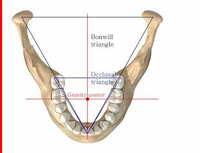
Triangle of Bonvill (unilateral, image attached)
Accepts the most important movements are vertical (opening and closing) around anatomical axis of rotation
Mechanical axis of rotation (hinge axis) is 2.5cm behind anatomical axis of rotation
what does the theory of movement of lower jaw around a sphere entail?
Monson 1898 - center is at crista Galli (2cm behind glabella)
Centre of this theory: curve of Spee, curve of Wilson
Villain 1914 - direction of all masticatory muscles is the same (towards crista galli)
what does the theory of movement of lower jaw around a cylinder entail?
Gysi (1910) - TMJ has leading role, and that articulating surfaces of teeth, just guide the lateral movements
what does theory of movement of lower jaw around a cone entail?
Hall (1925) - transversal movements are of major significance
Sagittal movements are almost impossible, so artificial teeth with flat surfaces were proposed by Hall
What does the theory of movement of the lower jaw around a helicoid entail?
Ackerman 1930 - center of helicoid is second premolar
F.Pfaff 1756 - first reproduction of occlusal relationship only
Evan 1840 - father of modern articulator, proposed device that not only reproduces occlusal but also articulating surfaces
Edgar Stark and Richmond Heiss 1889 - patented first articulator with descending condylar path
what are articulators/occludators?
Mechanical instrument designed to represent TMJ and joint members to which maxillary and mandibular casts may be attached to stimulate jaw movement
This position i when there is maximal intercuspation or centric occlusion
what is the function of articulator?
hold maxillary and mandibular cast in fixed position
Stimulate accurate jaw movements like opening and closing
Produce boarder movements (extreme lateral/protrusive movements) and intra boarder movements
what are the diff types of occludators?
Gypsum occludator
Occludator made of wire
Occludator with limitative screw. Made of bronze or brass it’s solid and massive
Modern occludators “Biocop-Orthomat”
why may dentures made of occludator not work as well?
Common issue is preliminary contacts, which mean teeth touch too soon and can lead to a traumatic occlusion or an uncomfortable bite
If a patients lower jaw movements are not quite right, what might dentists use?
They use articulating paper to identify the area that are causing problems
Trim these spots to make sure the jaw moves smoothly
what type of axis does an articulator have?
hinge axis
what is articulator designed to replicate?
precise neuro-muscular movements of lower jaw
what does Posselt say about action of TMJ?
Not jaws themselves but the neuro-muscular reflex that guides the TMJ action
The articular surfaces of TMJ are highly___
incongruent - incompatible
what are plaster models asssembly based on?
Bonvill triangle
Describe Bonvill Triangle
Plaster models are assembled based on this triangle
Triangle connects lower incisal point and highest point of condylar processes
Bisectrix of triangle is 8.5 cm
Anatomic axis of rotation is basis for this triangle
Mechanical axis is situated 2.5cm behind anatomic axis
Point of chin and highest point of condylar head moves along arches
what is the bisectrix of the Bonvill triangle?
8.5cm
which axis of rotation is the basis for Bovill triangle?
anatomic axis of rotation
where is mechanical axis located, relative to anatomic axis?
2.5cm behind and under anatomic axis
How is the mechanical axis determined from Bovills triangle?
is located at the intersection of the perpendicular lines drawn from the chords of two spheres
How far from lower incisal point should mechanical axis be in articulators?
11cm away
in articulators what should be 11cm away from lower incisal point
mechanical axis
What are the classifications of articulators based on their abilities?
Class 1 (non-adjustable)
Class 2 (non-adjustable)
Class 3 (semi-adjustable)
Class 4 (adjustable)
What does class 1 (non-adjustable) articulators entail?
Also called hinge occludators
Simple mechanical devices, only register static position between upper and lower jaws
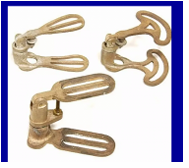
What does class 2 (non-adjustable) articulator entail?
allow horizontal and vertical movements, without reproducing movements of lower jaw
Upper jaw contains a screw adjuster
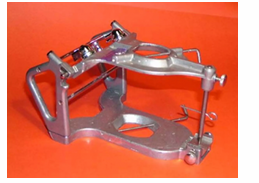
how are class 2 (non-adjustable) articulators further classified?
a) amount of eccentric motion only permitted by arbitrary values
b) amount of eccentric motion only permitted by theory of arbitrary motion
c) amount of eccentric motion permitted is determined by patient using engraving methods
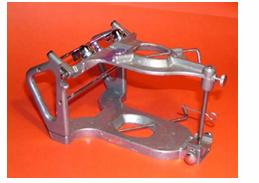
what does class 3 (semi-adjustable) articulators entail?
allow horizontal and vertical movements
Reproduce the path of condyle guidance (with mechanical model of TMJ).
Uses facebow to relate to patients TMJ
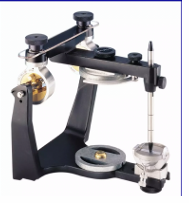
how is class 3 (semi-adjustable) articulators further classified?
Arcon and non-arcon
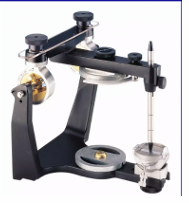
What is the biggest difference between arcon articulators and normal articulators?
the articulator is equal to human movement with the glenoid cavity located in the upper branch and the condyle in the lower branch
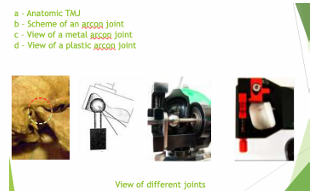
what does arcon articulator consist of?
spherical part that resembles condylar head (always made of metal)
Plate resembling glenoid fossa
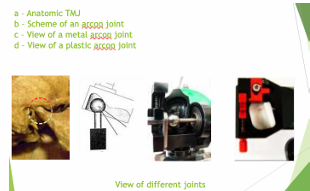
what are arcon articulators made of (material)?
The spherical part resembling condylar head is made of metal
Plate resembling glenoid fossa can be made of metal or highly rigid plastic material
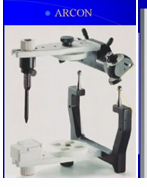
what is an advantage and disadvantage of the materials used to make acron articulators?
The plate, made of plastic is easily replaced when worn out
If it is made of metal, the replacement is very difficult
Sometimes the whole articulator is replaced with a new one
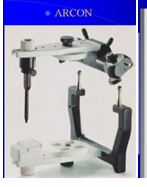
what can be said about the dentures made of arcon articulators?
Very precise
Good occluo-articulating relationship between upper and lower jaw as far as the sagittal and transversal movements are concerned
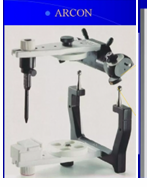
what does type one non-arcon articulators entail?
mechanical joint similar to arcon but metal plate is different
No anatomic curvature of articular tubercle so plate is absolutely flat
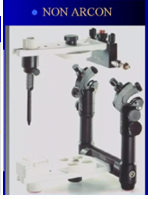
what does type two non-arcon articulators consist of?
two metal discs, placed into another
Inner disc has been drilled and inside this hole cylindrical body is placed, which helps movements be made
Sliding movements can be done with help of cylindrical or spherical body
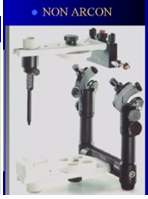
what is a variation found only in type two non-arcon articulators?
Joint with shape of horseshoe hat is opened in the distal direction
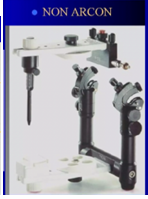
what is the biggest difference between non-acron and normal articulators?
condyles are in upper part and glenoid cavity in lower part of instrument
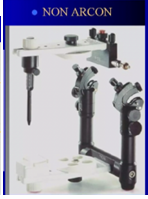
Describe class 4 (adjustable) articulators?
accepts 3D registers
Allows independent adjustment of each condyle
Duplicates the trajectory unilaterally
Mostly used in severe and difficult cases of malocclusion
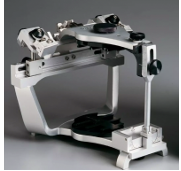
what class of articulators are mostly used in cases of sever or difficult malocclusion?
class 4 (adjustable)
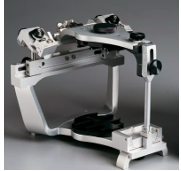
Types of articulators?
simple hinge articulators
classified according to adjustability
virtual articulators
average (mean) value of articulators
Rheihennach
Rigole
Katz
Simple hinge articulators
provide opening and closing movement in a fixed horizontal axis
what are the 3 levels of adjustments of articulators classified according to adjustability?
non-adjustable
semi-adjustable
fully adjustable
How do non-adjustable articulators work?
operate in fixed horizontal axis
fixed condylar paths for lateral and protrusive jaw movements
Incisal guide pins run on an inclined plate with a fixed inclination
How do semi-adjustable articulators work?
adjustable horizontal and lateral condylar paths
adjustable incisal guide tables
adjustable intercondylar distances
two types: Arcon and Non-arcon articulators
How do fully adjustable articulators work?
Adjustable to follow mandibular movement in all directions
numerous customizable settings tailored to each patient
Custom-made acrylic dough condyles for personalized guidance
Not commonly used due to complexity
Virtual articulators?
commonly used in CAD/CAM technologies
Simulates lower jaw movement during complex prosthetic constructions
Considered most accurate and precise
Describe average (mean) value articulators
based on average condylar (300) and incisive (100) guidance
widely used for ease of work and model assembly
Pre-set necessary values in the apparatus
what is deemed a prototype of an average (mean) value articulators?
Gisy’s articulator “New simplex”
how are the dentures made from average (mean) value articulators?
they are designed to align with average values of the articulators
Articulators with “mean values” are commonly used due to their ease of work and model assembly
Rheihennach type articulators
Most complex, have no clinical implication
Rigole types of articulators
Mouth is considered perfect articulator
What does Katz type of articulators suggest doing?
suggest using “stens” for making occlusal rims
Katz type of articulator
Suggests using “stens” for making occlusal rims
Uses Vaseline and carborundum powder paste to find the relationship of dentures recorded, transferring occlusal rims onto the articulators
Artificial teeth are placed according to the functionally formed plane
some concepts to remember
condylar path inclination
angle of incisal inclination
Bennett’s angle
condylar path inclination
healthy patients have angle value of 10-50 degrees
Edentulous patients have angle around 33 degrees
Inclination of condylar path during protrusive movements can be steep or shallow
Average angle of condylar path is 30.4 degrees (33-40) with horizontal reference plane
If protrusive inclination is steep, shorten cusp heights
If protrusive inclination is shallow, increase the cusp height
Angle of incisal inclination (anterior guidance)
Distance lower incisors pass on palatal side of upper incisors is called sagittal incisal path (from maximal intercuspation to edge-to-edge relationship)
angle with horizontal plane is called incisal guidance
angle value of this position is approx 40-50 degrees
Paths of incisal and condylar guidance are in very close relationship
It is very important for biomechanical landmark for construction of articulators
which two concepts are in very close relationship?
angle of incisal inclination (anterior guidance) and condylar path (condylar guidance)
What is the angle value of incisal inclination (anterior guidance)?
40-50 degrees
what is sagittal incisal path?
distance lower incisors pass on palatal side of upper incisors (from maximal intercuspation to edge-to-edge occlusion)
what is incisal guidance?
angle of incisal inclination with horizontal plane
Bennett’s angle
angle is important for transverse movements of mandible (left to right)
Transverse movemenst of mandible continue until working side cusp in contact and the balancing side (vice verse)
IT IS THE MOVEMENT FROM CENTRAL POSITION TO SIDE OCCLUSION
APPROXIMATELY 15-17 DEGREES
what is the actual bennett’s angle approximately?
15-17 degrees
What are the devices used alongside articulators?
facebows
Pantograph
role of facebow
device used to transfer the skull-based position of maxilla and hinge axis to articulator
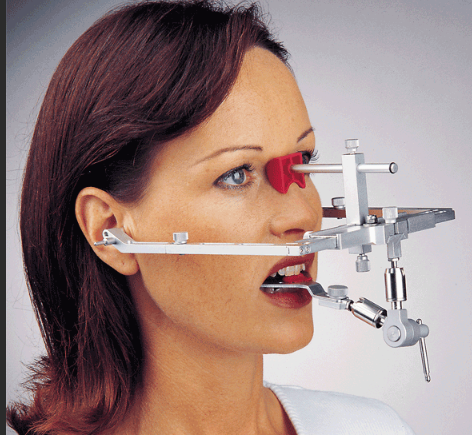
Role of pantograph
fixed to facebow device - necessary for transferring the patient’s dimensional data
Records patients mandibular border movement, applied to an articulator so the movements of articulator stimulate the border movements of patient
Application of articulators
Manufacturing full volume of prosthetic constructions (inlays to total dentures) as well as implant-supported appliances
Nowadays used in orthodontics, planning surgical procedures for resection of jaws, implantation for surgical guides etc