Rutgers Functional Human Anatomy Lec 5 (Axial Skeleton - Head & Vertebral Column & Thoracic Cage)
 Call Kai
 Learn
Learn Practice Test
 Spaced Repetition
 Match
Match Flashcards
 Knowt Play
1/35

There's no tags or description
Looks like no tags are added yet.
Name | Mastery | Learn | Test | Matching | Spaced | Call with Kai | Chat |
|---|
No analytics yet
Send a link to your students to track their progress
36 Terms
Function of the axial skeleton
- supports and protects body organ
- protects special sense organs
- attachment sites for muscles

Face (bones)
Vomer, Conchae, Nasal, Maxilla, Mandible, Palatine, Zygomatic, Lacrimal
(virgil can not make my pet zebra laugh)
Cranium (bones)
occipital, parietal, frontal, temporal, ethmoid, sphenoid
( Old people from timbuktu eat spaghetti)
Where does the pituitary gland sit?
sella turcica of the sphenoid bone

Palatine bone
- 2 bones making up the roof of the mouth
- posterior to the palatine process of the maxilla

Nasal bone
- 2 nasal bones articulate with the frontal bone

Inferior Nasal Conchae
- one on each side of the nasal septum attached to the lateral wall of the nasal cavity

Zygomatic bone
- articulate w/ the zygomatic process of the temporal bone (form the zygomatic arch)
- zygomaoicofacial foramen

Lacrimal bone
- found in the medial portion of the orbit of the eye
- lacrimal groove leads to the nasolacrimal canal

vomer
forms inferior portion of the nasal septum
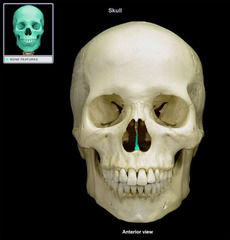
orbits
protects the eye
made up of:
front lobe (roof of orbit)
maxilla bone (floor of orbit)
lacrimal & ethmoid (medial wall of orbit)
Sphenoid ( posterior wall)
Zygomatic (lateral wall)

orbits consist of
- lacrimal gland
- adipose tissue
- muscles that move the eye
- blood vessels
- nerves
nasal complex consists of
- anterior nostrils
- posterior nasal apertures
- Nasal septum (vomer, perpendicular plate of ethmoid)
- Nasal wall (nasal conchae)
Paranasal sinuses in nasal complex
- air-filled chambers that open into the nasal cavity
- frontal sinuses
- sphenoidal sinuses
- maxillary sinuses
- ethmoid air cells

hyoid bone
- suspended by stylohyoid ligaments
- extremely mobile
- serve as points for muscle and ligament attachments

Vertebral column
- 26 bones in adult
- 24 vertebrae (7 cervical, 12 thoracic, 5 lumbar)
- 1 sacrum (5 fused vertebrae)
1 coccyx (3-5 fused vertebrae)
Functional anatomy of the vertebral column
- encloses and protects the spinal cord
- supports the skull
- supports weight of head, neck and trunk
- transfers weight to lower limbs
- helps maintain upright position of the body
Spinal curves
- cervical
- thoracic
- lumbar
- sacral
- help maintain balance along with muscle attachment
Vertebral arch
- forms vertebral foramen
- made of pedicle and laminae
- spinous process project posteriorly
- transverse process project laterally

spina bifida
- malformation of structures making up the vertebral arch where the vertebral arch fails to close completely

articular processes (facet)
superior and inferior articular process, attachment points where a superior facet of the bottom vertebrae attaches to the inferior facet of the superior vertebrae

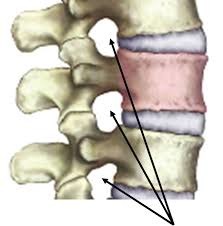
intervertebral foramina
- vertebrae have articular facets and vertebral canal
- vertebral bodies are separated by intervertebral discs
- resulting in a space called the intervertebral foramina
numbering system of vertebral regions
cervical region (C1 - C7)
thoracic region (T1 - T12)
lumbar region (L1 - L5)
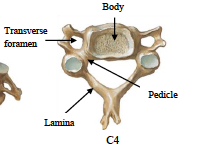
cervical vertebrae
- 7 cervical vertebrae
- supports weight of head
- spinous processes are bifid (v shaped) except for C7
- all have transverse foramina (where transverse process attaches to costal process)
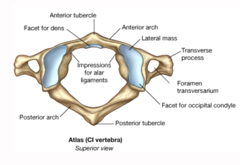
The Atlas
C1
- articulates with occipital condyles of the skull
- does not have a body
- consists of anterior and posterior vertebral arches & tubercles
- superior articular facets
inferior articular facets
- allows head to move in "yes" manner
- largest vertebral foramen of all vertebrae
The Axis
C2
- has dens
- allows head to move in a "no" manner

Vertebral Prominens (C7)
- has a long prominent spinous process
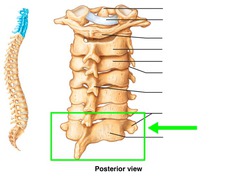
Ligamentum nuchae (C7)
- large elastic ligament
- begins at the vertebral prominens and extends to the external occipital crest of the skull

Thoracic region
- 12 vertebrae
- support the ribs
T1-T8 have superior and inferior costal facets
T9-T12 have only 1 facet
T1-T10 have transverse costal facets
- most spinous processes point inferiorly

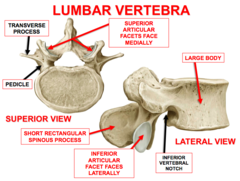
Lumbar vertebrae
- 5 vertebrae
- support weight of torso
- vertebral bodies are quite large
- spinous process point posteriorly
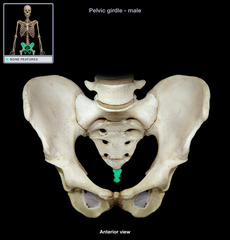
Sacrum
- one sacrum but consists of 5 fused vertebrae

coccyx
- consists of 3-5 fused vertebrae
- adult male coccyx points anteriorly
- adult female coccyx points inferiorly
- coccyx consists of the coccygeal cornua
Thoracic Cage Functions
- protection
- attachment site for muscles
types of ribs in thoracic cage
- vertebrosternal (true) ribs (connect to sternum via costal cartilages) 1-7
- vertebrochondral (false) ribs 8-12
- vertebral (floating) ribs 11-12

structure of a rib
head, neck, body, tubercle, angle, costal groove
sternal end - superior and inferior articular facet/interarticular crest

sternum
consist of:
manubrium
body
xiphoid process
jugular notch