PMT ( Formula)
 Call Kai
 Learn
Learn Practice Test
 Spaced Repetition
 Match
Match Flashcards
 Knowt Play
1/16

There's no tags or description
Looks like no tags are added yet.
Name | Mastery | Learn | Test | Matching | Spaced | Call with Kai | Chat |
|---|
No analytics yet
Send a link to your students to track their progress
17 Terms
expanded CF present value model
• Real risk free interest rate, lt,s
• Expected inflation, θt,s
• Risk-premium for uncertainty in future cash flows, ρt,s
πt,s = risk premium for uncertainty in future inflation
Credit premium is represented by γt,si It is the additional return required by investors as compensation for bearing credit risk.
κt,si - Represents the premium demanded by investors for investing in equities relative to bonds.

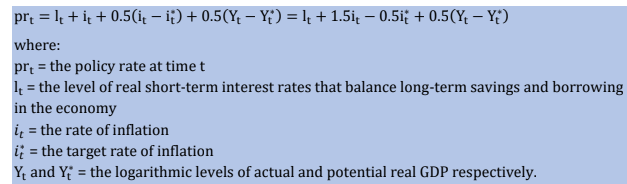
Taylor Rule
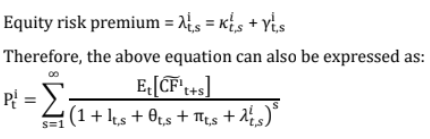
Equity risk premium
The equity risk premium can be assumed to be a sum of a risk premium for investing in equities, κt,si , and a premium for holding a default-free government bond, γt,s
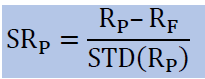
Sharpe ratio
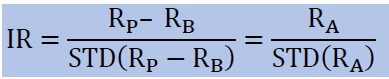
Information ratio
The IR measures the consistency of active return.
optimal portfolio Sharpe ratio,

total risk of the actively managed portfolio is

optimal amount of active risk
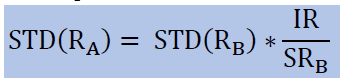
Active security returns
The diagram below illustrates the relationship between the three key parameters in the fundamental law of active management: forecasted active returns (μi), active portfolio weights (wi), and realized active returns (RAi).

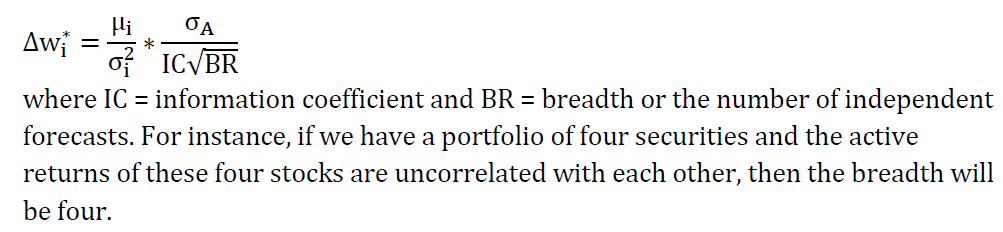
forecasted active returns using the Grinold rule
where IC = information coefficient and BR = breadth or the number of independent forecasts. For instance, if we have a portfolio of four securities and the active returns of these four stocks are uncorrelated with each other, then the breadth will be four.

The active security weights are given by
Signal quality / Information coefficient
measures the ex-ante correlation between the forecasted active returns and realized active returns

The transfer coefficient
measures the degree to which the investor’s forecasts are translated into active weights

Information ratio under full fundamental law

generic form of the APT equation

macroeconomic factor models
FGDP = the surprise in GDP growth
εi = an error term with a zero mean that represents the portion of the return to asset I not
explained by the factor model
