Histo Peripheral Blood & Circulatory System (2 Lectures)
 Call Kai
 Learn
Learn Practice Test
 Spaced Repetition
 Match
Match Flashcards
 Knowt Play
1/179

There's no tags or description
Looks like no tags are added yet.
Name | Mastery | Learn | Test | Matching | Spaced | Call with Kai | Chat |
|---|
No analytics yet
Send a link to your students to track their progress
180 Terms
55% plasma
45% erythrocytes
5% buffy coat
What percentages of the blood are made up by erythrocytes, plasma, and buffy coat?
water
What makes up 92% of plasma?

platelets
Anucleate cell fragments involved in blood coagulation; contain alpha granules and delta/dense granules

agranuloctes: lymphocytes and monocytes
granulocytes: neutrophils, eosinophils, and basophils
Which of the leukocytes are agranulocytes, and which are granulocytes?
erythrocytes
anucleate cells with no organelles and a lifespan of 120 days; most numerous formed element in the blood
erythrocytes
What cells transport oxygen from the lungs to all the tissues of the body and transport carbon dioxide waste from those tissues back to the lungs?
pallor
thin, lightly stained region of an erythrocyte

hemoglobin
An iron-containing protein in red blood cells that reversibly binds oxygen
oxyhemoglobin
Hemoglobin combined with oxygen
carbaminohemoglobin
the compound formed by the union of carbon dioxide with hemoglobin
sickle cell anemia
autosomal recessive disorder associated with the production of defective hemoglobins, which causes ischemia of tissue (inadequate blood supply)
hemoglobin
What protein is affected by sickle cell anemia?
alpha and delta
What 2 types of granules do platelets have?
Gray Platelet Syndrome
What problem occurs when alpha granules are absent in platelets?
storage pool deficiency
What problem occurs when delta granules are absent in platelets?
fibrin
Trauma to vessels results in a _______ clot.
lymphocytes
Leukocytes with a round/oval nucleus, dense chromatin, and a thin rim of basophilic cytoplasm; include B, T, and null cells and play roles in immune defense

B cells
lymphocytes involved in the humoral immune response
T cells
lymphocytes involved in the cellular immune response
null cells
pluripotential hemopoietic stem cells (PHSCs)/natural killer cells
Chronic Lymphocytic Leukemia (CLL)
blood cancer, where there are abnormally high levels of mature lymphocytes in peripheral blood and tissue, smudge cells are present, organs are enlarged, and pinpoint hemorrhages occur
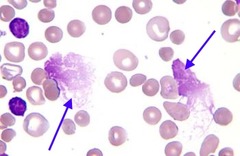
smudge cell
a ruptured leukocyte, seen in chronic lymphocytic leukemia
monocytes
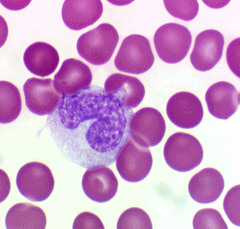
Large leukocytes with an elongated kidney-shaped nucleus and azurophilic granules; differentiate into tissue phagocytes such as macrophages, Kupffer cells, microglia, dust cells, and osteoclasts
neutrophils
Leukocytes with a multilobed nucleus, primary nonspecific granules, and secondary specific antibacterial granules; use oxidative killing via respiratory burst/H₂O₂ and nonoxidative killing via phagocytosis
band neutrophil
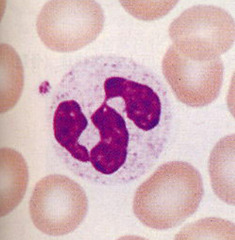
a neutrophil with a nucleus that has not yet become segmented (lack the thin connecting bits); many are present during infection

primary granules
In neutrophils, what kind of granules are nonspecific?
secondary granules
In neutrophils, what kind of granules are specific and contain antibacterial compounds?
hydrogen peroxide
What compound do neutrophils form during an oxidative respiratory burst?
eosinophils
Leukocytes with a 2–3 lobed nucleus and eosinophilic specific granules; degrade antigen-antibody complexes, degrade histamine to limit inflammation, and defend against parasitic infections

histamine
Eosinophils degrade _______ to limit inflammation.
basophils
rare leukocytes with a 2- or 3- lobed nucleus that release histamine and heparin in allergic reactions; attract eosinophils and neutrophils to the site; very dark blue/purple

neutrophil (54-62%)
Which leukocyte is most prevalent?
basophil
Which leukocyte is the most sparse?
liver, spleen, bone marrow, lymph nodes
Where are discontinuous capillaries located?
b) characterized by the presence of fat cells and blood vessels
The epicardium is one of the 3 layers of the heart. It is:
a) continuous with the endocardium via the annulus fibrosis
b) characterized by the presence of fat cells and blood vessels
c) composed of modified cardiac muscle cells called Purkinje fibers
d) capable of increasing intraventricular pressure
d) capable of decreasing rate of contraction
sinoatrial (SA) node
The generation of impulses in the normal heart is the responsibility of the ______________.
large vein
a vessel containing longitudinal bundles within its tunica adventitia is classified as what?
medium (muscular) artery
a vessel often characterized by an external elastic lamina, which separates the tunica media from the tunica adventitia is classified as what?
eosinophil
Which white blood cell has specific granules characterized by the presence of an internum?
e) osteoblast
Which of the following is NOT a cell that a monocyte might develop into?
a) macrophage
b) microglia
c) Kuppfer cell
d) dust cell
e) osteoblast
megakaryocytes
huge specialized cells in the bone marrow that produce platelets and have a large floppy nucleus

arteries
Between arteries and veins, which has high pressure?
large
What size are elastic arteries?
medium
What size are muscular arteries?
endocardium, myocardium, epicardium
3 layers of the heart wall
endocardium
inner lining of the heart ("c" in the image); consists of endothelium, subendothelial connective tissue, subendocardium, and Purkinje fibers

endothelium; mesothelium
Endocardium is covered by ____________, while epicardium is covered by __________.
myocardium
thick middle layer of the heart wall composed of cardiac muscle cells with intercalated discs ("a" in the image)

epicardium
outer layer of the heart ("b" in the image); contains nerves, blood vessels, and adipocytes and is covered by mesothelium

sinoatrial (SA) node
A specialized area of cardiac tissue, located in the right atrium of the heart, which initiates the electrical impulses that determine the heart rate; often termed the pacemaker for the heart
atrioventricular (AV) node
a node of specialized heart muscle located in the septal wall of the right atrium; receives impulses from the sinoatrial node and transmits them to the atrioventricular bundle
atrioventricular (AV) bundle
Bundle of specialized fibers that conduct impulses from the AV node to the right and left ventricles; also called bundle of His.
purkinje fibers
fibers in the ventricles that transmit impulses to the right and left ventricles, causing them to contract (terminal part of the conducting system)
ventricles
Between ventricles and atria, which are thicker?
chordae tendineae
cord-like structures connecting the cusps of bicuspid & tricuspid valves with the papillary muscles

pericardial effusion
excess fluid in the pericardial cavity due to inflammation of pericardium (pericarditis)
hemopericardium
condition when blood is trapped in the pericardial cavity
veins
Do arteries or veins have a larger lumen?
Smooth muscle
_________ cells produce elastic laminae in elastic arteries.
large (elastic) arteries
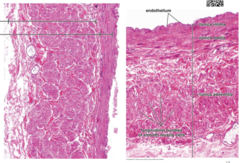
Which vessels have a thin tunica intima and tunica adventitia with vasa vasorum, and a thick tunica media (rich and well organized elastic laminae)? (AKA conducting arteries)

vasa vasorum
“vessels within a vessel” that provide nutrition and O₂ to the thick tunica media and tunica adventitia of large vessels

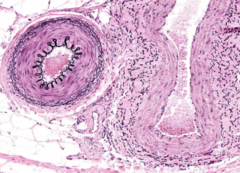
medium (muscular) arteries
Which vessels have a thin tunica intima and tunica adventitia, a thick tunica media with 6-40 layers of smooth muscle cells, and internal and external elastic laminae? (AKA distributing arteries) (on the left in the image)
dense bodies
structures in vascular smooth muscle cells that anchor actin filaments

arterioles
Which vessels have an endothelium, 1-2 layers of smooth muscle cells, and a small round lumen?

small arteries
Which vessels have a thin tunica intima and tunica adventitia, a tunica media consisting of 3-6 layers of smooth muscle cells, and an internal elastic lamina?

sympathetic nervous system
Which part of the autonomic nervous system helps with vasoconstriction?
parasympathetic nervous system
Which part of the autonomic nervous system helps with vasodilation?
arterioles
last segment of the arterial system; connect to the capillary network; able to sense changes in blood pressure, flow, O2 tension
endothelium
provides a permeability barrier; controls the composition of interstitial tissue fluid; allows the movement of leukocytes, fluid, and immunoglobins into tissue; provides for angiogenesis in the formation of new blood vessels; controls blood pressure; provides anticoagulent signals (thrombomodulin, nitrous oxide, prostacylin)
anticoagulant signals
Thrombomodulin, nitrous oxide, and prostacylin are all examples of ____________ provided by the endothelium of blood vessels.
endothelin
A peptide produced by a blood vessel's endothelium that causes the vessel to constrict (vasocontriction)
nitric oxide and prostacyclin
vasodilators provided by the endothelium of blood vessels
decreases platelet inhibitors
promotes platelet activation
exposes basal lamina/connective tissue
allows platelet adhesion and aggregation
If endothelial cells are injured, how does this affect platelets?
coronary artery atherosclerosis (CAD)
condition that involves changes within the artery wall, accumulation of lipid, formation of plaques, and thickening of tunica intima
capillaries
Which vessels function in exchange of metabolites, gases, and nutrients, as well as inhibition of clot formation?
continuous capillaries
What type of capillary is found in muscle, CT, nervous tissue, lungs, exocrine glands, and the thymus?

continuous capillary
What type of capillary has no pores, has a continuous basal lamina, and allows limited materials to pass through its walls?
fenestrated capillaries
What type of capillary is found in the intestine, glomerulus of kidney, and endocrine organs?

fenestrated capillary
What type of capillary has endothelial cells with small pores/diaphragms, has a continuous basal lamina, and allows a great range of substances to pass through their wall?
discontinuous (sinusoidal) capillaries
What type of capillary is found in the liver, spleen, bone marrow, and lymph nodes?

discontinuous (sinusoidal) capillary
What type of capillary has endothelial cells with large pores (intercellular clefts), has an incomplete basal lamina, and allows free movement of protein, plasma, and other materials/cells to pass through their wall? (formed elements can exit the lumen)
pericytes
spider-shaped contractile stem cells help stabilize capillary walls, control permeability, and play a role in vessel repair
false (this is true of arterioles, but capillaries lack smooth muscle)
T/F: Capillaries have 1-2 layers of smooth muscle in their walls.
metarterioles
Short vessels that link arterioles and capillaries
thoroughfare channel
metarteriole that continues through capillary bed to venule
sphincters
When the ________ are relaxed, the capillary bed is well perfused.
contracted
When the sphincters are __________, blood bypasses the capillary bed.
venules
the smallest veins, which are companions with arterioles but have larger lumens than arterioles; consist of endothelium and connective tissue (lack smooth muscle)

small vein
Which vessels have 1-3 layers of smooth muscle but less distinguishable smooth muscle layers, and are lined by endothelium?
medium veins
Which vessels have a thick adventitia layer and a few longitudinal smooth muscle bundles in the tunica adventitia?
large veins
Which vessels may have internal elastic lamina in the tunica intima, has a few layers of smooth muscle in the tunica media, and has a thick tunica adventitia with many densely arranged longitudinal smooth muscle bundles and vasa vasorum?