History of Neuroscience 01
 Call Kai
 Learn
Learn Practice Test
 Spaced Repetition
 Match
Match Flashcards
 Knowt Play
1/72

There's no tags or description
Looks like no tags are added yet.
Name | Mastery | Learn | Test | Matching | Spaced | Call with Kai | Chat |
|---|
No analytics yet
Send a link to your students to track their progress
73 Terms
what is neuroscience?
study of the nervous system.
What does neuroscience study?
How the nervous system affects movement, learning, memory, emotions, pain, pleasure, and reasoning.
What is trepanation?
An ancient surgery where a hole was made in the skull.
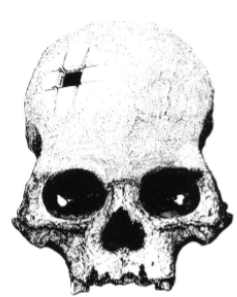
What did ancient trepanation show?
People understood the brain was vital to life, and healed skulls show some survived the surgery.
What was the Edwin Smith Surgical Papyrus?
Ancient Egyptian text describing 48 injury cases, including brain and spine injuries.
What did Egyptians recognize about CNS injuries?
Brain and spinal injuries can affect other parts of the body.
How did ancient Egyptians view the brain vs. the heart?
Heart = central organ
Brain = less important and removed during mummification
What did Hippocrates believe about the brain?
The brain controls sensation and intelligence and is the body’s main control center.
What did Aristotle believe about the brain and heart?
Heart = center of intellect
Brain = cools the blood/body
Hippocrates
brain is in control
Aristotle
heart is in control.
What brain structures did Galen study?
Cerebrum, cerebellum, and ventricles.
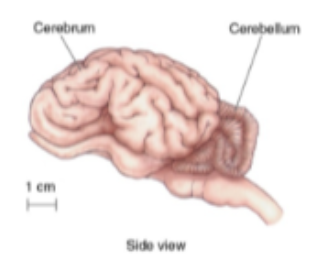
Identify the labeled structures.
Cerebrum, Cerebellum, Ventricles
Who helped establish modern human anatomy?
Andreas Vesalius during the Renaissance.
How did Vesalius change anatomy?
He questioned Galen’s anatomical descriptions using human anatomy.
How was the brain viewed in the 17th century?
As a machine controlled by fluid movement.
What is the mind-body problem?
The question of how the mind and physical brain/body are connected.
What did René Descartes believe about the mind and body?
Mind and body are separate but interact.
What was Descartes’ reflex theory?
The body acts like a machine, producing automatic responses.
What role did Descartes give the pineal gland?
The connection between the mind/soul and body.
What did Luigi Galvani discover?
Electricity causes muscles to contract.
What did Galvani discover about nerves?
Nerves are electrical conductors, not fluid-filled pipes.
How were nerves understood in the 19th century?
As “wires” that conduct electrical signals.
What did Bell and Magendie discover?
Dorsal and ventral roots carry signals in opposite directions.
Who developed phrenology?
Franz Joseph Gall.
What is phrenology?
The idea that different brain areas control different traits and abilities.
How did phrenologists determine a person’s traits?
By examining the shape and bumps of the skull.
What did Paul Broca discover?
The left hemisphere is important for language/speech.
What is expressive aphasia?
Difficulty speaking or writing thoughts.
What is receptive aphasia?
Difficulty understanding spoken or written language.
What is anomic aphasia?
Difficulty finding the correct words/names.
What is global aphasia?
Severe loss of language—speaking, understanding, reading, and writing.
Who developed the theory of evolution?
Charles Darwin.
How did evolution contribute to neuroscience?
It showed that brain structures and behaviors can be similar or different across species.
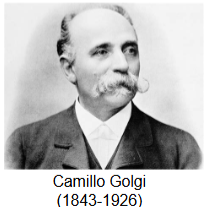
What did Camillo Golgi develop?
A silver staining method that made neurons visible.
What is the neuron doctrine?
The nervous system is made of separate cells called neurons.
Reticular theory vs. neuron doctrine?
Reticular: neurons form one continuous network.
Neuron doctrine: neurons are separate cells.
What did Ramón y Cajal contribute to neuroscience?
He showed that neurons are separate, individual cells.
How were synapses later visualized?
Using electron microscopes.
What does Nissl stain show?
Neuron cell bodies (somas) and their organization.
Nissl stain vs. Golgi stain?
Nissl: cell bodies
Golgi: entire neurons and their branches
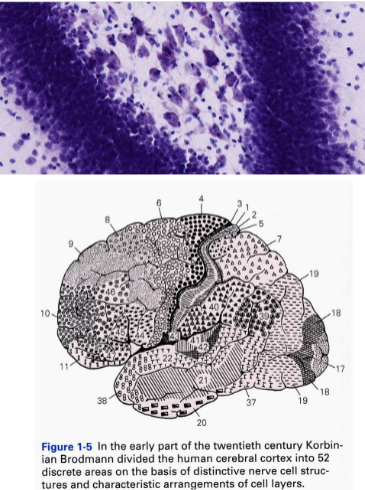
What is the cytoarchitectonic method?
Identifying brain areas by differences in cell structure and organization.
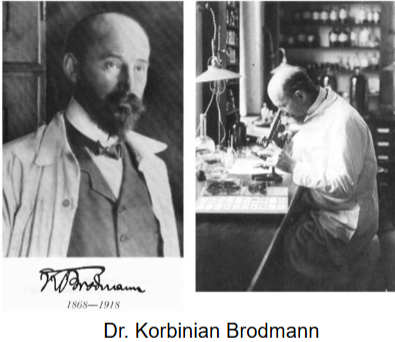
What did Korbinian Brodmann do?
Divided the cerebral cortex into distinct areas based on cell structure.
Light vs. electron microscope resolution?
Light: 0.1 µm
Electron: 0.1 nm (much higher resolution)
Why are electron microscopes used to view synapses?
Synapses are extremely small (~20 nm) and need higher resolution.
How can scientists visualize and study individual neurons?
Using specialized microscopes and microelectrodes.
What levels can modern neuroscience study?
Molecules → synapses → single cells → brain networks
What does functional brain imaging show?
Which brain areas are active during different tasks.
What is the current view of brain localization?
Specific functions involve specific brain areas AND multiple neural pathways.
What happens if one neural pathway is damaged?
Other pathways may compensate for the damage.
How does the brain process information?
Through serial and parallel processing across multiple brain areas.
Molecular neuroscience
Studies molecules and chemicals involved in nervous system function.
Cellular neuroscience
Studies neurons and other nervous system cells and how they work.
Levels of analysis in neuroscience
Molecular, cellular, systems, behavioral, cognitive, and computational
Systems neuroscience
Studies how neurons and brain regions work together.
Behavioral neuroscience
Studies how the brain and nervous system influence behavior.
Cognitive neuroscience
Studies brain processes behind thinking, memory, learning, and language.
Computational neuroscience
Uses math and computer models to understand brain function.
Main goal of neuroscience
To understand how the nervous system functions.
How does neuroscience study nervous system function?
Through brain imaging, behavior, and experiments on living tissue.
How does neuroscience improve healthcare?
Develops new treatments for nervous system disorders.
Alzheimer’s disease
Progressive brain degeneration causing dementia and memory loss.
Autism
A developmental disorder affecting communication, social interaction, and behavior.
Cerebral palsy
Motor disorder caused by brain damage around the time of birth.
Depression
Mood disorder involving persistent sadness and loss of interest.
Epilepsy
Abnormal brain electrical activity causing recurrent seizures.
Multiple sclerosis (MS)
Disease that disrupts nerve conduction, causing weakness and poor coordination.
Parkinson’s disease
Progressive brain disorder causing difficulty initiating and controlling movement.
Schizophrenia
Disorder involving delusions, hallucinations, and disorganized behavior.
Spinal paralysis
Loss of movement and sensation from spinal cord damage.
Stroke
Loss of brain function from disrupted blood supply to the brain.
Which system is responsible for most/all brain activity?
CNS (central nervous system)
Cognitive load
the load on working memory at any point in time, which can affect learning and task performance.