AIS Chapter 12
 Call Kai
 Learn
Learn Practice Test
 Spaced Repetition
 Match
Match Flashcards
 Knowt Play
1/39

There's no tags or description
Looks like no tags are added yet.
Name | Mastery | Learn | Test | Matching | Spaced | Call with Kai |
|---|
No analytics yet
Send a link to your students to track their progress
40 Terms
Information Security
an integrated, systematic approach that coordinates people, policies, standards, processes, and controls used to safeguard critical systems and information from internal and external security threats
Primary focus of Information System
Confidentiality
information is not accessible to unauthorized individuals or processes
Integrity
information is accurate and complete
Availability
information and systems are accessible on demand
Information Security Risks and Attacks
Virus
A self-replicating program that runs and spreads by modifying other programs/files
Worm
A self-replicating, self-propagating, self-contained program that uses networking mechanisms to spread itself.
Trojan horse
A non-self-replicating program that has a useful purpose in appearance, but in fact has a different, malicious purpose.
Spam
Sending unsolicited bulk information
Botnet (Bot)
A collection of software robots that overruns computers to act automatically in response to the bot-herder’s control through Internet.
Information Security and System Integrity
Denial-of-service (DoS)
The prevention of authorized access to resources (such as servers) or the delaying of time-critical operations.
Spyware
Software secretly installed into an information system to gather information on individuals or organizations without their knowledge of; a type of malicious code.
Spoofing
Sending a network packet that appears to come from a source other than its actual source.
Social engineering
Manipulating someone to take certain action that may not be in that person’s best interest such as revealing confidential information or granting access to physical assets, networks, or information.
Encryption
preventive control providing confidentiality and privacy for data transmission and storage. Main factors of encryption are key length, key management, and encryption algorithm
Factors of Encryption
Key length
Encryption algorithm
Key management
Symmetric-key Encryption
Fast
Suitable for large data set
Key distribution and key management are problematic
+ difficult to distribute key in secure way
+ managing one key is not cost effective
Asymmetric-key Encryption
Slow
Not suitable for large data set
Key distribution and key management are solved
+ public key is widely used while private key is kept secret
+ transmit confidential information
Authentication
process that establishes the origin of information or determines the identity of a user, process, or device
Asymmetric-key Encryption Key Factors
Certificate Authority (CA)
A trusted entity that issues and revokes digital certificates.
Digital Certificate
A digital document issued and digitally signed by the private key of a Certificate Authority that binds the name of a subscriber to a public key.
Public Key Infrastructure (PKI)
A set of policies, processes, server platforms, software and workstations used for the purpose of administering certificates and public-private key pairs to issue, maintain, and revoke public key certificates. message digest
Message Digest
short code generated through a process called hashing, where the original document passes through an algorithm such as SHA-256 or MD-5
Digital Signature
message digest (MD) of a document (or data file) that is encrypted using the document creator’s private key
Creation of digital signature
document creator must use his/her own private key to encrypt the MD, so the digital signature also authenticates the document creator
Criteria of Cybersecurity Risk Management Framework
description of the company’s cybersecurity risk management system
evaluation of the company’s cybersecurity controls
Fraud
Any illegal act characterized by deceit, concealment, or violation of trust. These acts are not dependent upon the threat of violence or physical force
The Statement of Auditing Standards (SAS) No. 99:
Consideration of Fraud in a Financial Statement Audit states that an entity’s management has primary responsibility for establishing and monitoring all aspects of the entity’s fraud risk-assessment and prevention activities and has both the responsibility and the means to implement measures to reduce the incidence of fraud
Fraud Triangle
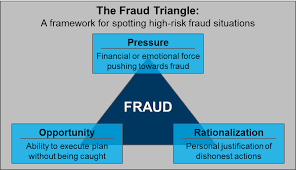
Computer fraud risk assessment
a systematic process that assists management and internal auditors in discovering where and how fraud may occur and who may commit the specific fraud.
a component of a firm’s enterprise risk management (ERM) program.
focuses on fraud schemes and scenarios to determine whether the controls exist and how the controls might be circumvented.
Computer Fraud Risk Assessment Steps
Identifying relevant IT fraud risk factors.
Identifying potential IT fraud schemes and prioritizing them based on likelihood and impact.
Mapping existing controls to potential fraud schemes and identifying gaps.
Testing operating effectiveness of fraud prevention and detection controls.
Assessing the likelihood and business impact of a control failure and/or a fraud incident
Fraud Prevention
Starts with a fraud risk assessment across the entire firm, taking into consideration the firm’s critical business divisions, processes, and accounts, performed by the management
Fraud Detection
Include an evaluation by internal auditors on the effectiveness of business processes, along with an analysis of transaction-level data to obtain evidence on the effectiveness of internal controls and to identify indicators of fraud risk or actual fraudulent activities
GDPR (General Data Protection Regulation)
protects European Union (EU) citizens from privacy and data breaches. GDPR aims to provide customers greater control of their personal data
Vulnerability
Weaknesses or exposures in IT assets or processes that may lead to a business risk, compliance risk, or security risk
risk management
more complex and strategic process, mostly conducted using a top-down, risk-based approachvulnerability manag
Vulnerability Management
tactical and short-term effort, frequently conducted using an IT asset-based approach
Vulnerability management prereqs
Determine the main objectives of its vulnerability management, as the firm’s resource for managing vulnerabilities is limited (in some cases, it could be to comply with applicable laws, regulations, and standards)
Assign roles and responsibility for vulnerability management.
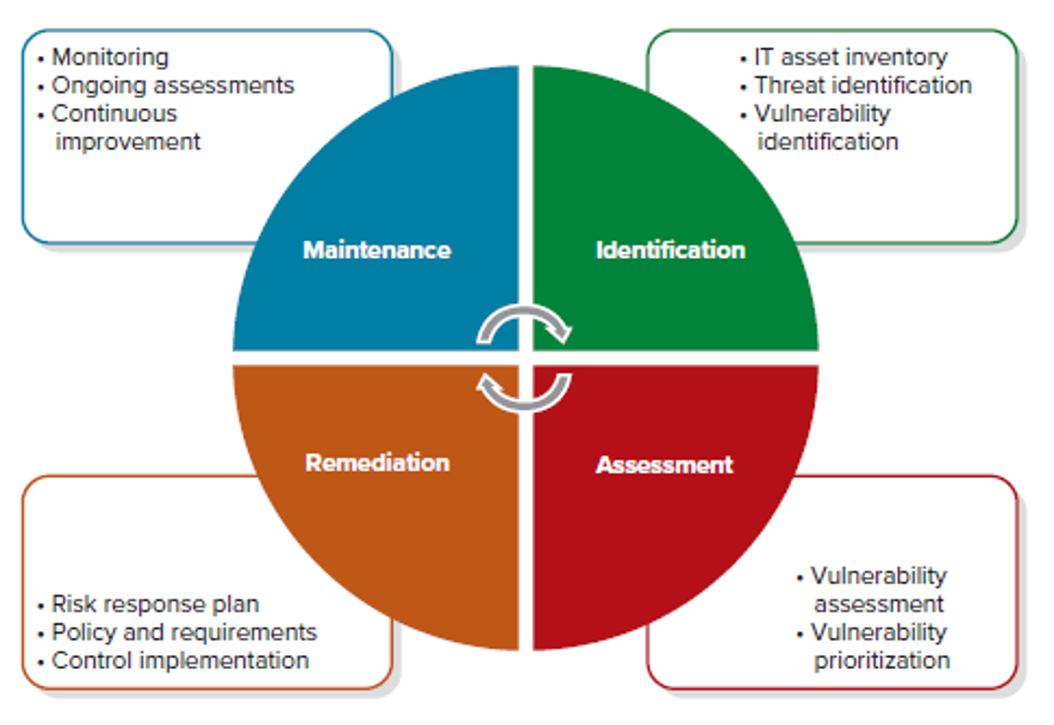
Overall Framework for Vulnerability Assessment and Management
Uninterruptible power supply
a device using battery power to enable a system to operate long enough to back up critical data and shut down properly during the loss of power
Fault tolerance
using redundant units to provide a system the ability to continue functioning when part of the system fails
Cloud computing
Good alternatives to backup data and applications
System and Organization Controls (SOC Reports)
Required to show reports of service providers prior to signing agreements for specific services.
SOC 1 Report
focuses on the impact of the service provider’s controls on the user company’s financial statementsS
SOC 2 & 3 report
Provide the evaluations on a broader set of controls relevant to security, availability, processing integrity, confidentiality, or privacy implemented by the service provide
SOC 1 Type 1
reports on (1) the fairness of the presentation of management’s description of the service organization’s system and (2) the suitability of the design of the controls to achieve the related control objectives as of a specified date
SOC 1 Type 2
Provides the same content as SOC 1 Type 1 report, but the examination should be throughout a specified period
SOC 2 (Type 1 & 2) Report
(1) the fairness of the presentation of management’s description of the service organization’s system and (2) the suitability of the design of the controls to achieve the related control objectives
Type 1 - Specified Date
Type 2 - Specified Period
SOC 3 Report
examines service organizations based on the Trust Services criteria and is a report for general use
SOC 2+ Report
SOC for Cybersecurity examination and report
SOC for Supply Chain reporting framework
Whitepapers on the Implications of the Use of Blockchain in SOC for Service Organization
Disaster recovery planning (DRP)
identifies significant events that may threaten a firm’s operations, outlining the procedures that ensure the firm’s smooth resuming of operations in the case this event occurs
Business Continuity management
the activities required to keep a firm running during a period of interruption of normal operations.
DRP and BCM are the most critical corrective controls, and DRP is a key component of the BCM.