Agency and Controll - Media
 Call Kai
 Learn
Learn Practice Test
 Spaced Repetition
 Match
Match Flashcards
 Knowt Play
1/56

There's no tags or description
Looks like no tags are added yet.
Name | Mastery | Learn | Test | Matching | Spaced | Call with Kai | Chat |
|---|
No analytics yet
Send a link to your students to track their progress
57 Terms
Media and Society - overall:
The impact of mass media over particular audiences has been present for a long time.
Early Media - Consideration into how new developments of press could sway political opinion. The emergence and popularity of film, wide access to radio, how this would change the way audiences would consume +interact with media content.
The broader impact/effect the media has on audiences particularly through the development of internet and digital technology, should be considered.
Agency:
The capacity of individuals to act independently and to make their own free choices.
When media audience, producer, institution has agency = feel they can use a medium however they choose, to communicate a message (good/not)
Modern media - both the media AND audiences now exercise agency — it's no longer a one-way relationship.
Control:
The power to influence or direct people’s behaviour or choices.
In relation to the media, control exists when they use that power to shape a message or direct how the media is used.
Agency and Control Relationship
Agency and Control - seen in the ways audiences use, engage and consume media, but also how producers and institutions create, negotiate and control the delivery of media that the audience engages with.
Media agencies (corporations, institutions, governments) still create and distribute content
Audience members now have their own agency - can:
Choose what to consume
Create and share their own content
Respond, critique, and challenge media messages
Influence others through social networks
Ongoing tension as they each attempt to claim agency and control over media products
Types of Audiences: List
Passive
Active
Susceptible
Passive Audiences:
Passive: Audience that does not question what the media has to say. They are like a sponge that absorbs everything they are told.
Active Audiences:
Active: Audience that doesn’t believe everything they are told, rather they question the media and use critical thinking.
Susceptible audiences:
Susceptible: This is a vulnerable audience that has the potential to be easily influenced.
Eg: Elderly, women, children
Extent of Media Effects: List
Nature of media effects
Extent of media effects
Moral Panics
Nature of media effects: (media effects)
Nature of media effects: Refers to how media influence people; in the ways in which media influence manifests across an audience (opinions, attitudes, behaviours).
Extent of Media effects (media effects)
Extent of media effects: Refers to the degree/level of influence that a media text or form has over or in shaping audiences views, behaviours and values.
Moral Panics (media effects)
Moral Panics
Refer to the widespread anxiety about an issue that is said to threaten the fabric of society. Moral panics often occur around forms of media technology.
eg: Y2K bug
List of potential media effects (some of many)
Lowered attention span
Overexposure and access
Media bias
‘Fake news’ Misinformation
Racial stereotyping
Sexualisation of children
Toxic relationships and tropes
Poor self image
Communication Models:
Is a theoretical and simplified representation of the communication process. Often used to illustrate theories.
i.e. a way to group communication theories
Communication Theories
A set of systematic informed generalisations about how the communication processes may work. i.e. individual theories about the communication process
Communication models types and effects: list
Types:
Communication - how communication travels
Mass Media - what happens when communication travels
Effects:
Limited effects (associated with Communication model)
Cultural Studies (associated with Cultural Studies)
—
Communication & Mass Media = the Models
Limited Effects & Cultural Studies = the theoretical frameworks
Two-step flow, Agenda-setting, Participatory culture, Parasocial relationships = the theories
Communication - Communication model
Process of information exchange between a sender and a receiver.
Media as powerful over audiences (top-down)
Audiences have the potential to influence the media (bottom up)
Both the media and audience have the ability to exert power and agency (mix)
Mass media - Communication models
Communication being relayed to a large group of people at one time.
Previously – radio, print and film mass produced for wider circulation
Currently – viral spread of messages is characteristic of new media
Communication models effects BOTH
Limited effects: How does or to what extent the media does to audiences?
Cultural Studies: What audiences do with the media.
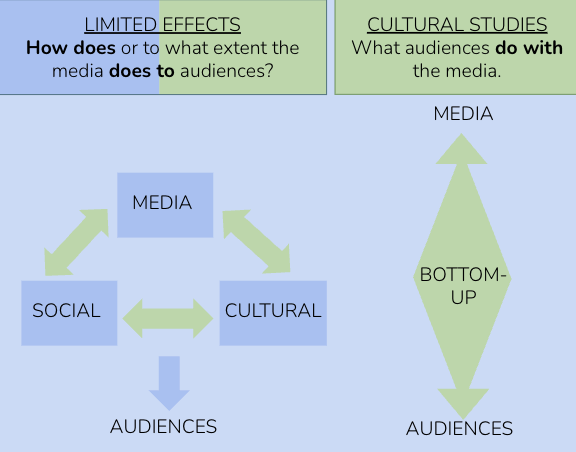
Limited Effects - Communication Models (and linked theories)
Limited effects
The kinds of effects the media has on audiences - Suggests the media has small and short-term influence on audiences. Identifies the audiences relationship with the media involves other factors such as social, cultural and institution (mix).
-
Communication Theories
1. Agenda-setting
2. Two-step flow
Cultural Studies - Communication Models (and linked theories)
Cultural Studies
How individuals + social groups use the media to structure their everyday lives. How the media + audiences work in a broader sense as cultures and institutions (bottom-up). Audiences are consider active agents, with a focus on how social groups use media.
-
Communication Theories
3. Parasocial relationships
4. Participatory culture
List of all Communication Theories:
1. Agenda-setting
2. Two-step flow
3. Parasocial relationships
4. Participatory culture
Audience has gradually more active power, and the media looses power as the list goes down.
Agenda-Setting Theory - (Communication Model LIMITED EFFECTS)
The media has power to set the agenda for any social, political or economic issue. The media tells the public what to think about (not what to think) - through selection, omission and framing process, the media focuses on the construction of discourse.
Agenda Setting Theory - Gatekeeping (Communication Model LIMITED EFFECTS)
Agenda-Setting Theory - Gatekeeping
News items are selected for distribution, based on values, public interest and the people’s ‘need to know’.
Through selection, omission, emphasis and elaboration information is presented. Some aspects are reinforced or favoured (coincide with values + interests of news companies), others are neglected if they conflict with stance on topic
Agenda Setting Theory - Strengths and Weaknesses (Communication Model LIMITED EFFECTS)
Strengths
Establishes a link between news and social engagement
-
Weaknesses
Nature of links are uncertain
Theory limited to news and information media
Media is more diverse now

SUMMARY - agenda setting theory (Communication Model LIMITED EFFECTS)
Characteristics
The media tells audiences what to think about.
Selection, framing and omission determine discourse
Two-step flow theory (Communication Model LIMITED EFFECTS)
Two-Step Flow Theory
A diffusion model of influence, asserting that information from the media moves in two stages.
People are more likely to be influenced by opinion leaders and personal informal contacts, to then pass on the media messages.
Opinion Leaders - Two-step flow (Communication Model LIMITED EFFECTS)
Opinion Leaders
Influential people - able to help people change their attitudes /behaviour.
Have a close relationship with the media (celebrities, journalists, bloggers, social media celebrities, etc.)
Often similar to the audience/hold values that align with audiences
Two step flow process (Communication Model LIMITED EFFECTS)
Process
Opinion Leaders (pays attention to media) receive info.
Opinion leaders forms their own interpretations of the content, using personal influence to intervene with the direct message + audience’s reaction to the message.
Opinion leaders pass on their personal influence and the actual content (media message), to wider audience.
Two-step flow strengths and limitations: (Communication Model LIMITED EFFECTS)
Strengths
The model examines the way that personal relationships may help to mediate messages from the media
Audiences are not a mass of isolated individuals, but that the social groups to which people belong influence the opinions they hold
-
Weaknesses
The process suggests audiences access information from opinion leaders first.
It doesn’t explain why opinion leaders should be active.
Two step flow summary (Communication Model LIMITED EFFECTS)
Characteristics
Opinion leader has status
Spreads their opinion
Audience access the message through their following

Parasocial Relationships (Communication Model CULTURAL STUDIES)
Parasocial Relationships
The one sided relationships can occur between media personalities and their audience. One person extends emotional energy, interest and time, and the other party, is completely unaware of the other's existence.
Parasocial Relationships, strengths and weaknesses (Communication Model CULTURAL STUDIES)
Strengths
Acknowledges the changing relationships audiences have with content creators and vice versa.
Relationships are more socially motivated.
-
Weaknesses
Associations with media effects: eating disorders and low self-esteem
Participatory Culture (Communication Model CULTURAL STUDIES)
Participatory Culture
Participatory culture puts power in the hands of the public. Whereby the public plays a huge role in creating the product, not just the media producer.
This theory highlights the participatory culture vs media technologies.
Participatory Culture - TYPES (Communication Model CULTURAL STUDIES) LIST!!!!
Civic engagement
Media technologies and literacy
Participatory Culture - Civic engagement (Communication Model CULTURAL STUDIES)
1. Civic engagement
Culture and society
Working to make a difference in the civic life of one's community and developing the combination of knowledge, skills, values and motivation to make that difference.
Involvement in discourse, issues and society
Participatory Culture - Media tech. and literacy (Communication Model CULTURAL STUDIES)
2. Media technologies and literacy
Internet and technology
Audiences have the knowledge and skills to use different media technologies.
It is an assumption audiences know how to use these technologies effectively.
This is not necessarily the case?
Participatory Culture further insight (Communication Model CULTURAL STUDIES)
How audiences receive information about the world around them has shifted beyond traditional media outlets.
It is how popular culture and social media now informs audiences perspectives and knowledge about the world.
Participatory Culture Strengths and Weaknessed (Communication Model CULTURAL STUDIES)
Strengths
This theory was conceptualised prior to the internet
Theory still holds relevance to both traditional and new media formats.
-
Weaknesses
Media literacy required for audiences to present information that is factual, correct whilst also presenting opinion added to discourse
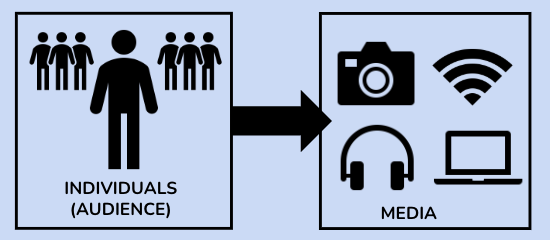
Participatory Culture Summary (Communication Model CULTURAL STUDIES)
Characteristics
Audiences engage with civic issues
Contribute to the media landscape
Find community and social connection who feel similarly
Media Regulation - Globalisation
The shift in communication that is expanding power relations across the world’s regions and continents.
How media content is globally accessible and instantaneous, readily available for all media users.
Media Regulation overall (definition and why its necessary)
The process of control and guidance of mass media by governments and other bodies. It is about regulating what certain people have access to.
Regulation is necessary:
The Media is powerful
Vulnerable audiences need protecting
Media organisations are large and profitable; they both have rights and responsibilities.
Media Regulation vs Censorship
Media Regulation ≄ Censorship
Censorship
The suppression of communication that a ruling body, deem inappropriate, harmful, or inconvenient to a greater social purpose.
Media Regulation - Australian Context
Australian audiences still experience limitations and frustrations in regards to the accessibility of media content around the world.
Piracy and streaming?
Availability and delays – release dates
Geoblockers and VPN/proxies to navigate distribution and copyright.
Types of Regulation: (2 and defintions)
Government
Standard endorsed by the government as an expectation for compliance. Exists to protect the rights of citizens. Will establish guidelines for self-regulatory bodies.
-
Self-regulation (industry)
Non-government industries established by media organisations develop a code of practice adhering to guidelines developed my government authorities. They respond to complaints with a panel of industry representatives, using code to adjudicate.
Types of regulation - regulatory bodies (media regulation)
Government | Self-regulation (industry) |
Australian Communications and Media Authority (ACMA) | Ad Standards |
Media Regulation - Government Regulation - ACMA!
Australian Communications and Media Authority (ACMA)
ACMA upholds regulatory requirements that media organisations must adhere to.
Ensure license agreements given out by ACB are maintained, otherwise fines are administered if the license is breached.
The public can complain to the ACMA if they find something in the media offensive.
ACMA will investigate the complaint and enforce disciplinary action if there has been a breach of the relevant regulatory code.
Media Regulation - Self Regulation - Ad standards
Ad Standards is Australia’s advertising regulator.
Gives a voice to community concerns about the content of ads and promote responsible advertising.
Independently handling complaints under the advertising industry codes.
Reasons for media regulation: LIST
Protecting vulnerable audiences
Informing the public
Protecting cultural identity
Government enforced codes of practice
Ownership and ensuring a range of voices
PIP GO
Media Regulation reason - Protecting vulnerable audiences
A primary role for regulatory bodies is to protect the audience from that which may harm or disturb them - particularly vulnerable audiences.
Codes of practice enforced surrounding content for children
Difficult to prove the cause and effect (causation), rather there is an understanding correlation for media effects.
Media Regulation reason - Government enforced codes of practice
It is easier for the government and industry bodies to regulate the media and protect vulnerable groups in society, than individuals physically monitoring access to media at all times.
Regulation helps Australia promote content that maintains a tolerant and diverse society. Prevent content that encourages racial, religious and sexual discrimination.
Media Regulation reason - Informing the public
Classification provides audiences with view discretion and choice to consume and gain access to media products.
News media to keep governments, institutions and businesses accountable.
Media Regulation reason - Protecting cultural identity
Restrictive guidelines and quotas are enforced to ensure there is Australian content on screen and on radio.
Between the hours of 6.00am-midnight, for a calendar year:
TV content on free-to-air 55% Australian content
Advertising on free-to-air 80% Australian produced
Radio 55% Australian performed music
Media industry employment
Development of Australian content
E.G. Government National Cultural Policy
Media Regulation reason - Ownership and ensuring a range of voices
Australian Government considers the concentrated nature of Australian media ownership. There are laws regarding cross media ownership.
This is to help prevent media owners from setting agendas in their content (agenda-setting theory!)
Without these laws, there would be limited perspectives, voices, experiences and stories told through media outlets.
Globilisation
Globalisation
Refers to a shift in communication that is expanding power relations across the world’s regions and continents. How media content is globally accessible and instantaneous, readily available for all media users.
Has changed the way audiences and the media engage with:
Production → how is media created by institutions, individuals?
Distribution → how is media made available to an audience?
Reception → how is media received (reception context)?
Consumption → how do audience choose to engage with media?
Ethical and legal issues
The development of new media technologies, and the increasing balance between control and agency in and of the media, means that ethical and legal issues arise.
Media ethics refer to the subdivision of applied ethics dealing with the specific ethical principles and standards of media. This includes broadcast media, film, theatre, the arts, print media and the internet.
Legal issues arise when the laws and policies in place to protect media producers, distributors and users are broken. This can refer to intellectual property and copyright laws.
Ethical and Legal Issues - Examples
Defamation
Artifical intelligence - generative content
Classification/regulation
Live-streaming - bad content
Digital authentication and regulatory standards can increase accountability and protect audiences from harmful or deceptive media, but may also reduce audience agency by increasing government and platform control over media production and consumption.