Topic 2
 Call Kai
 Learn
Learn Practice Test
 Spaced Repetition
 Match
Match Flashcards
 Knowt Play
1/83

Earn XP
Description and Tags
Virus structure and classification. the beginning and the end of the virus replication cycle in the cell
Name | Mastery | Learn | Test | Matching | Spaced | Call with Kai | Chat |
|---|
No analytics yet
Send a link to your students to track their progress
84 Terms
what are virus particles
molecular structures that package virus genome in infected cells and transmit them to new host cells
what is the definition of virion
complete, infectious virus particle
what are structural proteins?
any viral proteins present within virus particles.
not all virus encoded proteins are incorporated within viral particles
what makes up a virion or virus particle
the entire structure of the virus (the genome, the capsid, and the envelope)
what are capsids
virions can be composed of rigid, symmetrical containers
what are nucleocapsid
when the viral nucleic acid genome is packaged within the capsid, the resulting structure is called a nucleocapsid
how does the function of protection in a virus work?
protecting the nucleic acid genome from physical, chemical, or enzymatic damage.
Capsid proteins surround the genome.
They physically shield it from damage.
They prevent nucleases from accessing the DNA/RNA.
They reduce damage from UV, chemicals, and drying.
In enveloped viruses, the envelope adds another layer, but it is relatively fragile.
how does the function of recognition of susceptible host cell in a virus work?
the outer surface of the virus is responsible for recognition of and interaction with the host cell. this takes the form of binding of a specific virus encoded attachment protein to a cellular receptor molecule.
virus → attachment protein → cell receptor
example: A virus that infects liver cells recognizes receptors found primarily on liver cells.
It ignores cells that don't have that receptor.
how does the function of genome release system in a virus work?
the virion also initiates infection by delivering the genome in a form in which it can interact with the host cell (for transcription and replication). The purpose of the genome release system is to deliver the viral DNA or RNA into the correct part of the host cell so it can begin transcription and replication. Most related to uncoating
Why is genome release necessary?
Remember: The capsid protects the genome outside the cell. But inside the cell, the capsid becomes a barrier.
The genome must be released so it can interact with:
host ribosomes
RNA polymerase
DNA polymerase
viral enzymes
how does the function of enzyme transport in a virus work?
Many virions also include enzymes that are essential for virus infectivity but cannot be “stolen” from the cell, so viruses must “travel” with these enzymes from cell to cell
Some viruses carry viral enzymes inside the virion because these enzymes are essential immediately after infection.
Without them, the virus would be unable to begin replication.
These enzymes are packaged into the virus particle before it leaves an infected cell and are delivered into the next cell during infection.
how does a virus protect its nucleic acid genome
The viral capsid encloses the DNA or RNA and protects it from physical damage, UV radiation, desiccation, chemicals, and nucleases. Some viruses also possess a lipid envelope that provides additional protection and aids in cell entry, although the envelope itself is relatively fragile.
Why are naked viruses often more resistant to disinfectants than enveloped viruses
Because naked viruses rely on a tough protein capsid, whereas enveloped viruses depend on a lipid membrane that is easily disrupted by soap and alcohol.
Which viral structure is primarily responsible for recognizing a susceptible host cell?
A. Viral nucleic acid (DNA/RNA)
B. Viral attachment protein
C. Viral polymerase
D. Capsid enzymes
B
Why?
The viral attachment protein binds to a specific receptor on the host cell.
This interaction is the first step in infection.
Why the others are wrong:
A. Viral nucleic acid – Contains the genetic information but does not recognize host cells.
C. Viral polymerase – Replicates the viral genome after the virus enters the cell.
D. Capsid enzymes – Most viruses don't even contain capsid enzymes for attachment.
A virus can infect liver cells but not muscle cells. What is the most likely explanation?
A. Liver cells are larger.
B. Liver cells contain the specific receptor recognized by the virus.
C. Muscle cells have thicker membranes.
D. Liver cells produce more ATP.
B
Viruses infect only susceptible cells that express the appropriate receptor for the virus's attachment protein.
Why must a virus release its genome after entering a host cell?
A. To make the capsid larger.
B. To allow the viral genome to interact with host or viral enzymes for transcription and replication.
C. To protect the genome from UV light.
D. To recognize the host receptor.
B
Explanation: The genome must be released from the capsid so it can be used to make viral mRNA and replicate the viral genome.
True or False: The viral capsid remains permanently attached to the viral genome throughout infection.
False
After the virus enters the host cell, the capsid is removed during uncoating, allowing the viral genome to direct the production of new viruses.
Why does HIV package reverse transcriptase inside the virion?
A. To help the virus attach to host cells.
B. Because human cells lack an enzyme that converts RNA into DNA.
C. To protect the viral capsid.
D. To destroy the host cell membrane.
B
Explanation: Human cells do not have reverse transcriptase, so HIV must carry its own to convert its RNA genome into DNA.
Which type of virus must carry an RNA-dependent RNA polymerase in the virion?
A. A positive-sense RNA virus that can immediately use its genome as mRNA.
B. A negative-sense RNA virus that must first synthesize mRNA.
C. A DNA virus that uses host RNA polymerase in the nucleus.
D. A virus that does not replicate.
B
Explanation: Negative-sense RNA viruses cannot be directly translated by ribosomes. They must first convert their genome into positive-sense mRNA using a viral RNA-dependent RNA polymerase carried in the virion.
what are the two symmetries in viruses
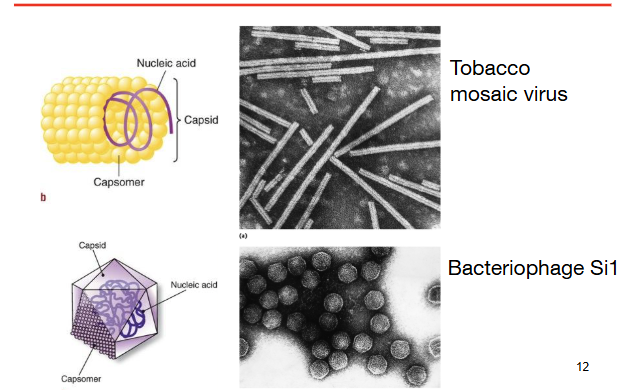
helical (most plants)
icosahedral
helical symmetry
the simplest way to arrange multiple, identical protein subunits is to use rotational symmetry. The SAME protein is used over and over for their structure. For example, tobacco mosaic virus (TMV) uses one protein over and over for their structure.
assembly of helical capsids
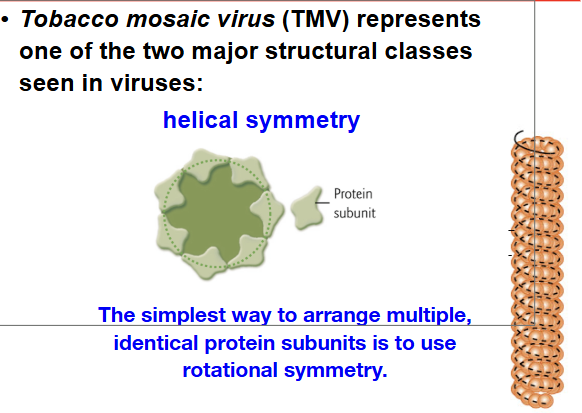
capsomers self assemble into disks → RNA “packaging signal” (pac site) binds → RNA triggers shape change → RNA acts like a “thread” → helix grows continuously
Capsid proteins (capsomers) self-assemble into disk-like structures that interact with a specific packaging sequence (pac site) on the viral RNA. Binding of the RNA induces a conformational change in the capsomers, converting the disks into a helical starter structure. Additional capsomers then assemble sequentially, guided by the RNA, which acts as a template or scaffold. This results in the formation of a helical capsid with the genome enclosed within the protein helix.
very thin long virus can go through. you can get a super long genome
icosahedral capsids
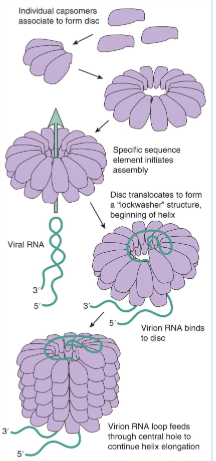
The criteria for arranging subunits on the surface of a quasispherical solid are more complex than those for a helix:
Tetrahedron (four triangular faces)
Cube (six square faces)
Octahedron (eight triangular faces)
Dodecahedron (12 pentagonal faces)
Icosahedron - a solid shape consisting of 20 triangular faces arranged around the surface of a sphere.
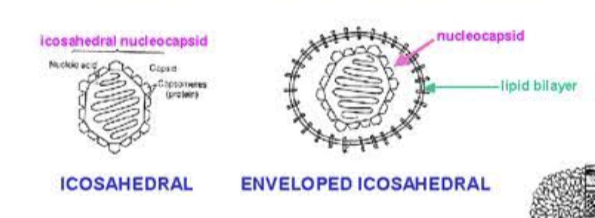
T-1 virions
T=1 icosahedral capsid is composed of 12 pentameric capsomeres for a total of 60 capsid proteins
each of the triangle has 3 proteins
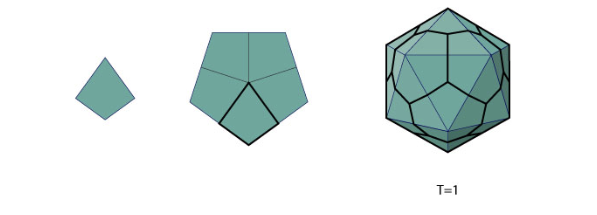
minimum number of proteins to make a virion
MINIMUM N of proteins is 60 (20X3) to make a virion!
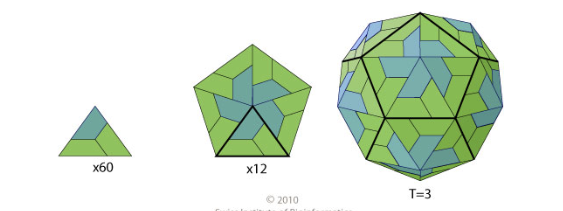
T-3 virions
T=3 icosahedral capsid is composed of 12 pentameric and 20 hexameric capsomeres for a total of 180 capsid proteins.
if we know that T1 is 60 proteins, do 60 × 3 = 180
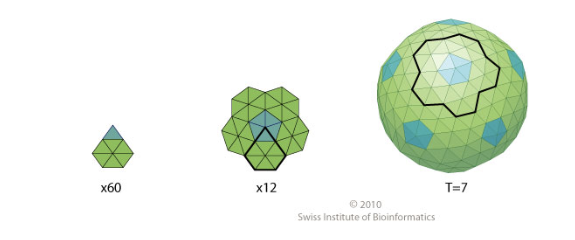
T-7 virions
Icosahedral capsids with a triangulation number T=7 are composed of 12 pentameric and 60 hexameric capsomeres for a total of 420 capsid proteins.
if we know that T1 is 60 proteins, do 60 × 7 = 420
assembly of icosahedral capsids
Assembly of the phage P22 capsid and maturation by insertion of viral genomic DNA
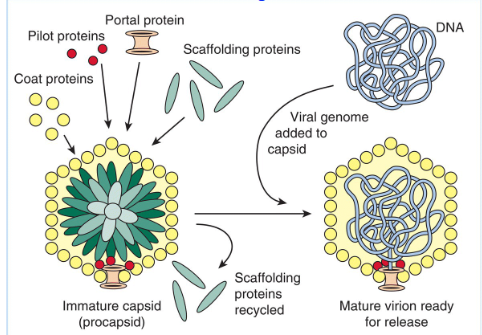
T=1 icosahedral capsid is composed of ___ capsid proteins
60
what are envelope proteins
An unbroken lipid bilayer coating is effectively inert, and would not permit recognition of receptor molecules on the host cell – therefore, viruses incorporate viral proteins (glycoproteins) into the cellular membrane
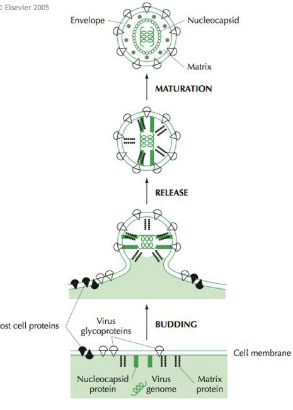
how is the shape of envelope viruses determined?
The shape of a given type of virus is determined by the shape of the virus capsid and really does not depend on whether or not the virus is enveloped.
For most viruses, the lipid envelope is amorphous and deforms readily upon preparation for visualization using the electron microscope.
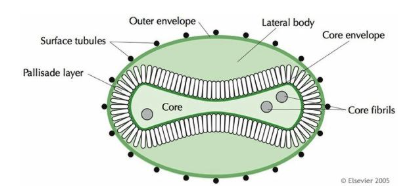
what are poxviruses
One example of complex virus structures are found in the Poxviridae.
Oval or 'brick-shaped' particles 200-400 nm long.
These particles are so large that they were first observed in using optical microscopes in 1886, and thought to be 'the spores of micrococci'.
The particles are extremely complex and have been shown to contain more than 100 different proteins.
no symmetry but still infectious
less stable outside of your body
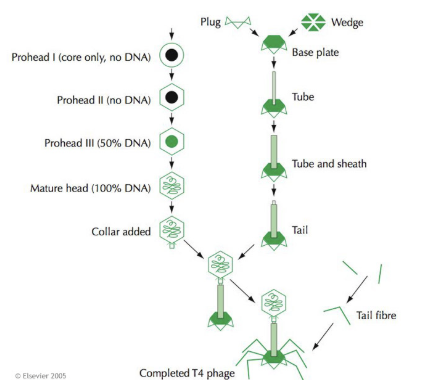
what are head-tail morphology of some phages
think of bacteriophages
There are separate assembly pathways for the head and tail sections of the particle, which come together to make up the virion.
These viruses illustrate how complex particles can be built up from the simple principles outlined before.
what are reoviruses
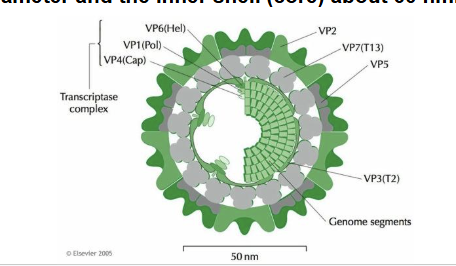
Reoviruses have non-enveloped, icosahedral capsids composed of double protein shell with a complex structure.
The outer shell of this virus is approximately 80 nm in diameter and the inner shell (core) about 60 nm.
all viruses lose their genome to the cell but not reoviruses. its like “hidden”, they have extra protection (multiple layers)
virion enzyme activities
Virus particles of many viruses (but not all!!!) contain one or more enzymes. Generally, those are enzymes that absent or cannot be easily stolen from the cell
All viruses with negative-sense RNA genomes must carry with them a virus-specific RNA-dependent RNA polymerase.
Reverse transcription of retrovirus genomes occurs inside a particulate complex and not free in solution.
The more complex DNA viruses (e.g. herpesviruses and poxviruses) carry a multiplicity of enzymes, mostly concerned with nucleic acid metabolism.
why is the classification of viruses important?
Classification brings order and to all this diversity and permit study of representative viruses that can inform us about their less known relatives
how are viruses classified?
what kind of genome is in the capsid: DNA or RNA
how is the protein arranged around the nucleic acid
any other components of the virion
naked or envelope
disease is not considered because related viruses can very different diseases, and very different viruses can cause very similar diseases
the david baltimore classification
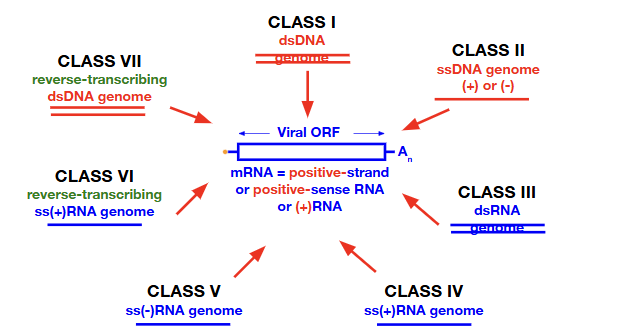
functional classification based on the mechanism of genome replication and gene expression. The David Baltimore classification is a system that groups viruses based on how they produce messenger RNA (mRNA). Since all viruses must make mRNA to produce proteins using the host cell's ribosomes, the classification focuses on the pathway each virus uses to reach that common goal. Your diagram places mRNA (positive-sense RNA) in the center because every viral genome must ultimately generate positive-sense mRNA for protein synthesis.
*ss → single-stranded, ds → double stranded
CLASS I) dsDNA genome
CLASS II) ssDNA genome (+) or (-)
CLASS III) dsRNA genome
CLASS IV) ss(+) RNA genome
CLASS V) ss(-) RNA genome
CLASS VI) reverse-transcribing ss(+)RNA genome
CLASS VII) reverse-transcribing dsDNA genome
**Positive-sense (+) RNA = readable by ribosomes.
Negative-sense (−) RNA = the complementary copy, which must be converted into (+) RNA before it can be read.
International committee on taxonomy of viruses (ICTV)
recognition of a limited number of viral features that can be used for classification. These include the nature of the viral genome, the presence of an envelope, and the morphology of the virus particle
what are the official objectives of ICTV
To develop an internationally agreed taxonomy for viruses
To develop internationally agreed names for virus taxa, including species and subviral agents
To communicate taxonomic decisions to all users of virus names, in particular the international community of virologists, by publications and via the Internet
To maintain an index of virus names
To maintain an ICTV database on the Internet, that records the data that characterize each named viral taxon, together with the common names of each taxon in all major languages
what are the ICTV’s essential principles of virus nomenclature
Stability
To avoid or reject the use of names which might cause error or confusion
To avoid the unnecessary creation of names
The ICTV's universal virus classification system uses a slightly modified version of the standard biological classification system. It only recognizes the taxa below kingdom: those of order, family, subfamily, genus, and species. When it is uncertain how to classify a species into a genus but its classification in a family is clear, it will be classified as an unassigned species of that family. Many taxa remain unranked.
what does polythetic mean
a group whose members always have several properties in common, although no single common attribute is present in all of its members and absent in the members of other groups.
how would we consider virus families and larger groupings
polythetic
For viruses, it is impossible to use any one discriminating character for distinguishing related groups and families, because of the inherent variability of the members.
The ICTV had adopted the principle that a virus species is a polythetic class of viruses that constitutes a replicating lineage and occupies a particular ecological niche)
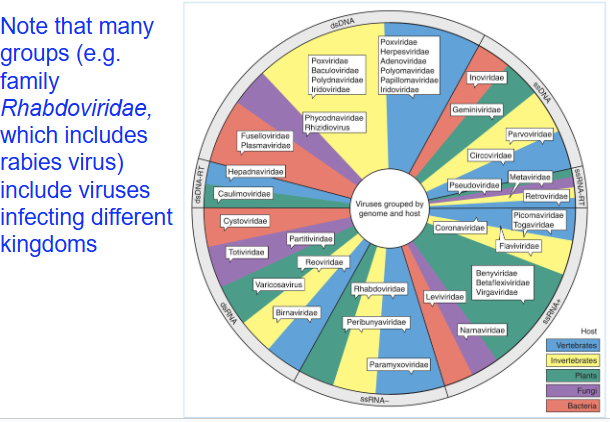
virus families always include viruses infecting the same kingdom (plants, animals, etc)
false
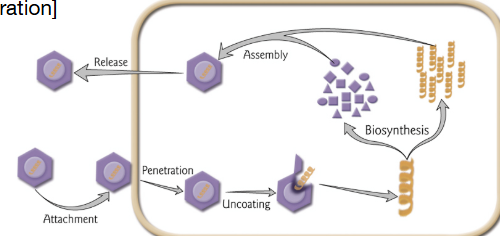
what are the 6 common phases of virus multiplication cycle
attachment
penetration
uncoating
biosynthesis
assembly
release
maturation (sometimes)