4. Panum's Area and Rivalry - Eye Movements & Binocular Vision Summer 2026
 Call Kai
 Learn
Learn Practice Test
 Spaced Repetition
 Match
Match Flashcards
 Knowt Play
1/90

There's no tags or description
Looks like no tags are added yet.
Name | Mastery | Learn | Test | Matching | Spaced | Call with Kai | Chat |
|---|
No analytics yet
Send a link to your students to track their progress
91 Terms
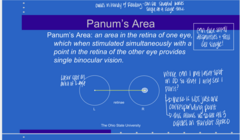
What is Panum's Area?
an area in the retina of one eye, which when stimulated simultaneously with a point in the retina of the other eye provides single binocular vision
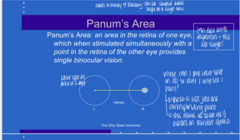
What is the importance of Panum's Area?
We can fuse small disparities and still see single!
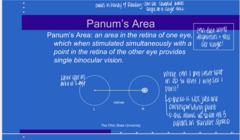
______ allows us to see all 3 dots on Randot stereo test
Panum's area
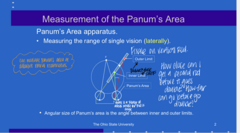
What does the Panum's Area Apparatus measure?
Measuring the range of single vision (laterally)
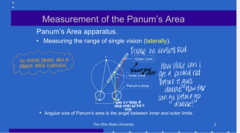
What is the angular size of Panum's Area?
angle between inner and outer limits of Panum's area
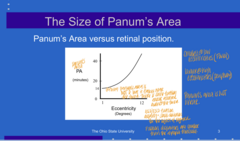
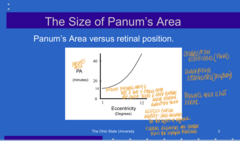
Panum's Area vs Retinal Eccentricity (Pic)
Panum's Area vs Retinal Eccentricity (Pic)
Is Panum's area 0 at the fovea?
No -- there is still some fixation error allowed at the fovea
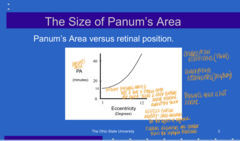
Where is Panum's Area the smallest?
At the fovea -- low eccentricity
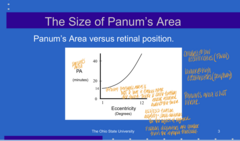
Where is Panum's area the largest?
In the retinal periphery -- high eccentricity
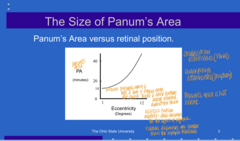
Is there a linear relationship between Panum's area and eccentricity?
No -- the relationship is NOT linear
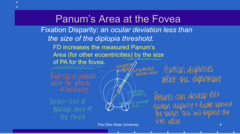
What is a fixation disparity?
an ocular deviation less than the size of the diplopia threshold
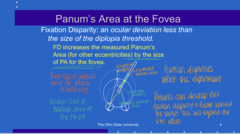
Fixation Disparity will (increase/decrease) the measured size of Panum's area
increase
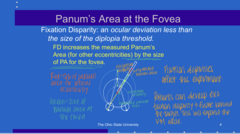
Fixation disparity will increase the measured Panum's area by the size of what?
by the size of Panum's area at the fovea
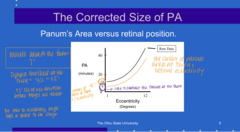
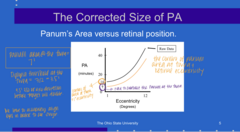
Panum's Area vs Retinal Position (Pic)
Panum's Area vs Retinal Position (Pic)
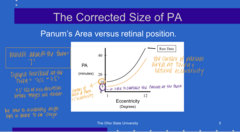
What is the size of Panum's area at the fovea?
7' (seconds of arc)
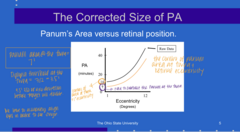
What is the diplopia threshold at the fovea?
7/2 = 3.5'
True or False:
We have to accurately align our eyes in order to see single
true
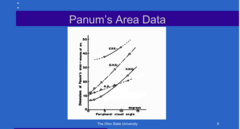
Panum's Area Data (Pic)
Panum's Area Data (Pic)
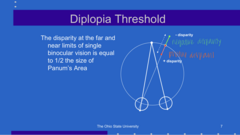
The disparity at the far and near limits of single binocular vision is equal to what?
1/2 the size of Panum's area
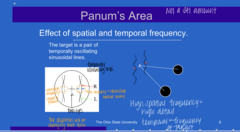
When the target is a pair of temporary oscillating sinusoidal lines, will the disparities (crossed/uncrossed) change over time?
Yes d/t the sinusoidal nature of the lines
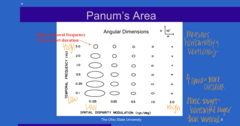
High Temporal Frequency and Low Spatial Disparity Shape of Panum's Area
Large circle
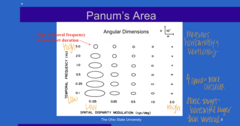
High Temporal Frequency and High Spatial Disparity Shape of Panum's Area
Small circle
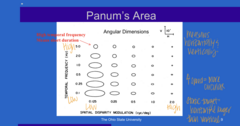
Low Temporal Frequency and Low Spatial Disparity Shape of Panum's Area
Large oval (elongated horizontally)
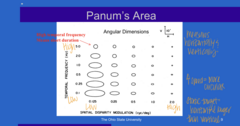
Low Temporal Frequency and High Spatial Disparity Shape of Panum's Area
Small oval (elongated horizontally)
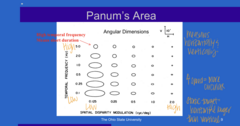
Panum's area will be larger (horizontally/vertically) when temporal frequency is low
horizontally
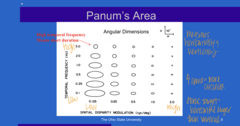
If you increase the speed of the target (temporal frequency), the target will become more _______
circular
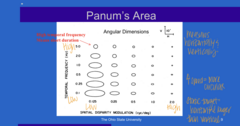
If you increase the detail of the target (spatial frequency), the target will become ______
smaller
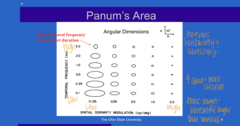
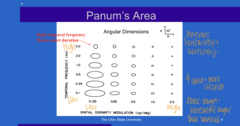
Panum's areas are largest and elliptical where?
Low spatial frequency, Low temporal frequency
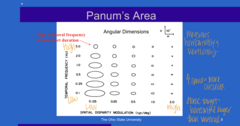
Panum's areas are smallest and circular where?
High spatial frequency, high temporal frequency
Panum's area are circular at (higher/lower) temporal frequencies
higher
When trying to induce diplopia for therapy (suppression, vergence, etc) it takes much (less/more) vertical prism than horizontal prism
less
Why does it take less vertical prism to double an image than horizontal?
-smaller Panum's area vertically
-smaller vertical vergence ranges to fuse
What is Binocular rivalry?
the appearance of non-fusible targets
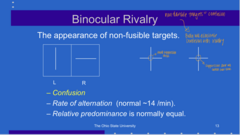
The brain will eliminate confusion with ______
rivalry
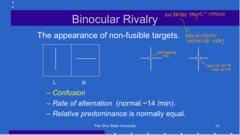
What is the NORMAL rate of alternation for binocular rivalry?
~14 times /min
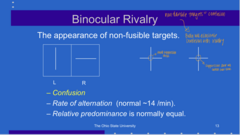
________ is normally equal between the 2 eyes
Relative predominance
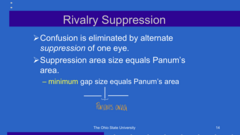
How is confusion eliminated?
By alternate suppression of one eye
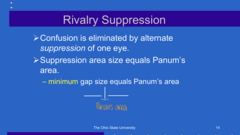
Suppression area will equal what?
The size of Panum's area
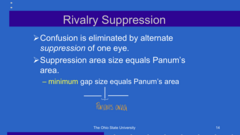
Minimum gap size equals what?
the size of Panum's area
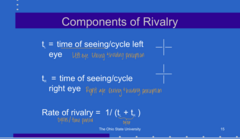
What are the components of Rivalry?
-tL (time of seeing/cycle in the left eye)
-tR (time of seeing/cycle in the right eye)
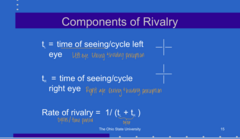
What is the equal for RATE OF RIVALRY?
1 / (tL + tR)
What is Levelt's Law?
The duration of the impression of one eye decreases as the stimulus strength in the other eye increases
What is stimulus strength as described in Levelt's Law?
defined as the power of contralateral suppression
How long the right eye will hold suppression has to do with how strong the stimulus is to the (right/left) eye?
left
True or False:
Increasing the stimulus strength to the right eye will change how long the right eye will hold perception
false -- will not change how long the right eye will hold perception
Increasing the stimulus strength for the left eye will determine what about this eye?
determines how fast it will steal perception from the right eye
What are the factors that influence stimulus strength?
-Target contrast
-Contrast sensitivity of the eye
Higher contrast targets will provide (greater/lesser) stimulus strength
greater
Contrast sensitivity is influenced by what?
-light adaptation
-retinal eccentricity
If you increase contrast target for the right eye, what will this influence?
How fast it can steal perception from the left eye
If you increase contrast to the LEFT EYE ONLY, how will this change tL, tR, and rate of rivalry in each eye?
-L eye: Increase contrast, No change in tL
-R eye: No change in contrast, Decrease tR
-Rivalry rate will increase
If you increase contrast to the LEFT EYE ONLY, relative predominance will increase for the (left/right) eye
left
If you decrease contrast to the LEFT EYE ONLY, how will this change tL, tR, and rate of rivalry in each eye?
-L eye: Decrease contrast, No change in tL
-R eye: No change in contrast, Increase tR
-Rivalry rate will decrease
If you decrease contrast to the LEFT EYE ONLY, relative predominance will increase for the (left/right) eye
right
If you increase contrast to BOTH EYES, how will this change tL, tR, and rate of rivalry in each eye?
-L eye: Increase contrast, Decrease tL
-R eye: Increase contrast, Decrease tR
-Rivalry rate will increase
If you increase contrast in BOTH EYES, relative predominance will do what?
Be unchanged for either eye
If you decrease contrast to BOTH EYES, how will this change tL, tR, and rate of rivalry in each eye?
-L eye: Decrease contrast, Increase tL
-R eye: Decrease contrast, Increase tR
-Rivalry rate will decrease
If you decrease contrast in BOTH EYES, relative predominance will do what?
Be unchanged for either eye
How do you decrease suppression of OD?
-Reduce the strength of OS image so that OD holds onto the image longer
-Patch the OS
-Atropine OS
-Bangerter foil in OS
-Opticla blue in OS
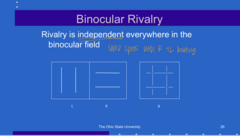
Rivalry is _____ everywhere in the binocular field
independent
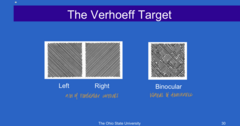
The Verhoeff Target (Pic)
The Verhoeff Target (Pic)
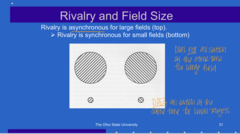
Rivalry is _______ for large fields
asynchronous -- does NOT all switch at the same time
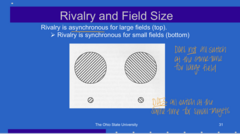
Rivalry is _______ for small fields
synchronous -- does switch at the same time for small targets
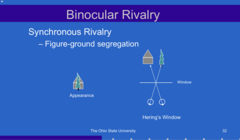
Synchronous Rivalry -- Figure Ground Segregation (Pic)
Synchronous Rivalry -- Figure Ground Segregation (Pic)
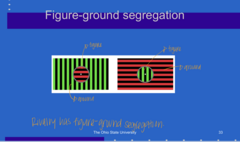
Figure-Ground Segregation (Pic)
Figure-Ground Segregation (Pic)
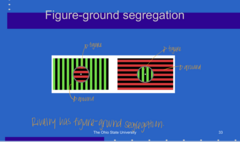
Does rivalry have figure-ground segregation?
Yes
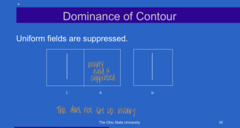
True or False:
Uniform fields will be suppressed
true
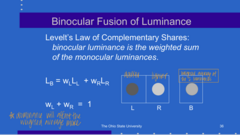
What is Levelt's Law of Complementary Shares?
Binocular luminance is the weighted sum of the monocular luminances
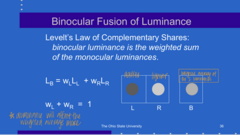
True or False:
Brightness viewing with both eyes is normally the same as with one eye
true
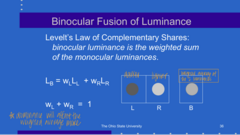
The luminances of the two eyes are the ______ not the sum of the luminances of the two eyes
average
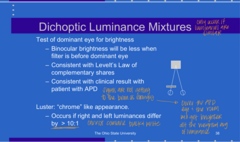
Binocular brightness will be less when filter is before the (dominant/non-dominant eye)
dominant
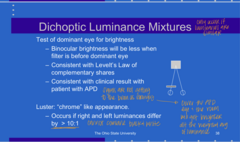
If a patient has an APD and you cover that eye, the room is likely to get (dimmer/brighter) d/t Levelt's Law of Complementary Shares
brighter
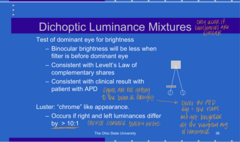
If R eye and L eye luminances differ by more than 10:1 ratio, what will be the appearance?
Luster -- chrome like appearance
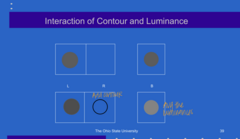
Interaction of Contour and Luminance (Pic)
Interaction of Contour and Luminance (Pic)
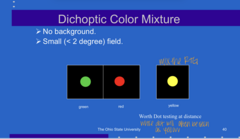
Dichoptic Color Mixture (Pic)
Dichoptic Color Mixture (Pic)
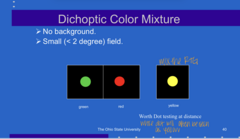
How to create a dichoptic color mixture?
No background
Small (<2º) field
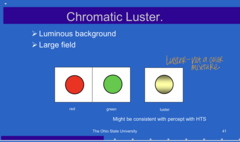
How to create chromatic luster?
-luminous background
-large field
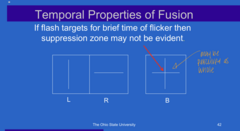
True or False:
If you flash targets for a brief time of flicker, then suppression zone MAY NOT be evident
true -- may be perceived as a whole
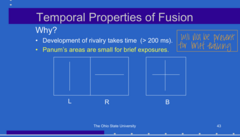
Why does this happen?
If you flash targets for a brief time of flicker, then suppression zone MAY NOT be evident
-Development of rivalry takes time (>200ms)
-Panum's Areas are small for brief exposures

What is the Cheshire Cat (Rivalry) Illusion?
-Moving eraser that OD can see will cause increased stimulus strength to the OD
-Causes parts of the face (OS field) to disappear
-Movement in front of OD causes it to dominant over the left
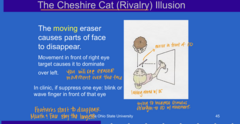
How is the Cheshire Cat Illusion relevant to clinic?
If one eye starts to suppress, blink or wave a finger in front of that eye
_____ eliminates confusion
Rivalry suppression
When non-fusible targets fall on corresponding points, one is alternately _______
suppressed
_______ eliminates diplopia
Panum's area
If images are fusible, only a ____ image is seen within Panum's area
single
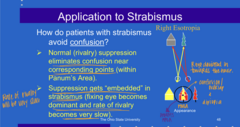
How do patients with strabismus avoid confusion?
-Normal (rivalry) suppression eliminates confusion near corresponding points (within Panum's area)
-Suppression gets embedded in strabismus (fixating eye becomes dominant and rate of rivalry will become very slow)
How do patients with strabismus avoid diplopia?
-A change in retinal correspondence (ARC) to shirt Panum's area
-Enlargement of Panum's Area
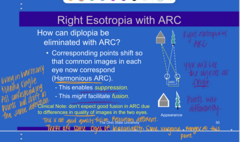
Why can diplopia be eliminated with anomalous retinal correspondence (ARC)?
Corresponding points shift so that common images in each eye now correspond (Harmonious correspondence)
Enabling of suppression
Facilitation of fusion
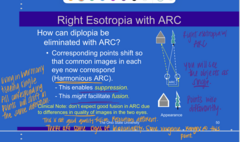
Should you clinically expect good fusion with ARC?
No, d/t difference in quality of images in the 2 eyes
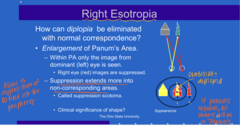
How can diplopia be eliminated with normal correspondence (ARC)?
Enlargement of Panum's area
Within Panum's areas, only the image from the dominant eye will be seen
Other eyes images will be suppressed
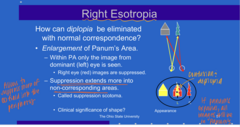
When Panum's area is enlarged with normal correspondence, what is the result of this?
Suppression extends more into non-corresponding areas (suppression scotoma)