Chest anatomy and positioning (halfway done)
 Call Kai
 Learn
Learn Practice Test
 Spaced Repetition
 Match
Match Flashcards
 Knowt Play
1/37

There's no tags or description
Looks like no tags are added yet.
Name | Mastery | Learn | Test | Matching | Spaced | Call with Kai | Chat |
|---|
No analytics yet
Send a link to your students to track their progress
38 Terms
3 Sections of chest anatomy
1.Bony thorax
2.Respiratory system
3.Mediastinum
Bony thorax
Provides protective framework for parts of the chest
involved with breathing and blood circulation

Thoracic viscera
Consists of lungs, and remaining thoracic organs contained in the mediastinum.

Parts of the bony thorax
Sternum
Clavicles - 2
scapulae - 2
ribs - 12 pairs
thoracic vertebrae - 12
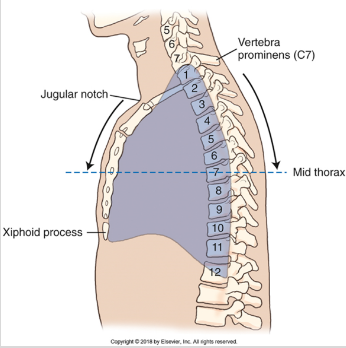
Vertebra prominens
Level T1 of body. it is the C7 spinous process near where people have neck hump.
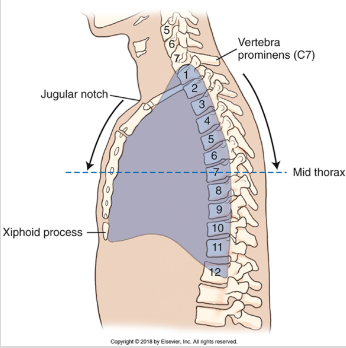
Jugular notch
Level T2/T3. Top of the sternum the suprasternal notch. The little divot where your two clavicles meet medially at the top of the sternum.
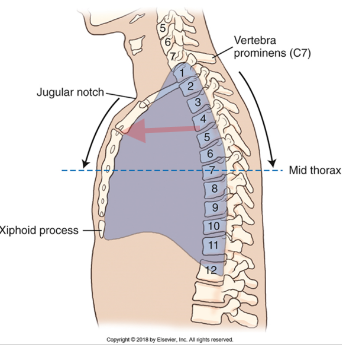
Sternal angle
level T4/T5. Roughly 2-3 fingers width away from jugular notch where the angle of the sternum begins to go more vertical rather than horizontal.
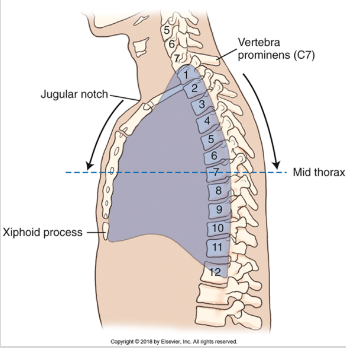
xiphoid process
Level T9/T10. The bottom tid bit of sternum.

Parts of the respiratory system
pharynx, trachea, lungs, and bronchi
Inspiration
Breathing in
Diaphragm moves down
increases volume of thoracic cavity
Decreases intrathoracic pressure.
(Think “im so inspired right now im going to take a really deep breath!” aka gasp)
Expiration
breathing out
diaphragm moves up
decreased volume of thoracic cavity
increased intrathoracic pressure
(think “breathing out your last breath then you expire” )
Upper Airway parts
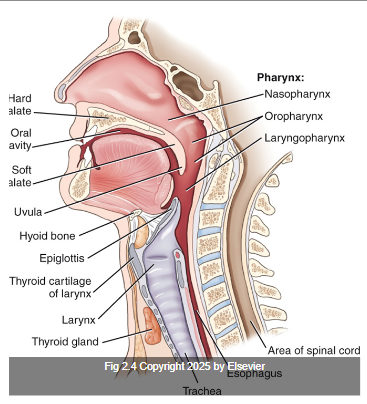
Hard palate and soft palate
Uvula
Pharynx three subdivsions-
Nasopharynx: posterior to nose
oropharynx: posterior to mouth
laryngopharynx: extends from epiglottis and connects to esophagus
Esophagus: posterior to trachea and layrnx

Hard and soft palate
roof of oral cavity; soft - Uvula which is the boundary between nasopharynx and oropharynx.
Pharynx
Passageway for food fluid and air. There are three divisions of it.
Nasopharynx
1st of the three divisions of pharynx; Posterior to nose and houses opening of the auditory tube and pharyngeal tonsils.
Oropharynx
2nd of three divisions of pharynx; Posterior to mouth and contains the palatine and lingual tonsils

Laryngopharynx
3rd division of pharynx; Extends from epiglottis and connects to the esophagus.

Esophagus
Posterior to larynx and trachea

Larynx a.k.a. the voice box
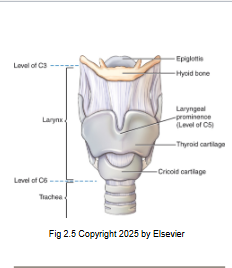
Cage like structure made of cartilage
The organ of voice
Suspended by hyoid bone
Level C3-C6
Vocal cords
Sounds are made as air passes between chords
Located within layrnx

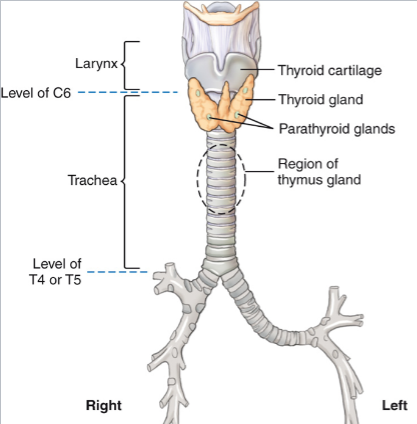
Thyroid cartilage
Anterior wall of larynx
at level C5
Anterior projection
also known as Adams apple(laryngeal prominence)


Cricoid cartilage
Ring of cartilage that forms inferior and posterior wall of larynx
attaches to trachea


Epiglottis
Unique cartilage that is a part of the larynx
flips down and covers trachea when swallowing

Trachea(windpipe)
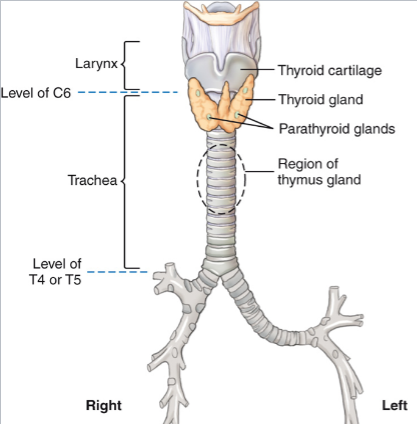
Connects larynx to bronchi tree
Fibrous muscular tube
16-20 C shaped rings of cartilage are embedded in anterior wall
keeps airway open by preventing trachea from collapsing during expiration
Trachea length?
Extends from C6 to level of T4/5
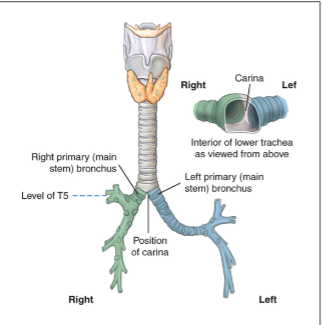
Trachea divides at the carina at T4/5

Thyroid gland
located just below thyroid cartilage.
more radiosensitive than most body structures or organs
stores and releases hormones that aid in metabolism
DECREASES calcium levels in blood through calcitonin
Parathyroid gland
Small round glands embedded in the posterior surface of thyroid(2 on each side - 4 total)
stores and secretes hormones that aid in specific blood function
INCREASES calcium levels in blood through PTH(parathyroid hormone)
Primary bronchi
Right and left bronchi split by the carina
The right primary bronchus is wider, shorter, and more vertical than left.
(food particles more likely to get lodged in right bronchus)
Secondary bronchi
Right divides into 3 secondary bronchi
left divides into 2
Do secondary bronchi divide any further?
YES!
They divide into smaller branches called bronchioles(terminal bronchioles)
These terminate into small air sacs called Alveoli!
Alveoli count and use?
lungs contain around 500-700 million alveoli
Oxygen and carbon dioxide are exchanged in blood through the thin walls of the alveoli
Lungs
Composed of parenchyma which allows for the expansion and contraction.
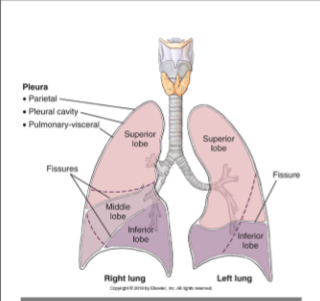
Each lung is contained in a double walled sac called the pleura.
Outer layer of the pleura is called?
Parietal pleura

Inner layer of pleura is called?
Pulmonary or visceral pleura
What is the Pleural cavity and what does it do?
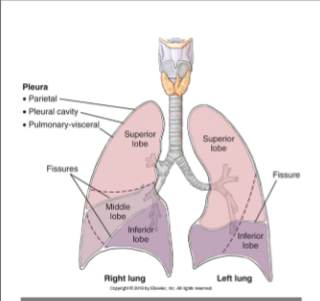
The space between the double walled pleura.
It allows movement during breathing because of its lubricating fluid.

Pneumothorax
Also known as a collapsed lung
occurs when air leaks into the space between the pleural cavity
Give me a description and the location of the Apex of the lungs
The apex oof the lungs is the rounded upper area of the lungs above the level of the clavicles.
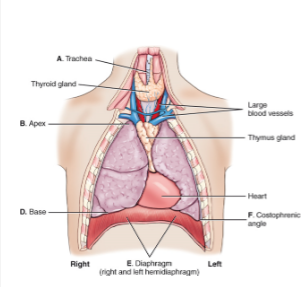
Give me a description and the location of the Base of the lungs
Lower concave area of each lung. They rest on the diaphragm.