Localisation of function in the brain
 Call Kai
 Learn
Learn Practice Test
 Spaced Repetition
 Match
Match Flashcards
 Knowt Play
1/10

There's no tags or description
Looks like no tags are added yet.
Name | Mastery | Learn | Test | Matching | Spaced | Call with Kai | Chat |
|---|
No analytics yet
Send a link to your students to track their progress
11 Terms
Localisation of function
The theory that different areas of the brain are responsible for specific behaviours, processes or activities
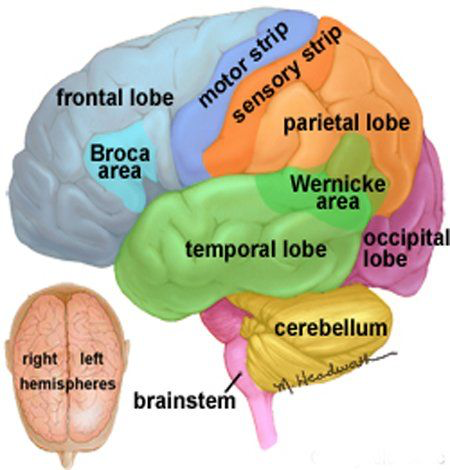
Motor centre
A region of the frontal lobes of each hemisphere involved in regulating movement
Auditory centre
Located in the temporal lobes of each hemisphere.
Concerned with the analysis of speech-based information
Somatosensory centre
An area of the parietal lobes of each hemisphere that processes sensory information such as touch
Visual centre
A part of the occipital lobes of each hemisphere that receives and processes visual information
Broca’s area
An area of the frontal lobe in the left hemisphere
Responsible for speech production
Leads to Broca’s aphasia - limited amount of words in sentences. Can’t speak certain words.
Wernicke’s area
An area in the temporal lobe in the left hemisphere
Responsible for language comprehension
Encircles the auditory cortex
Leads to fluent aphasia if damaged - incoherent or made up words when speaking
S Case study evidence
Broca studied Leborgne. Known as “Tan” as he could only say the word tan.
In a post mortem there were lesions in the posterior of the frontal lobe in Left hemisphere only. Known as Broca’s area
Wernicke found lesions in a patient in the posterior of the temporal lobe in LH only. Known as Wernicke’s area, They had problems with speech understanding.
Supports both Broca’s and Wernicke’s area
S Dougherty
Gave 44 patients with OCD a cingulotomy to take away their cingulate gyrus (in the limbic system)
32 weeks after, a third had shown significant improvement in their OCD
14% had shown partial improvement.
Suggests that certain parts of the brain are linked to certain disorders.
W Dronkers
Language production may not be confined to Broca’s area alone.
Re-examined Leborgne’s brain and looked at other brains. Used MRIs.
There were lesions in Broca’s area as well as in other areas which may have been responsible for the language difficulties
Doesn’t fully support Broca’s area.
W D!ck and Tremblay
Reported that 2% of modern researchers think that language is controlled in Broca’s and Wernicke’s area.
Advances in brain imaging techniques like fMRI mean that neural processes can be studied with more clarity. Langauge function is distributed more holistically than was first thought.
Language streams have been identified in regions in the RH as well as subcortical regions like the thalamus.
Suggests that language may be more holistically organised and contradicts localisation theory