Organisation of the Organism
 Call Kai
 Learn
Learn Practice Test
 Spaced Repetition
 Match
Match Flashcards
 Knowt Play
1/24

Earn XP
Description and Tags
Biology Chapter 2
Name | Mastery | Learn | Test | Matching | Spaced | Call with Kai | Chat |
|---|
No analytics yet
Send a link to your students to track their progress
25 Terms
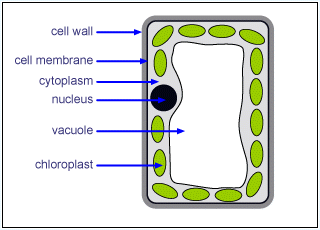
Cell
Cell membrane
Controls movement in and out of cells
Cytoplasm
Where chemical or metabolic reactions take place
Nucleus
Contains DNA, stores genetic information and controls the activity of the cell
Mitochondria
Where aerobic respiration happens
Ribosome
Allows protein synthesis in the cytoplasm
Endoplasmic reticulum
System of membranes that helps in the transport of substances within the cell and in the synthesis of proteins and lipids.
Vacuole
Cell sap to keep cell turgid
Cell wall
Rigid to hold the shape of the cell, strengthens the cell
Chloroplast
Contain chlorophyll, which absorbs light energy for photosynthesis
Bacterial cell
only contains a cell wall made of peptidoglycan, cell membrane, cytoplasm, ribosomes, and plasmids
Plasmids
are small, circular rings of DNA in the cytoplasm with extra genes outside the chromosomal DNA.


Tissue
Groups of cells with similar structures working together to perform a shared function
Organ
Group of tissues working together to perform a specific function
Organ system
Group of organs with related functions working together to perform body functions
Organism
Any living thing that can carry out all the basic processes of life independently.
Specialised Cells
Specialised Cells have Specific Functions.
Specialised Cells | Specific Function | Location of Cell |
|---|---|---|
Ciliated cells | Movement of mucus in the trachea and bronchi | Respiratory Tract, Fallopian Tube, Testes |
Root Hair cells | Absorption | Roots |
Palisade Mesophyll cell | Photosynthesis | Leaf Cells |
Neurones | Conduction of electrical impulses | Everywhere in an organism |
Red Blood cells | Transport of oxygen | Everywhere in an organism |
Sperm and Egg cells/ovum (gametes) | For reproduction | In their respective gonads (glands) |
Cilia
specialized epithelial cells with hairlike projections. They use sweeping to-and-fro moment to move items or also can have a sensory function

Root hair cell
specialized extensions epidermal cells located at the tips of roots to maximise water and mineral absorption

Palisade mesophyll cell
elongated epidermal cell on the surface level which contains a lot of chloroplasts to maximise photosynthesis
Neurone
specialized cells of the nervous system responsible for sensory reception, processing and transmitting information
Red blood cell
Biconcave shaped discs without nucleus or mitochondria to maximise oxygen consumption

Sperm cell
Specialized for fertilization having a streamlined body and a flagellum for swimming, numerous mitochondria for energy production and acrosomes on the head which produce enzymes to penetrate the egg
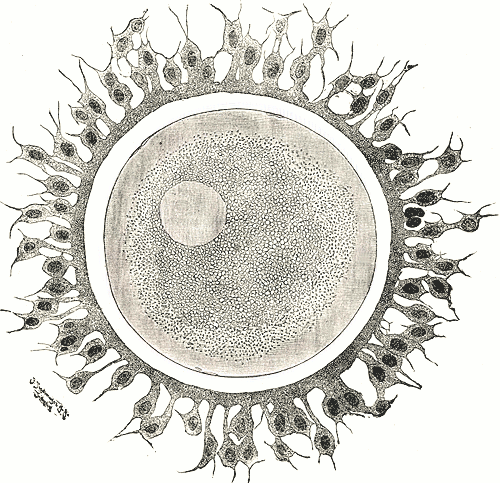
Egg

Egg cell
One of the largest cells in the body and also non-motile. Contains nutrients needed for initial development of zygote once it gets fertilized by the sperm.
Magnification
Refers to how many times larger an object appears when viewed through a microscope compared to its actual size
The general formula is represented in these ways:
Magnification=size of drawing size of specimen=image actual=IA Magnification=size of specimen size of drawing=actual image=AI

Other Forms in Magnification Formula
Actual size = image size ÷ magnification
Image size = magnification x actual size
Unit Conversions (μm - micrometre)
1cm = 10mm
1mm = 1000μm
1μm = 0.001mm
Magnification does NOT have any units (‘x 50’ or ‘x 5000’)