PKP Kap. 7
 Call Kai
 Learn
Learn Practice Test
 Spaced Repetition
 Match
Match Flashcards
 Knowt Play
1/4

There's no tags or description
Looks like no tags are added yet.
Name | Mastery | Learn | Test | Matching | Spaced | Call with Kai | Chat |
|---|
No analytics yet
Send a link to your students to track their progress
5 Terms
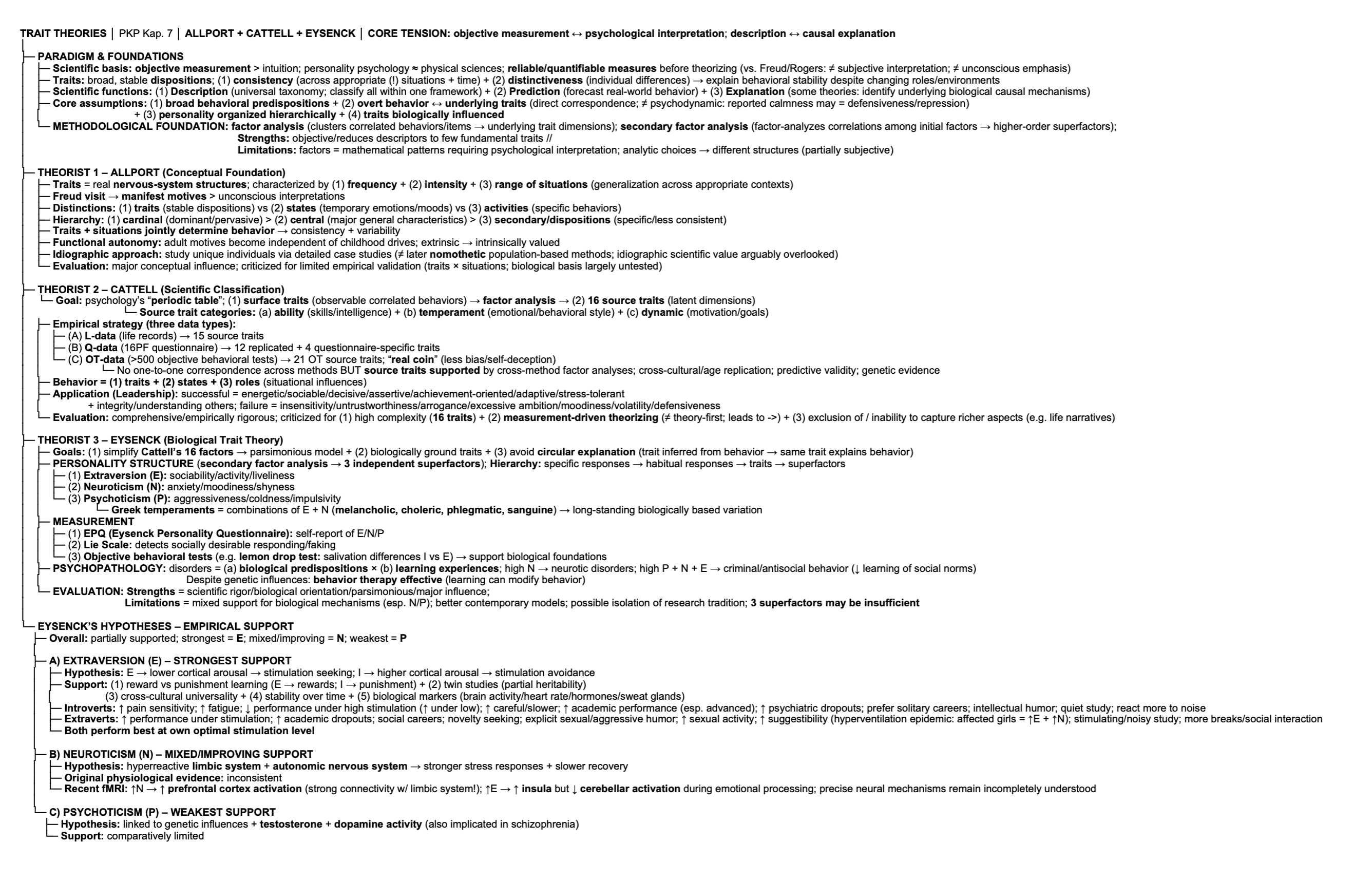
What are the defining characteristics of trait theories and what are they fundamentally based on?
Scientific basis; objective measurement > intuition; personality psychology ≈ physical sciences; construct reliable, quantifiable measures before theorizing; contrast Freud/Rogers (subjective interpretation; unconscious emphasis).
Trait theories; personality = traits (broad, stable dispositions);
(1) consistency (across appropriate (!) situations + time)
(2) distinctiveness (individual differences); explain behavioral stability despite changing roles/environments.
Scientific functions of traits;
(1) Description (universal taxonomy; classify all individuals within one framework);
(2) Prediction (forecast real-world behavior from measured traits);
(3) Explanation (some theories: identify underlying—primarily biological—causal mechanisms).
Core assumptions;
(1) people possess broad behavioral predispositions;
(2) overt behavior ↔ underlying traits (direct correspondence; ≠ psychodynamic view where reported calmness may reflect defensiveness/repression rather than true calmness);
(3) personality organized hierarchically;
(4) many traits assumed biologically influenced.
Methodological foundation;
Factor analysis (clusters correlated behaviors/items → underlying trait dimensions);
Secondary factor analysis (factor-analyzes correlations among the initial factors themselves → higher-order “superfactors”);
Strengths = objective, reduces hundreds of descriptors to a few fundamental traits;
Limitations = factors are mathematical patterns requiring psychological interpretation; analytic choices → different personality structures (partially subjective).
Describe two trait perspective personality psychologists.
Gordon W. Allport (Conceptual foundation);
Traits = real nervous-system structures; characterized by (1) frequency (how often expressed), (2) intensity (how strongly expressed), (3) range of situations (generalization across appropriate contexts);
Freud visit → emphasize manifest motives > unconscious interpretations;
Distinguish (1) traits (stable dispositions) vs (2) states (temporary emotions/moods) vs (3) activities (specific behaviors);
Hierarchy = (1) cardinal (dominant, pervasive) vs (2) central (major general characteristics) vs (3) secondary traits/dispositions (specific, less consistent tendencies);
Traits + situations jointly determine behavior (consistency + variability);
Functional autonomy (adult motives become independent of childhood drives; initially extrinsic → intrinsically valued);
Idiographic approach (study unique individuals via detailed case studies); later trait theorists adopted nomothetic population-based methods, arguably overlooking idiographic scientific value;
Evaluation = major conceptual influence; criticized for limited empirical validation (e.g., traits × situations, biological basis largely untested) + see above
Raymond B. Cattell (Scientific classification);
Goal = psychology’s “periodic table”: (1) surface traits (observable correlated behaviors) → factor analysis → 16 (2) source traits (latent dimensions); categories = (a) ability (skills; intelligence), (b) temperament (emotional/behavioral style), (c) dynamic (motivation/goals).
Empirical strategy = (A) L-data (life records; 15 source traits) → (B) Q-data (16PF; 12 replicated + 4 questionnaire-specific traits) → (C) OT-data (objective behavioral tests; >500 tests; 21 OT source traits; “real coin” due to less bias/self-deception);
No one-to-one correspondence across methods; BUT source traits supported by cross-method factor analyses, cross-cultural/age replication, predictive validity, genetic evidence.
Behavior determined by (1) traits + (2) states + (3) roles (situational influences).
Evaluation = comprehensive, empirically rigorous taxonomy; criticized for (1) high complexity (16 traits), (2) measurement-driven theorizing (as opposed to 1. theory, 2. measurement; issue →), and (3) inability to capture richer personality aspects (e.g., life narratives).
Application (Leadership);
Successful leaders = energetic, decisive, adaptive, assertive, sociable, achievement-oriented, stress-tolerant;
Top executives distinguished by integrity + understanding others // failure associated with insensitivity, untrustworthiness, arrogance, excessive ambition, moodiness, volatility under pressure, defensiveness.
Describe the third trait personality theorist.
Hans J. Eysenck (Biological trait theory)
Goal = (1) simplify Cattell’s 16-factor model into a parsimonious, (2) biologically grounded theory; biological explanation needed to (3) avoid circular explanations (trait inferred from behavior → same trait used to explain behavior).
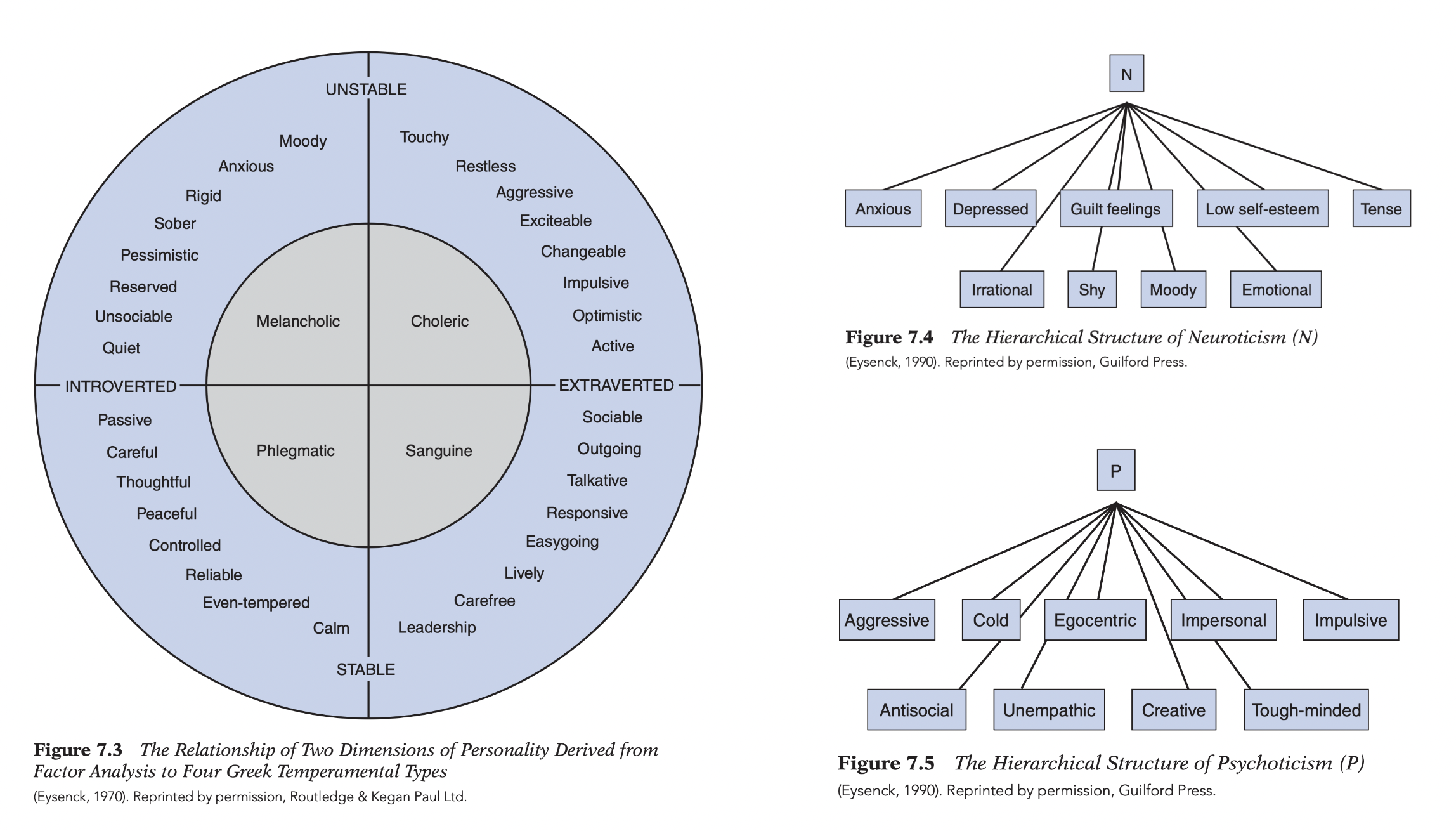
Personality structure; secondary factor analysis (factor-analyzes correlations among first-order factors → higher-order factors) → 3 independent superfactors (highest-order dimensions):
(1) Extraversion (E) (sociability, activity, liveliness), (2) Neuroticism (N) (anxiety, moodiness, shyness), (3) Psychoticism (P) (aggressiveness, coldness, impulsivity);
Hierarchy = specific responses → habitual responses → traits → superfactors + Related Greek temperaments to combinations of E + N, suggesting long-standing, biologically based personality variation.
Measurement;
(1) Eysenck Personality Questionnaire (EPQ) (self-report of E, N, P),
(2) Lie Scale (detects socially desirable responding/faking),
(3) objective behavioral tests (e.g., lemon drop test measuring salivation differences / differences between I + E!) to support biological foundations.
Biological explanation; traits correspond to underlying biological systems rather than merely describing behavior (see research on E/I, N, P!)
Psychopathology; disorders = (a) biological predispositions × (b) learning experiences;
high N → neurotic disorders;
high P + N + E → criminal/antisocial behavior (weaker learning of social norms); despite genetic influences
BUT behavior therapy effective because learning can modify behavior!
Evaluation; strengths = scientific rigor, biological orientation, parsimonious model, major influence on modern personality psychology
Limitations = mixed support for biological mechanisms (especially N/P), better contemporary models, possible isolation of his research tradition, 3 superfactors may be insufficient to capture full personality complexity.
Are Eysenck’s hypotheses supported?
Overall; partially supported; strongest support = Extraversion; mixed/improving support = Neuroticism; weakest support = Psychoticism.
Extraversion (E);
Hypothesis = (E) lower cortical arousal → stimulation seeking (extraverts) vs (I) higher cortical arousal → stimulation avoidance (introverts)
Supported by (1) reward vs punishment learning (E → rewards; I → punishment), (2) twin studies (partial heritability), (3) cross-cultural universality, (4) stability over time, (5) correlations with biological markers (brain activity, heart rate, hormones, sweat glands).
Behavioral evidence;
Introverts = ↑pain sensitivity, ↑fatigue, ↓performance under high stimulation (↑ under low stimulation), ↑careful/slower, ↑academic performance (esp. in advanced), ↑psychiatric dropouts, prefer solitary careers, intellectual humor, quiet study (react more to noise);
Extraverts = ↑performance under stimulation, ↑academic dropouts, social careers, novelty seeking, explicit sexual/aggressive humor, ↑sexual activity, ↑suggestibility (hyperventilation epidemic: affected girls = ↑E + ↑N), stimulating/noisy study environments, more breaks/social interaction.
Both perform best at their own optimal stimulation level!
Neuroticism (N);
Hypothesis = hyperreactive limbic system + autonomic nervous system → stronger stress responses + slower recovery; original physiological evidence inconsistent
Recent fMRI findings provide stronger support (↑N → greater prefrontal cortex activation VS. ↑E → greater insula but less cerabellar activation during emotional processing); precise neural mechanisms remain incompletely understood.
Psychoticism (P);
Hypothesis = linked to genetic influences, testosterone, later dopamine activity (also implicated in schizophrenia); support comparatively limited.
Tree (PKP Kap. 7)