Chemistry Unit 1 Test—Matter and Energy
 Call Kai
 Learn
Learn Practice Test
 Spaced Repetition
 Match
Match Flashcards
 Knowt Play
1/192

There's no tags or description
Looks like no tags are added yet.
Name | Mastery | Learn | Test | Matching | Spaced | Call with Kai | Chat |
|---|
No analytics yet
Send a link to your students to track their progress
193 Terms
Chemical Change
A reaction in which the composition of a substance is changed
Chemical Property
Describes the way a substance will react or not react in a given situation
Chromatography
Separation of liquids based on polarity (using component colors from dye/natural coloring based on their polarity)
Compound
a pure substance composed of two or more elements that are chemically combined in definite proportion
Diatomic
A molecule with two identical elements
What are the diatomic elements?
Hydrogen (H2)
Nitrogen (N2)
Fluorine (F2)
Oxygen (O2)
Iodine (I2)
Chlorine (Cl2)
Bromine (Br2)
Distillation
Separating two liquids based on their boiling point (separating two homogeneous liquids by boiling)
Element
A substance that cannot be broken down by chemical means, found on the periodic table
Endothermic
Reaction that absorbs heat; heat enters the reaction
Evaporation
Separation of a dissolved solid from a liquid by heating and evaporating the liquid (often water)
Exothermic
Reaction that releases heat; heat exits the reaction
Filtration
Separation of a liquid and a solid based on particle size
Gas
phase of matter without definite shape or volume
Heterogeneous
a mixture in which the particles are not uniformly mixed, has layers
Homogeneous
a mixture in which particles are uniformly mixed, looks the same throughout
Liquid
phase of matter that has no definite shape, but has definite volume
Matter
anything with mass and volume
Mixture
substance physically combined in variable proportion
Particle Diagram
drawing of atoms and or molecules frozen in time as a solid, liquid, or gas and as an element, compound, or mixture
Physical Change
a change that doesn’t alter the chemical properties of a substance
Physical Property
a trait that describes the way something looks, feels, or smells or how much of a substance there is
Precipitate
the insoluble product of a reaction between two aqueous solutions
Solid
phase of matter with definite shape and volume
Can compounds be broken?
Yes, but only by a chemical reaction
What is the smallest piece of a compound called?
a molecule
What is the most basic form of matter?
An element
How many elements are on the periodic table?
118
How many monatomic elements are there?
111
How many diaatomic elements are there?
7
Why are diatomic elements always bonded to another atom of the same type?
For additional stability
What is the smallest piece of an element?
an atom
What does a heterogenous mixture look like?
Different throughout. May have layers or easily distinguishable parts
What does a homogeneous mixture look like?
The same throughout; it is visually indistinguishable
What are aqueous solutions?
Substances dissolved in water, which are usually homogeneous
What does an (aq) after a chemical formula mean?
It means it’s a homogeneous mixture
What does the chemical formula for a mixture look like?
It will be separated in some way, like with a plus sign
Can a mixture be broken?
Yes, by a physical change
What are examples of chemical properties?
Will it oxidize in air?
Is it flammable?
Does it react with a certain chemical?
Will it rust or corrode in air?
Is Co a monatomic element, diatomic element, heterogeneous mixture, or homogeneous mixture?
Monatomic element
Is CO a monatomic element, diatomic element, heterogeneous mixture, or homogeneous mixture?
Compound
Is B2 a monatomic element, diatomic element, heterogeneous mixture, or homogeneous mixture?
Diatomic element
Is the combination of oil and water a monatomic element, diatomic element, heterogeneous mixture, or homogeneous mixture?
Heterogeneous mixture
Is air a monatomic element, diatomic element, heterogeneous mixture, or homogeneous mixture?
Homogeneous mixture
Is salt water a monatomic element, diatomic element, heterogeneous mixture, or homogeneous mixture?
Homogeneous mixture
Is salt and sand a monatomic element, diatomic element, heterogeneous mixture, or homogeneous mixture?
Heterogeneous mixture
Is sulfur being yellow a physical property, chemical property, physical change, or chemical change?
Physical property
Is neon being nonreactive a physical property, chemical property, physical change, or chemical change?
Chemical property
Is copper conducting electricity a physical property, chemical property, physical change, or chemical change?
physical property
Is chlorine reacting with water to form an acid a physical property, chemical property, physical change, or chemical change?
Chemical property
Is baking a cake a physical change or chemical change?
chemical change
Is boiling water a physical change or chemical change?
Physical change
Is burning wood a chemical change or physical change?
Chemical change
Is ripping a piece of paper a chemical change or phsyical change?
Physical change
Is dissolving sugar in water a chemical change or a physical change?
Physical change (can undo it)
What are examples of physical properties?
Color
Smell
Feel
Taste
What are examples of physical changes?
Chewing
Burning
boiling
freezing
Crushing/breaking
Bending
What are examples of chemical changes?
color change
temperature change
generation of light
forming of a precipitate (solid)
new smell
What does each new capital letter represent in a chemical formula?
A new element
What does a subscript number mean in a chemical formula?
the number of atoms for the element abbreviation before it
What does a coefficient (number) mean in a chemical formula?
The number of molecules (how many of that specific combination)
It also multiplies by all the atoms in the formula (to give you the total number of each atom)
What do parentheses do in a chemical formula?
Act as parentheses in math. You multiply to find the total number of atoms
How are particles in solids arranged?
In an organized and predictable pattern
How are particles in liquids arranged?
Particles are somewhat organized with no pattern
How are the particles in gases arranged?
Evenly spread out across the space (container)
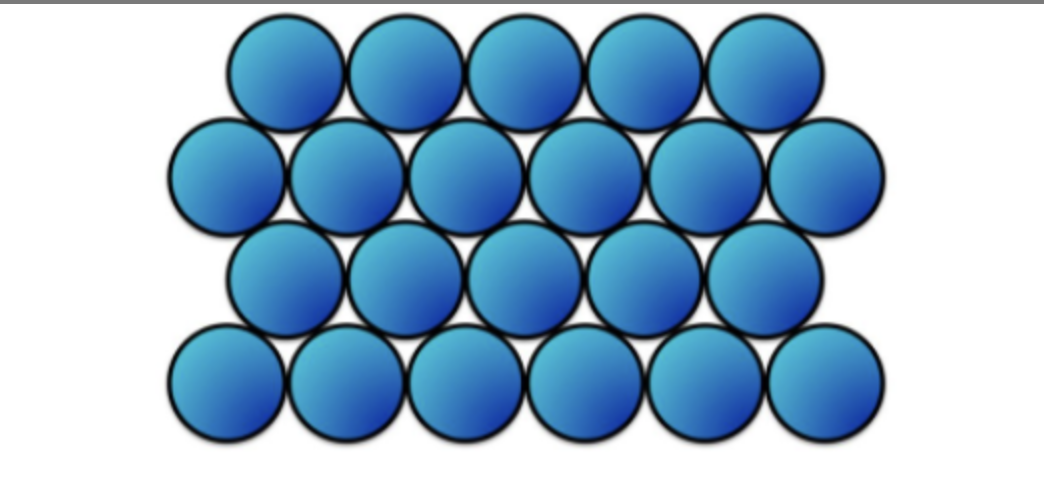
What state of matter do these particles represent?
Solid
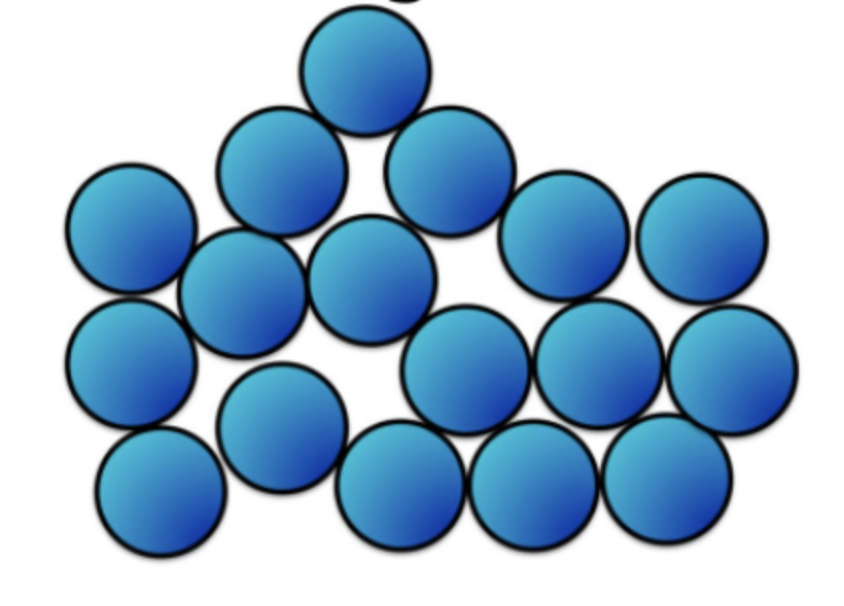
What state of matter do these particles represent?
Liquid
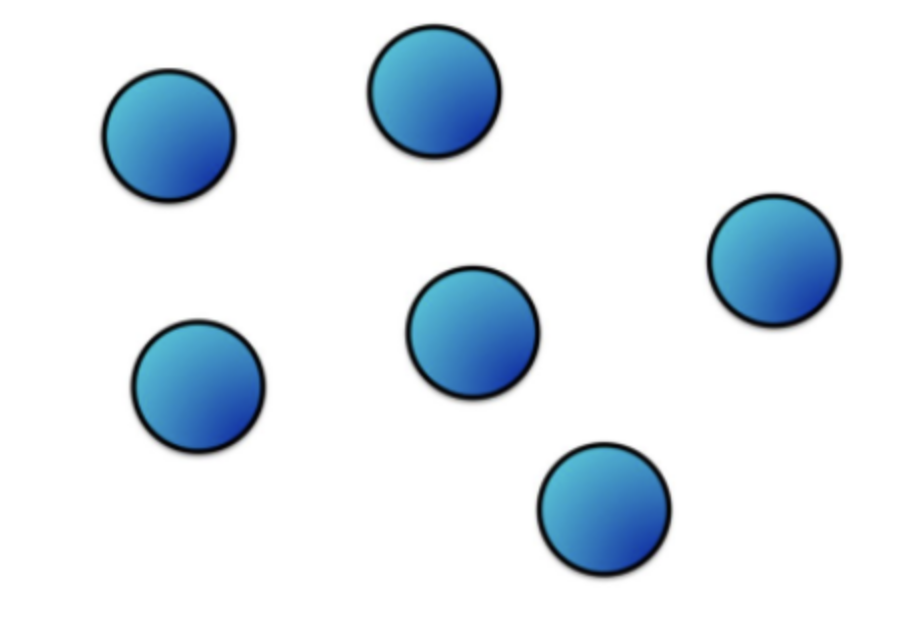
What state of matter do these particles represent?
Gas
What is the difference between an element and a compound?
An element has particles of all the same type, while a compound has at least two different particles (touching each other)
What is a mixture?
At least two different elements or compounds NOT touching each other
What is the difference between a compound and a mixture?
The elements/particles in a compound touch but they don’t in a mixture
How should you smell chemicals?
Waft, don’t inhale directly
What should you do with your hair when in the lab?
Tie it back
How should you NOT use a pipette?
With your mouth
What should you do when you’re done using chemicals in containers/bottles?
Close/cover them
Where should you NOT measure substances? Where is the correct place to measure them?
Above eye level
leave on desk and measure from there
Are you allowed to eat or drink in the lab?
No
What should you do after you are done with a lab?
Clean up
What should you do with trash and chemicals after a lab?
Dispose of chemicals or trash accordingly (listen to teacher instructions)
What kind of shoes should you wear in the lab?
Close toed shoes
What is the purpose of the fume hood?
To use when dealing with reactions that give off gases or strong reactions. The fume hood keeps the reaction/gas away from you
What is the purpose of the chemical storage cabinet?
To hold supplies and properly store chemicals
What is the fire extinguisher used for?
Putting out fire on inanimate objects
What is the eye wash for?
To wash eyes in the event that chemicals get into your eyes
What is the first-aid kit in the classroom for?
Minor injuries that don’t require going to the nurse
What is the shower in the classroom for?
To wash off if a large portion of your body is exposed to or covered in a chemical
Pure substances
have a fixed proportion
cannot break down by physical change
What are two types of pure substances?
elements and compounds
What are two categories of mixtures?
Homogeneous and heterogeneous
What does a diatomic element look like?
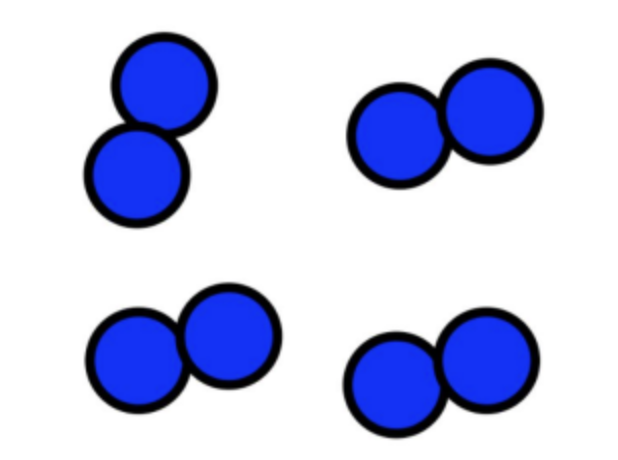
What does a monatomic element look like?
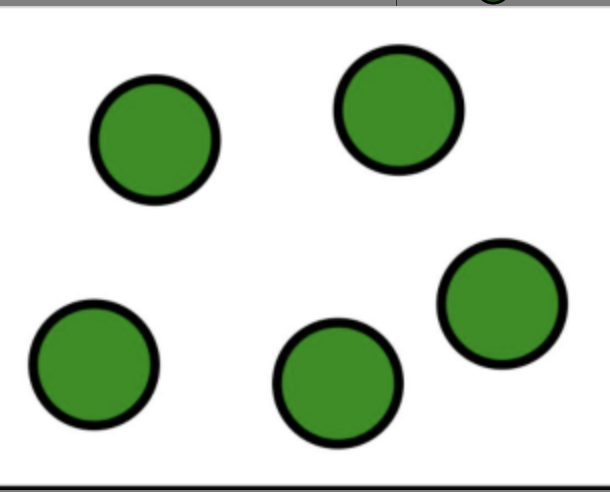
What does a compound look like?
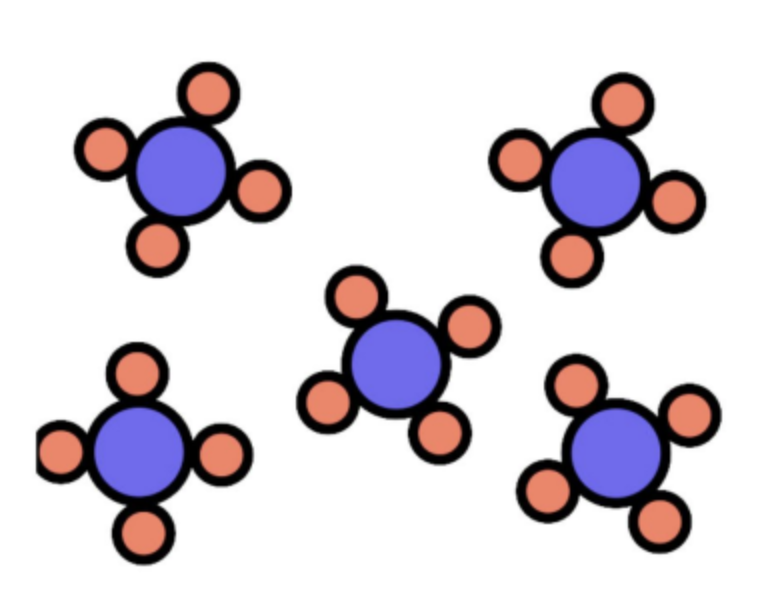
What does a mixture look like?
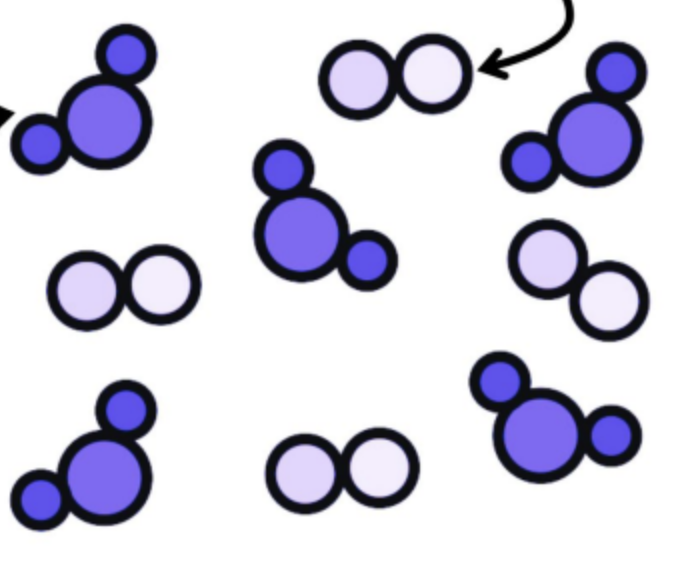
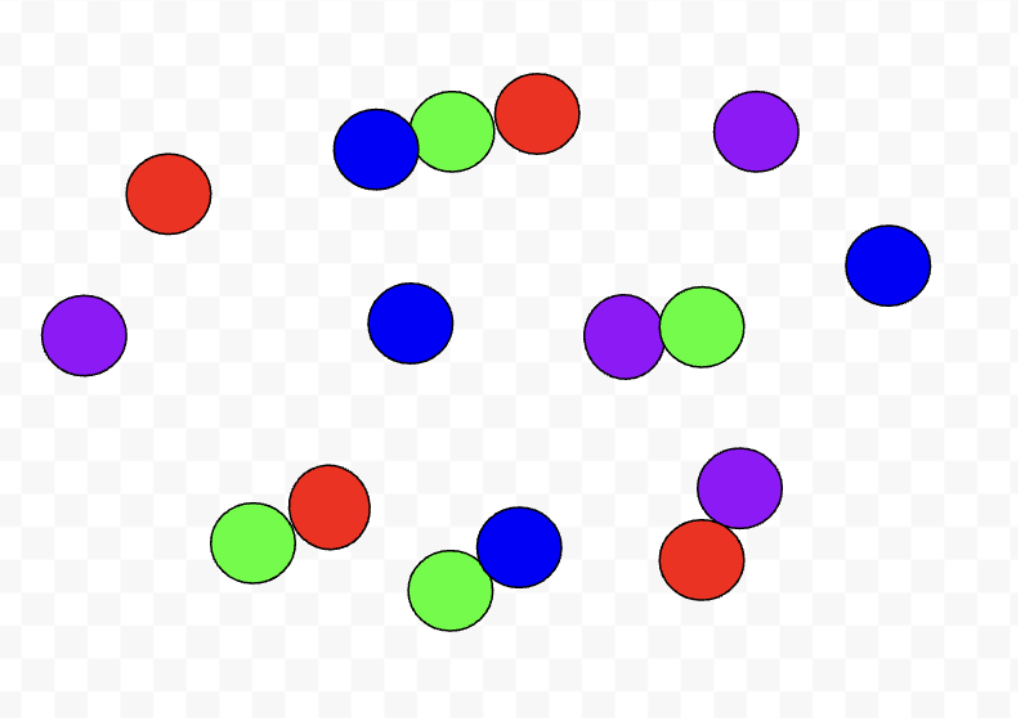
What does a mixture of compounds look like?
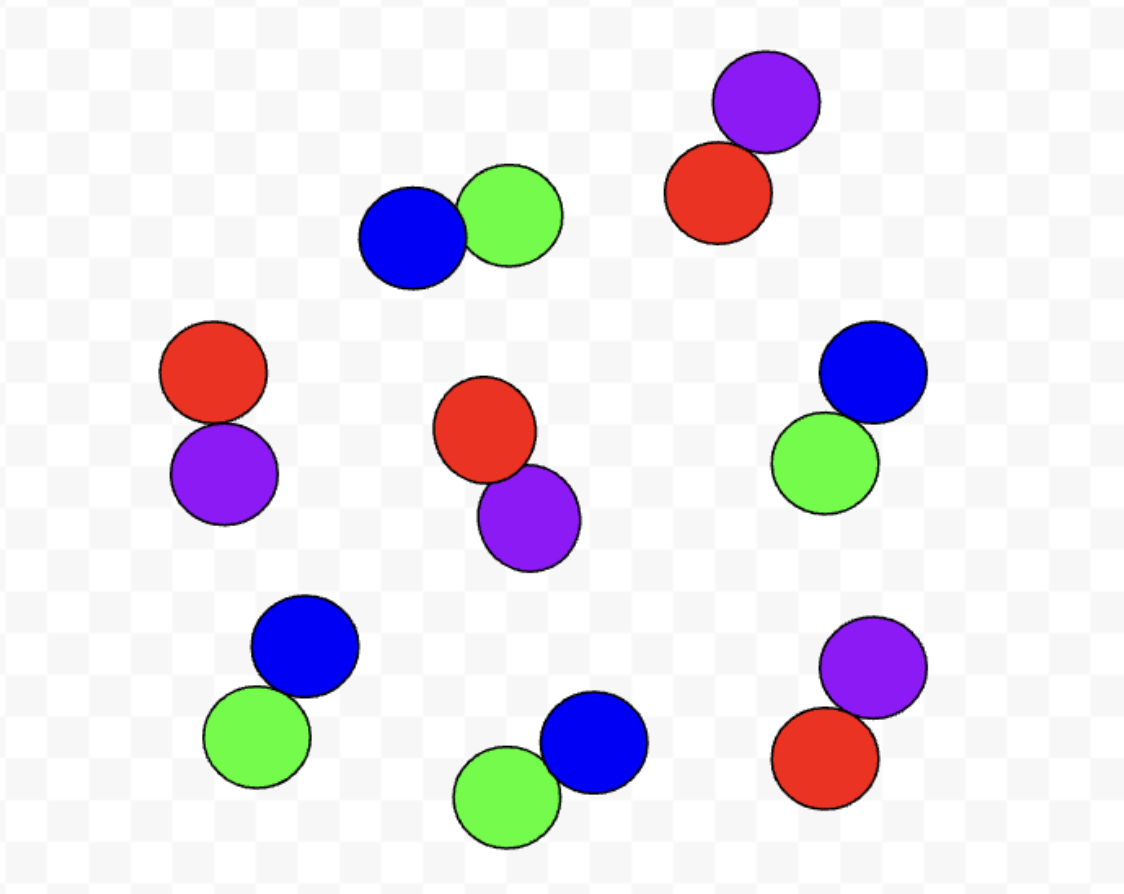
What does a mixture of elements and compounds look like?
Precipitation
removing a dissolved substance from a homogeneous mixture by making it react with another substance
Separatory Funnel
separate two heterogeneous liquids by gravity
Evaporation
heating a homogeneous mixture so that the water evaporates leaving behind a salt
Filtration
removing a solid from a liquid. Solid gets caught in the filter and the liquid will pass through (this doesn’t work for homogeneous mixtures)
What kinds of separation can be used for homogeneous mixtures?
Distillation, precipitation, evaporation, chromatography
What kinds of separation can be used for heterogeneous mixtures?
Separatory funnel and filtration