Part 2.3.2 - Autonomic Drugs - Parasympatholytics
 Call Kai
 Learn
Learn Practice Test
 Spaced Repetition
 Match
Match Flashcards
 Knowt Play
1/54

Earn XP
Description and Tags
Proverbs 16:3
Name | Mastery | Learn | Test | Matching | Spaced | Call with Kai | Chat |
|---|
No analytics yet
Send a link to your students to track their progress
55 Terms
c. Cholinergic
Parasympatholytics are also known as ________ antagonists.
a. Adrenergic
b. Dopaminergic
c. Cholinergic
d. Histaminergic
c. both
Parasympatholytics classifications
a. Antimuscarinics
b. Antinicotinics
c. both
b. Anticholinergics
[ANTIMUSCARINICS]
Antimuscarinics are also known as ________.
a. Adrenergics
b. Anticholinergics
c. Sympathomimetics
d. Cholinomimetics
b. Atropine
[ANTIMUSCARINICS]
Drug that is a prototype antimuscarinic
a. Scopolamine
b. Atropine
c. Benztropine
d. Ipratropium
b. Gastric
[ANTIMUSCARINICS]
Blocking M1 receptors by atropine inhibits ________ secretion.
a. Salivary
b. Gastric
c. Bronchial
d. Lacrimal
b. Tachycardia
[ANTIMUSCARINICS]
Blocking M2 receptors by atropine causes ________.
a. Bradycardia
b. Tachycardia
c. Bronchodilation
d. Ileus
a. Secretion
Blocks M3: Inhibits secretion & Smooth Muscles
[ANTIMUSCARINICS]
Blocking M3 receptors by atropine inhibits ________.
a. Secretion
b. Lipolysis
c. Dopamine release
d. Peristalsis only
Dry mouth
Anhidrosis (no sweating)
Cutaneous vasodilation (widening of skin blood vessels)
Erythema (skin redness)
[ANTIMUSCARINICS]
Blocks M3 by atropine: Inhibits secretion may lead to
Salivation / wet mouth or Dry mouth?
Anhidrosis (no sweating) or Sweating / diaphoresis?
Cutaneous vasodilation (widening of skin blood vessels) or Cutaneous vasoconstriction?
Pallor (pale skin) or Erythema (skin redness)?
Mydriasis
Cycloplegia
Bronchodilation
Ileus
Urinary retention
[ANTIMUSCARINICS]
Blocks M3 by atropine: Smooth Muscles may lead to
Miosis or Mydriasis?
Cycloplegia or Accommodation / normal focusing?
Bronchodilation or Bronchoconstriction?
Normal bowel movement / peristalsis or Ileus?
Urination or Urinary retention?
All
CNS / mental confusion symptoms
Acute Psychosis → abnormal thinking/perception
Confusion → cannot think clearly
Agitation → restless or disturbed behavior
Disorientation → confused about place, time, or person
[ANTIMUSCARINICS]
CNS Effects of blocking muscarinic receptors by atropine
I. Acute Psychosis
II. Confusion
III. Agitation
IV. Disorientation
All

[ANTIMUSCARINICS]
Other Anticholinergics for CNS
I. Scopolamine
II. Trihexyphenidyl
III. Benztropine
IV. Biperiden
All

[ANTIMUSCARINICS]
Other Anticholinergics for Eyes
I. Homatropine
II. Anistropine
III. Cyclopentolate
All

[ANTIMUSCARINICS]
Other Anticholinergics for Bronchi
I. Ipratropium
II. Tiotropium
III. Oxytropium
Both

[ANTIMUSCARINICS]
Other Anticholinergics for Gastric Gland
I. Pirenzepine
II. Telenzepine
All
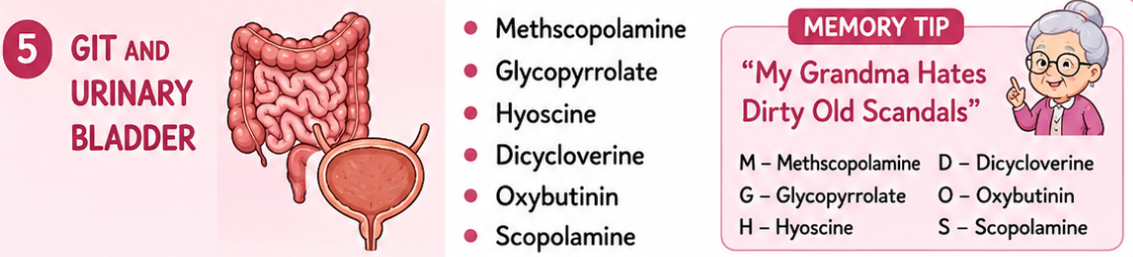
[ANTIMUSCARINICS]
Other Anticholinergics for GIT and Urinary Bladder:
Methscopolamine, Glycopyrrolate, Hyoscine, Dicycloverine, Oxybutinin, Scopolamine
d. Atropine
[ANTIMUSCARINICS]
For Symptomatic Bradycardia
a. Trihexyphenidyl
b. Scopolamine
c. Biperiden
d. Atropine
d. Atropine
[ANTIMUSCARINICS]
Treatment of Cholinomimetic Poisoning
a. Trihexyphenidyl
b. Scopolamine
c. Biperiden
d. Atropine
d. Atropine
[ANTIMUSCARINICS]
Given with Diphenoxylate to minimize addiction with Diphenoxylate
a. Trihexyphenidyl
b. Scopolamine
c. Biperiden
d. Atropine
b. Scopolamine
[ANTIMUSCARINICS]
Management of Motion sickness
a. Trihexyphenidyl
b. Scopolamine
c. Biperiden
d. Atropine
II. Trihexyphenidyl
III. Benztropine
IV. Biperiden
[ANTIMUSCARINICS]
Management of EPS and Parkinsonism
I. Scopolamine
II. Trihexyphenidyl
III. Benztropine
IV. Biperiden
I. Homatropine
II. Anistropine
III. Cyclopentolate
[ANTIMUSCARINICS]
For Mydriatic Cycloplegics
I. Homatropine
II. Anistropine
III. Cyclopentolate
IV. Biperiden
I. Ipratropium
II. Tiotropium
III. Oxytropium
[ANTIMUSCARINICS]
For Bronchial and COPD
I. Ipratropium
II. Tiotropium
III. Oxytropium
IV. Cyclopentolate
II. Pirenzepine
IV. Telenzepine
[ANTIMUSCARINICS]
For Management of hyperacidity
I. Ipratropium
II. Pirenzepine
III. Oxytropium
IV. Telenzepine
All
[ANTIMUSCARINICS]
For Management of hypermotility D/O and urinary incontinence
I. Methscopolamine
II. Glycopyrrolate
III. Hyoscine
IV. Dicycloverine
V. Oxybutinin
VI. Scopolamine
b. Ganglionic Blockers
[ANTINICOTINIC]
_______ are Nn blockers.
a. Neuromuscular Blockers
b. Ganglionic Blockers
c. Muscarinic agonists
d. Bronchodilators
b. Skeletal muscle relaxants
[ANTINICOTINIC]
_______ are Neuromuscular blockers.
a. Ganglionic Blockers
b. Skeletal muscle relaxants
c. Bronchodilators
d. Antimuscarinic agents
a. Ganglionic Blockers
[ANTINICOTINIC]
Vasodilation and anticholinergic
a. Ganglionic Blockers
b. Neuromuscular Blockers
a. Ganglionic Blockers
[ANTINICOTINIC]
These agents are no longer clinically useful
a. Ganglionic Blockers
b. Neuromuscular Blockers
b. Neuromuscular Blockers
[ANTINICOTINIC]
Used for spastic disorders
a. Ganglionic Blockers
b. Neuromuscular Blockers
b. Neuromuscular Blockers
[ANTINICOTINIC]
Anesthetic adjuncts
a. Ganglionic Blockers
b. Neuromuscular Blockers
a. Ganglionic Blockers
[ANTINICOTINIC]
Hexamethonium
a. Ganglionic Blockers
b. Neuromuscular Blockers
a. Ganglionic Blockers
[ANTINICOTINIC]
Trimethaphan
a. Ganglionic Blockers
b. Neuromuscular Blockers
a. Ganglionic Blockers
[ANTINICOTINIC]
Mecamylamine
a. Ganglionic Blockers
b. Neuromuscular Blockers
b. Neuromuscular Blockers
[ANTINICOTINIC]
Classified as Depolarizing or Non-depolarizing
a. Ganglionic Blockers
b. Neuromuscular Blockers
a. Depolarizing NMB
[ANTINICOTINIC]
Succinylcholine
a. Depolarizing NMB
b. Non-depolarizing NMB
b. Non-depolarizing NMB
[ANTINICOTINIC]
Curare derivatives
a. Depolarizing NMB
b. Non-depolarizing NMB
b. Succinylcholine
[ANTINICOTINIC]
_______ is an anti-nicotinic agonist useful when rapid endotracheal intubation is required during induction of anesthesia.
a. Rocuronium
b. Succinylcholine
c. Atracurium
d. Neostigmine
a. Succinylcholine
[ANTINICOTINIC]
_______ is used during electroconvulsive shock treatment.
a. Succinylcholine
b. Tubocurarine
c. Pancuronium
d. Rocuronium
a. Succinylcholine
[ANTINICOTINIC]
MOA of ________: irreversibly activates Nm receptor.
a. Succinylcholine
b. Atracurium
c. Pancuronium
d. Tubocurarine
a. Succinylcholine
[ANTINICOTINIC]
Initial phase of effect of ________ is skeletal muscle contraction, followed by final relaxation paralysis.
a. Succinylcholine
b. Rocuronium
c. Tubocurarine
d. Atracurium
a. Succinylcholine
[ANTINICOTINIC]
Respiratory paralysis caused by ________ may be treated with Endrophonium or Neostigmine.
a. Succinylcholine
b. Cyclopentolate
c. Pirenzepine
d. Ipratropium
b. Dantrolene
[ANTINICOTINIC]
Malignant hyperthermia caused by Succinylcholine is treated with ___.
a. Rocuronium
b. Dantrolene
c. Tubocurarine
d. Atracurium
a. Myalgia, Myositis, and Rhabdomyolysis
[ANTINICOTINIC]
Adverse effects of Succinylcholine include ________.
a. Myalgia, Myositis, and Rhabdomyolysis
b. Hyperacidity and diarrhea
c. Bronchospasm and cough
d. Mydriasis and cycloplegia
b. Block Nm receptor causing immediate paralysis
[ANTINICOTINIC]
MOA of curare derivatives: ________.
a. Irreversibly activate Nm receptor
b. Block Nm receptor causing immediate paralysis
c. Stimulate muscarinic receptor
d. Increase acetylcholine release
c. Acetylcholine (ACh)
[ANTINICOTINIC]
At low doses, curare derivatives competitively block ________ at nicotinic receptors, preventing depolarization and muscle contraction.
a. Dopamine
b. Epinephrine
c. Acetylcholine (ACh)
d. Serotonin
b. Ion channels
[ANTINICOTINIC]
At high doses, curare derivatives block ________ of the motor template, further weakening neuromuscular transmission.
a. Muscarinic receptors
b. Ion channels
c. Sodium pumps
d. Alpha receptors
a. Type I Non-depolarizing NMB
[ANTINICOTINIC]
Isoquinoline (-curium)
a. Type I Non-depolarizing NMB
b. Type II Non-depolarizing NMB
a. Type I Non-depolarizing NMB
[ANTINICOTINIC]
Atracurium
a. Type I Non-depolarizing NMB
b. Type II Non-depolarizing NMB
a. Type I Non-depolarizing NMB
[ANTINICOTINIC]
Tubocurarine
a. Type I Non-depolarizing NMB
b. Type II Non-depolarizing NMB
b. Type II Non-depolarizing NMB
[ANTINICOTINIC]
Steroidal (-curonium)
a. Type I Non-depolarizing NMB
b. Type II Non-depolarizing NMB
b. Type II Non-depolarizing NMB
[ANTINICOTINIC]
Pancuronium
a. Type I Non-depolarizing NMB
b. Type II Non-depolarizing NMB
b. Type II Non-depolarizing NMB
[ANTINICOTINIC]
Rocuronium
a. Type I Non-depolarizing NMB
b. Type II Non-depolarizing NMB
b. Neostigmine and Edrophonium
[ANTINICOTINIC]
Respiratory/diaphragmatic paralysis caused by non-depolarizing blockers is treated with ________.
a. Dantrolene and Epinephrine
b. Neostigmine and Edrophonium
c. Atropine and Dopamine
d. Tiotropium and Ipratropium
a. Epinephrine
[ANTINICOTINIC]
Tubocurarine may cause an anaphylactoid reaction treated with ________.
a. Epinephrine
b. Dantrolene
c. Neostigmine
d. Scopolamine
c. Tubocurarine
[ANTINICOTINIC]
May cause an anaphylactoid reaction
a. Epinephrine
b. Dantrolene
c. Tubocurarine
d. Scopolamine