STATS FINAL: Chi-Square Tests

0.0(0)
studied byStudied by 0 people
0.0(0)
full-widthCall with Kai
learnLearn
examPractice Test
spaced repetitionSpaced Repetition
heart puzzleMatch
flashcardsFlashcards
GameKnowt Play
Card Sorting

1/15

encourage image

There's no tags or description

Looks like no tags are added yet.

Study Analytics
Name
Mastery
Learn
Test
Matching
Spaced
Call with Kai

No study sessions yet.

16 Terms

1
New cards

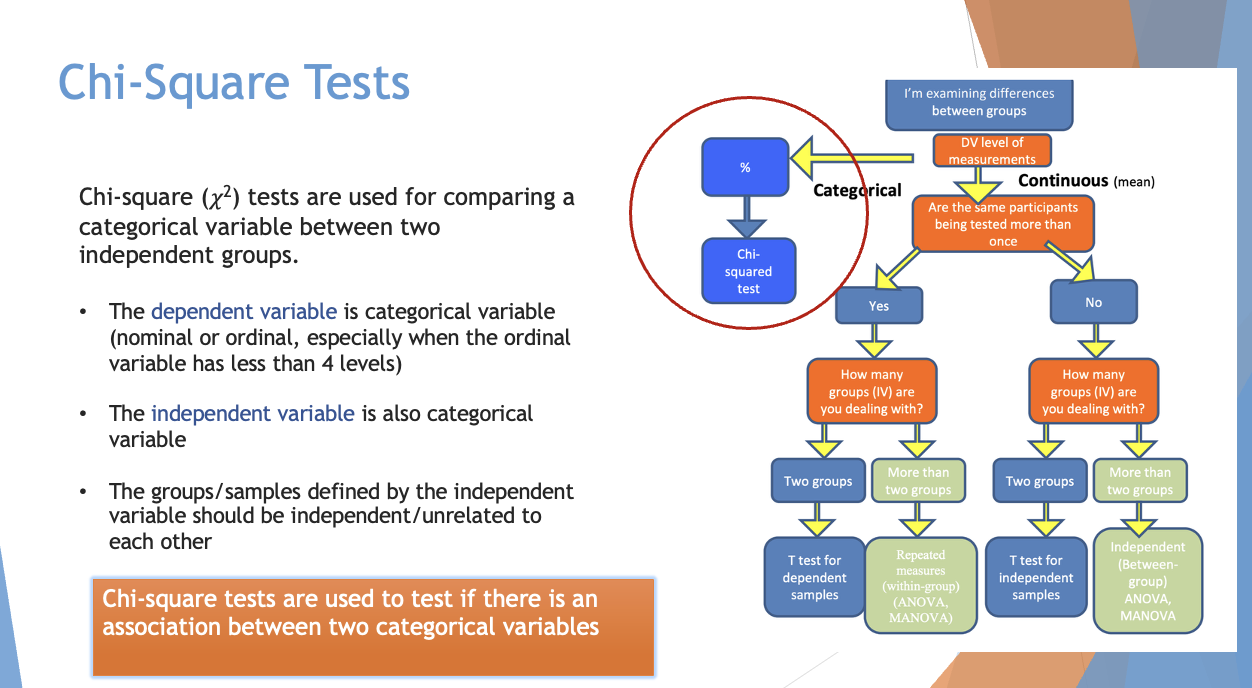
What are chi-square tests?

they’re used for comparing a categorical variable between two independent groups

  • the responding variable is categorical (nominal or ordinal)

  • Independant variable is also categorical

**The groups/samples defined by the manipulated variable should be independent/unrelated to each other
<p>they’re used for comparing a<strong> categorical variable </strong>between <strong>two independent groups</strong></p><p></p><ul><li><p>the responding variable is categorical (nominal or ordinal)</p></li><li><p>Independant variable is also categorical</p></li></ul><p></p><p><strong>**</strong><span><strong><span>•</span></strong></span><span style="font-family: &quot;Trebuchet MS&quot;;"><strong><span>The groups/samples defined by the manipulated variable should be independent/unrelated to each other</span></strong></span></p><p></p>
2
New cards

What are the key characteristics of a chi-square test?

  • a non-parametric test ==> doesn’t rely on underlying assumptions like normality because it’s specifically designed for categorical data

    •  where the data information contain counts or frequencies

  • Focused on frequency distributions: uThe chi-square test examines the distribution of observed frequencies in comparison to expected frequencies under a specific hypothesis.

3
New cards

What are the assumptions for a chi-square test:

  • independence of observations ==> a must

  • Mutually Exclusive Categories ===>Each observation belongs to only one category per variable.

  • categorical data for both manipulated and responding variable

  • Sufficiently Large Expected Frequencies

4
New cards

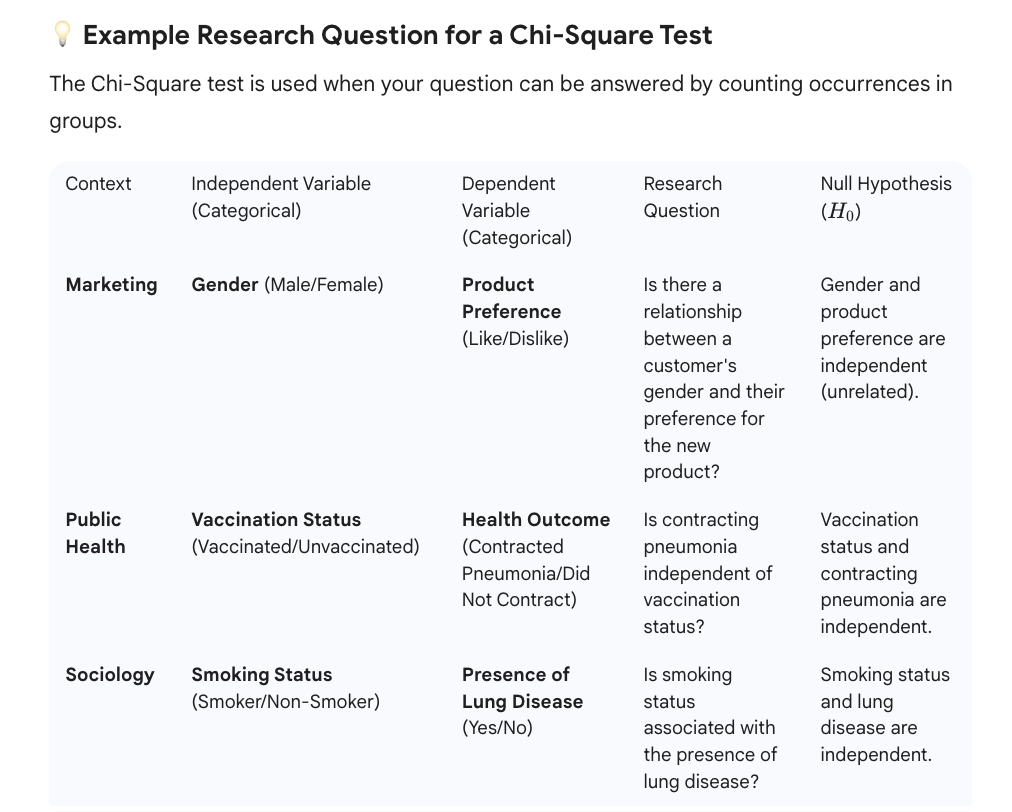
Chi-Square test is used when you have two or more categorical variables and you want to see if they are related (dependent) or independent (unrelated).

So the “experiment” revolves around things like:

In short, the Chi-Square test determines if the proportions of one category (e.g., the proportion of "Likes") are the same across the groups of the other category (e.g., Male vs. Female).
<p>So the “experiment” revolves around things like:</p><p></p><p>In short, the<strong> Chi-Square test determines if the proportions of one category (e.g., the proportion of "Likes") are the same across the groups of the other category</strong> (e.g., Male vs. Female).</p>
5
New cards

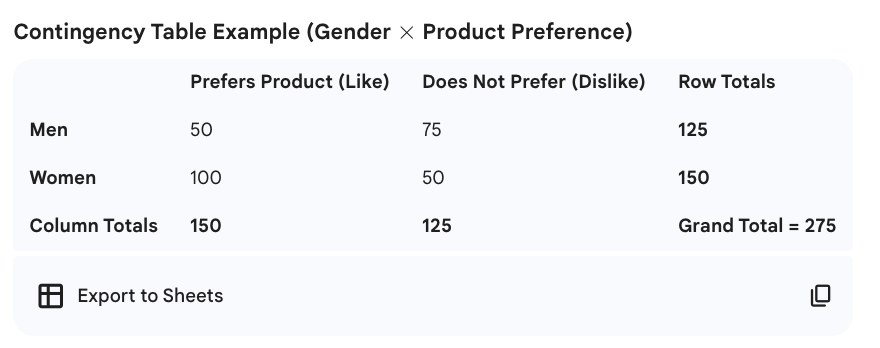
What is a contingency table:

A Contingency Table (also called a cross-tabulation or cross-tab) is a table that displays the frequencies (counts) of observations for every combination of your two categorical variables.
<p><span>A </span><strong><span>Contingency Table</span></strong><span> (also called a cross-tabulation or cross-tab) is a table that displays the </span><strong><span>frequencies (counts)</span></strong><span> of observations for every combination of your two categorical variables.</span></p><p></p><p></p>
6
New cards

Observed vs. Expected frequencies:

observed ==> what we actually count

expected ==> what the count should be if the null hypothesis were true

  • Observed Frequencies ($O$): These are the actual counts you recorded in your study, representing the real-world data collected for each combination of categories (the numbers inside the contingency table cells).

  • Expected Frequencies ($E$): These are the counts you would theoretically expect to find in each cell if there were absolutely no relationship between the two variables (if the null hypothesis were true).

The Chi-Square test then compares $O$ and $E$;

  • the bigger the difference between what you observed and what you expected, the stronger the evidence that the two categorical variables are actually related.

7
New cards

What is the null hypothesis for a chi-square test?

Null (H0​): There is no association between the two categorical variables (they are independent).

** SO WE ASSUME INDEPENDENCE BECAUSE WE’RE TRYING TO TEST IF THERE IS AN ASSOCIATION

8
New cards

for us to use a chi-square test, the expected frequency has to be:

greater or = 5, if it’s less we use fisher’s test

9
New cards

What is the statistic we calculate for chi-square test?

•𝜒2-statistic

10
New cards

How do we calculate expected frequency for per cell?

Respiratory Disease (Yes)

Respiratory Disease (No)

Total

Smoke

50 (A)

30 (B)

80 (A+B)

Non-smoker

20 (C)

100 (D)

120 (C+D)

Total

70 (A+C)

130 (B+D)

200 (A+B+C+D)

row x colum/total

<table style="min-width: 100px;"><colgroup><col style="min-width: 25px;"><col style="min-width: 25px;"><col style="min-width: 25px;"><col style="min-width: 25px;"></colgroup><tbody><tr><td colspan="1" rowspan="1" style="height: 57.71pt; width: 99pt;"><p style="text-align: left;"></p></td><td colspan="1" rowspan="1" style="width: 107pt;"><p style="text-align: center;"><span style="font-family: &quot;Trebuchet MS&quot;;"><span>Respiratory Disease (Yes)</span></span></p></td><td colspan="1" rowspan="1" style="width: 98pt;"><p style="text-align: center;"><span style="font-family: &quot;Trebuchet MS&quot;;"><span>Respiratory Disease (No)</span></span></p></td><td colspan="1" rowspan="1" style="width: 117pt;"><p style="text-align: center;"><span style="font-family: &quot;Trebuchet MS&quot;;"><span>Total</span></span></p></td></tr><tr><td colspan="1" rowspan="1" style="height: 30.07pt; width: 99pt;"><p style="text-align: left;"><span style="font-family: &quot;Trebuchet MS&quot;;"><span>Smoke</span></span></p></td><td colspan="1" rowspan="1" style="width: 107pt;"><p style="text-align: center;"><span style="font-family: &quot;Trebuchet MS&quot;;"><span>50 (A)</span></span></p></td><td colspan="1" rowspan="1" style="width: 98pt;"><p style="text-align: center;"><span style="font-family: &quot;Trebuchet MS&quot;;"><span>30 (B)</span></span></p></td><td colspan="1" rowspan="1" style="width: 117pt;"><p style="text-align: center;"><span style="font-family: &quot;Trebuchet MS&quot;;"><span>80 (A+B)</span></span></p></td></tr><tr><td colspan="1" rowspan="1" style="height: 30.07pt; width: 99pt;"><p style="text-align: left;"><span style="font-family: &quot;Trebuchet MS&quot;;"><span>Non-smoker</span></span></p></td><td colspan="1" rowspan="1" style="width: 107pt;"><p style="text-align: center;"><span style="font-family: &quot;Trebuchet MS&quot;;"><span>20 (C)</span></span></p></td><td colspan="1" rowspan="1" style="width: 98pt;"><p style="text-align: center;"><span style="font-family: &quot;Trebuchet MS&quot;;"><span>100 (D)</span></span></p></td><td colspan="1" rowspan="1" style="width: 117pt;"><p style="text-align: center;"><span style="font-family: &quot;Trebuchet MS&quot;;"><span>120 (C+D)</span></span></p></td></tr><tr><td colspan="1" rowspan="1" style="height: 41.77pt; width: 99pt;"><p style="text-align: left;"><span style="font-family: &quot;Trebuchet MS&quot;;"><span>Total</span></span></p></td><td colspan="1" rowspan="1" style="width: 107pt;"><p style="text-align: center;"><span style="font-family: &quot;Trebuchet MS&quot;;"><span>70 (A+C)</span></span></p></td><td colspan="1" rowspan="1" style="width: 98pt;"><p style="text-align: center;"><span style="font-family: &quot;Trebuchet MS&quot;;"><span>130 (B+D)</span></span></p></td><td colspan="1" rowspan="1" style="width: 117pt;"><p style="text-align: center;"><span style="font-family: &quot;Trebuchet MS&quot;;"><span>200 (A+B+C+D)</span></span></p></td></tr></tbody></table><p></p><p><strong>row x colum/total</strong></p>
11
New cards

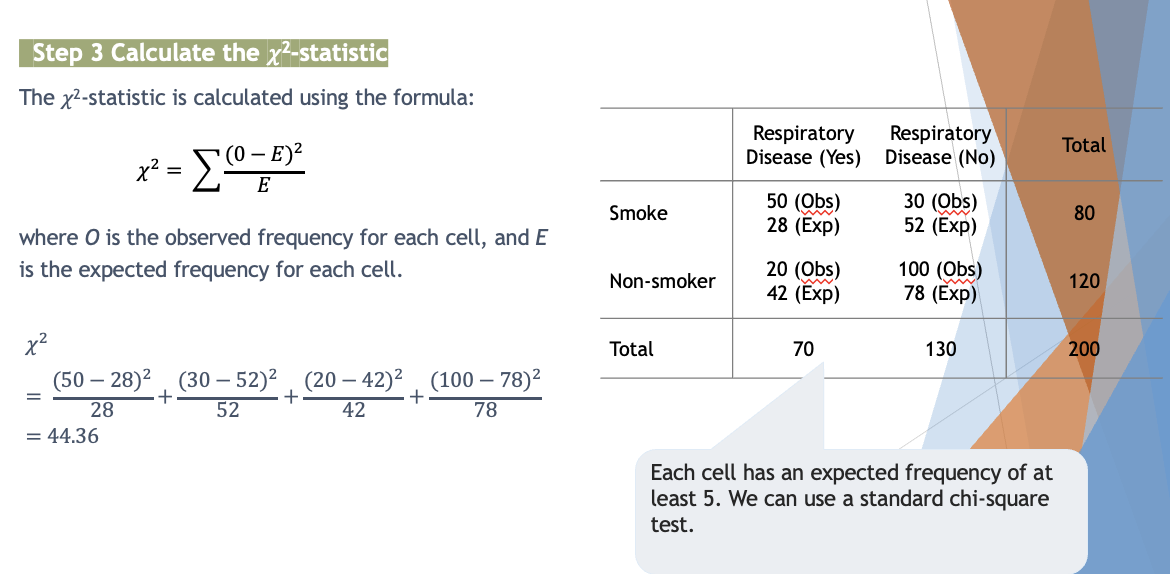
How do we calculate 𝜒2-statistic?

Each cell has an expected frequency of at least 5. We can use a standard chi-square test.
<p><span style="font-family: &quot;Trebuchet MS&quot;;"><span>Each cell has an expected frequency of at least 5. We can use a standard chi-square test.</span></span></p>
12
New cards

Degrees of freedom for a chi-square test is:

Df = (r−1) * (c−1)

where r is the number of rows and c is the number of columns.

13
New cards

Rows are horizontal: ROW HO

columns are vertical

14
New cards

The calculated 𝜒2-statistic has to be > than the critical value (find via. a and df), we reject null

Then there is an association

15
New cards

What are the limitations of chi-square tests?

uHighly sensitive to sample size

uSensitive to small frequencies (<5)

uIt does not provide information about the strength and direction of the relationship.

The Chi-Square test determines if a statistical relationship exists between two categorical variables by comparing the counts you observed to what you expected under the assumption of no link.

However, its limitation is that a significant result only confirms the association and does not tell you the strength, direction, or where exactly the differences lie within the categories. ==> like if smoking cause pneumonia.

16
New cards

What is the fisher’s exact test?

  • used when any expected frequencies are less than 5