Stationary Waves
 Call Kai
 Learn
Learn Practice Test
 Spaced Repetition
 Match
Match Flashcards
 Knowt Play
1/28

There's no tags or description
Looks like no tags are added yet.
Name | Mastery | Learn | Test | Matching | Spaced | Call with Kai | Chat |
|---|
No analytics yet
Send a link to your students to track their progress
29 Terms
Stationary wave
The superposition of two progressive waves with the same wavelength, amplitude and frequency moving in opposite directions
Do stationary waves transfer energy
No
How can a stationary wave be demonstrated with a string
1- Attach a vibration transducer at one end of a stretched string, with the other end fixed. The transducer is given a wave frequency by a signal generator and creates a wave by vibrating the string
2- The wave generated by the vibration is reflected back and forth
3- Alter the signal generator to a resonant frequency
Resonant frequency
An exact number of half-wavelength fits onto the string
What does a resonant frequency produce
A stationary wave
What are stationary waves also called
Standing waves
What are stationary waves made up of
Nodes and antinodes
Node
Zero displacement due to destructive interference
Antinode
Maximum displacement due to constructive interference
How long is 1 wavelength of a stationary wave
2 node-nodes
How long is ½ a wavelength of a stationary wave
1 node-node
Name the first 3 harmonics
-Fundamental mode of vibration
-Second harmonic
-Third harmonic
What is the lowest possible resonant frequency
The fundamental mode of vibration
How many wavelengths is the fundamental mode of vibration
½
How many wavelengths is the second harmonic
1
How many wavelengths is the third harmonic
1½
Ways to demonstrate stationary waves
-Reflected microwaves
-Powder
Explain how stationary waves are demonstrated using reflected microwaves
A microwave transmitter transmits microwaves which reflect off a metal plate and are picked up by a moveable probe, connected to a meter. The reading will be strongest at antinodes and 0 at nodes
Explain how stationary waves are demonstrated by powder
Lycopodium powder is in a closed glass tube, with a loudspeaker at one end. The powder is shaken away at antinodes, but is undisturbed at nodes
μ symbol
Mass per unit length
Experiment to investigate factors affecting resonant frequencies of a string
1- Fix a string to a vibration transducer attached to a signal generator on a bench. Attach the string to a pulley and some masses over the edge of the bench.
2- Calculate μ with the mass of the string/length of the string
3- Calculate the with mass of the weights x g
4- Turn on the signal generator and vary the frequency until you find the first harmonic
5- Alter length, tension or μ
How to do the stationary wave experiment with altered length
Move the vibration transducer towards or away from the pulley, find the first harmonic and record f against length
How to do the stationary wave experiment with altered tension
Add or remove masses, find the first harmonic and record f against T
How to do the stationary wave experiment with altered μ
Use different string samples, find the first harmonic and record f against μ
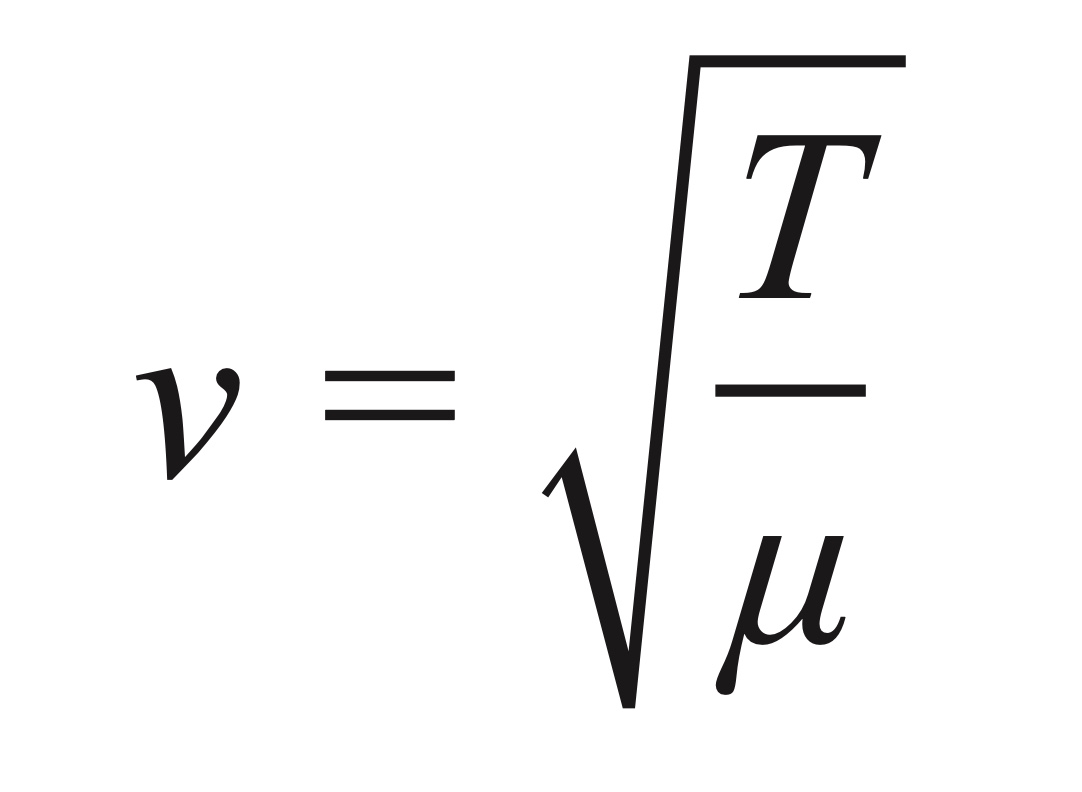
Speed of a transverse wave on a string equation
v = root(T/μ)
How does increasing the length of the string affect resonant frequency
Decreases it
How does increasing μ of the string affect resonant frequency
Decreases it
How does having a looser string affect resonant frequency
Decreases it
Amplitude distribution of a stationary wave vs progressive wave
Amplitude varies in a stationary wave, whilst it is the same at all points of a progressive wave