18 Bovine Respiratory Diseases: Bacterial Causes
 Call Kai
 Learn
Learn Practice Test
 Spaced Repetition
 Match
Match Flashcards
 Knowt Play
1/26

There's no tags or description
Looks like no tags are added yet.
Name | Mastery | Learn | Test | Matching | Spaced | Call with Kai | Chat |
|---|
No analytics yet
Send a link to your students to track their progress
27 Terms
1. Mannheimia haemolytica
2. Pasteurella multocida
3. Histophilus somni
4. Mycoplasma bovis
Name the major bacterial players for Bovine Respiratory Disease
Mycoplasma bovis
There are 4 major bacterial causes of bovine respiratory disease. Which is the ONLY ONE that is not a commensal?
*Cranioventrally*
What is the PRIMARY DISTRUBUTION of where Mannheimia and Pasteurella caused increased lung sounds with crackles and wheezes?
Gram NEGATIVE
Mannheimia haemolytica is a gram *positive or negative* nonspore forming coccobacilli (cocci and rod) with an incubation of 7-14 days
Upper resp tract in *tonsillar crypts*
Where is Mannheimia a commensal organism?
Mannheimia haemolytica
(classic "man" to "hit it and quit it")
What organism has the "hit and run", replicating quickly, causing damage, then retreating the system (back to where it is a commensal), making it particularly difficult to culture
Leukotoxin (kills WBC)
What is the most IMPORTANT VIRULENCE FACTOR of Mannheimia haemolytica?
Mannheimia itself doesn't cause damage, the toxin does. *The leukotoxin is what vaccines are made from*
What is important to know about the Leukotoxin of Mannheimia haemolytica?
Mannheimia haemolytica
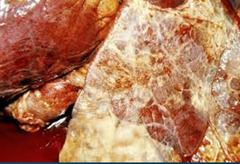
This respiratory bacteria of cattle causes fibrinosuppurative hemorrhagic bronchopneumonia, extensive thrombosis, necrotic foci (much larger than BRSV), and red to black areas of cranioventral consolidation

NEGATIVE
Pasteurella multocida is a gram *positive or negative* nonspore forming coccobacilli (cocci and rod) with an incubation of 7-14 days
Nasal passages: *nasopharynx*
Where is Pasteurella multocida a commensal organism?
Pasteurella multocida
note: remember Mannheimia is the "hit and run"
What organism has the "simmer and smolder", hanging out in the lungs for a long time and often seen in conjunction with other infections
Pasteurella multocida
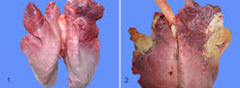
This bovine respiratory bacteria causes purulent bronchopneumonia, fibrinous areas in lungs and bronchioles, and limited pulmonary necrosis
Sleeper calves
What is another name for Histophilus somni?
NEGATIVE rod
Histophilus somni is a gram *positive or negative* nonencapsulated *rod or cocci* with an incubation of 7-14 days
Upper resp. tract, prepuce, vagina
Where is Histophilus somni a commensal?
Feedlot and stocker
What stage of cattle do you typically see Histophilus somni in?
Septicemia
What often causes death in Histophilus somni cattle?
Histophilus somni
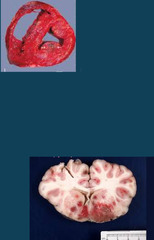
A cow presents with pneumonia, synovitis, endocarditis/myocarditis, and thromboembolic meningeencephalitis (TEME). Necropsy shows septicemia. Thoughts?
Histophilus somni
Which bacteria is hard to treat because it creates a biofilm and is resistant to antibiotic penetration?
Anaerobic bacteria
Mycoplasma bovis is a/n *aerobic or anaerobic* bacteria with NO CELL WALL with an incubation of 7-14 days
Mycoplasma bovis
A cow presented with pneumonia, otitis media/interna, polyarthritis, mastitis, and pink eye. After death, you find caseonecrotic bronchopneumonia and arthritic joints. Thoughts on the bacteria?
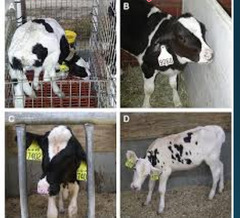
Mycoplasma bovis
Which bacteria is possible to spread from milking and fomites from mothers to babies?
Mycoplasma bovis
Which bacteria causes treatment problems because it has no cell wall, is very hard on dairies/lactating animals, may colonize the upper resp. tract of young animals and not cause disease, and you will see all manifestations of the disease at one farm during an outbreak?
Beta lactams
Because Mycoplasma doesn't have a cell wall, what can you NOT use to treat?
TRUE
TRUE OR FALSE: all the respiratory bacteria of cattle (mannheimia, pasteurella, histoplasma, mycoplasma) will eventually cause abscessation if the animal doesn't improve in about 3 weeks
Mycoplasma bovis
Of the respiratory bacteria of cattle, which has the ability to be spread like this, causing massive problems for the dairy industry?