N333: Fluid, Electrolytes, and Diuretics
 Call Kai
 Learn
Learn Practice Test
 Spaced Repetition
 Match
Match Flashcards
 Knowt Play
1/62

Earn XP
Description and Tags
Shifts, Imbalances, and the Role of Diuretics
Name | Mastery | Learn | Test | Matching | Spaced | Call with Kai | Chat |
|---|
No analytics yet
Send a link to your students to track their progress
63 Terms
____ ____ refers to the equilibrium between fluid intake and output to maintain hydration and proper fluid distribution. It regulates blood pressure, nutrient transport, waste elimination, and temperature control. Disruptions can lead to heart failure, kidney disease, and hypertension
Fluid balance (fluid management is critical for treatment and maintaining balance)
Hydrostatic pressure, hormonal regulation, fluid intake/output, oncotic pressure, renal function, electrolyte balance, capillary permeability, lymphatic system, acid-base balance are factors contributing to __ ___
Fluid balance (regulation of body fluid to maintain a stable internal enviorment)
The body has 2 main fluid compartments: ___ ___ refers to fluid inside cells. It makes up about 60% of total body water (TBW) and includes major electrolytes such as K⁺, PO₄ ³⁻, Mg²⁺
Intracellular Fluid (ICF)
The body has 2 main fluid compartments: ___ ___ refers to fluid outside cells. It makes up about 40% of total body water and includes major electrolytes like Na⁺, Cl⁻, HCO₃⁻
Extracellular Fluid (ECF)
ECF is further divided into _____ which refers to fluid in blood vessels (~20% of ECF), _____ which refers to fluid between cells (~75% of ECF), and ______ which refers to specialized fluids such as CSF, synovial, peritoneal (~5% of ECF)
Intravascular (plasma), Interstitial, Transcellular
___ ____ refers to the movement of water between compartments due to pressure or solute changes. These maintain balance, adjusts hydration, and supports nutrient/waste exchange.
Fluid shifts
Key mechanisms of fluid shifts include ____ ____, _____ ____, and ______. These mechanisms work together to regulate fluid distribution between the ICF and ECF
Hydrostatic Pressure, Oncotic Pressure, Osmosis
____ ____ is the force of fluid (blood) pushing against vessel walls. It functions as a “push force” that is driven by blood volume and flow. Along Capillaries, the highest is the ____ end (blood entering) and the lowest is the ____ end (blood leaving).
Hydrostatic pressure, arterial, venous (fluid moves OUT of vessels INTO tissues so intravascular into interstitial and supports nutrient delivery)
____ ____ is the force from plasma proteins (albumin) pulling water into bloodstream. It functions as the “pull force” that maintains fluid in vessels. If albumin is ____, there is a decrease in oncotic pressure leading to a weaker pull causing fluid to shift out of vessels and into tissue → edema
Oncotic pressure, low (fluid moves from tissues and INTO vessels so interstitial into intravascular and supports fluid balance
Normal Fluid Balance Capillary Exchange: ___ + ____ = push and pull system that regulates fluid balance and prevents edema
Hydrostatic (blood volume/flow that pushes fluid out leading to filtration/nutrient delivery) Oncotic (albumin/proteins pulls fluid in leading to reabsorption which maintains volume + removes waste)
The ____ end is high hydrostatic (hydrostatic > oncotic) and leads to net filtration to tissues. The _____ end ↓ hydrostatic and oncotic dominates and leads to net reabsorption to vessels
Arterial, venous
_____ return excess interstitial fluid leading to venous circulation (subclavian veins). What doesn’t get reabsorbed goes to lymph and then goes back to the veins
Lymphatics
Imbalance in hydrostatic and oncotic pressure lead to abnormal fluid distribution: ___ ____ refers to an increase in hydrostatic pressure (↑ push out → fluid → tissues) and a decrease in oncotic (↓ albumin and ↓ pull in so fluid stays in tissues)
Fluid excess (edema) (EX: Heart failure, liver/renal disease, burns)
Imbalance in hydrostatic and oncotic pressure lead to abnormal fluid distribution: ___ ____ refers to a decrease in circulating volume (↓ hydrostatic → ↓ perfusion) so fluid shifts from tissues and into vessels (compensatory)
Fluid deficit (dehydration / volume loss) (EX: Dehydration, hemorrhage, diuretics)
Disruptions in fluid balance include ____ which is too much out or not enough in and ____ which is not enough volume in system both leading to imbalances
Edema, dehydration
Fluid imbalances: ___ ___ occurs when the body retains more fluid than it needs, leading to edema and increased workload on the heart
Fluid overload
Fluid imbalances: _____ ____ occurs when there is insufficient fluid intake or excessive fluid loss, leading to hypovolemia
Fluid deficit (dehydration)
Indicators of fluid overload include ____ _____ (rapid, especially in a short period), ____ (swelling of feet, ankles, or lungs), _____ _____ ____ (dyspnea, fluid accumulation in lungs), and _____ _____ ____ (due to excessive fluid in vascular system)
Weight gain, edema, shortness of breath, increased blood pressure
Indicators of fluid deficit include ____ (early sign), ____ ____ and _____ _____ (ex: in the mouth and eyes), ____ ____ _____ (due to low volume), ______ (compensatory response), and decreased ___ ____ (dark colored urine)
Thirst, dry skin mucous membranes, low blood pressure, tachycardia, urine output
___ ____ (fluid shift) occurs when fluid moves into spaces where it cannot be used by the body. It caused by inflammation, burns, injury which causes fluid to leave the vascular and interstitial spaces and shifts into non-functional areas. Examples include ascites (abdomen), pleural effusion (pleural space), and pericardial effusion (pericardial sac).
Third spacing (fluid becomes “trapped” so it’s not available for circulation or exchange leading to an INCREASED risk of hypovolemia)
____ ____is a vasopressin that functions by increasing water retention by kidneys and conserving fluid. It is released and triggered by high blood osmolarity (ex: dehydration). Fluid deficit leads to an INCREASE to retain water whereas fluid overload leads to an DECREASE to excrete excess water
Antidiuretic hormone (ADH)
___ ____ restore fluid balance, treat dehydration and shock. They work by correcting electrolyte imbalances and support blood volume
IV Fluids
____ _____ are small molecules that move between compartments. They provide short-term intravascular volume expansion and are a first-line therapy in most cases
IV Crystalloids
____ ____ are large molecules that remain in the vascular space. They pull fluid into vessels by increasing oncotic pressure and provide longer-lasting volume expansion
IV Colloids
When using IV Fluids, you should start with ____ then use ___ selectively if response is inadequate
Crystalloids, colloids
IV Crystalloids: _____ (0.9% NS, LR, Ringer’s, D5W) stays in vascular space so there is NO fluid shift. It expands intravascular volume leading to increased perfusion, used for hypovolemia or shock
Isotonic (D5W is isotonic in bag BUT acts hypotonic in body)
IV Crystalloids: _____ (0.45% NS, 0.33% NS, 0.225% NS, D5W) is when water moves into cells so the cells swell causing vascular volume to decrease which increases risk of hypotension. This solution is used for intracellular dehydration
Hypotonic
IV Crystalloids: _____ (3% NS, 5% NS, D5NS, D5LR, D5 ½ NS, D10W) pulls water out of cells causing the cells to shrink causing intravascular volume to increase which increases perfusion. This solution is used for severe hyponatremia and cerebral edema
Hypertonic
IV Colloids: _____ (5%, 25%) stays in vascular space leading to an increase in oncotic pressure. This pulls fluid from interstitial so intravascular volume increases. It is used for hypovolemia (after crystalloids), cirrhosis, and large volume paracentesis
Albumin
IV Colloids: ____ ____ such as PRBCs, Plasma, Platelets remain intravascular and restore volume + components. PRBCs lead to increased oxygen-carrying capacity, plasma replaces clotting factors and improves coagulation, and platelets (an increased platelet count improves hemostasis). These are used for hemorrhage, anemia, coagulopathy
Blood products
____ exert oncotic pull leading to a more sustained volume expansion than crystalloids. These are used selectively due to cost and risk such as fluid overload and transfusion reactions
Colloids
____ are electrically charged minerals found in body fluids. These are needed for nerve function (enable electrical impulses for nerve signaling, including cardiac conduction to regulate heart rhythm), muscle contraction (proper muscle function), acid-base balance (help maintain pH balance in body fluids), and fluid balance (regulate water movement in cells, tissues, and blood vessels)
Electrolytes
The main electrolytes in the body include ____ (Na⁺), _____ (K⁺), _____ (Cl⁻), ____ (HCO₃⁻) ____ (Ca²⁺), _____ (Mg²⁺), and _____ (PO₄ ³⁻)
Sodium, potassium, chloride, bicarbonate, calcium, magnesium, phospate
Electrolytes affect fluid balance because _____ controls fluid outside cells (blood + tissues) and since water follows sodium it moves toward higher Na⁺
Sodium (Na⁺)
___ occurs when water moves out of cells + into bloodstream so the cells shrink leading to cellular dehydration
Hypernatremia (high sodium)
____ occurs when water moves into cells leading the cells to swell leading to edema
Hyponatremia (low sodium)
Fluid balance affects electrolytes because changes in fluid volume change ____ ____
Electrolyte concentration
____ ____ occurs when there is too much water which dilutes Na⁺ and K⁺ and leads to hyponatremia or hypokalemia
Fluid overload
_____ occurs when there is too little water which concentrates Na⁺ and leads to hypernatremia
Dehydration
____ is a major extracellular cation respoible for fluid balance, nerve transmission + BP regulation
Sodium (Na+)
_____ is when Na⁺ < 135 mEq/L and is caused by SIADH, diuretics, HF/liver failure, ↑ intake. Signs and symptoms include headache, confusion, nausea leading to cramps and seizures. Treatment includes slow correction by preventing demyelination, fluid restriction for SIADH, 3% NaCl if severe, and diuretics for fluid overload
Hyponatremia
____ is when Na⁺ > 145 mEq/L and is caused by dehydration, hyperaldosteronism, cushing’s, or DI. Signs and symptoms include thirst, dry mouth leading to irritability and twitching. Treatment includes hypotonic fluids (0.45% NaCl), oral fluids if able, treat cause, and monitor frequently
Hypernatremia
____ is a major intracellular cation responsbile for nerve transmission, muscle contraction, cardiac rhythm leading to fluid & acid-base balance
Potassium (K+)
_____ is when K⁺ < 3.5 mEq/L and is caused by diuretics, vomiting, diarrhea. Signs and symptoms include fatigue, muscle weakness, cramps (constipation), arrhythmias (leading to U waves, PVCs, and torsades). Treatment includes Oral/IV K⁺ → NEVER IV bolus!
Hypokalemia
_____ is when K⁺ > 5.0 mEq/L and is caused by renal failure, K⁺-sparing diuretics, acidosis. Signs and symptoms include weakness, fatigue, palpitations (arrhythmias: peaked T, wide QRS), nausea. Treatment includes calcium gluconate to stabilize heart, insulin + dextrose (shifts K⁺ into cells), sodium bicarbonate (shifts K⁺ acidosis), diuretics or dialysis (remove K⁺)
Hyperkalemia
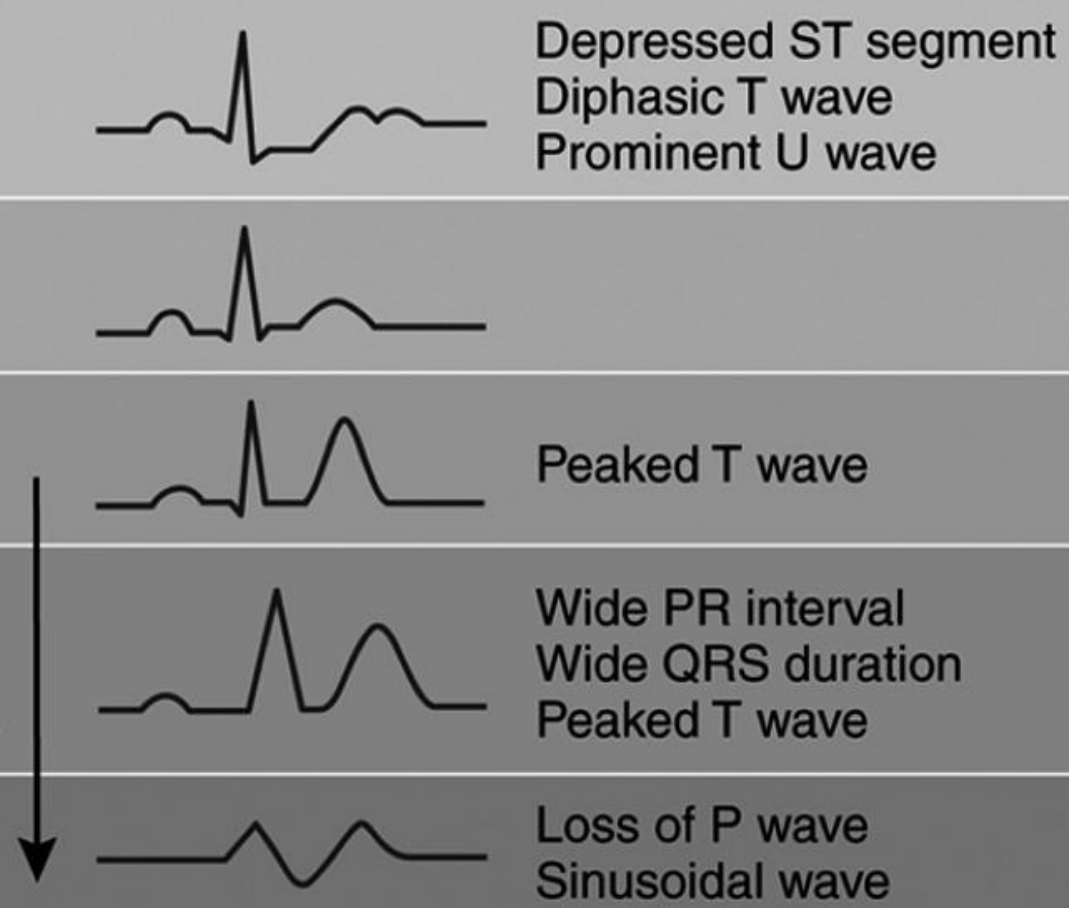
Effects of K Imbalance on Cardiac Conduction: _____ (depressed ST segment, diphasic T wave, prominent U wave), increasing severity of ______ (wide PR interval, wide QRS duration, peaked T wave) and eventually leads to loss of P wave and sinusoidal wave
Hypokalemia, hyperkalemia
_____ is a major extracellular anion that works with sodium to help maintain osmotic pressure and fluid balance
Chloride (Cl-)
_____ is when Cl- < 98 mEq/L and is caused by vomiting, metabolic alkalosis, diuretics. Signs and symptoms include muscle twitching, weakness, slow, shallow breathing, respiratory distress, confusion. Treatment includes chloride-rich fluids, 0.9% NaCl or LR
Hypochloremia
____ is when Cl- > 108 mEq/L and is caused by dehydration, renal failure, respiratory acidosis. Signs and symptoms include tachypnea, hypertension, lethargy, deep and rapid breathing (kussmaul respirations). Treatment includes hypotonic fluids, sodium bicarbonate to correct acidosis
Hyperchloremia
_____ is a key role in acid-base balance as a buffer to maintain pH in the body and works with carbonic acid to maintain homeostasis
Bicarbonate (HCO3-)
_____ ____ is when there is Low HCO3- < 22 mEq/L and is caused by diarrhea, renal failure, metabolic acidosis. Signs and symptoms include rapid breathing (kussmaul respirations), fatigue, confusion, nausea, vomiting. Treatment includes sodium bicarbonate IV to neutralize acid
Metabolic Acidosis
____ ____ is when there is High HCO3- > 28 mEq/L and is caused by vomiting, metabolic alkalosis, compensatory respiratory acidosis. Signs and symptoms include slow, shallow breathing, confusion, dizziness, muscle twitching, tetany. Treatment includes correction of underlying cause, potassium chloride, and fluids to correct electrolyte imbalances
Metabolic Alkalosis
_____ is essential for bone/tooth formation, neuromuscular function, blood clotting. It helps maintain cellular function and cardiac rhythm
Calcium (Ca2+)
_____ is when (Ca++ < 8.5 mg/dL) and is caused by hypoparathyroidism, vitamin D deficiency, CKD. Signs and symptoms include muscle cramps, twitching, tetany, numbness/tingling around the mouth and in extremities, positive Chvostek's and Trousseau's signs. Treatment includes calcium gluconate or calcium chloride IV
Hypocalcemia
_____ is when (Ca++ > 10.5 mg/dL) and is caused by hyperparathyroidism, cancer, excessive vitamin D intake. Signs and symptoms include lethargy, weakness, confusion, nausea, vomiting, constipation, kidney stones, bone pain. Treatment includes hydration with IV fluids, bisphosphonates, calcitonin
Hypercalcemia
_____ is important for neuromuscular transmission, enzyme function, and ATP production and helps regulate cardiac rhythm and muscle function
Magnesium (Mg2+)
_____ is when (Mg++ < 1.5 mg/dL) and is causesd by alcohol use disorder, malnutrition, diuretics. Signs and symptoms include muscle cramps, weakness, tremors, seizures, confusion, cardiac arrhythmias (Torsades de Pointes). Treatment includes magnesium sulfate IV or oral magnesium
Hypomagnesemia
_____ is when (Mg++ > 2.5 mg/dL) and is caused by renal failure, excessive Mg supplementation, antacids/laxatives containing magnesium. Signs and symptoms include hypotension, bradycardia, respiratory depression, muscle weakness, drowsiness. Treatment includes stop magnesium-containing medications, administer calcium gluconate, possibly dialysis
Hypermagnesemia
_____ is a key component of ATP, DNA, and RNA and plays a role in bone health, acid-base balance, and energy metabolism
Phosphate (PO4-)
_____ is when (PO4- < 2.5 mg/dL) and is caused by malnutrition, hyperparathyroidism, alcohol use disorder. Signs and symptoms include muscle weakness, fatigue, irritability, confusion, bone pain or weakness. Treatment includes Oral or IV phosphate supplementation
Hypophosphatemia
_____ is when (PO4- > 4.5 mg/dL) and is caused by renal failure, hypoparathyroidism, excessive phosphate intake. Signs and symptoms include itchy skin, muscle cramps, calcium phosphate deposits in soft tissues (ex: skin and eyes), symptoms of hypocalcemia. Treatment includes treating the underlying cause, phosphate binders, dietary restrictions
Hyperphosphatemia
Treatment Goals to Restore Fluid and Electrolyte Balance include _____ electrolyte imbalances, _____ the patient and managing _____ volume
Correcting, rehydrating, intravscular
Treatment Strategies (Fluid and Electrolyte Imbalances): ____ ____ (oral or IV) for dehydration and third spacing and _____ for fluid overload and edema because they increase urine output, but you must monitor electrolytes, especially K+
Fluid replacement, Diuretics