mls 322 exam 1
 Call Kai
 Learn
Learn Practice Test
 Spaced Repetition
 Match
Match Flashcards
 Knowt Play
1/154

There's no tags or description
Looks like no tags are added yet.
Name | Mastery | Learn | Test | Matching | Spaced | Call with Kai | Chat |
|---|
No analytics yet
Send a link to your students to track their progress
155 Terms
analyte
substance being tested
anticoagulant
prevents or delays blood coagulation
turnaround time
time taken from blood draw to reporting of results
hemotology
study of blood and relations of the bone marrow to the systemic circulation, relations of plama environment to RBC life span and relation of hemoglobin to the RBC
blood
window to body & predictior of vitality
ocular/ eye piece
provide initial 10x magnification
diaphragm apparatus
increase or decrease volume of light directed toward image, useful when examining cell structures in nucleus that needs more light
10x objective
used for locating feathered edge & gross slide abnormalities
40x objective
scanning and estimating counts
50x objective
oil mag
100x objective
fine microscopic work (oil objective)
magnification number
how large the image appears and how much of the viewing field can be observed
numerical aperture
resolution power of objective, objective ability to gather light and distinguish objects in close proximity.
tube length
distance from eye piece to objective
iris diaphragm
Increase or decrease the amount of light. amount of light may be desirable depending on source of sample.
adjustment knobs
moves stage horizontal or vertical
fine adjustment knob
moves stage left or right, for use after focus, used to get clarity
coarse adjustment knob
moves stage up and down, uses 10x objective
corrective actions for using microscope
-cant see image-turn slide over
-fine details cant be detected in immature cells- use 100x and fully open diaphragms
-40x obj is blurry- wipe w/ lent free paper
-particles on slide that arent large enough to be platelets - clean eyepieces
Microscope care
rest on a level, nonvibrating surface, secure bottom, and hold arm w/ other hand; never drag dry high obj’s across slides that contain oil; high dry obj never uses oil, oil objs wiped clean with lens paper only; eyepieces are cleaned with lens paper after each viewing; never wrap cords around objs or oculars
standard precautions
Treat all specimens as a potential source of infection, Proper PPE (gloves, masks, eye/face shields, countertop shields, fluid-resistant gowns/labcoats), and handwashing
gloves
worn during activities that involves contact body fluids, change immediately if contaminated or damaged and after pt contact, removed b4 exiting lab
gowns/labcoats
fluid-resistant long sleeves and wrist cuffs, not worn outside of lab, changed if they become contaminated or torn, treated as disposable biohazards
Splash/shields
goggles, face shields and plexiglass countertops, minimize risk of aerosol and specimen splashes
handwashing
highly effective first step against contamination; use soap and warm water 10-15 sec, should occur before and after each pt encounter, when gloves are taken off and anytime ungloved hands becomes contaminated
saftey precautions
Puncture-resistant containers for sharps, protection of mucus membranes, no smoking, eating, drinking, or chewing gum; keep loose papers and notebooks out of the lab; long hair tied back, fingernails trimmed, and beards trimmed; no dangling jewelry or rings; no applying lip balm.
quality assurance
comprehensive and systematic process that strives to ensure reliable patient results
quality assurance indicators
‒ Number of labeling errors
‒ Errors in data entry
‒ Testing turnaround times
‒ Proficiency testing performance
‒ Standardized competency testing
quality control monitoring
process of analyzing control specimens with known target values (normal and abnormal) along with pt samples to evaluate assay precision and accuracy, detect analytical errors or trends, and ensure valid lab results before release
quality control components
standards/calibrators, control materials, statistics
standards/calibrators
solutions have a known amount of analyte, sets the base normal for analyte
control materials
include at least one normal and abnormal level, analyzes and detects correct known level of analyte to verify instruments are correctly working.
statistical quality control system
establish target range for analyte; data points should cluster around the central tendency (measured by mean, median, and mode); represents normal distribution of data
mean
arithmetic average
median
middle value
mode
most frequent value
standard deviation (SD)
precision measurement that describes the average distance of each data point from the mean in normal distribution
coefficient of variaton (CV)
SD expressed as a percentage, lower = more precise data; usually less than 5%
accuracy
closest to true value
precision
reproducibility and repeatability of test samples; great value= compromised
reference intervals
range of results that are considered normal for a specific population; established for a particular analyte, method, or instrument
delta checks
comparison btw current pt results and previous pt results; allows operator to detect large variations; key to identifying preanalytic errors; provide opportunity to identify a reason for variations before releasing results
potential causes of delta checks
misidentified samples, analytic errors, or changes in the pt condition
reflex testing
additional testing to verify abnormal results (may require manual verifications)
critical values
marked results decreased or increased from the reference range; marked different from pt result history; automatically flagged by machines; notify someone immediately; determined by each laboratory
preanalytic values
affect samples before testing
examples of preanalytic values
proper pt identification
properly labled tubes
proper anticoagulant
proper mixing of sample
timely delivery
tube checked for clots
medication administered to pt
previous blood transfusion
intravenous line contamination
proper collection of blood sample
postanalytic variables
occur after sample testing; lead to poor pt care
postanalytic variables examples
proper documentation of test results
timely reporting ( if critical results observed)
proper handling of samples
delta checks
reflex testing
specimen check for clots
results released
which is a violation of standard precautions
applying cosmetics
The role of calibrators, standards, and quality control materials is to:
Define analyte values for instruments

#1
oculars/eyepiece

#2
coarse adjustment knob

#3
fine adjustment knob
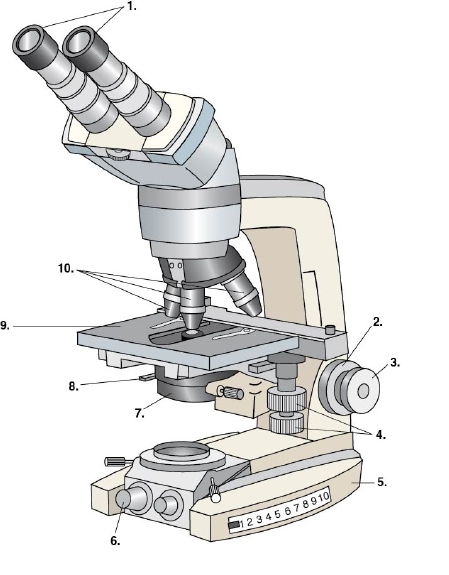
#4
stage adjustment knobs

#5
base
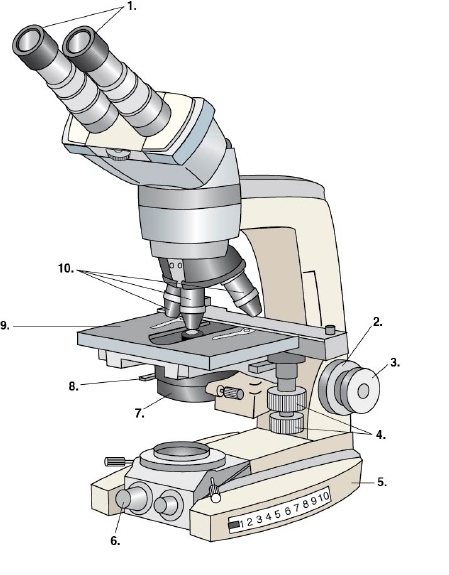
#6
light source
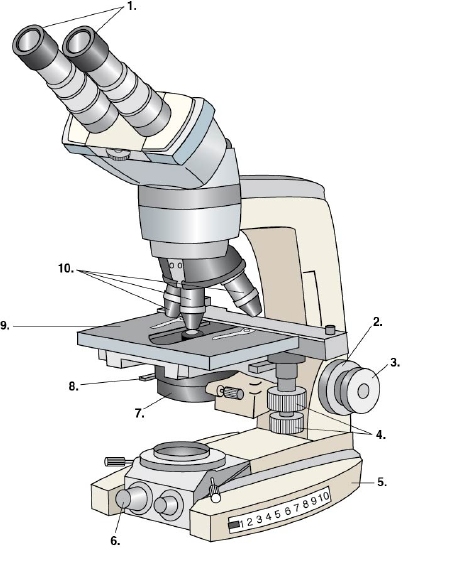
#7
condenser

#8
iris diaphragm

#9
stage

#10
objectives (10x, 40x,100x and sometimes 50x)
Dangling jewelry or long hair are possible sources of contamination or injury if caught in machines
true
error analysis, standard protocol and turnaround time is part of the
quality assurance system
normal disturbution curve will have 99.7% of measured values fall w/in 2 standard deviations distribution
false
normal distribution curve
68% within the mean one SD from the mean
95.5% within the mean and two SDs (2SD) from the mean
99.7% within the mean and three SDs (3SD) from the mean
saftey training include includes
precautions to prevent bloodborne pathogen exposure, proper use of PPE, and evacuation routes incase of fire
When handwashing after a patient contact, the soap application process should last at least:
10-15 seconds
Which of the following is not considered a postanalytic variable?
Collection of specimens with appropriate anticoagulants
Reflex testing is used in the hematology laboratory to
Immediately order additional testing to verify abnormal results
acrocyanosis
blue or purple mottled discoloration of fingers toes or nose or all 3
hepatosplenectomy
spleen enlargement and liver
hypoxia
decreased oxygen
reticuloendothelial system (RES)
system of fixed macrophages and circulation monocytes that serve as phagocytes
hematopoiesis
production, development, differentiation, and maturation of all types of blood cells
bone marrow
can produce 3 billion red blood cells, 1.5 billion white blood cells, and 2.5 billion platelets per day per body weight; extremly versatile and serves the body well by supplying life-giving cells w/ a multiplicity of funtions
Within the basic bone marrow structure lies the mechanisms to
Supply the peripheral circulation constantly with mature cells.
Mobilize the bone marrow to increase production if hematological conditions warrant.
Compensate for decreased hematopoiesis within the bone marrow by recruiting other hematopoietic sites (non-bone marrow sites, liver, and spleen)
intramedullary hematopoesis
w/in bone marrow
extramedullary hematopoiesis
outside bone marrow; primarily in liver and spleen in adults; can cause hematosplenectomy (indicator that hematological health is compromised)
early fetal development hematopoiesis mesoblastic period
2 wk-2 mth-yolk sack
early fetal development hematopoiesis, hepatic period
2mth- 7mth- spleen, liver, thymus, and lymph nodes
Late fetal development—adult life hematopoiesis
7mth- birth- adult bone marrow
Hematopoietic function of the spleen
RBC filtration—red pulp, lymphocyte processing—white pulp, stores WBC and platelets—marginal zone; produce WBC RBC or platelets if necessary.
Reservoir function of the spleen
stores one-third of platelets and granulocytes, able to mobilize platelets into circulation if necessary.
Filtration function of the spleen
gets rid of abnormal cells
Immunologic function of the spleen
supplies opsonizing antibodies, promotes phagocytic activity, and provides protection, possibly leading to serious concequences.
splenectomy risks
OPSIs may occur w/in 3 yrs; many die bc spleen cant play vital role; abnormal RBCs present ; WBC and platelets have to fine another storage site.
bone marrow
consists of yellow marrow (fat/not active), red marrow (active), and intricate supply of nutrients and blood vessels; root of hematological disease; contains RBC, WBC, and platelets of various stages along with osteoclasts, stroma, and fatty tissue; responds to anemia
bone marrow in long bones
first 18 yrs
bone marrow in iliac crest and sternum
18+ years
myeloid:erythroid ratio (M:E ratio)
can predict hematological problems; normal ratio 3:1 to 4:1
Erythroid hyperplasia
Anemia stimulates the body to produce erythropoietin (EPO) to increase red blood cells; ↑ immature red blood cells in circulation; Abnormal in peripheral circulation: nucleated red blood cells, reticulocytes, and polychromasia
polychromasia
nucueated RBC; indicates bone marrow response to an event
Lymphoid precursors
T cells or B cells
T cells
responsible for cellular immunity (cell-cell communication)
B cells
responsible for humoral immunity (production of antibodies
Nonlymphoid precursors
GEMM (granulocyte, erythroid, monocyte, megakaryocyte)
cytokines and interleukins
uniquely responsible for promoting a specific lineage of cell (RBC production); used to stimulate specific cell production to yield theraputic benefits
specific conditions in which recombinant cytokines have been useful
Treatment of graft-versus-host disease after bone marrow transplant therapy
Increasing white blood cell counts (WBCs) in patients with AIDS on antiretroviral therapy
Stimulation of red blood cell production for chronically anemic patients and chemotherapy patients
Recovery from neutropenia resulting from myelotoxic therapy
Erythropoietin (EPO)
Cytokine; Hormone produced by the kidneys; Stimulates red blood cell production; Available as a pharmaceutical product
kidney detect hypoxia
increase EPO and production of RBC